Introduction
Identity Verification (IDV) Tools are specialized software solutions that confirm a person’s digital identity matches their real-world persona. In an era where “faceless” digital transactions are the norm, these tools serve as a high-tech gateway, ensuring that the person behind a screen is who they claim to be. The process typically involves a multi-layered check: first, analyzing a government-issued ID for authenticity (document forensics); second, capturing a live selfie to match against the ID photo (biometric facial matching); and third, ensuring the user is a live human being rather than a digital spoof or mask (liveness detection).
The importance of IDV tools has shifted from a “nice-to-have” security feature to a mandatory operational requirement. As synthetic identity fraud and deepfake technology become more accessible to bad actors, businesses face significant financial and legal risks. Beyond stopping fraud, these tools are the backbone of Know Your Customer (KYC) and Anti-Money Laundering (AML) compliance. By automating these checks, organizations can onboard legitimate users in seconds, reducing the friction that often leads to abandoned sign-ups while maintaining a rigorous security posture that satisfies global regulators.
Key Real-World Use Cases
- Financial Services: Rapidly opening bank accounts or approving credit cards without requiring a physical branch visit.
- The Sharing Economy: Verifying the identities of drivers for ride-sharing apps or hosts and guests for short-term rental platforms.
- Cryptocurrency Exchanges: Ensuring users meet regulatory “Travel Rule” requirements during high-value asset transfers.
- Age-Gated Commerce: Automatically verifying that a customer is of legal age to purchase restricted goods like alcohol or gaming services.
- High-Risk Workforce Access: Confirming the identity of employees or contractors before granting access to sensitive company data or server rooms.
What to Look For (Evaluation Criteria)
When selecting an IDV tool, the primary metric should be Verification Accuracy vs. Latency. A tool that takes five minutes to verify a user will drive away customers, while one that is too lax will let fraudsters through. Look for Global Document Coverage; the platform must support the specific IDs and languages of your target markets. Furthermore, Liveness Detection is now non-negotiable—specifically “Passive Liveness,” which checks for human presence without forcing the user to perform awkward movements like nodding or blinking.
Best for:
Identity Verification tools are a perfect fit for Fintechs, Online Marketplaces, Healthcare Providers, and Gig-Economy Platforms. They are essential for Compliance Officers, Product Managers, and Risk Analysts at companies of all sizes—from seed-stage startups to global enterprises—who need to scale their user base securely.
Not ideal for:
Small brick-and-mortar businesses that only interact with customers in person or low-risk blogs and informational sites that do not handle sensitive transactions or regulated data. If your primary goal is simple login security rather than legal identity proofing, a standard Multi-Factor Authentication (MFA) tool may be a more cost-effective alternative.
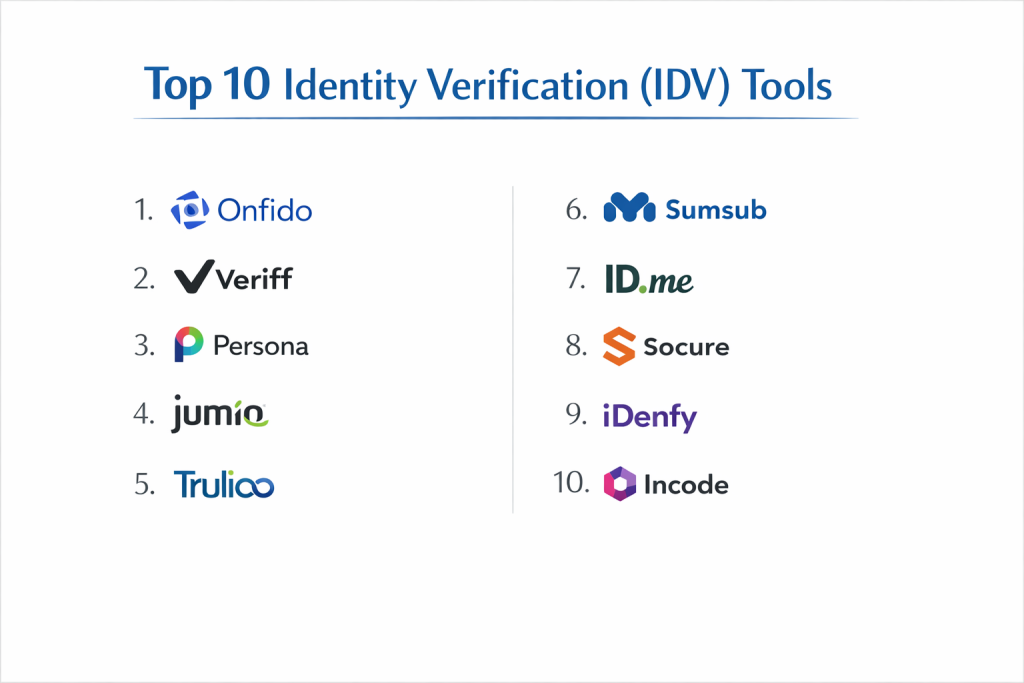
Top 10 Identity Verification (IDV) Tools
1 — Onfido
Onfido is an industry heavyweight known for its “Atlas AI” platform, which automates the verification of thousands of document types across the globe. It is a top choice for high-growth fintechs and established financial institutions.
- Key features:
- Atlas AI for high-speed automated document forensics.
- Motion Liveness detection (users perform a simple, fluid head movement).
- Modular “Studio” for building custom verification logic.
- Comprehensive KYC and AML screening against global watchlists.
- Known Faces detection to prevent multiple accounts from the same user.
- Highly optimized mobile and web SDKs for a seamless UI.
- Pros:
- Excellent global coverage with support for over 2,500 document types.
- The “Smart Capture” SDK significantly reduces the rate of blurry or unusable photos.
- Cons:
- Pricing can be complex and steep for very low-volume users.
- Automated checks can occasionally take longer (30–60 seconds) than “instant” competitors.
- Security & compliance: SOC 2 Type II, ISO 27001, and GDPR compliant; uses AES-256 encryption.
- Support & community: Strong developer documentation, dedicated enterprise success managers, and 24/7 global support availability.
2 — Veriff
Veriff is an Estonian-born powerhouse that has gained a reputation for being the fastest IDV tool on the market. It excels in high-trust environments like crypto and gaming where speed is the ultimate competitive advantage.
- Key features:
- Average verification decision time of just 6 seconds.
- Cross-device linking (start on desktop, finish on mobile).
- NFC-based chip reading for modern e-passports.
- Proprietary liveness technology that works invisibly in the background.
- Automatic language detection for over 45 languages.
- Video-based verification that analyzes the background environment for fraud signals.
- Pros:
- Arguably the best user experience (UX) for the end-user.
- Extremely effective at catching “Presentation Attacks” (like holding up a photo of a phone).
- Cons:
- The heavy use of video can be demanding for users on slow mobile data connections.
- Some advanced features are locked behind high-tier enterprise plans.
- Security & compliance: GDPR, SOC 2, and ISO certified; data residency options available for EU/US clients.
- Support & community: Extensive API guides, a responsive support ticket system, and active participation in the fraud-fighting community.
3 — Persona
Persona is the “Lego set” of identity verification. It offers a highly modular platform that allows businesses to build intricate, branching verification flows without writing custom code.
- Key features:
- Dynamic Flow builder with drag-and-drop conditional logic.
- Passive Liveness detection that requires no user action.
- In-depth Link Analysis to visualize connections between fraudulent accounts.
- Government database lookups (SSN, credit bureaus) as an alternative to document uploads.
- Customizable “Case Management” for manual fraud investigations.
- Native support for age verification and re-authentication.
- Pros:
- Unmatched flexibility; you can change your verification logic in minutes.
- Highly localized experience—automatically adjusts the flow based on user’s location.
- Cons:
- The platform’s depth can be overwhelming for teams looking for a “simple” plug-and-play tool.
- Analytic features are powerful but require a learning curve to master.
- Security & compliance: SOC 2 Type II, HIPAA, and GDPR compliant; granular role-based access controls (RBAC).
- Support & community: Top-tier technical documentation and high-touch customer success for mid-market and enterprise tiers.
4 — Jumio
Jumio is one of the original pioneers of the IDV space. Its “KYX” platform is an end-to-end ecosystem that handles everything from the first ID check to ongoing transaction monitoring.
- Key features:
- AI-powered document and biometric authentication.
- Human-in-the-loop review option for borderline cases.
- “Jumio 360” for continuous user monitoring throughout the lifecycle.
- Certified iBeta Level 2 liveness detection.
- Integrated AML and PEP (Politically Exposed Person) screening.
- Strong support for “Tier 1” banking regulations.
- Pros:
- Trusted by some of the largest banks and retailers in the world.
- The hybrid AI+Human approach yields very high accuracy.
- Cons:
- The UI can feel slightly dated compared to modern “SaaS-native” tools.
- Integration can be more complex due to the platform’s enterprise-first focus.
- Security & compliance: PCI-DSS Level 1, SOC 2, and GDPR compliant; high-tier banking security standards.
- Support & community: Massive global support infrastructure and extensive professional services for implementation.
5 — Trulioo
Trulioo takes a “Data-First” approach. While they offer document verification, their true strength lies in their access to over 400 authoritative data sources to verify 5 billion people globally.
- Key features:
- Access to government, credit, and utility records across 195+ countries.
- “Global Gateway” API for single-point access to worldwide data.
- Business Verification (KYB) for identifying “Ultimate Beneficial Owners.”
- Watchlist screening for real-time AML compliance.
- ID document capture with OCR (Optical Character Recognition).
- Risk-based verification triggers based on transaction value.
- Pros:
- Best-in-class for markets where people don’t always have a physical ID but have a digital record.
- Exceptional for complex B2B verification (KYB).
- Cons:
- Document verification is a secondary focus compared to their data network.
- Data-only verification can occasionally miss “Synthetic Identity” fraud if not paired with biometrics.
- Security & compliance: SOC 2 Type II and GDPR compliant; rigorous data privacy and deletion policies.
- Support & community: Strong strategic account management and comprehensive training resources.
6 — Sumsub
Sumsub (formerly Sum&Substance) provides an “all-in-one” compliance suite. It is widely regarded as one of the best-value platforms for companies needing KYC, KYB, and AML in a single dashboard.
- Key features:
- Integrated KYC/AML/KYB workflow orchestration.
- “Travel Rule” compliance solution for crypto entities.
- Video identification for high-risk regions or regulated industries.
- Automatic proof-of-address verification via geolocation.
- Deepfake and mask detection during biometric checks.
- No-code dashboard for non-technical compliance managers.
- Pros:
- Highly transparent pricing that is accessible for startups.
- Excellent “out-of-the-box” setup that requires minimal engineering effort.
- Cons:
- The support response times can be slower for lower-tier customers.
- Customization is good, but not as deep as Persona’s modular system.
- Security & compliance: ISO 27001, SOC 2, and GDPR compliant; multi-regional data storage.
- Support & community: Extensive video tutorials and a helpful community for small-to-midsize compliance teams.
7 — ID.me
ID.me has a unique business model. Instead of verifying a user once for one site, they create a “portable identity.” Users verify once with ID.me and then use that “digital wallet” to log in to thousands of other services.
- Key features:
- Reusable digital identity for 100M+ users.
- Live video chat verification for users who fail automated checks.
- Specialized verification for military, students, and first responders.
- NIST 800-63-3 compliant (IAL2 and AAL2).
- High-security multi-factor authentication (MFA).1
- Strong focus on “Inclusion” (verifying users without traditional credit files).2
- Pros:3
- Huge “Network Effect”—many of your users may already have an ID.me account.4
- The o5nly option that truly offers 100% verification via human video backup.
- Cons:
- Very U.S.-centric; not ideal for international expansion.
- The “ID.me” branding is prominent, which may not fit your site’s aesthetic.
- Security & compliance: FedRAMP authorized, SOC 2, and NIST compliant; high-grade government security.
- Support & community: Massive consumer support team and dedicated public sector assistance.
8 — Socure
Socure is the leader in “Predictive Analytics.” They specialize in identifying “Identity Risk” by analyzing digital signals like email, phone, and IP address before the user even uploads an ID.
- Key features:
- Sigma Identity Fraud engine for real-time risk scoring.
- Direct access to the largest proprietary US identity datasets.
- Best-in-class detection of “Synthetic Identity” fraud.
- Inclusion-focused verification for “Thin-File” individuals (Gen Z, immigrants).
- Automated document and selfie verification module.
- Predictive modeling for account opening and credit risk.
- Pros:
- Incredible accuracy in the US market; often detects fraud that others miss.
- Reduces the number of users who actually need to upload an ID, lowering friction.
- Cons:
- Limited effectiveness outside of the United States.
- Pricing is premium and tailored for high-volume enterprises.
- Security & compliance: SOC 2 Type II, ISO 27001, and HIPAA compliant.
- Support & community: Elite enterprise support and a heavy focus on professional services for model tuning.
9 — iDenfy
iDenfy is a Lithuania-based provider that has built its reputation on a “Zero False Positive” promise. They achieve this by combining automation with 24/7 human oversight for every single check.
- Key features:
- Hybrid verification system (Automation + Human QA).
- Real-time liveness and document authentication.
- Integrated AML, PEP, and Sanctions screening.
- Age verification and digital signature modules.
- Support for over 200 countries and territories.
- Flexible, usage-based pricing models.
- Pros:
- The “Human-in-the-loop” approach makes it nearly impossible to spoof.
- Highly cost-effective for smaller businesses with low transaction volumes.
- Cons:
- The manual review can add a few seconds of delay for the end-user.
- Dashboard analytics are functional but less visual than some competitors.
- Security & compliance: ISO 27001, SOC 2, and GDPR compliant; uses high-standard encryption.
- Support & community: Known for very fast and helpful technical support via chat and email.
10 — Incode
Incode is the “New Age” of IDV, focusing heavily on a fully automated, passive experience. They are highly popular with luxury brands and high-end financial services that want “invisible” security.
- Key features:
- Proprietary passive liveness detection (no user action required).
- One-to-many biometric matching to prevent account takeover.
- Advanced deepfake and digital mask detection.
- On-premise deployment options for highly sensitive industries.
- Frictionless web and mobile SDKs with high-fidelity image capture.
- Real-time face matching against government databases.
- Pros:
- The fastest “invisible” verification—feels like magic to the user.
- Owns its entire tech stack; no third-party data sub-processors.
- Cons:
- Premium pricing that reflects its high-end positioning.
- Lacks some of the deep “manual investigation” tools found in Persona.
- Security & compliance: NIST/iBeta certified, SOC 2, and GDPR compliant; unique non-custodial data options.
- Support & community: High-touch implementation support and regular product innovation updates.
Comparison Table
| Tool Name | Best For | Platform(s) Supported | Standout Feature | Rating (Gartner/TrueReview) |
| Onfido | Global Enterprise | Web, iOS, Android | Atlas AI Forensics | 4.4 / 4.5 |
| Veriff | Rapid Onboarding | Web, iOS, Android | 6-Second Decisions | 4.7 / 4.6 |
| Persona | Custom Workflows | Web, Mobile SDK | No-Code Flow Builder | 4.7 / 4.9 |
| Jumio | Regulated Banking | Web, Cloud, API | AI + Human Hybrid | 4.3 / 4.4 |
| Trulioo | Global Data Depth | API, Web | 400+ Data Sources | 4.5 / 4.5 |
| Sumsub | All-in-One Compliance | Web, Mobile SDK | Crypto Travel Rule Tool | 4.6 / 4.7 |
| ID.me | US Gov & Portable ID | Web, Mobile App | NIST-Certified Wallet | 4.6 / N/A |
| Socure | Predictive Fraud | API, Web | Sigma Fraud Engine | 4.5 / 4.7 |
| iDenfy | Budget-Conscious | Web, API | 24/7 Human Oversight | 4.8 / 4.9 |
| Incode | Frictionless UX | Web, Mobile, On-Prem | Passive Liveness | 4.7 / N/A |
Evaluation & Scoring of Identity Verification (IDV) Tools
| Criteria | Weight | Evaluation Method |
| Core features | 25% | Assessment of document forensic accuracy, biometrics, and liveness. |
| Ease of use | 15% | Analysis of end-user friction and admin dashboard intuitiveness. |
| Integrations | 15% | Breadth of SDKs (React, Flutter, etc.) and API documentation quality. |
| Security & compliance | 10% | Presence of SOC 2, ISO 27001, and NIST certifications. |
| Performance | 10% | Average processing time (latency) and historical uptime/SLA. |
| Support & community | 10% | Availability of 24/7 support and active developer forums. |
| Price / value | 15% | Return on investment (ROI) based on fraud prevented vs. cost per check. |
Which Identity Verification (IDV) Tool Is Right for You?
Solo Users vs. SMB vs. Mid-Market vs. Enterprise
For solo users and micro-SaaS owners, iDenfy is a winner due to its affordable, pay-as-you-go pricing. SMBs looking for a broad range of features with little setup should prioritize Sumsub. Mid-market companies that need to balance speed with a branded experience should look at Veriff or Persona. Finally, Enterprise organizations with complex global regulations (like Tier 1 banks) will find the most value in Jumio, Onfido, or Incode due to their massive scale and deep compliance reporting.
Budget-Conscious vs. Premium Solutions
If you are strictly budget-conscious, Sumsub and iDenfy often offer the most competitive volume-based pricing. If you are a premium brand where a single failed verification costs you a high-value customer, investing in Incode or Veriff is the better strategic move, as their higher “Auto-Pass” rates will pay for themselves in increased conversion.
Feature Depth vs. Ease of Use
Teams that need extreme feature depth—such as building conditional logic like “If user is from Germany and transaction > $1000, trigger video KYC”—should choose Persona. If your priority is ease of use and you want a solution that “just works” out of the box with zero configuration, Veriff is the most streamlined option.
Integration and Scalability Needs
If your engineering team is small, prioritize tools with No-Code dashboards (Persona, Sumsub). If you have a large engineering team and want to build a completely custom experience via API, Socure and Onfido provide the most robust developer environments. For businesses scaling globally, Trulioo is unmatched for its ability to verify identities in emerging markets using local data.
Security and Compliance Requirements
If you are in a highly regulated industry (like healthcare or government), ID.me and Jumio offer the highest levels of federal certification. For European companies, ensure the vendor has an EU-based data center to satisfy strict GDPR data-sovereignty rules—Onfido and Veriff are particularly strong in this area.
Frequently Asked Questions (FAQs)
1. What is the difference between KYC and IDV?
IDV (Identity Verification) is the technology used to prove a person is who they say they are. KYC (Know Your Customer) is the broader legal regulation that mandates businesses use IDV and AML checks to prevent financial crime.
2. How long does the average identity verification take?
Most modern tools like Veriff or Incode complete the process in under 15 seconds. Older or more complex enterprise tools may take between 30 and 60 seconds.
3. What is “Liveness Detection,” and why is it important?
It is a technology that ensures the user is a real human, not a photo, a mask, or a digital deepfake. It prevents “presentation attacks” where a fraudster tries to trick the camera.
4. Can IDV tools verify people without a passport?
Yes. Most tools support national IDs, driver’s licenses, and even residence permits. Tools like Trulioo can also verify people using utility bills or government records if they lack a physical ID.
5. Are IDV tools safe for my customers’ data?
Leading vendors use bank-level encryption (AES-256) and are SOC 2 compliant. Most also offer data-retention settings that allow you to delete sensitive PII (Personally Identifiable Information) immediately after the check is complete.
6. Do these tools work on older smartphones?
Yes. Most modern SDKs are optimized for low-bandwidth and older cameras, though very old devices may struggle with high-definition video liveness checks.
7. How much does identity verification cost?
Pricing is typically “per check.” It can range from $1.00 to $5.00 depending on the volume and the complexity of the check (e.g., adding AML screening or manual human review).
8. Can I use these tools for age verification?
Absolutely. Most platforms have a specific “Age Verification” module that can confirm a user is over 18 or 21 without requiring a full KYC background check.
9. What happens if a legitimate user fails a check?
Top tools like ID.me offer a “Fallback” to a live video chat with a human agent. Others, like Persona, allow you to set up a “Manual Review” queue for your internal team to look at the photos.
10. Do I need a developer to set these up?
Not necessarily. While APIs provide the most control, tools like Sumsub and Persona offer “No-Code” links that you can simply email to your customers or embed on your site.
Conclusion
The “Identity Crisis” of the digital age is real, but as we’ve seen, the tools to combat it have never been more advanced. Choosing the right Identity Verification tool is no longer just about stopping the “bad guys”—it’s about opening the door for the “good guys” as quickly and smoothly as possible.
Whether you prioritize the unmatched flexibility of Persona, the lightning speed of Veriff, or the government-grade security of ID.me, the most important step is to start. As fraudsters move toward Generative AI and deepfakes, having a robust IDV partner is the only way to ensure your business remains a trusted space for legitimate users.