Introduction
A Hotel Revenue Management System (RMS) is a sophisticated software solution designed to help hoteliers maximize their profitability by selling the right room to the right guest at the right price, at the right time. Unlike manual pricing strategies, an RMS uses advanced algorithms and big data to automate complex calculations. It acts as a digital brain for a hotel’s financial strategy, constantly analyzing demand shifts, competitor movements, and local market trends to recommend or automatically implement the most profitable rates.
In the fast-paced hospitality landscape, these systems have moved from being a luxury for large chains to a necessity for properties of all sizes. The primary goal is to optimize Revenue Per Available Room (RevPAR) and Average Daily Rate (ADR). By automating the “heavy lifting” of data analysis, an RMS allows revenue managers to focus on high-level strategy rather than getting bogged down in spreadsheets. These systems ensure that a hotel remains competitive 24/7, reacting to market changes faster than any human operator could.
Key Real-World Use Cases
- Dynamic Pricing: Automatically increasing rates when a major local concert is announced or lowering them to capture last-minute bookings during low-demand periods.
- Demand Forecasting: Predicting occupancy levels weeks or months in advance based on historical trends and current pick-up rates.
- Inventory Control: Setting “Minimum Length of Stay” (MLOS) restrictions during peak weekends to ensure the hotel isn’t filled with one-night stays that block longer, more profitable bookings.
- Channel Management Sync: Ensuring that price updates are pushed instantly to all Online Travel Agencies (OTAs) and the hotel’s direct booking engine to maintain rate parity.
What to Look For (Evaluation Criteria)
When evaluating an RMS, the most critical factor is Integration Depth. A system is only as good as its connection to your Property Management System (PMS) and Channel Manager. Additionally, look for AI and Machine Learning Capabilities that offer “Autopilot” modes for automated rate updates. User Interface (UI) Simplicity is also essential; your team should be able to interpret complex data heatmaps and dashboards at a glance without extensive technical training.
Best for: Revenue managers, general managers, and hotel owners at boutique hotels, large-scale resorts, independent inns, and multi-property hospitality groups looking to drive data-led profitability.
Not ideal for: Very small, low-occupancy guest houses or seasonal vacation rentals that may find the subscription costs and data-heavy nature of an RMS more complex than their operational needs require.
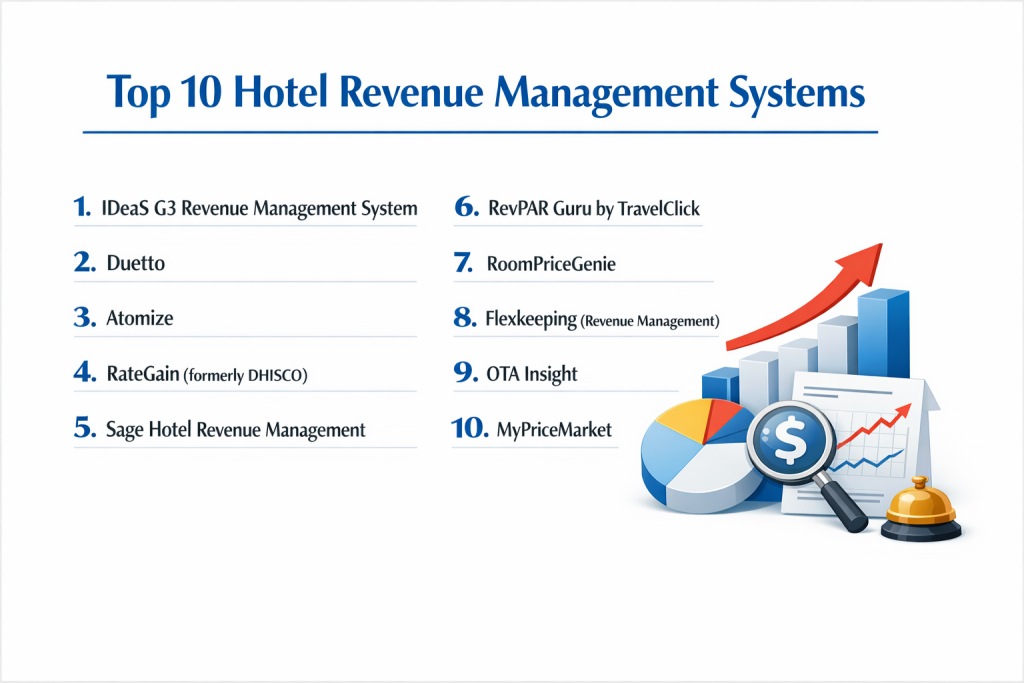
Top 10 Hotel Revenue Management Systems Tools
1 — IDeaS G3 Revenue Management System
IDeaS is widely considered the industry pioneer, utilizing SAS® High Performance Analytics to deliver scientific pricing decisions. It is the go-to solution for large chains and complex resorts that require the highest level of forecasting precision.
- Key features
- Scientific pricing and inventory control at the room type and rate code level.
- Advanced group evaluation tools to analyze the displacement of transient business.
- Automated “overbooking” recommendations to mitigate the impact of no-shows.
- Sophisticated market intelligence and competitive benchmarking.
- Multi-property management capabilities for global hotel portfolios.
- Scenario analysis to project the impact of different pricing strategies.
- Pros
- Unmatched forecasting accuracy powered by decades of data science expertise.
- Highly reliable and scalable for the most complex hospitality environments.
- Cons
- Can have a steep learning curve due to the sheer depth of features.
- Implementation and training can be more time-consuming compared to “plug-and-play” rivals.
- Security & compliance: ISO 27001, SOC 1 & 2, GDPR, SSO, and bank-level encryption.
- Support & community: 24/7 global support, IDeaS University for certification, and a massive network of experienced revenue professionals.
2 — Duetto GameChanger
Duetto is a cloud-native platform famous for its “Open Pricing” philosophy. It allows hotels to price all segments, room types, and distribution channels independently in real-time.
- Key features
- Open Pricing allows for dynamic rate adjustments across all channels simultaneously.
- Interactive customizable dashboards with visual heat maps.
- Demand and financial forecasting for up to five years into the future.
- Integrated STR data to leverage competitive set benchmarking.
- “Command Center” for business intelligence across multiple properties.
- Intelligent “Auto-pilot” for automated pricing updates.
- Pros
- Extremely user-friendly interface that focuses on “decision-readiness.”
- Greatly improves RevPAR by moving away from traditional “fixed-tier” pricing.
- Cons
- Premium pricing may be high for smaller, budget-focused independent hotels.
- Highly dependent on the quality of data coming from the PMS.
- Security & compliance: SOC 2 Type II, GDPR, PCI DSS compliant, and SSO.
- Support & community: High-touch onboarding, Duetto Academy, and very responsive customer success managers.
3 — Atomize
Atomize is a fast-growing, highly automated RMS designed for efficiency. It gained popularity for its “Autopilot” functionality and its modern, mobile-first approach to revenue.
- Key features
- Sophisticated “Autopilot” mode that accepts price recommendations automatically 24/7.
- Real-time price optimization (RTO) that reacts to market shifts within seconds.
- Group pricing evaluation tool for quick and profitable quotes.
- Future demand insights that spot market trends up to two years ahead.
- Multi-property forecasting to compare regional brand performance.
- Seamless “two-way” integration with leading PMS providers.
- Pros
- Huge time-saver; users report saving up to 20-30 hours a month on manual tasks.
- Modern, sleek UI that is very easy for non-technical managers to navigate.
- Cons
- Lacks some of the ultra-deep enterprise customization found in IDeaS.
- Integration speed can vary depending on the third-party PMS provider.
- Security & compliance: GDPR, SSO, and secure cloud infrastructure.
- Support & community: Excellent documentation and responsive chat-based support.
4 — FLYR for Hospitality
Formerly known as Pace Revenue, FLYR utilizes advanced AI and decision intelligence to provide a holistic view of a property’s revenue and business performance.
- Key features
- AI-driven decision intelligence that goes beyond simple room pricing.
- Hourly data refreshes to capture rapid shifts in market demand.
- Integrated Business Intelligence (BI) for deep exploration of revenue data.
- Customizable “Automation Levels” to move from manual to full autopilot.
- Performance analytics that allow for A/B testing of different pricing strategies.
- Multi-currency and multi-language support for international operations.
- Pros
- Highly innovative approach that treats every night as a unique business opportunity.
- Very fast implementation times compared to traditional enterprise systems.
- Cons
- The “black box” nature of some AI algorithms can be unsettling for “old school” revenue managers.
- Reporting is very deep, which might require a dedicated data analyst to fully exploit.
- Security & compliance: GDPR, encryption at rest and in transit, and SSO.
- Support & community: Proactive account management and regular user webinars.
5 — RateGain (Rev-AI)
RateGain offers an integrated platform that accelerates revenue generation through AI-driven insights. It is widely used by both independent hotels and large global chains.
- Key features
- Real-time market intelligence and rate shopping capabilities.
- AI-based demand forecasting that accounts for traveler intent data.
- Integrated channel management for immediate rate distribution.
- Ancillary revenue management to optimize non-room spend (spa, dining).
- Centralized control system to manage rate parity across all OTAs.
- Bulk update features for rapid pricing adjustments across date ranges.
- Pros
- One of the most comprehensive ecosystems, including marketing and distribution tools.
- Exceptional market intelligence that helps you stay ahead of competitors.
- Cons
- Occasional connectivity delays reported during peak system usage.
- The platform is so broad that it can feel fragmented at times.
- Security & compliance: GDPR, PCI DSS, and 24/7 security monitoring.
- Support & community: Global 24/7 multi-lingual support and a strong industry reputation.
6 — RoomPriceGenie
Specifically built for independent hotels and smaller properties, RoomPriceGenie focuses on making revenue management accessible to everyone, regardless of their technical background.
- Key features
- Simple, intuitive “Price Recommendations” that can be accepted with one click.
- Automated rate updates that run in the background.
- Hyper-local market demand tracking.
- Easy integration with smaller, SMB-focused PMS providers.
- Transparent pricing strategy that explains “why” a rate was recommended.
- Mobile-responsive design for management on the go.
- Pros
- Excellent value for small properties that cannot afford a full-time revenue manager.
- Very fast setup process (often less than a week).
- Cons
- Lacks the advanced group evaluation and enterprise reporting of IDeaS or Duetto.
- Not designed for massive resorts with complex internal departments.
- Security & compliance: GDPR compliant and secure data handling.
- Support & community: Friendly, high-touch support specifically tailored for small business owners.
7 — ZettaRMS (by Sciative)
ZettaRMS is an emerging leader in the AI-driven pricing space, offering a platform that balances deep market insights with seamless automation.
- Key features
- AI-driven automated pricing with real-time market insights.
- Dynamic pricing for ancillary items like meals and extras.
- Nested virtual inventory management to optimize room categories.
- Instant market insights and competitive benchmarking.
- Smart segmentation and seasonal demand optimization.
- Multi-property functionality for centralized hotel management.
- Pros
- Strong focus on “Total Revenue Management,” not just room rates.
- Deeply integrated automation that minimizes manual intervention.
- Cons
- Newer player in the global market, so the user community is still growing.
- Reporting dashboards are functional but less “polished” than Duetto.
- Security & compliance: Varies / Standard industry encryption.
- Support & community: Responsive technical support and personalized onboarding.
8 — PriceLabs
While famous in the vacation rental space, PriceLabs has become a powerful contender for boutique hotels and aparthotels that need flexible, data-driven pricing.
- Key features
- Hyper-local demand data including Airbnb and hotel trends.
- Customizable “Base Prices” and “Minimum/Maximum” constraints.
- Automated daily price pushes to PMS or Channel Managers.
- Market dashboards that visualize local occupancy and price trends.
- Multi-property functionality with bulk update tools.
- Portfolio-level analytics to track performance across regions.
- Pros
- The best tool for hotels that compete directly with short-term rentals.
- Very affordable and transparent pricing model.
- Cons
- Lacks traditional hotel enterprise features like group displacement analysis.
- UI is more “utility-focused” than “luxury-hotel” focused.
- Security & compliance: GDPR compliant and secure API connections.
- Support & community: Extensive knowledge base and active community of “Power Users.”
9 — Infor RMS
Infor offers an enterprise-grade RMS that is particularly popular in the casino and large-scale resort industry due to its ability to handle complex guest loyalty data.
- Key features
- Scientific forecasting based on total guest value, not just room rate.
- Deep integration with the Infor HMS (Hospitality Management System).
- Automated rate and restriction recommendations.
- Advanced reporting for C-level executives and ownership groups.
- Sophisticated overbooking and wash forecasting.
- Multi-language and multi-currency capabilities.
- Pros
- The “gold standard” for properties where gambling or ancillary spend is high.
- Highly stable and reliable for high-volume transactions.
- Cons
- Can feel quite “corporate” and less agile than modern cloud startups.
- High cost of entry and significant training requirements.
- Security & compliance: ISO 27001, SOC 2, GDPR, and enterprise-grade SSO.
- Support & community: Enterprise-level support with dedicated account managers.
10 — RevenueWay
RevenueWay is a newer entrant that focuses on providing a balanced RMS experience for independent hotels looking for professional tools without the enterprise price tag.
- Key features
- Real-time market tracking and price suggestions.
- Easy-to-use forecasting tool for daily and monthly planning.
- Channel manager integration for automated rate distribution.
- Basic competitive set benchmarking.
- Yield management rules for occupancy-based pricing.
- User-friendly dashboard for quick performance checks.
- Pros
- Very approachable for hotels moving from manual spreadsheets to their first RMS.
- Competitive pricing that offers a high ROI for small-to-mid-sized properties.
- Cons
- Fewer integrations compared to larger players like Atomize or Cloudbeds.
- Feature set is narrower than enterprise-level competitors.
- Security & compliance: GDPR compliant and secure cloud hosting.
- Support & community: Personalized customer service and helpful onboarding guides.
Comparison Table
| Tool Name | Best For | Platform(s) Supported | Standout Feature | Rating |
| IDeaS G3 | Enterprise Chains | Cloud, Mobile | Scientific Displacement Analysis | 4.8 / 5 |
| Duetto | Mid-Market/Boutique | Cloud, Mobile | Open Pricing Architecture | 4.7 / 5 |
| Atomize | Independent Hotels | Cloud, Mobile | Autopilot Efficiency | 4.9 / 5 |
| FLYR | Data-Heavy Strategy | Cloud | Hourly Decision Intelligence | 4.6 / 5 |
| RateGain | Global Distribution | Cloud | Integrated Intent Data | 4.5 / 5 |
| RoomPriceGenie | Small Hotels/B&Bs | Cloud, Mobile | One-Click Recommendations | 4.4 / 5 |
| ZettaRMS | Total Revenue Mgmt | Cloud | Ancillary Pricing Optimization | N/A |
| PriceLabs | Aparthotels | Cloud | Hyper-local Market Data | 4.6 / 5 |
| Infor RMS | Casinos/Large Resorts | Cloud, On-premise | Total Guest Value Logic | 4.2 / 5 |
| RevenueWay | Entry-level RMS | Cloud | Simplicity for Beginners | N/A |
Evaluation & Scoring of Hotel Revenue Management Systems
| Evaluation Criteria | Weight | Content & Scoring Logic |
| Core Features | 25% | Depth of forecasting, autopilot modes, and pricing algorithms. |
| Ease of Use | 15% | Intuitiveness of dashboards and speed of daily tasks. |
| Integrations | 15% | Breadth of 2-way PMS and Channel Manager connections. |
| Security & Compliance | 10% | Presence of SOC 2, GDPR, and SSO for data protection. |
| Performance | 10% | System uptime and speed of real-time market updates. |
| Support & Community | 10% | Quality of onboarding, training docs, and help desk response. |
| Price / Value | 15% | Comparison of cost versus RevPAR uplift and time saved. |
Which Hotel Revenue Management System Tool Is Right for You?
Solo users vs SMB vs mid-market vs enterprise
If you are a solo owner of a small inn, RoomPriceGenie is built for you; it won’t overwhelm you with data. SMBs with a small team will find Atomize or PriceLabs to be the perfect balance of automation and control. Mid-market boutique hotels often gravitate toward Duetto or FLYR for their superior design and strategic depth. Enterprise groups should stick with IDeaS or Infor, as these platforms are battle-tested for high-volume, multi-departmental operations.
Budget-conscious vs premium solutions
For those on a tight budget, PriceLabs and RoomPriceGenie offer some of the best entry-level pricing in the industry. If you are a high-luxury property where a 1% increase in RevPAR equals millions in revenue, a premium solution like IDeaS or Duetto is a worthwhile investment due to their superior analytical precision.
Feature depth vs ease of use
There is often a trade-off here. IDeaS has immense feature depth but requires a dedicated professional to master. On the other hand, Atomize prioritizes ease of use, making it possible for a General Manager to manage revenue in just a few minutes a day. Assess your team’s technical ability before choosing a system that might be “too smart” for your current operational capacity.
Integration and scalability needs
Before signing any contract, ensure the RMS has a two-way integration with your current PMS. Without this, you will be stuck manually copying prices from the RMS to the PMS, which defeats the purpose of automation. If you plan to expand your portfolio, look for “Multi-property” dashboards that let you see the health of all your hotels in one screen.
Security and compliance requirements
Data breaches are a major threat to hotel reputations. Ensure your chosen tool is GDPR compliant and offers SSO (Single Sign-On) to keep your internal access secure. For large hotels, SOC 2 compliance is a must-have to ensure the vendor follows the highest data security protocols.
Frequently Asked Questions (FAQs)
1. What is the difference between an RMS and a Channel Manager?
An RMS decides what the price should be based on data analysis. A Channel Manager is the delivery truck that takes that price and pushes it to your website and OTAs like Expedia.
2. Can an RMS work with my current PMS?
Most modern RMS tools have hundreds of integrations. However, you must confirm that a “two-way” connection exists so rates update automatically without manual entry.
3. Will the AI take over my job as a Revenue Manager?
No. The AI handles the repetitive data crunching. This allows the human Revenue Manager to focus on high-level strategy, such as marketing campaigns and long-term contract negotiations.
4. How much does a Hotel RMS cost?
Pricing usually depends on room count. Smaller properties might pay $100-$300/month, while large enterprise systems can cost thousands of dollars per month plus setup fees.
5. How long does implementation take?
Cloud-native tools can be live in a few days. Complex enterprise systems may take 4-8 weeks to properly calibrate and train the staff.
6. Do I need an RMS if I have a small hotel?
Even a 10-room hotel can benefit. If an RMS helps you sell just one extra room or increase your rate by $10 during a busy night, it often pays for its own monthly subscription.
7. Does the system account for local events?
Yes. Advanced systems track flight data, local festivals, and even weather patterns to adjust your rates before you even realize demand is rising.
8. Is “Autopilot” safe to use?
Yes, but most managers start with “Recommendation Mode.” Once you see the system making smart choices for a few weeks, you can safely switch to Autopilot with set guardrails.
9. Can an RMS help with group bookings?
Enterprise tools like IDeaS and Duetto have “Group Evaluation” tools. They tell you if accepting a low-rate wedding block will displace higher-paying individual travelers.
10. What is the average RevPAR uplift?
While results vary, industry research shows that hotels moving from manual pricing to an RMS typically see a RevPAR increase of 7% to 20%.
Conclusion
Selecting a Hotel Revenue Management System is one of the most impactful decisions you can make for your property’s bottom line. In an era where market demand changes by the hour, relying on gut feeling or manual spreadsheets is no longer sustainable. Whether you choose the scientific power of IDeaS, the innovative open-pricing of Duetto, or the rapid automation of Atomize, the goal remains the same: driving higher profitability with less manual effort.
The best tool isn’t necessarily the one with the most features, but the one that aligns with your property’s size, your team’s technical skill, and your specific growth goals. By leveraging the power of AI and real-time data, you can stop leaving money on the table and start capturing every revenue opportunity available.