Introduction
A Hospitality Property Management System (PMS) is the central nervous system of a hotel or lodging business. In simple terms, it is a software platform that handles everything from the moment a guest books a room to the moment they check out. It manages room assignments, guest check-ins and check-outs, billing, and housekeeping schedules. Beyond the front desk, a modern PMS connects with other systems like online booking sites (Expedia or Booking.com), payment processors, and even the electronic locks on room doors.
These systems are important because they eliminate the need for manual paperwork and spreadsheets, which are prone to errors. By automating daily tasks, a PMS allows hotel staff to spend less time looking at a computer screen and more time focusing on guest service. Furthermore, a PMS provides valuable data on occupancy rates and revenue, helping owners make better decisions about pricing and marketing. In a competitive market, having a reliable PMS ensures that a property runs smoothly, avoids double-bookings, and maximizes its profit potential.
Key Real-World Use Cases
- Automated Check-In: Allowing guests to check in via their smartphones and receive a digital room key, reducing wait times at the lobby.
- Housekeeping Coordination: Updating room status in real-time so the front desk knows exactly when a room is cleaned and ready for the next guest.
- Channel Management: Automatically updating room availability across all travel websites (OTAs) the instant a booking is made, preventing overbooking.
- Guest Profile Management: Storing preferences such as “extra pillows” or “near the elevator” to personalize the experience for returning visitors.
What to Look For (Evaluation Criteria)
When selecting a PMS, you should prioritize Integration Capabilities. Your PMS needs to “talk” to your payment gateway and channel manager effortlessly. Ease of Use is equally vital; hospitality has high staff turnover, so the software must be intuitive enough for a new hire to learn in a single shift. Finally, look for Cloud-Based Access, which allows managers to check on the property’s performance from anywhere using a mobile device or tablet.
Best for: Hotel owners, general managers, and front-desk supervisors at boutique hotels, large resorts, hostels, and multi-property hospitality groups.
Not ideal for: Single-unit short-term rentals (like a single Airbnb) where a simpler vacation rental channel manager might be more cost-effective, or small bed-and-breakfasts that prefer manual, offline operations.
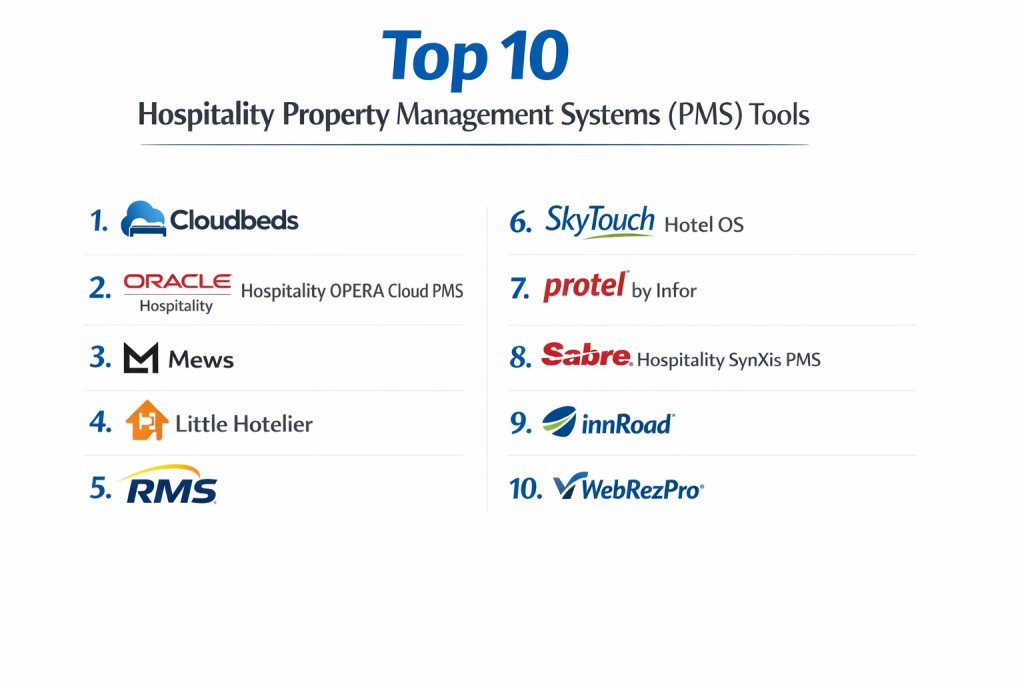
Top 10 Hospitality Property Management Systems (PMS) Tools
1 — Mews
Mews is a modern, cloud-native PMS designed to move away from the traditional “front desk” model. it focuses heavily on automation and guest self-service, making it a favorite for forward-thinking boutique hotels and chains.
- Key features
- Fully mobile-optimized “Mews Terminals” for staff to check in guests anywhere.
- Integrated “Mews Guest Journey” for online check-in and digital keys.
- Open API that allows for hundreds of third-party integrations.
- Automated payments and billing settlements.
- Multi-property management from a single dashboard.
- Detailed analytics and real-time reporting.
- Pros
- Incredibly user-friendly interface that looks and feels like a modern app.
- Greatly reduces administrative work through high levels of automation.
- Cons
- Pricing can be higher than older, legacy systems.
- The vast number of features can be overwhelming for very small properties.
- Security & compliance: SOC 2 Type II compliant, GDPR compliant, and PCI DSS Level 1 for payments.
- Support & community: 24/7 online support, a comprehensive digital “University” for training, and an active user community.
2 — Cloudbeds
Cloudbeds is an all-in-one hospitality platform that combines a PMS, channel manager, and booking engine into a single interface. It is specifically designed to help independent properties compete with the big chains.
- Key features
- Unified “Cloudbeds Dashboard” that manages all bookings and guest info.
- Built-in channel manager with real-time syncing to over 300 OTAs.
- Integrated booking engine for commission-free reservations on your website.
- Drag-and-drop calendar for easy room assignments.
- Automated guest communication emails and SMS.
- Multi-currency and multi-language support.
- Pros
- Having everything in one tool prevents “integration headaches” between different software.
- Excellent value for money for mid-sized independent hotels.
- Cons
- Some advanced reporting features are locked behind higher-priced tiers.
- The system can occasionally experience lag during heavy synchronization periods.
- Security & compliance: PCI DSS compliant, GDPR compliant, and uses SSL encryption.
- Support & community: 24/7 global support, dedicated onboarding coaches, and a massive knowledge base.
3 — Oracle Opera Cloud
Opera is perhaps the most famous name in the hotel industry. The Cloud version takes their world-class enterprise features and moves them into a web-based environment, suited for large hotels and global brands.
- Key features
- Highly customizable guest profiles and loyalty program management.
- Deep financial reporting and accounting integrations.
- Advanced housekeeping and maintenance management.
- Mobile “tablet” mode for staff roaming the property.
- Support for complex group bookings and events.
- Robust security features for large-scale operations.
- Pros
- There is no feature a large hotel could need that Opera doesn’t have.
- It is the industry standard, meaning most experienced hotel managers already know how to use it.
- Cons
- The interface, while improved, is still more complex than modern cloud-first competitors.
- Setup and implementation take a long time and require professional help.
- Security & compliance: ISO 27001, SOC 1 & 2, GDPR, and highest-level data encryption.
- Support & community: 24/7 global enterprise support and professional on-site training availability.
4 — Guesty
Guesty is a powerful platform that originally focused on short-term rentals but has expanded to become a top-tier PMS for boutique hotels and “aparthotels.”
- Key features
- Unified Inbox that gathers all guest messages from Airbnb, Booking.com, and email.
- Advanced automation for messages, reviews, and task assignments.
- Multi-calendar view for managing hundreds of listings at once.
- Integrated payment processing and owner portal for reporting.
- Mobile app for housekeeping and maintenance staff.
- Branded booking website builder.
- Pros
- The best tool for businesses managing a mix of hotel rooms and apartment rentals.
- Communication automation is world-class, saving hours of manual chatting.
- Cons
- Not designed for large “full-service” hotels with complex restaurant or spa needs.
- Pricing is often based on a percentage of revenue, which can become expensive.
- Security & compliance: GDPR compliant and PCI-compliant payment integrations.
- Support & community: 24/7 help center, dedicated account managers for large clients, and regular webinars.
5 — Little Hotelier
Owned by SiteMinder, Little Hotelier is built specifically for small properties like B&Bs, guesthouses, and small inns. It focuses on simplicity and ease of use.
- Key features
- Simple “Front Desk” view for managing daily check-ins.
- Direct connection to the SiteMinder channel manager.
- Mobile app for managing the property on the go.
- Basic guest communication templates.
- Integrated “Book Now” button for social media and websites.
- Simple reporting on occupancy and revenue.
- Pros
- Very affordable for small businesses with only a few rooms.
- Extremely simple to set up—you can be live in a few hours.
- Cons
- Lacks the deep features needed for larger hotels (like group billing).
- Integration options outside of the SiteMinder ecosystem are limited.
- Security & compliance: PCI DSS compliant and standard data encryption.
- Support & community: Phone and email support, with localized help in many regions.
6 — Stayntouch
Stayntouch is a cloud PMS that focuses on the “mobile” experience. It is designed to let hotels operate without a fixed front desk, using tablets and self-service kiosks.
- Key features
- Mobile-first design for staff and guests.
- Self-service kiosk mode for automated check-in.
- Direct guest messaging and upsell opportunities.
- Group booking and room block management.
- Real-time housekeeping updates on mobile devices.
- Open API for third-party integrations.
- Pros
- Very sleek and modern interface that appeals to younger travelers.
- Excellent at driving extra revenue through “upsell” prompts during check-in.
- Cons
- Smaller third-party marketplace compared to Mews or Opera.
- Implementation can be pricey for smaller, budget-focused properties.
- Security & compliance: SOC 2 compliant and fully GDPR compliant.
- Support & community: 24/7 support and a dedicated implementation team.
7 — RoomKeyPMS
RoomKeyPMS is a reliable, long-standing system that offers a strong balance of traditional hotel features with modern cloud accessibility.
- Key features
- Comprehensive property management with deep guest history.
- Integrated CRM for guest loyalty and marketing.
- Robust reporting and financial management.
- Online booking engine and channel management.
- Mobile check-in and check-out capabilities.
- Dedicated support for multi-property groups.
- Pros
- Known for having very high levels of data accuracy and financial reliability.
- A “one-stop shop” that doesn’t require as many external plugins.
- Cons
- The user interface looks a bit older than modern competitors like Mews.
- Can have a steeper learning curve for non-technical staff.
- Security & compliance: PCI DSS compliant and standard web security.
- Support & community: Highly rated North American-based support team and training videos.
8 — Frontdesk Anywhere
Frontdesk Anywhere is a sleek, web-based PMS designed for independent hotels and motels. It focuses on being a “work-anywhere” tool for property owners.
- Key features
- Clean, visual dashboard showing daily arrivals and departures.
- Integrated channel manager and booking engine.
- Automated email marketing for guests.
- Yield management tools to adjust prices based on demand.
- Group management and corporate billing.
- Inventory and POS (Point of Sale) integrations.
- Pros
- Very fast to learn; the layout is logical and easy to navigate.
- Pricing is transparent and usually fits well with SMB budgets.
- Cons
- Lacks some of the ultra-high-end enterprise features of Opera.
- Customer support is good but can be slower during peak times.
- Security & compliance: GDPR compliant and uses SSL encryption.
- Support & community: Online tutorials, email support, and scheduled onboarding sessions.
9 — Maestro PMS
Maestro is a veteran in the hospitality space, known for providing “Service-First” technology. It is often the choice for independent resorts that need very specific, tailored features.
- Key features
- Comprehensive suite including Spa, Activities, and Condo management.
- Integrated CRM and loyalty tracking.
- Mobile check-in and digital signature capture.
- Yield management and sophisticated rate tools.
- Centralized guest profiles across multiple properties.
- Robust data mining and business intelligence.
- Pros
- Incredible flexibility; they can customize the software to fit your unique property rules.
- Exceptional customer support—often cited as some of the best in the industry.
- Cons
- The software is very deep, which can make it complex for basic users.
- Implementation costs are high due to the level of customization.
- Security & compliance: PCI DSS compliant, GDPR compliant, and SOC 2 ready.
- Support & community: 24/7 “Diamond Plus” support and live training webinars.
10 — WebRezPro
WebRezPro is a cloud-based PMS that has been around for decades. It is a “workhorse” system that is reliable, affordable, and used by thousands of properties worldwide.
- Key features
- Full suite of front-desk and back-office features.
- Integrated accounting and commission tracking.
- Mobile-friendly interface for housekeeping and management.
- Group booking and event management.
- Direct integrations with hundreds of third-party vendors.
- Customizable booking engine for websites.
- Pros
- Extremely reliable with a proven track record of uptime.
- Offers a very wide range of features at a lower price point than enterprise systems.
- Cons
- The design is functional but looks very “traditional” and less modern.
- The setup process can be a bit manual and time-consuming.
- Security & compliance: PCI DSS Level 1 compliant and GDPR compliant.
- Support & community: Excellent phone support and a library of hundreds of “how-to” articles.
Comparison Table
| Tool Name | Best For | Platform(s) Supported | Standout Feature | Rating |
| Mews | Boutique/Modern Hotels | Web, iOS, Android | Guest Self-Service Flow | 4.7 / 5 |
| Cloudbeds | Independent SMB Hotels | Web, Mobile | All-in-one Integration | 4.5 / 5 |
| Oracle Opera | Global Enterprise/Chains | Web, Desktop | Enterprise Customization | 4.2 / 5 |
| Guesty | Aparthotels/Rentals | Web, Mobile app | Unified Communication Inbox | 4.6 / 5 |
| Little Hotelier | B&Bs and Small Inns | Web, Mobile app | Extreme Simplicity | 4.4 / 5 |
| Stayntouch | Mobile/Kiosk Ops | Web, Tablet | Self-Check-in Kiosks | 4.5 / 5 |
| RoomKeyPMS | Traditional Hotels | Web, Desktop | Financial Accuracy/Audit | 4.3 / 5 |
| Frontdesk Anywhere | Independent Motels | Web | Visual User Interface | 4.1 / 5 |
| Maestro PMS | Full-Service Resorts | Web, Desktop | Spa & Activity Management | 4.8 / 5 |
| WebRezPro | Value-Seeking Properties | Web | Integrated Accounting | 4.4 / 5 |
Evaluation & Scoring of Hospitality Property Management Systems (PMS)
| Evaluation Criteria | Weight | Content & Scoring Logic |
| Core Features | 25% | Presence of check-in, housekeeping, billing, and reservations. |
| Ease of Use | 15% | How quickly new staff can learn the system without errors. |
| Integrations | 15% | The number and quality of connections to OTAs and hardware. |
| Security/Compliance | 10% | Encryption, GDPR, and PCI compliance for payment data. |
| Performance | 10% | Software speed and uptime during busy check-in hours. |
| Support | 10% | Availability of 24/7 help and quality of training materials. |
| Price / Value | 15% | ROI based on time saved and commission-free bookings. |
Which Hospitality Property Management System (PMS) Tool Is Right for You?
Solo users vs SMB vs mid-market vs enterprise
If you are a solo owner of a tiny bed and breakfast, Little Hotelier is the way to go because it doesn’t require a tech expert to run. Small and Medium Businesses (SMBs) with 20-50 rooms will find the best balance in Cloudbeds or Frontdesk Anywhere. Mid-market boutique hotels that want to offer a high-tech guest experience should choose Mews or Stayntouch. Finally, Enterprise chains and massive resorts need the heavy-duty power of Oracle Opera or Maestro PMS, which can handle thousands of guests and complex department management.
Budget-conscious vs premium solutions
If you are on a tight budget, WebRezPro offers the most features for the lowest price point, providing a solid “no-frills” experience. If you are looking for a premium solution and are willing to pay for it, Mews or Stayntouch provide a superior guest experience that can actually allow you to charge higher room rates because the service feels so modern and polished.
Feature depth vs ease of use
A tool like Oracle Opera has incredible depth, but it is very difficult for a beginner to use. If your staff changes often, you should prioritize Ease of Use and choose a tool like Cloudbeds or Mews. These tools use “modern” web design that feels familiar to anyone who has used a smartphone, reducing the number of mistakes made during a busy check-in rush.
Integration and scalability needs
Do you plan on opening five more hotels in the next few years? If so, you need a Scalable cloud system. Mews and Oracle Opera Cloud are built to manage multiple properties from one single login. Also, check the “Marketplace” of the tool—ensure it integrates with the specific Point of Sale (POS) system you use in your hotel restaurant or the electronic locks you have on your doors.
Security and compliance requirements
Every hotel must be PCI DSS compliant to handle credit cards safely. If you have guests from Europe, GDPR compliance is mandatory. Enterprise-level hotels should look for SOC 2 compliance, which is a high-level security certification that ensures your business data is protected against cyber-attacks. Most modern cloud systems handle this, but always double-check the fine print.
Frequently Asked Questions (FAQs)
1. What is the difference between a PMS and a Channel Manager?
A PMS is the “internal” brain of your hotel (managing rooms and guests), while a Channel Manager is the “external” communicator that sends your prices and availability to sites like Expedia and Booking.com.
2. Can I use a PMS on my smartphone?
Most modern systems like Mews, Cloudbeds, and Stayntouch are cloud-based and have mobile apps or mobile-responsive websites so you can manage your hotel from anywhere.
3. Does the software work if the internet goes out?
Most cloud-based systems require the internet. However, many offer a “Daily Report” that you can download or print every morning, so you have a paper backup of who is checking in and out if the web goes down.
4. How long does it take to switch to a new PMS?
For a small property, it can take a few days. For a large hotel with complex data, it can take 4 to 8 weeks to move all your guest history and train your entire staff.
5. Can a PMS help me make more money?
Yes. Most systems have “Yield Management” or “Revenue Management” features that suggest when you should raise your prices (like during a local festival) or lower them to fill empty rooms.
6. Do I need to buy a special server for my hotel?
Not anymore. Most modern PMS tools are “Cloud-Based,” meaning the data is stored on the provider’s secure servers. All you need is a computer or tablet and a good internet connection.
7. Can guests check themselves in?
With systems like Mews and Stayntouch, yes. You can set up a kiosk in the lobby or send the guest a link to check in on their phone, much like an airline boarding pass.
8. Is my guest data safe?
Yes, as long as the provider is PCI and GDPR compliant. These systems use high-level encryption to ensure that guest names, addresses, and credit card numbers are kept private.
9. Can I manage my hotel restaurant through the PMS?
Some systems have a built-in Point of Sale (POS), but most integrate with external ones. This allows a guest to “charge a meal to their room,” and the cost will automatically appear on their final hotel bill.
10. What happens to my data if I cancel the service?
By law (and GDPR), you own your data. Most providers allow you to export your guest list and financial history to a spreadsheet before you close your account.
Conclusion
Choosing a Hospitality Property Management System (PMS) is one of the most important business decisions a hotelier will ever make. The right tool acts as a partner that works 24/7 to keep your guests happy and your staff organized. If you want a system that is easy to learn and scales with your growth, Cloudbeds or Mews are fantastic modern choices. If you are running a massive, world-class resort, the traditional power of Oracle Opera or Maestro remains hard to beat.
Remember, the “best” PMS isn’t the one with the most buttons; it’s the one that fits your property’s specific workflow. Take the time to sign up for a demo, ask about integration costs, and make sure your staff feels comfortable with the interface. By moving your operations to the right cloud platform, you aren’t just buying software—you are buying the freedom to focus on what hospitality is really about: the guest experience.