Introduction
A Hospitality Channel Manager is a software solution that allows accommodation providers to sell their rooms on multiple online travel agencies (OTAs) and booking sites simultaneously. It acts as a central distribution hub, ensuring that when a room is booked on one platform—such as Expedia or Booking.com—the inventory is instantly updated and blocked across all other connected channels, including the hotel’s own website. By centralizing the management of rates and availability, it eliminates the need for manual updates on dozens of individual extranets.
This tool is vital because it prevents the dreaded “overbooking” scenario, which can damage a property’s reputation and lead to costly relocation fees. Beyond inventory control, it allows hoteliers to implement dynamic pricing strategies, pushing rate changes to the entire market in seconds. It provides a level playing field, allowing smaller boutique properties to achieve the same global visibility as massive international chains. In an era where travelers shop across multiple sites before booking, a channel manager ensures your property is visible wherever they look.
Key Real-World Use Cases
- Real-Time Inventory Sync: Automatically closing a room on Airbnb the moment a guest books that same room via your hotel website.
- Rate Parity Management: Ensuring that your room prices are consistent across all platforms to satisfy OTA contract requirements and maintain guest trust.
- Dynamic Pricing Execution: Raising rates across 50+ channels simultaneously during a local festival or high-demand weekend.
- New Market Expansion: Connecting to niche or regional OTAs (like Agoda in Asia or HRS in Europe) to reach new demographics without increasing administrative workload.
What to Look For (Evaluation Criteria)
When selecting a channel manager, priority should be given to Two-Way Integration. This means the tool doesn’t just send data to OTAs but also pulls booking data back into your Property Management System (PMS). You should also evaluate Channel Breadth—ensure they connect to the specific platforms relevant to your region. Pooled Inventory capabilities are essential so that all your rooms are available on all channels at once, rather than manually allocating specific blocks to specific sites.
Best for: Hotel owners, revenue managers, and vacation rental hosts ranging from solo operators with a single unit to enterprise-level hotel chains and multi-property management companies.
Not ideal for: Very small, single-room homestays that only list on one platform (like Airbnb only) or hotels that rely 100% on walk-ins and local phone bookings without any online presence.
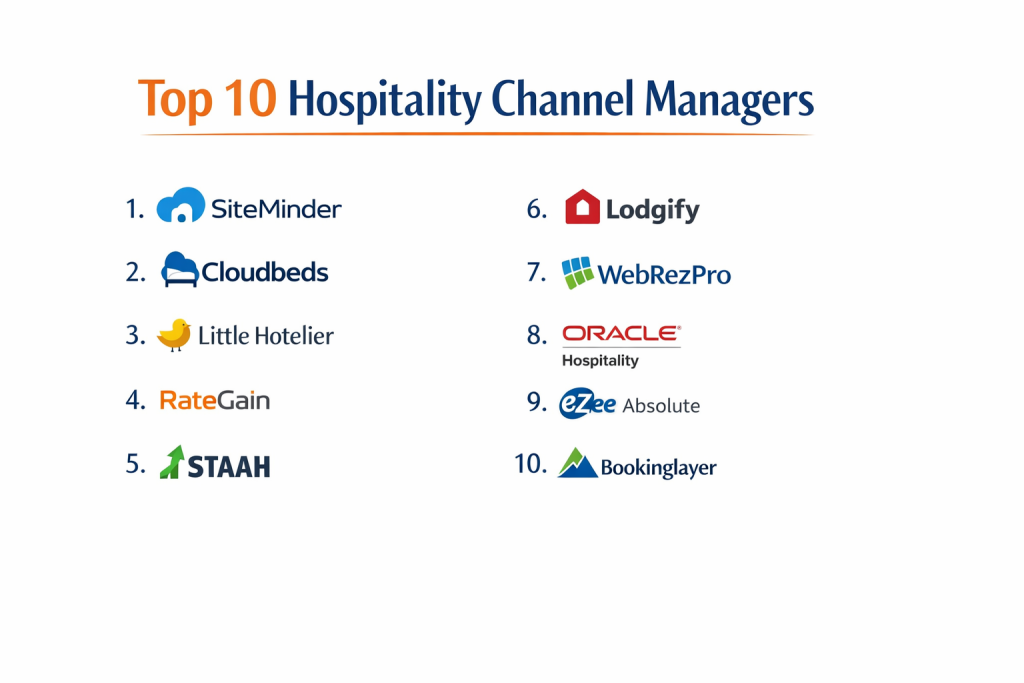
Top 10 Hospitality Channel Managers Tools
1 — SiteMinder
SiteMinder is widely regarded as the global leader in hotel distribution, known for its massive reach and robust technical infrastructure. It is designed for properties that want high-performance connectivity and advanced revenue insights.
- Key features
- Connectivity to over 450 OTAs, GDS, and wholesalers.
- Real-time, two-way PMS integration for seamless data flow.
- Integrated booking engine for commission-free direct reservations.
- Advanced “Insights” tool to monitor competitor pricing and market trends.
- Multi-property management for centralized group operations.
- Yield management rules to automate rate adjustments based on occupancy.
- Global Distribution System (GDS) connectivity for corporate travel.
- Pros
- Industry-leading reliability with nearly zero downtime during syncs.
- The most extensive list of channel connections in the hospitality world.
- Cons
- The interface can be complex for beginners due to the high volume of features.
- Pricing is on the higher end, making it a “premium” choice.
- Security & compliance: PCI DSS compliant, GDPR compliant, SSO, and bank-grade encryption.
- Support & community: 24/7 global support, extensive knowledge base, and a dedicated “SiteMinder University” for user training.
2 — Cloudbeds
Cloudbeds is an all-in-one hospitality platform that includes one of the most reliable channel managers on the market. It is specifically built to help independent properties compete with big brands.
- Key features
- Built-in channel manager that shares a database with the Cloudbeds PMS.
- Real-time synchronization with 300+ global and regional OTAs.
- “Marketplace” for connecting third-party apps and revenue tools.
- Instant notifications for new bookings and cancellations.
- Simple dashboard for managing rates and availability in bulk.
- Native booking engine with multi-currency and multi-language support.
- Pros
- Extremely user-friendly; easy for staff to learn in a very short time.
- Zero commission fees on bookings made through their native channel connections.
- Cons
- Best used as part of their full suite; may feel limited if used as a standalone tool.
- Fewer niche channel connections compared to SiteMinder.
- Security & compliance: PCI DSS Level 1, GDPR compliant, and secure API data transmission.
- Support & community: 24/7 support in multiple languages and an active user community of independent hoteliers.
3 — RateGain (RezGain)
RateGain is an enterprise-grade distribution platform that specializes in high-volume environments. It uses AI-driven insights to help hotels optimize their electronic distribution.
- Key features
- Smart distribution logic to prioritize the most profitable channels.
- Automated rate parity monitoring and alerts.
- Deep connectivity with wholesalers and tour operators.
- AI-based forecasting to suggest when to open or close channels.
- Centralized management for large, multi-brand hotel portfolios.
- Detailed productivity reports by channel and room type.
- Pros
- Powerful for hotels that work heavily with B2B wholesalers, not just B2C OTAs.
- Robust reporting that helps revenue managers identify “leakage.”
- Cons
- The UI can feel “corporate” and less modern than newer SaaS startups.
- Implementation takes longer due to the complexity of enterprise setups.
- Security & compliance: SOC 2 Type II, ISO 27001, GDPR, and PCI DSS compliant.
- Support & community: Dedicated account managers for enterprise clients and global technical helpdesks.
4 — STAAH
STAAH is a popular choice for properties in the Asia-Pacific region but has expanded globally. It is known for its “Max” platform which offers an incredibly fast and clean user experience.
- Key features
- “Instant” sync technology that updates OTAs in sub-seconds.
- Visual calendar for easy rate overrides and “Stop Sell” management.
- Integrated voucher system for selling gift certificates.
- Mobile app for managing the property on the go.
- Robust rate-shopper tool to track competitors.
- Multi-currency support for global bookings.
- Pros
- Known for being very cost-effective without sacrificing speed.
- The mobile app is highly functional for busy owners who are away from their desks.
- Cons
- The user community is smaller in the North American market.
- Documentation can sometimes be less detailed than the major global leaders.
- Security & compliance: PCI DSS compliant and GDPR compliant.
- Support & community: Strong localized support in various time zones and helpful video tutorials.
5 — D-EDGE
Formed by the merger of Availpro and Fastbooking, D-EDGE is a European powerhouse that offers a highly sophisticated, cloud-based distribution ecosystem.
- Key features
- Connectivity to over 500 distribution partners.
- “Smart Channel Manager” that suggests which channels to join based on data.
- Integrated Digital Marketing tools to drive direct traffic.
- Multi-property CRS (Central Reservation System) capabilities.
- Automated payment processing and guest folio creation.
- Highly visual reporting and analytics dashboards.
- Pros
- Excellent for European properties due to deep connections with local travel sites.
- The design is very clean and prioritizes the “user journey.”
- Cons
- Pricing can be complex depending on the number of modules added.
- Can be “too much software” for a simple 10-room guesthouse.
- Security & compliance: ISO 27001, GDPR compliant, and PCI DSS certified.
- Support & community: Professional onboarding and localized support across Europe and Asia.
6 — Little Hotelier
Owned by SiteMinder, Little Hotelier is the “smaller sibling” designed specifically for bed and breakfasts, guesthouses, and small inns.
- Key features
- Simplified version of the SiteMinder distribution engine.
- All-in-one front desk, booking engine, and channel manager.
- Drag-and-drop calendar for manual reservation management.
- Automated guest emails (pre-arrival and post-departure).
- Basic reporting on occupancy and top-performing OTAs.
- Mobile app optimized for small business owners.
- Pros
- Gives small properties access to world-class SiteMinder tech in a simpler package.
- Very affordable for properties with 1 to 20 rooms.
- Cons
- Lacks the advanced revenue management features of the main SiteMinder platform.
- Limited customization for complex billing or group bookings.
- Security & compliance: PCI DSS compliant and GDPR compliant.
- Support & community: Extensive self-help documentation and email/phone support.
7 — HotelRunner
HotelRunner is a cloud-based platform that acts as a bridge between hotels, OTAs, and travel agencies. It is particularly strong in the Mediterranean and emerging markets.
- Key features
- Direct integration with Booking.com, Airbnb, and Google Hotels.
- “Marketplace” where hotels can find and contract with new travel agencies.
- Social media booking tools for Facebook and Instagram.
- Automated rate and availability updates across all platforms.
- Integrated CRM for guest loyalty management.
- Support for “promotions” and “last-minute” deals.
- Pros
- Excellent for networking and finding new B2B partners.
- Offers a free tier for very small properties (though with limited features).
- Cons
- The interface can sometimes feel a bit cluttered with marketing offers.
- Sync speed can occasionally lag behind the “sub-second” leaders.
- Security & compliance: PCI DSS compliant and GDPR compliant.
- Support & community: Active blog and webinar series; support response times are generally good.
8 — YieldPlanet
YieldPlanet provides a highly flexible channel manager that focuses on giving revenue managers total control over their distribution strategy.
- Key features
- Advanced “Rule-Based” pricing (e.g., “if room type A is sold out, raise price on room type B”).
- Differentiation of prices by channel, guest type, and length of stay.
- Over 400 OTA and GDS connections.
- “Price Shopper” integration to monitor the market.
- Detailed logs for every synchronization and rate update.
- Multi-property management with different user permission levels.
- Pros
- Exceptional for revenue managers who want to build complex “if/then” scenarios.
- High level of transparency in their sync logs; you can see exactly when an OTA updated.
- Cons
- Higher learning curve for staff who are not comfortable with logic-based rules.
- Not as “all-in-one” as Cloudbeds; requires a separate PMS integration for best results.
- Security & compliance: PCI DSS compliant and GDPR compliant.
- Support & community: Professional technical support and detailed API documentation.
9 — WuBook
WuBook is an Italian-based channel manager that has gained a cult following among independent hotels for its flexibility and “pay-per-use” style options.
- Key features
- Open API that is highly popular with developers and custom PMS systems.
- No setup fees and flexible monthly contracts.
- “Zak” PMS integration for an all-in-one experience.
- Direct connectivity to all major OTAs and several niche European sites.
- Yield management tools to manage “Close to Arrival” and “Close to Departure” rules.
- Clean, no-nonsense interface.
- Pros
- One of the most “fair” pricing models in the industry.
- The API is world-class, making it the top choice for custom tech setups.
- Cons
- Fewer automated “marketing” features compared to D-EDGE or HotelRunner.
- Support is primarily centered in Europe.
- Security & compliance: PCI DSS compliant and GDPR compliant.
- Support & community: Strong developer community and responsive email support.
10 — Guesty
Guesty is a specialized platform for short-term rentals and “aparthotels.” It is the gold standard for managers who handle a mix of hotel-style rooms and private apartments.
- Key features
- Unified Inbox for guest messages from Airbnb, VRBO, and Booking.com.
- “Multi-Calendar” view for managing hundreds of individual units at once.
- Automated task management for housekeeping and maintenance.
- Branded booking website builder.
- Native payment processing and financial reporting.
- Pre-built integrations with “Smart Home” tech (locks, thermostats).
- Pros
- The absolute best for managing “distributed” properties (rooms in different buildings).
- Automation features for guest messaging are second to none.
- Cons
- Pricing is usually a percentage of revenue, which can be expensive as you grow.
- Not ideal for traditional hotels that need complex “Front Desk” features.
- Security & compliance: SOC 2 Type II, GDPR compliant, and PCI DSS compliant.
- Support & community: 24/7 support, dedicated account managers, and a massive annual user conference.
Comparison Table
| Tool Name | Best For | Platform(s) Supported | Standout Feature | Rating |
| SiteMinder | High-Growth Hotels | Web, Mobile app | 450+ Channel Connections | 4.8 / 5 |
| Cloudbeds | Independent Hotels | Web | Zero-commission direct engine | 4.7 / 5 |
| RateGain | Enterprise Chains | Web, Hybrid | AI-powered distribution | 4.1 / 5 |
| STAAH | APAC / Mid-market | Web, Mobile app | Sub-second sync speed | 4.6 / 5 |
| D-EDGE | European Market | Web | Digital Marketing Suite | 4.5 / 5 |
| Little Hotelier | B&Bs / Small Inns | Web, Mobile app | Simplified “Front Desk” view | 4.4 / 5 |
| HotelRunner | B2B Networking | Web | Agency Marketplace | 4.3 / 5 |
| YieldPlanet | Revenue Managers | Web | Rule-based automation | 4.2 / 5 |
| WuBook | Custom Tech / Devs | Web, API | Developer-friendly API | 4.5 / 5 |
| Guesty | Short-term Rentals | Web, Mobile app | Unified Guest Messaging | 4.8 / 5 |
Evaluation & Scoring of Hospitality Channel Managers
| Evaluation Criteria | Weight | Content & Scoring Logic |
| Core Features | 25% | Presence of 2-way sync, pooled inventory, and rate parity tools. |
| Ease of Use | 15% | Intuitiveness of the dashboard and speed of bulk updates. |
| Integrations | 15% | Breadth of PMS, GDS, and OTA connections. |
| Security & Compliance | 10% | PCI DSS certification and GDPR data protection measures. |
| Performance | 10% | Average synchronization speed and system uptime. |
| Support & Community | 10% | Quality of documentation and 24/7 support availability. |
| Price / Value | 15% | ROI based on time saved and elimination of overbookings. |
Which Hospitality Channel Managers Tool Is Right for You?
Solo users vs SMB vs mid-market vs enterprise
If you are a solo user with a single vacation rental, Guesty or Little Hotelier will feel the most intuitive. For SMBs (small boutique hotels), Cloudbeds offers the best “bang for your buck” by providing an all-in-one suite. Mid-market hotels with complex revenue goals should look toward SiteMinder or STAAH. Finally, Enterprise chains require the deep data mining and wholesale connectivity found in RateGain or D-EDGE.
Budget-conscious vs premium solutions
If you are budget-conscious, WuBook or HotelRunner are your best bets, as they offer flexible pricing or even free tiers for very small users. If you are looking for a premium solution where reliability is the top priority, SiteMinder is the industry standard for a reason—you pay more for the peace of mind that comes with their massive infrastructure.
Feature depth vs ease of use
A tool like YieldPlanet offers incredible feature depth but is essentially a “pilot’s cockpit” that requires training. If you prefer ease of use, Cloudbeds is designed to be learned in an afternoon. It is important to match the tool to the technical skill of your staff to avoid expensive errors.
Integration and scalability needs
Do you use a specific local PMS? Check the “Marketplace” or integration list of the channel manager first. If you plan to scale from 10 rooms to 100 rooms, choose a tool like SiteMinder that can handle that volume without forcing you to switch platforms later.
Security and compliance requirements
Never compromise on PCI DSS compliance. If your channel manager handles credit card details, they must meet this standard to protect you from liability. If you operate in the EU, ensure the vendor is fully GDPR compliant and can provide a Data Processing Agreement.
Frequently Asked Questions (FAQs)
1. What is the difference between a PMS and a Channel Manager?
A PMS (Property Management System) is your internal “daily log” for housekeeping and guest check-ins. A Channel Manager is the “megaphone” that tells the world’s booking sites how many rooms you have left.
2. Can I use a channel manager without a PMS?
Yes, most channel managers have a “manual” grid where you can type in your availability. However, it is much more efficient to connect the two so they talk to each other automatically.
3. Will a channel manager fix my overbooking problems?
Yes. A channel manager updates all sites within seconds. While an overbooking is still technically possible if two people click “book” at the exact same millisecond, the risk is reduced by 99%.
4. Does a channel manager charge a commission on every booking?
Most modern channel managers charge a flat monthly fee based on the number of rooms or channels you have. This is usually much cheaper than paying a percentage of every booking.
5. How long does it take to set up?
A basic setup can take a few days, but a full “two-way” integration with your PMS and dozens of OTAs can take 2 to 4 weeks to ensure every rate is mapped correctly.
6. Can I set different prices for different OTAs?
Yes. Most channel managers allow “Channel-Specific Markup.” For example, you can raise your price on Expedia by 15% to cover their commission while keeping your own website price lower.
7. Is it possible to manage Airbnb through these tools?
Yes, most of the top 10 (especially Guesty and Cloudbeds) are “Preferred Partners” with Airbnb, allowing you to manage your listing content and photos directly from their dashboard.
8. What happens if the internet goes out at my hotel?
Since these tools are cloud-based, the sync between the OTAs and the Channel Manager will continue to work. You just won’t be able to see the new bookings until your internet returns.
9. Can I manage “Promotions” and “Discounts” through a channel manager?
Advanced tools like SiteMinder and D-EDGE allow you to push “Early Bird” or “Last Minute” deals to all channels at once, rather than setting them up manually on each site.
10. Do I need a channel manager if I only list on Booking.com?
Probably not. If you only have one channel, you can manage it manually. You only need a channel manager once you want to list on two or more sites simultaneously.
Conclusion
A Hospitality Channel Manager is no longer a luxury—it is a foundational requirement for any accommodation business that wants to thrive in the digital age. By automating the distribution of your inventory, you eliminate human error, maximize your visibility, and free up your time to focus on the guests who are actually standing in your lobby.
The “best” tool depends entirely on your specific context. A small B&B in the countryside will have very different needs than a 500-room city hotel or a multi-unit Airbnb business. Prioritize a tool that integrates with your current PMS, offers 24/7 support in your language, and fits your long-term growth plans. By choosing the right distribution partner, you aren’t just buying software; you are opening your doors to the entire world.