Introduction
A Healthcare Electronic Medical Record (EMR) System is the digital foundation of modern clinical practice. It is the comprehensive software platform where all patient health information is created, gathered, managed, and consulted. An EMR goes beyond simple digital charts—it integrates patient demographics, medical history, medications, treatment plans, immunization dates, allergies, radiology images, and lab results into a single, accessible record. This system replaces the paper filing cabinet with a secure, intelligent database that can be accessed by authorized clinicians across different care settings.
The importance of a robust EMR system cannot be overstated. It is critical for patient safety, reducing medication errors through alerts and digital prescriptions. It enhances clinical efficiency by streamlining workflows like charting, ordering, and billing. It supports coordinated care by allowing different providers to share a patient’s complete story, and it empowers data-driven decisions through built-in analytics and reporting. Furthermore, it is essential for regulatory compliance, including billing accuracy and public health reporting.
Key real-world uses include a primary care physician reviewing a patient’s full history during an annual check-up, a specialist accessing hospital records before a consultation, a nurse documenting vital signs at the bedside, and a billing specialist generating insurance claims directly from the documented visit.
When choosing an EMR system, you should look for specialty-specific workflow support, intuitive user interface to minimize clinician burnout, interoperability capabilities to connect with labs, pharmacies, and other health systems, robust reporting for quality measures, and a proven track record of regulatory compliance (like ONC certification). The total cost of ownership, including implementation, training, and ongoing support, is also a paramount consideration.
Best for: These systems are essential for physicians, nurses, medical assistants, and administrative staff across the healthcare spectrum. They benefit hospitals and health systems, multi-specialty clinics, small private practices, urgent care centers, ambulatory surgery centers, and community health centers.
Not ideal for: Individual wellness coaches or practitioners offering non-medical services (like massage therapy or personal training) who may only need simple client scheduling and note-taking software. Very small, cash-only practices with minimal regulatory requirements might use simpler practice management software, though they often still benefit from a full EMR.
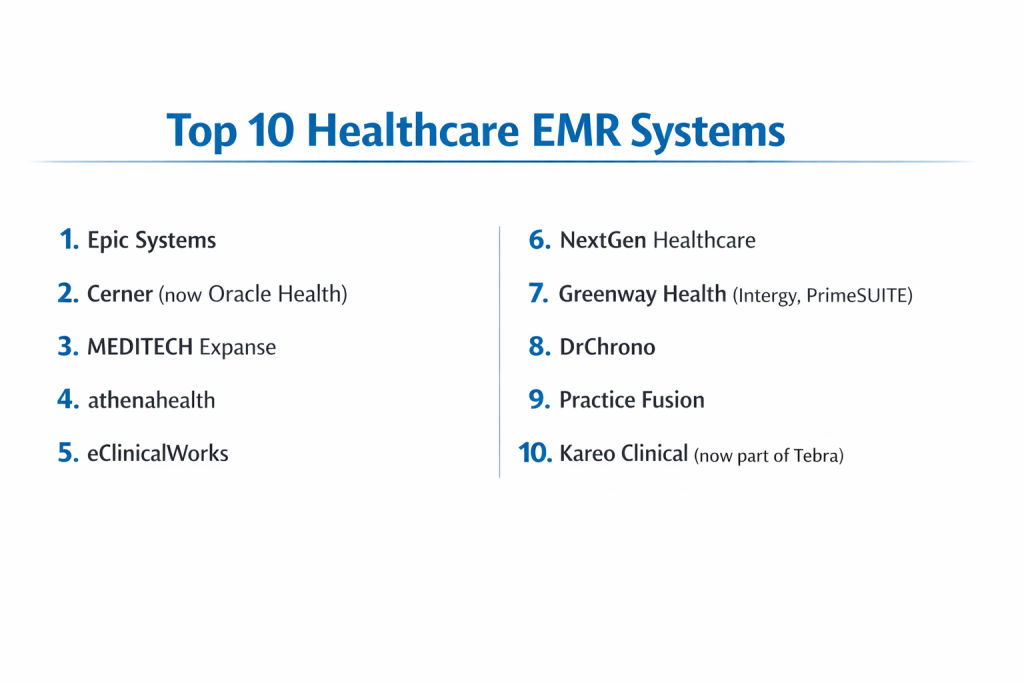
Top 10 Healthcare EMR Systems
Here is a detailed look at ten of the most prominent and capable EMR platforms in healthcare today.
1 — Epic Systems
Epic is the dominant enterprise-scale EMR, primarily serving large academic medical centers, integrated delivery networks, and multi-state health systems. It is renowned for its depth, interoperability, and patient-centric “One Virtual System” philosophy.
Key features:
- Unified Patient Record (Chronicles): A single, shared patient record accessible across all Epic-using organizations, creating a true longitudinal health record.
- MyChart Patient Portal: The industry-leading patient engagement tool, allowing patients to view records, message providers, schedule appointments, and pay bills.
- High Interoperability via Care Everywhere: Seamlessly shares patient records with other Epic and non-Epic systems across the country, a key differentiator.
- Comprehensive Module Suite: Covers every specialty and setting: inpatient, ambulatory, emergency department, surgery, oncology, cardiology, and revenue cycle.
- Robust Analytics & Reporting (Caboodle, Cogito): A powerful data warehouse and analytics platform for population health, research, and operational reporting.
- Configurable Clinical Workflows: Highly customizable physician and nursing workflows, though this requires significant build expertise.
Pros:
- Unmatched Integration & Data Unity: Creates a seamless experience for patients and providers across the entire care continuum within an organization.
- Market Leader in Large Healthcare: The de facto standard for major health systems, ensuring stability and continuous investment.
- Strong Patient Engagement: MyChart sets the benchmark for patient portal functionality and adoption.
Cons:
- Extremely High Cost & Long Implementation: Total costs can reach hundreds of millions, with implementations taking 1-3+ years.
- Vendor Lock-in & Complexity: Switching away is notoriously difficult and expensive. The system requires a large, dedicated internal IT team.
- Can Be Cumbersome for Small Practices: Its scale and complexity are overkill for independent solo or small group practices.
Security & compliance: Epic hosts its own data centers with the highest security standards. It is fully HIPAA compliant, ONC-certified, and meets stringent requirements for data privacy and integrity expected by large enterprises.
Support & community: Epic provides implementation support through its “Epic Staff” model. It has an enormous and active user community (the “UserWeb” forum) and hosts the massive annual XGM user group meeting.
2 — Cerner (now Oracle Health)
Cerner, now part of Oracle Health, is a major enterprise competitor to Epic, with a strong presence in large hospitals and government health systems (like the U.S. Department of Veterans Affairs). It emphasizes a unified architecture and data-driven insights.
Key features:
- HealtheIntent Population Health: A robust platform for managing patient populations, identifying risk, and coordinating care across settings.
- RevElate Revenue Cycle: An integrated revenue cycle management system designed to work seamlessly with clinical data.
- PowerChart Ambulatory & PowerChart Touch: Core clinical documentation suites for ambulatory and inpatient settings, with a modern mobile-friendly interface.
- Oracle Cloud Infrastructure (OCI) Integration: Leveraging Oracle’s cloud for scalability, analytics, and potential future AI/ML enhancements.
- Comprehensive Millennium Platform: A broad suite covering pharmacy, laboratory, radiology, and acute care nursing workflows.
- Open Developer Ecosystem (Cerner Open Developer Experience): Provides APIs for third-party innovation and integration.
Pros:
- Strong Inpatient & Acute Care Focus: Historically deep in hospital-based workflows, including complex orders and medication administration.
- Powerful Population Health Tools: HealtheIntent is a mature and capable platform for value-based care initiatives.
- Oracle’s Backing & Cloud Vision: Access to Oracle’s R&D and global cloud infrastructure promises future innovation and scale.
Cons:
- Post-Acquisition Uncertainty & Change: The integration into Oracle has led to product roadmap shifts and organizational changes, causing some customer concern.
- User Interface Challenges: Has been criticized for having a less intuitive and more fragmented user experience compared to some modern competitors.
- Implementation & Optimization Complexity: Similar to Epic, it is a massive, complex system requiring extensive resources to implement and optimize.
Security & compliance: Enterprise-grade security, compliant with HIPAA, HITECH, and other global standards. The move to OCI aims to enhance security and resilience.
Support & community: Support is provided through Oracle Health. The user community is large, with events like the Cerner Health Conference, though the community dynamic is evolving post-acquisition.
3 — MEDITECH Expanse
MEDITECH Expanse represents the company’s modern, web-browser-based platform. It is a major player, particularly in mid-sized community hospitals and health systems, known for offering enterprise functionality at a lower total cost of ownership.
Key features:
- 100% Web-Based, Device Agnostic: Accessible from any modern web browser on any device, reducing IT complexity for desktop management.
- Integrated Acute & Ambulatory EHR: Provides a single patient record and user experience across hospital, physician practice, and post-acute settings.
- MEDITECH as a Service (MaaS): A cloud-hosted subscription model that eliminates the need for on-premise servers and hardware management.
- Guided Workflows & Clinical Decision Support: Designed with usability in mind, offering context-aware guidance to streamline common clinical tasks.
- Patient & Consumer Health Platform: Includes tools for patient engagement, telehealth, and personal health record access.
- Strong Financial & Revenue Cycle Integration: Tightly couples clinical and financial data for efficient billing and reporting.
Pros:
- Lower Total Cost of Ownership: Often more affordable than Epic or Cerner for similar-sized organizations, especially with the MaaS model.
- Modern, Simplified User Experience: The Expanse platform is a significant usability upgrade, focused on reducing clicks and clinician burden.
- Strong for Community & Regional Systems: Excellent fit for organizations that need enterprise depth without the extreme scale and cost of the largest players.
Cons:
- Less Dominant in Large Academic Centers: While growing, its market share is smaller in the largest, most complex academic medical centers compared to Epic/Cerner.
- Ecosystem & App Marketplace: Its third-party application ecosystem is not as vast as some competitors, though it is expanding.
- Brand Perception: Sometimes perceived as a “legacy” vendor, though Expanse has aggressively modernized this image.
Security & compliance: MEDITECH operates secure data centers and its MaaS offering is built on robust cloud infrastructure. It is fully HIPAA compliant and ONC-certified.
Support & community: Known for reliable customer support. Has a loyal user base with regional user groups and an annual MEDITECH Physician and CIO Forum.
4 — athenahealth
athenahealth operates a unique, cloud-based network model. It combines an EMR with integrated practice management, revenue cycle management, and patient engagement services, all delivered as a service.
Key features:
- Network-Enabled Services: Leverages data from its vast network of clients to provide insights, benchmark performance, and automate tasks like claim submission and prior auths.
- Fully Integrated RCM: Revenue cycle management is not a separate module but is intrinsically built into the clinical workflow to minimize billing errors.
- athenaOne Coordinated Platform: A single, unified platform for EMR, practice management, patient engagement (athenaCommunicator), and telehealth.
- Proactive Claim Management: The system automatically identifies and addresses claim issues before they are denied, improving collections.
- Mobile-Optimized & User-Friendly: Known for a clean, intuitive interface that works well on tablets and mobile devices.
- Strong for Ambulatory Care: Particularly robust for primary care and multi-specialty group practices.
Pros:
- Reduced Administrative Burden: The network effect automates many back-office tasks, allowing practices to focus on patients.
- Predictable, All-in-One Cost: A single percentage-of-collections or per-provider fee covers software, updates, and support, simplifying budgeting.
- Rapid Implementation & Updates: As a true multi-tenant SaaS, practices can go live quickly and receive updates automatically without downtime.
Cons:
- Less Customizable: The trade-off for simplicity and automation is less ability to deeply customize workflows to unique specialist needs.
- Service-Centric Model: You are buying an outcome-focused service; you have less direct control over the software roadmap and IT environment.
- Can Be Costly at Scale: The percentage-based model can become expensive for very high-revenue practices or specialists.
Security & compliance: Hosted on secure, HIPAA-compliant cloud infrastructure (originally AWS). The company manages all security, backups, and compliance at the infrastructure level.
Support & community: Support is bundled into the service fee. athenahealth hosts user conferences (athenahealth MOMENTUM) and has an active user network that benefits from shared network insights.
5 — eClinicalWorks
eClinicalWorks is a major vendor in the ambulatory space, serving tens of thousands of small to medium-sized practices. It is known for aggressive pricing, frequent updates, and a comprehensive integrated product suite.
Key features:
- Integrated Practice Management & RCM: Combines scheduling, billing, and clinical documentation in one system.
- healow Patient Engagement Suite: Includes a patient portal, telehealth (healow TeleVisits), appointment reminders, and a health tracking app.
- EHR Version 11 (V11): A modern, cloud-based platform with a redesigned user interface and enhanced interoperability tools.
- National Health Information Network (Nationwide HIE): Operates its own health information exchange to facilitate record sharing between its customers and other networks.
- Comprehensive Specialty Templates: Offers tailored templates for numerous specialties, from cardiology to dermatology.
- Population Health (eClinicalWorks Cloud): Tools for chronic care management, patient registries, and reporting on quality measures.
Pros:
- Strong Value for Cost: Offers a very wide feature set at a competitive price point, especially attractive to cost-conscious practices.
- Frequent Innovation & Updates: Regularly releases new features and enhancements, particularly in areas like telehealth and patient engagement.
- Established in the Ambulatory Market: A well-known entity with a large installed base, providing a sense of stability for small practices.
Cons:
- Mixed Reputation for Support: Has faced criticism in the past for customer support responsiveness, though reports suggest improvement.
- Occasional Stability Issues: Some users report encountering bugs or performance issues with new updates more frequently than with more conservative vendors.
- Perception as a “Commodity” EHR: Its lower cost and broad market can lead to a perception of being less tailored for highly complex specialty workflows.
Security & compliance: Offers both cloud-hosted and on-premise deployment. Its cloud solutions are HIPAA compliant and hosted on secure data centers.
Support & community: Provides support through various channels. Hosts an annual user conference (eClinicalWorks National Conference) and has local user groups.
6 — NextGen Healthcare
NextGen Healthcare focuses on ambulatory practices of all sizes, with particular strength in community health centers (FQHCs), multi-specialty groups, and behavioral health. It emphasizes interoperability and regulatory expertise.
Key features:
- Integrated Behavioral Health & Physical Health: Strong tools for documenting and managing integrated care, a key need for FQHCs and modern practices.
- NextGen Office: PM + EHR: A unified platform combining practice management and clinical workflows.
- Mobile-First Solution (NextGen Mobile): A robust mobile app that allows for significant clinical functionality (charting, orders) from an iPad or iPhone.
- MIPS/APM Optimization: Provides dedicated tools and reporting to help practices succeed in value-based payment models.
- NextGen Share interoperability: A platform for health information exchange and connecting to community partners.
- Dental EHR Integration: Offers integrated solutions for practices that include dental services.
Pros:
- Expertise in Community Health & Specialties: Deep understanding of the unique billing (UDCs), reporting, and workflow needs of FQHCs and complex specialties.
- Powerful Mobile Capability: Its mobile app is consistently praised as one of the most functional in the industry for point-of-care use.
- Strong Interoperability Focus: Invests heavily in tools to connect with hospitals, HIEs, and public health agencies.
Cons:
- Interface Can Feel Dated: While functional, the desktop interface is not considered the most modern or visually appealing.
- Complex Setup for Optimal Use: To leverage its full power, significant configuration and training are often required.
- Customer Service Variability: Support experiences can be inconsistent, with some practices reporting challenges.
Security & compliance: HIPAA compliant and ONC-certified. Offers cloud-hosted (NextGen Hosted) and on-premise deployment options with robust security controls.
Support & community: Provides customer support and implementation services. Hosts an annual user conference (NextGen User Group Meeting) and has specialty-specific user communities.
7 — Greenway Health (Intergy, PrimeSUITE)
Greenway Health serves primarily ambulatory practices, with a focus on primary care, women’s health, and multi-specialty groups. It offers different platform options and emphasizes clinical and financial integration.
Key features:
- Dual Platform Strategy: Offers Intergy (a robust, established platform) and PrimeSUITE (a modern, cloud-based platform), allowing practices to choose based on need.
- Revenue Cycle Management Services: Provides outsourced RCM services that integrate directly with its EMR software.
- Greenway Marketplace: An app store for third-party integrations with labs, imaging centers, and other tools.
- Clinical Quality & Analytics: Tools for tracking quality measures, patient outcomes, and practice performance.
- Patient Engagement (Greenway Patient): Portal for patient communication, bill pay, and record access.
- Interoperability via CommonWell & Carequality: Active participant in major national interoperability networks.
Pros:
- Choice of Platforms: Allows practices to select between a mature, feature-rich system (Intergy) and a newer cloud-native platform (PrimeSUITE).
- Strong in Primary Care & OB/GYN: Well-regarded for its workflow support in these key ambulatory specialties.
- Integrated Financial Services: The option to bundle RCM services can simplify operations for some practices.
Cons:
- Platform Transition Considerations: Practices must carefully evaluate which platform is right for their future, as moving between them is a significant project.
- Market Position & Innovation Pace: Faces strong competition from both larger and more niche vendors, requiring constant execution.
- Implementation Experiences Can Vary: Success often depends heavily on the partner or internal team managing the implementation.
Security & compliance: HIPAA compliant and ONC-certified. Its PrimeSUITE cloud platform is built on Microsoft Azure, leveraging enterprise-grade security.
Support & community: Offers customer support and success programs. Hosts an annual user conference (Greenway Health ENGAGE) and facilitates user groups.
8 — DrChrono
DrChrono is a modern, cloud-native EHR and practice management platform built from the ground up for iPad and web. It is particularly popular with startups, direct primary care practices, and specialists seeking a flexible, mobile-first system.
Key features:
- iPad-Native EHR: The core experience is designed for the iPad, with an intuitive touch interface for charting, e-prescribing, and orders on the go.
- API-First & Highly Customizable: Offers a robust API (DrChrono API) for building custom integrations, forms, and workflows, appealing to tech-savvy practices.
- Integrated Medical Billing & RCM: Includes built-in billing tools and offers optional outsourced RCM services.
- Patient Engagement & Telehealth: Features a patient portal, online booking, and an integrated telehealth solution.
- App Marketplace: A curated marketplace for connecting with labs, imaging, and other health tech services.
- Focus on Ambulatory Flexibility: Well-suited for non-traditional practice models like concierge medicine, urgent care, and multi-location groups.
Pros:
- Exceptional Mobile & User Experience: The iPad app is often praised as one of the best-designed clinical interfaces, promoting efficiency.
- Developer-Friendly & Extensible: The open API allows practices to create tailored solutions, a major draw for innovative clinics.
- Rapid Setup & Low Overhead: As a pure SaaS product, implementation is fast, with no hardware to manage.
Cons:
- Less Depth for Complex Inpatient/Procedural Specialties: May lack the ultra-specialized tools needed for hospital-based surgeons or proceduralists.
- Growing Pains & Scaling: As a younger company, it may face challenges scaling support and features for very large, complex multi-specialty enterprises.
- Brand Recognition in Traditional Healthcare: Less known among more conservative, traditional medical practices compared to established players.
Security & compliance: A cloud-native provider on secure infrastructure (Google Cloud). HIPAA compliant and HITRUST CSF certified, which is a rigorous security framework.
Support & community: Provides support via multiple channels. Fosters a community among its users, who tend to be early adopters of technology.
9 — Practice Fusion
Practice Fusion, a subsidiary of NextGen Healthcare, is a free, ad-supported EMR primarily targeting very small, independent practices (especially in primary care). It offers a straightforward, web-based system.
Key features:
- Freemium, Ad-Supported Model: Core EMR and practice management functionality is free, with revenue from sponsored content and optional paid upgrades.
- Simple, Web-Based Interface: Designed for ease of use with a clean, uncluttered layout to get practices started with digital records quickly.
- Integrated e-Prescribing & Lab Orders: Includes basic connectivity for e-prescribing (Surescripts) and electronic lab ordering.
- Patient Portal: Offers a portal for patient messaging and record access.
- Basic Practice Management: Includes scheduling and billing tools to manage a small practice.
- Focus on Small Practice Viability: Aims to lower the barrier to entry for digital health records for solo practitioners.
Pros:
- Zero-Cost Entry Point: Eliminates the upfront software cost, which can be critical for a new or struggling small practice.
- Extremely Easy to Start Using: Minimal training required; practices can begin documenting patient visits almost immediately.
- Good for Basic Primary Care Needs: Covers the fundamentals for a straightforward primary care or family medicine workflow.
Cons:
- Advertisements in the Interface: The presence of sponsored content and ads can be distracting and perceived as unprofessional.
- Limited Features & Customization: Lacks the depth, specialty tools, and configurability of paid systems.
- Data Portability & Vendor Lock-in Concerns: Practices may find it difficult to export their data if they wish to switch to another system later.
Security & compliance: As a cloud-based service, it is HIPAA compliant. Security is managed by the vendor. The ad-supported model raises unique questions about data use that practices should scrutinize in the terms of service.
Support & community: Support is available, with priority given to paid upgrade subscribers. The community consists of its large base of small practice users.
10 — Kareo Clinical (now part of Tebra)
Kareo Clinical, now integrated into the Tebra platform, is designed specifically for the independent practice. Tebra combines Kareo’s practice management and billing with a modern, cloud-based EHR.
Key features:
- Built for Independence: The entire Tebra platform is tailored to the operational, financial, and clinical needs of small, independent practices and startups.
- Integrated Patient Experience: Tools for online booking, automated reminders, patient intake forms, and a patient portal.
- Streamlined Clinical Workflow: Focuses on fast, efficient charting with templates and tools to reduce administrative time.
- Kareo Billing & RCM: Tightly integrated billing software or optional outsourced RCM services to manage the financial health of the practice.
- Tebra Marketing Services: Offers additional tools to help practices with online presence and patient acquisition.
- Cloud-Based & Mobile Friendly: Accessible from any device, with apps to manage the practice on the go.
Pros:
- Holistic Practice Platform: Addresses clinical, financial, and patient engagement needs in one cohesive system.
- Strong Focus on Practice Viability: More than just an EHR; it’s a toolset to help independent practices thrive financially.
- Modern, Intuitive Design: The interface is clean and designed for usability, which aids in staff adoption.
Cons:
- Niche Focus: Its strengths are in independent ambulatory care; it is not designed for hospitals or large, complex health systems.
- Evolving Product Identity: The merger into Tebra is recent, and the long-term integration and product roadmap are still being realized.
- May Lack Ultra-Specialist Depth: Certain highly specialized surgical or procedural fields may require more specific functionality.
Security & compliance: A cloud-based SaaS platform. HIPAA compliant and employs industry-standard security practices to protect patient data.
Support & community: Tebra provides customer support and success resources. It is building a community around the independent practice model.
Comparison Table
| Tool Name | Best For | Platform(s) Supported | Standout Feature | Rating |
|---|---|---|---|---|
| Epic Systems | Large Health Systems & Academic Medical Centers | Client-server, Web, Mobile (Haiku, Canto) | System-wide interoperability & unified patient record | 4.8/5 |
| Cerner (Oracle Health) | Large Hospitals & Government Health Systems | Client-server, Web, Mobile | Population health (HealtheIntent) & acute care depth | 4.5/5 |
| MEDITECH Expanse | Mid-sized Community Hospitals & Health Systems | 100% Web Browser | Lower-cost enterprise EHR with modern web UX | 4.3/5 |
| athenahealth | Ambulatory Practices wanting a service/network model | Cloud (SaaS) | Network-enabled automation for RCM & admin tasks | 4.4/5 |
| eClinicalWorks | Small-Medium Ambulatory Practices (value-focused) | Cloud, On-premise | Comprehensive features at competitive cost | 4.0/5 |
| NextGen Healthcare | Community Health (FQHCs) & Multi-Specialty Groups | Cloud, On-premise, Mobile | Integrated behavioral health & powerful mobile app | 4.1/5 |
| Greenway Health | Ambulatory Practices (Primary Care, OB/GYN focus) | Cloud (PrimeSUITE), On-premise (Intergy) | Choice of mature vs. modern platform | 3.9/5 |
| DrChrono | Tech-savvy & Mobile-First Independent Practices/Specialists | Cloud (SaaS), iPad Native | Exceptional iPad UX & developer-friendly API | 4.2/5 |
| Practice Fusion | Very Small, Independent Primary Care Practices | Cloud (SaaS) | Free, ad-supported entry-level EMR | 3.5/5 |
| Kareo Clinical (Tebra) | Independent Practices seeking a holistic platform | Cloud (SaaS) | Integrated practice clinical/financial/engagement tools | 4.0/5 |
Evaluation & Scoring of Healthcare EMR Systems
Choosing an EMR requires balancing clinical needs with operational and financial realities. Use this rubric to evaluate options.
| Evaluation Category | Weight | What to Look For | Top Performer Example |
|---|---|---|---|
| Core Features | 25% | Specialty-specific charting, order sets, CPOE, e-prescribing, clinical decision support, reporting. | Epic, Cerner |
| Ease of Use | 15% | Intuitive physician/nurse workflow, minimal clicks, modern interface, mobile accessibility. | DrChrono, MEDITECH Expanse |
| Integrations & Ecosystem | 15% | Interoperability (FHIR, Direct), lab/radiology interfaces, PM/RCM integration, app marketplace. | Epic, athenahealth |
| Security & Compliance | 10% | HIPAA compliance, audit trails, data encryption, access controls, ONC certification. | All Major Vendors |
| Performance & Reliability | 10% | System uptime, chart open speed, downtime procedures, scalability. | Epic, athenahealth (Cloud) |
| Support & Community | 10% | Implementation help, training, responsive support, active user community. | Epic, MEDITECH |
| Price / Value | 15% | Total cost (software, implementation, support) vs. features, ROI in efficiency & collections. | MEDITECH, eClinicalWorks |
Which Healthcare EMR System Is Right for You?
Your practice type, size, and financial model are the primary guides.
- Solo Practitioner / Very Small Practice (<5 providers): You need affordability and simplicity. Practice Fusion is a free starting point. Kareo Clinical (Tebra) or DrChrono offer excellent all-in-one platforms with modern interfaces. eClinicalWorks provides a full-featured option at a good value.
- Small to Medium-Sized Group / Single-Specialty Practice: You need robust features and integrated billing. athenahealth (for the service model), NextGen (for specialty depth), Greenway Health, and eClinicalWorks are strong contenders.
- Large Multi-Specialty Group / Community Health Center: You need scalability, complex specialty support, and population health tools. NextGen excels here. athenahealth can scale. Epic (through Epic Community Connect) or Cerner may be options via a larger partner hospital.
- Hospitals & Health Systems (Mid-sized): You need enterprise depth at a controlled cost. MEDITECH Expanse is a prime choice. Cerner and Epic are also major players in this segment.
- Large Academic Medical Centers & National Health Systems: You need maximum depth, interoperability, and scalability. Epic is the dominant choice. Cerner (Oracle Health) is the primary competitor.
Budget-conscious vs. premium solutions: Practice Fusion is free, eClinicalWorks and MEDITECH offer strong value. athenahealth provides a service-based model. Epic and Cerner represent the largest capital investments.
Feature depth vs. ease of use: Epic and Cerner have immense depth but steep learning curves. DrChrono and MEDITECH Expanse prioritize modern, intuitive design. The key is finding sufficient depth for your specialty without overwhelming complexity.
Integration and scalability needs: If connecting to a specific hospital is critical, use what they use (often Epic or Cerner via a Community Connect program). For cloud scalability and automatic updates, pure SaaS models (athenahealth, DrChrono) excel.
Security and compliance requirements: All certified vendors meet baseline HIPAA/ONC rules. For highly sensitive research data or extreme scale, the enterprise vendors (Epic, Cerner) have dedicated infrastructure. Cloud vendors assume this burden for you.
Frequently Asked Questions (FAQs)
1. What’s the difference between an EMR and an EHR?
EMR (Electronic Medical Record) is the digital version of a patient’s chart within a single practice. EHR (Electronic Health Record) is a more comprehensive record designed to be shared across different healthcare providers, including labs, specialists, and hospitals. In practice, the terms are now used interchangeably.
2. How much does an EMR system typically cost?
Costs vary wildly: from free (Practice Fusion) to thousands per provider per year for cloud SaaS models, to multi-million dollar enterprise licenses. Include costs for implementation/training (often 1-3x the software cost), annual support (15-20% of license fee), and potential hardware.
3. How long does implementation take?
For a cloud-based system in a small practice: 30-90 days. For an enterprise system in a hospital: 12-36 months. Data migration, workflow design, and training are the major time factors.
4. Can we get our data out if we switch systems later?
Yes, but it can be difficult and expensive. HIPAA gives patients the right to their data, and vendors should provide export tools. However, transferring structured historical data into a new system’s format is a complex project. Ask about data portability before you sign.
5. Is a cloud-based EMR safe?
Reputable cloud EMR vendors use enterprise-grade security (encryption, access logs, secure data centers) that often exceeds what a small practice could implement on its own. Ensure they sign a Business Associate Agreement (BAA) and can provide security attestations (like SOC 2).
6. What is “Meaningful Use” and how does it affect our choice?
“Meaningful Use” (now part of Promoting Interoperability programs) sets standards for EMR use to qualify for government incentives. Choose an ONC-certified EMR that is updated to meet the latest program requirements to ensure you can participate and avoid penalties.
7. How do we ensure our doctors will actually use the new EMR?
Involve physicians in the selection process. Prioritize ease of use and mobility. Invest heavily in specialty-specific training. Choose a vendor known for good physician adoption. Consider a “physician champion” to advocate internally.
8. What is interoperability and why is it important?
Interoperability is the ability of different systems to exchange and use data. It’s critical for coordinated care, avoiding duplicate tests, and ensuring any provider has the full picture. Look for vendors active in networks like Carequality and CommonWell.
9. What’s the #1 mistake practices make when choosing an EMR?
Choosing based on price or a sales demo alone, without thoroughly testing the software with their own real-world workflows and involving the staff who will use it daily.
10. Can an EMR help with value-based care or MIPS?
Absolutely. Modern EMRs have tools to track quality measures, generate reports for MIPS submission, identify gaps in care, and manage patient populations—all essential for succeeding in value-based payment models.
Conclusion
Selecting the right Electronic Medical Record system is one of the most critical decisions a healthcare organization will make. It impacts clinical care, operational efficiency, financial health, and staff satisfaction for a decade or more. The landscape offers tailored solutions, from the streamlined simplicity of DrChrono for the independent practitioner to the transformative, system-wide integration of Epic for the largest medical centers.
The vital takeaway is that context is everything. The “best” EMR is the one that aligns with your specific clinical workflows, scales with your growth ambitions, fits within your financial model, and—most importantly—is adopted by your clinicians. A system that is a perfect fit for a large hospital would cripple a small clinic, and vice-versa.
Invest time in a meticulous selection process that weighs clinical functionality, usability, total cost, and vendor stability. By aligning the system’s core strengths with your organization’s fundamental needs, you can implement an EMR that becomes a catalyst for better patient care and a more sustainable practice, rather than a source of frustration. This foundational technology should empower your mission, not hinder it.