Introduction
GRC (Governance, Risk & Compliance) Platforms are comprehensive software solutions designed to help organizations manage their corporate strategy, handle potential risks, and ensure they meet all legal and regulatory requirements. Think of a GRC platform as the “brain” of a company’s internal operations. It brings together three critical functions that used to live in separate silos: Governance (setting the rules and goals), Risk (identifying things that could go wrong), and Compliance (proving that the company is following the rules). Instead of managing these complex tasks through hundreds of disconnected spreadsheets, a GRC tool provides a single, central dashboard where everything is tracked in real-time.
The importance of these platforms has grown significantly as businesses face more pressure from regulators, customers, and investors. A single slip-up in compliance or an unmanaged risk can lead to millions of dollars in fines and lasting damage to a company’s reputation. By using a GRC platform, organizations can automate the boring but essential tasks of gathering evidence, tracking audits, and monitoring vendor security. This allows management to make faster, data-driven decisions while ensuring the business remains stable and ethical.
Key Real-World Use Cases
- Audit Management: Streamlining the process of internal and external audits by keeping all evidence in one searchable place.
- Risk Mapping: Visualizing potential threats to the business, such as cyberattacks or supply chain failures, and assigning “owners” to fix them.
- Regulatory Tracking: Automatically updating the company’s policies whenever a new law like GDPR or HIPAA is passed or updated.
- Vendor Risk Management: Sending out automated security questionnaires to third-party partners to ensure they are safe to work with.
- Policy Management: Distributing company codes of conduct and tracking which employees have read and signed them.
What to Look For (Evaluation Criteria)
When choosing a GRC platform, you should look for Integration Capabilities above all else; a GRC tool is only as good as the data it can pull from your other systems. Ease of Use is also vital, as these tools are often used by people who aren’t tech experts. Finally, check for Scalability. You want a system that can handle your needs today but won’t break if your company doubles in size or expands into a new country with different laws.
Best for:
These tools are most beneficial for Chief Risk Officers (CROs), Compliance Managers, and IT Security Teams. They are essential for companies in highly regulated industries like banking, healthcare, energy, and aerospace, as well as high-growth tech startups that need to achieve SOC 2 or ISO 27001 certifications quickly.
Not ideal for:
Small businesses with very low risk and no specific legal requirements to follow. If your company only has five employees and doesn’t handle sensitive customer data, the high cost and complexity of a GRC platform will likely outweigh the benefits.
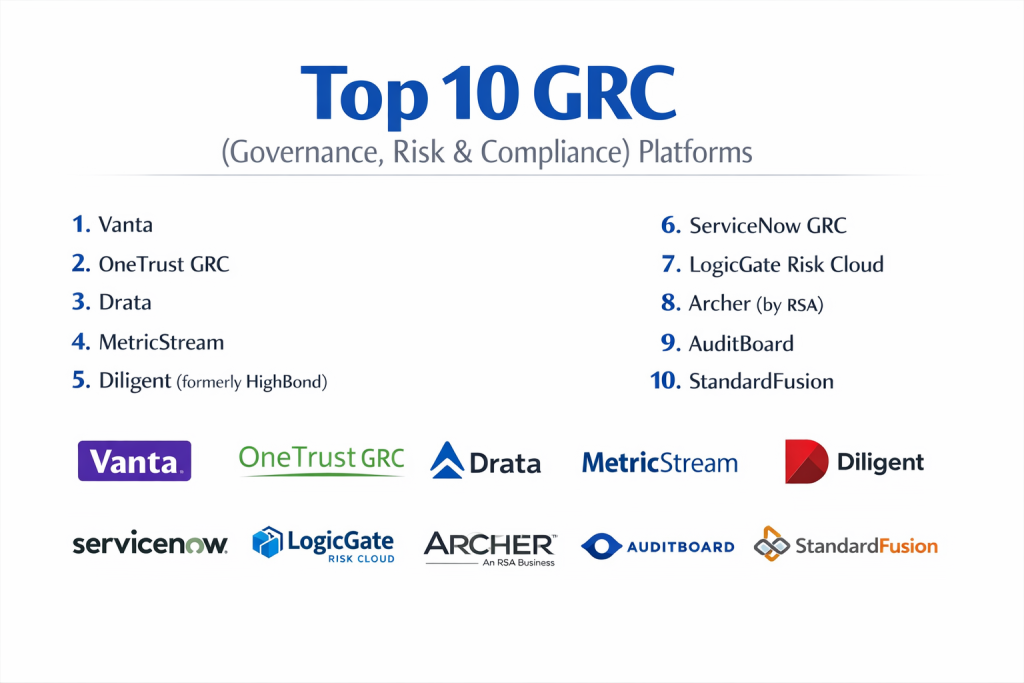
Top 10 GRC (Governance, Risk & Compliance) Platforms
1 — Vanta
Vanta is a modern GRC tool that focuses heavily on automation, especially for tech companies and startups. It is widely known for helping businesses get “audit-ready” in weeks rather than months by connecting directly to the tools they already use.
- Key features:
- Automated evidence collection for SOC 2, ISO 27001, and HIPAA.
- Continuous monitoring that alerts you if a security setting changes.
- Integrated “Trust Center” to show customers your security posture.
- Automated employee security training tracking.
- Direct integrations with AWS, Google Cloud, Slack, and GitHub.
- Risk assessment templates specifically built for cloud-native companies.
- Pros:
- Drastically reduces the manual work needed for compliance audits.
- Very fast to set up and easy for non-technical staff to understand.
- Cons:
- Mostly focused on IT and security compliance rather than general corporate governance.
- Can be restrictive if you have very unique or non-standard internal processes.
- Security & compliance: SOC 2 compliant, uses strong data encryption, and offers detailed audit logs for all platform activity.
- Support & community: High-quality customer success managers and a large community of security professionals using the platform.
2 — OneTrust GRC
OneTrust GRC is part of the massive OneTrust suite. It is built for large organizations that need to manage a vast array of privacy, security, and operational risks across global offices.
- Key features:
- Extensive regulatory library that tracks law changes in 100+ countries.
- Deep vendor risk management with automated scoring.
- Detailed data mapping to see how information flows through the company.
- Integrated incident management for tracking data breaches.
- Highly customizable dashboards for different levels of management.
- Support for ESG (Environmental, Social, and Governance) reporting.
- Pros:
- One of the most comprehensive tools on the market; it can handle almost any task.
- Excellent for global companies that need to meet many different international standards.
- Cons:
- The platform is very large and can feel slow or “bloated” to some users.
- Requires a significant amount of training and professional help to set up correctly.
- Security & compliance: ISO 27001, SOC 2, GDPR, and FedRAMP compliant; includes enterprise-grade SSO.
- Support & community: Massive online training “University” and 24/7 technical support for large accounts.
3 — Drata
Drata is a direct competitor to Vanta, focusing on “continuous compliance.” It is designed to take the stress out of audits by providing a real-time view of a company’s compliance status.
- Key features:
- Automated evidence collection via deep integrations.
- Custom control framework support for unique company needs.
- Automated personnel onboarding and offboarding checks.
- Risk management module with a pre-built library of threats.
- “Auditor view” that lets external auditors see your data without you having to email files.
- Support for over 15 major compliance frameworks.
- Pros:
- The user interface is very clean and makes complex tasks feel simple.
- Automation is extremely reliable, leading to fewer “false alerts” than other tools.
- Cons:
- The focus is primarily on security-related compliance.
- Pricing can scale up quickly as you add more employees.
- Security & compliance: SOC 2 Type II, GDPR, and HIPAA compliant; provides robust encryption for all stored evidence.
- Support & community: Dedicated compliance managers who help you during the actual audit process.
4 — MetricStream
MetricStream is a “legacy” leader in the GRC space, meaning they have been around for a long time and have built a platform that can handle the most complex requirements of the world’s largest banks and corporations.
- Key features:
- Highly sophisticated risk modeling and “what-if” scenario planning.
- Integrated internal audit management for global teams.
- Deep focus on regulatory compliance in the financial and energy sectors.
- External threat intelligence feeds integrated into the dashboard.
- Enterprise-wide policy management.
- Advanced analytics and “heat maps” for risk visualization.
- Pros:
- Capable of handling incredibly complex organizational structures.
- Deeply trusted by regulators in the finance and insurance industries.
- Cons:
- The interface can feel outdated and “clunky” compared to modern SaaS tools.
- Implementation projects can take a year or more to complete.
- Security & compliance: Meets the highest global security standards, including ISO, SOC, and regional financial regulations.
- Support & community: Extensive professional services and global consulting partners to assist with setup.
5 — Diligent (formerly HighBond/Galvanize)
Diligent offers a GRC platform that is particularly strong in “Governance.” It is built for boards of directors and executive teams who need high-level oversight of company risks and compliance.
- Key features:
- Board management tools for secure communication between executives.
- Integrated risk, audit, and compliance workflows.
- Powerful data automation that flags anomalies in financial records.
- ESG tracking and reporting modules.
- Vendor risk and third-party monitoring.
- Centralized policy library with automated version control.
- Pros:
- Excellent for companies that want their board of directors involved in risk oversight.
- Very strong reporting features that look great in board presentations.
- Cons:
- Can be very expensive if you need all the different modules.
- Some of the older parts of the platform are still being modernized.
- Security & compliance: SOC 2, HIPAA, and ISO 27001 compliant; uses high-level encryption for board-level data.
- Support & community: Strong global presence with 24/7 support and localized training.
6 — ServiceNow GRC
ServiceNow GRC is an extension of the popular ServiceNow IT management platform. It is a natural choice for companies that already use ServiceNow for their IT helpdesk or asset management.
- Key features:
- Continuous monitoring of IT assets for compliance gaps.
- Automated risk response workflows based on IT incidents.
- Integrated business continuity and disaster recovery planning.
- Deep integration with the broader ServiceNow ecosystem.
- Real-time risk dashboards for different business units.
- Policy and compliance management that links directly to IT tasks.
- Pros:
- If you already use ServiceNow, the “data sync” between IT and GRC is perfect.
- Very powerful for managing operational and IT risk in one place.
- Cons:
- Extremely complex and usually requires a dedicated consultant to manage.
- Very high cost, both for the software and the people needed to run it.
- Security & compliance: FedRAMP, ISO 27001, SOC 1, and SOC 2 compliant.
- Support & community: Huge global user community and a massive ecosystem of certified developers.
7 — LogicGate Risk Cloud
LogicGate is known for its “no-code” approach. It is a very flexible tool that allows companies to build their own GRC workflows without needing to write any computer code.
- Key features:
- Drag-and-drop workflow builder for custom risk processes.
- Centralized “Graph” view that shows how risks and controls are connected.
- Pre-built “Applications” for common tasks like SOC 2 or Vendor Risk.
- Automated reminders and task assignments for team members.
- Flexible reporting that can be customized for any department.
- Strong integrations with common business tools via APIs.
- Pros:
- Highly adaptable; the software fits your process, rather than you fitting theirs.
- Very modern and fast interface that teams actually enjoy using.
- Cons:
- The “blank slate” nature can be overwhelming if you don’t know exactly what you want.
- Pricing can be tricky as it is based on the number of “applications” you use.
- Security & compliance: SOC 2 Type II compliant; offers robust encryption and user access controls.
- Support & community: Known for having very proactive “Customer Success” managers who help build your workflows.
8 — Archer (by RSA)
Archer is one of the most famous names in GRC. It is a high-end, heavy-duty platform that is used by many of the world’s largest government agencies and Fortune 500 companies.
- Key features:
- Massive library of pre-built risk and compliance frameworks.
- Sophisticated incident management and response tracking.
- Enterprise-wide visibility into operational and financial risks.
- Deep capabilities for large-scale vendor and third-party risk.
- Highly detailed audit trails for every single action taken in the system.
- On-premise or cloud deployment options.
- Pros:
- Incredible depth; there is almost nothing this tool cannot do.
- Very stable and reliable for massive organizations with tens of thousands of users.
- Cons:
- Known for being very difficult to use and having a steep learning curve.
- Often requires a full-time internal team just to maintain the platform.
- Security & compliance: Meets almost every major global government and industry security standard.
- Support & community: Very mature community and a large number of specialized consulting firms that only work on Archer.
9 — AuditBoard
AuditBoard is a top choice for teams that are primarily focused on the “Audit” and “Compliance” parts of GRC. It is particularly popular for companies managing SOX (Sarbanes-Oxley) compliance.
- Key features:
- Streamlined workflows for internal auditors and risk managers.
- Real-time collaboration between the company and external auditors.
- Automated task tracking and evidence collection.
- Integrated risk management that feeds directly into the audit plan.
- ESG and environmental compliance modules.
- Very strong reporting for financial and IT controls.
- Pros:
- Widely considered the best tool for internal audit teams.
- Very fast implementation compared to other “big” GRC tools.
- Cons:
- Not quite as strong in “Governance” as tools like Diligent.
- Some of the non-audit features feel like “add-ons” rather than core parts of the tool.
- Security & compliance: SOC 2 Type II compliant and offers strong encryption.
- Support & community: Excellent customer service and a very active user group.
10 — StandardFusion
StandardFusion is a GRC tool that strikes a balance between the simplicity of startups and the power of enterprises. It is built to be “approachable” while still being powerful enough for complex audits.
- Key features:
- Unified interface for managing multiple standards (ISO, SOC, HIPAA) at once.
- Simplified risk registers with automated scoring.
- Audit management with direct evidence linking.
- Vendor risk management with easy-to-use questionnaires.
- Task management with email notifications for owners.
- Flexible reporting for stakeholders and management.
- Pros:
- Very straightforward pricing that is easier for mid-sized companies to handle.
- The software is intuitive enough that you can start using it on day one.
- Cons:
- Fewer automated “cloud integrations” than tools like Vanta or Drata.
- Lacks the deep “what-if” risk modeling of MetricStream or Archer.
- Security & compliance: SOC 2 compliant; focuses on helping customers meet ISO and GDPR.
- Support & community: Great direct support and a very clear documentation site.
Comparison Table
| Tool Name | Best For | Platform(s) Supported | Standout Feature | Rating |
| Vanta | Tech Startups | Cloud / SaaS | Automated Evidence Collection | 4.8/5 |
| OneTrust GRC | Global Enterprises | Cloud / Web | Regulatory Library (100+ countries) | 4.4/5 |
| Drata | Continuous Compliance | Cloud / SaaS | Auditor-Specific Dashboard | 4.7/5 |
| MetricStream | Banking & Finance | Cloud / Hybrid | Advanced Risk Modeling | 4.2/5 |
| Diligent | Boards & Executives | Cloud / Mobile | Board Governance Tools | 4.3/5 |
| ServiceNow GRC | ServiceNow Users | Cloud / IT-Native | IT-to-Compliance Syncing | 4.5/5 |
| LogicGate | Custom Workflows | Cloud / No-Code | Drag-and-Drop App Builder | 4.6/5 |
| Archer | Large Corporations | Cloud / On-Prem | Industrial-Strength Scale | 4.1/5 |
| AuditBoard | Internal Auditors | Cloud / Web | Audit-Auditor Collaboration | 4.6/5 |
| StandardFusion | Mid-Market Teams | Cloud / Web | Simple, Clean Risk Registers | 4.5/5 |
Evaluation & Scoring of GRC Platforms
| Criteria | Weight | Evaluation Method |
| Core features | 25% | Presence of risk management, audit, and compliance automation. |
| Ease of use | 15% | Time required to train staff and the clarity of the interface. |
| Integrations | 15% | How many other apps (AWS, Slack, Jira) it can connect to. |
| Security & compliance | 10% | Internal security standards of the tool (SOC 2, ISO, etc.). |
| Performance | 10% | Speed of the platform and reliability of automated scans. |
| Support & community | 10% | Quality of documentation and availability of help. |
| Price / value | 15% | Total cost of ownership versus the time and risk saved. |
Which GRC Platform Tool Is Right for You?
Solo Users vs. SMB vs. Mid-Market vs. Enterprise
A solo founder or a tiny team likely doesn’t need a GRC platform at all. For SMBs and high-growth startups, Vanta or Drata are usually the best starting points because they are fast and automated. Mid-Market companies that have more complex needs but still want modern software should look at StandardFusion or LogicGate. Large Enterprises with global footprints will almost always end up with OneTrust, ServiceNow, or Archer due to the sheer scale of their operations.
Budget-Conscious vs. Premium Solutions
If you are on a strict budget, look for tools like StandardFusion which offer clear pricing. Be careful with “Enterprise” tools—while they are powerful, they often have hidden costs for implementation and consulting. Automation-heavy tools like Vanta might seem expensive up front, but they save you from having to hire extra staff for compliance work.
Feature Depth vs. Ease of Use
If your primary goal is to get a SOC 2 certificate quickly, ease of use and automation are your best friends—choose Drata or Vanta. If your goal is to manage a complex risk profile for a bank or an oil company, you need feature depth and should look at MetricStream or Archer, even if they are harder to use.
Integration and Scalability Needs
Think about where your data is. If everything is in the cloud (AWS/Azure), you need a cloud-native tool. If you have data in old, on-site servers, you need a tool that can handle “Hybrid” or “On-Prem” setups. If you already use ServiceNow for IT, choosing their GRC module is often the most scalable path.
Security and Compliance Requirements
Check the “Frameworks” supported. If you need ISO 27001, almost all of these tools work. However, if you need a very specific law (like French health data laws or Brazilian privacy rules), make sure the tool has that specific framework pre-built in its library.
Frequently Asked Questions (FAQs)
1. What is the difference between GRC and a simple checklist?
A checklist is static and manual. A GRC platform is dynamic; it connects to your systems and automatically updates your status. If someone changes a security setting in your cloud, the GRC platform sees it and flags it as a risk instantly.
2. How long does it take to set up a GRC platform?
Modern automated tools like Vanta can be running in a few days. Large enterprise systems like Archer or ServiceNow can take anywhere from six months to two years to fully integrate.
3. Do these tools guarantee I will pass an audit?
No tool can guarantee a pass. An audit is performed by a human auditor who looks at your culture and processes. However, these tools make it much harder to fail by ensuring all your evidence is organized and your controls are working.
4. Can a GRC tool help with ESG (Environmental, Social, Governance) reporting?
Yes, many modern tools like OneTrust and Diligent now have specific modules to track carbon footprints, board diversity, and other ESG metrics that investors care about.
5. Is GRC software expensive?
It varies widely. Simple automated platforms for startups might start at $10,000–$15,000 per year. Large enterprise systems for thousands of users can cost hundreds of thousands of dollars annually.
6. Can I build my own GRC system in Excel?
Many companies start this way. However, as soon as you have more than one compliance framework (like SOC 2 and GDPR), Excel becomes very difficult to manage and prone to human error.
7. Who usually manages the GRC platform within a company?
It is usually managed by the Information Security (InfoSec) team, the Legal department, or a dedicated Compliance Officer. In very large companies, there may be a specific “GRC Team.”
8. Do these tools handle vendor security?
Most of them do. They allow you to send out security questionnaires to your vendors and store their answers in one place, so you can see which partners are risky.
9. What is “Continuous Monitoring”?
This is a feature where the software checks your systems every hour or day to make sure security settings haven’t been changed. If a setting “drifts” and becomes unsecure, the tool alerts you immediately.
10. What is a “Control” in GRC terms?
A “control” is a specific action you take to prevent a risk. For example, “requiring two-factor authentication for all employees” is a control that reduces the risk of a hacked account.
Conclusion
Choosing a GRC platform is a major decision that can change how your entire company manages risk and growth. There is no such thing as a “one size fits all” winner in this category. A fast-moving tech startup has completely different needs than a global investment bank. The “best” tool for you is simply the one that integrates most naturally into your existing workflows without adding unnecessary burden to your team.
When you are ready to choose, focus on the problem you are trying to solve right now—whether that is passing an upcoming audit or managing a complex web of global regulations. Start small, ensure your team is comfortable with the interface, and choose a partner that can grow with you. A good GRC tool shouldn’t just be a place where you store documents; it should be a strategic asset that helps your company operate with more confidence and transparency.