Introduction
Genomics analysis pipelines are standardized, automated sequences of computational steps designed to process raw DNA or RNA sequencing data into meaningful biological insights. These pipelines take the massive, “noisy” output from Next-Generation Sequencing (NGS) machines and perform a series of complex operations: quality control, read alignment to a reference genome, variant calling, and functional annotation. Without these structured workflows, the petabytes of genetic data generated globally would remain unintelligible. By formalizing these steps, pipelines ensure that genomic research is reproducible, scalable, and accurate, transforming raw nucleotides into the building blocks of personalized medicine and evolutionary biology.
The importance of genomics analysis pipelines has reached a critical peak as the cost of sequencing continues to plummet. They are the engine behind “Precision Medicine,” allowing doctors to tailor treatments based on a patient’s unique genetic profile. Key real-world use cases include identifying rare genetic disorders in pediatric care, tracking the evolution of viral pathogens during pandemics, and discovering somatic mutations in oncology to guide targeted cancer therapies. When choosing a pipeline, users must evaluate computational efficiency, biological accuracy (sensitivity and specificity), workflow portability (e.g., Docker/Singularity support), and adherence to community standards like the GATK Best Practices.
Best for: Bioinformaticians, clinical geneticists, pharmaceutical R&D teams, and academic researchers in life sciences. It is ideal for organizations ranging from small biotech startups to massive national healthcare systems that require high-throughput genomic data processing.
Not ideal for: General laboratory technicians without a basic understanding of computational biology, or researchers working with low-complexity data that doesn’t require high-performance computing (HPC) environments.
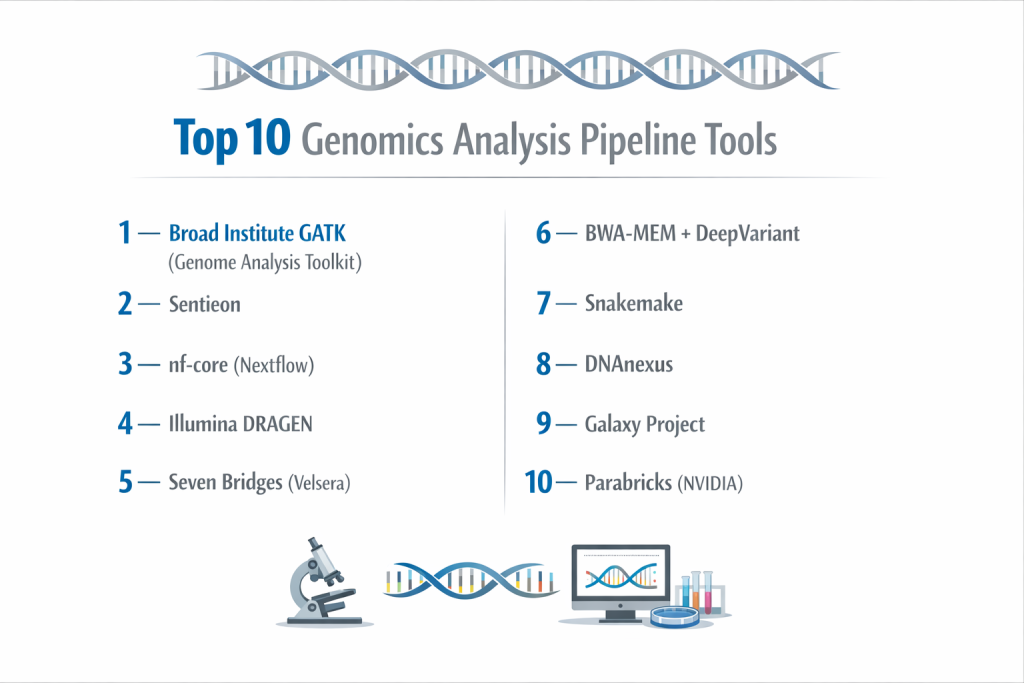
Top 10 Genomics Analysis Pipelines Tools
1 — Broad Institute GATK (Genome Analysis Toolkit)
GATK is the industry gold standard for variant discovery in high-throughput sequencing data. Developed by the Broad Institute, it offers an extensive suite of tools primarily focused on identifying SNPs and Indels in germline and somatic samples.
- Key features:
- Best Practices Workflows: Industry-standardized scripts for germline, somatic, and RNA-seq discovery.
- HaplotypeCaller: A state-of-the-art tool for highly accurate SNP and Indel calling via local de novo assembly.
- BQSR & VQSR: Advanced recalibration tools to filter out systematic technical errors and sequencing noise.
- Mutect2: Specialized pipeline for detecting somatic mutations in cancer research.
- WDL Compatibility: Native support for the Workflow Description Language for cloud execution.
- Pros:
- Unmatched scientific rigor and community trust; the benchmark for most genomic publications.
- Extensive documentation and a massive repository of pre-trained resource bundles.
- Cons:
- High computational footprint; can be slow and expensive to run on massive cohorts.
- Steeper learning curve for users unfamiliar with Java-based command-line tools.
- Security & compliance: HIPAA and GDPR compliant when run on secure cloud instances (e.g., Terra); supports detailed audit logs.
- Support & community: Vibrant community forum, extensive tutorials, and premium support available through cloud partnerships.
2 — Sentieon
Sentieon provides high-performance, drop-in replacements for traditional bioinformatics tools. It is engineered to perform the exact same mathematical operations as GATK but with a focus on extreme computational speed and efficiency.
- Key features:
- DNASeq & TNSeq: Highly optimized versions of standard germline and somatic pipelines.
- HapMap-consistent results: Guaranteed to produce results matching GATK Best Practices but 10x–50x faster.
- Low Compute Footprint: Specifically designed to reduce memory usage and CPU cycles on local servers or cloud.
- Support for UMI: Advanced tools for processing Unique Molecular Identifiers in liquid biopsy.
- Somatic Joint Calling: Improved sensitivity for detecting shared mutations in multi-sample cancer studies.
- Pros:
- Dramatic reduction in cloud computing costs due to shortened execution times.
- Highly stable and reliable for clinical production environments where “turnaround time” is critical.
- Cons:
- Commercial, proprietary software requiring a paid license (unlike open-source GATK).
- Not an “original” algorithm designer; follows the lead of community-developed math.
- Security & compliance: SOC 2, HIPAA, and GDPR compliant; supports encryption at rest and in transit.
- Support & community: Enterprise-grade technical support with guaranteed response times; extensive documentation for integration.
3 — nf-core (Nextflow)
nf-core is a community-driven effort to collect and curate a set of high-quality, peer-reviewed genomics pipelines built using the Nextflow workflow engine.
- Key features:
- Modular Design: Highly portable pipelines that run seamlessly on HPC, AWS, Google Cloud, or Azure.
- Containerization: Every pipeline is fully Docker and Singularity compatible for 100% reproducibility.
- Continuous Integration: Pipelines are automatically tested against small datasets to ensure stability.
- Sarek & RNAseq: Top-tier pipelines for germline/somatic variant calling and transcriptomics.
- MultiQC Integration: Automatically generates comprehensive quality control reports for every run.
- Pros:
- Incredible community support; pipelines are constantly updated with the latest scientific discoveries.
- Absolute portability—run the same pipeline on your laptop or a 10,000-node cluster.
- Cons:
- Requires familiarity with Nextflow and the Groovy programming language for customization.
- Some specialized pipelines in the repository may have varying levels of maturity.
- Security & compliance: Varies by deployment; the software itself supports SSO and encrypted data handling via cloud plugins.
- Support & community: Exceptional Slack community with thousands of experts; very high-quality online documentation.
4 — Illumina DRAGEN (Dynamic Read Analysis for GENomics)
DRAGEN is a field-programmable gate array (FPGA) based platform that provides ultra-rapid genomic analysis. It is designed to process an entire human genome in under 30 minutes.
- Key features:
- Hardware Acceleration: Uses specialized FPGA chips to offload heavy computational tasks from the CPU.
- Multimodal Pipelines: Handles DNA, RNA, Methylation, and Cyto-genomic data on a single platform.
- Machine Learning Filtering: Uses built-in ML models to improve the precision of variant calling.
- Graph-based Mapping: Better alignment in difficult-to-sequence regions like the HLA or SMA genes.
- Native Compression: Integrated ORA compression to reduce storage costs for FASTQ and BAM files.
- Pros:
- The fastest genomic pipeline on the market; essential for high-throughput clinical labs.
- High accuracy in “dark” regions of the genome where standard aligners often fail.
- Cons:
- Requires specific hardware (on-premise server) or specific cloud instances (AWS F1), increasing hardware lock-in.
- High upfront investment cost for on-premise deployments.
- Security & compliance: ISO 27001, HIPAA, GDPR, and SOC 2; integrated into the secure Illumina Connected Analytics platform.
- Support & community: Professional enterprise support from Illumina; extensive training programs for clinical users.
5 — Seven Bridges (Velsera)
Seven Bridges is a comprehensive cloud-based platform that offers a graphical interface for building, running, and analyzing genomics pipelines at scale.
- Key features:
- Visual Pipeline Editor: Drag-and-drop interface for building complex bioinformatics workflows.
- Multi-Cloud Execution: Run workloads on AWS or Google Cloud without changing your code.
- Public Data Integration: Native access to massive datasets like TCGA, Target, and CPTAC.
- CWL Native: Uses Common Workflow Language to ensure pipelines are not vendor-locked.
- Cost Management: Detailed tools to track and limit spending on cloud compute and storage.
- Pros:
- Excellent for research teams that lack deep command-line or DevOps expertise.
- Facilitates massive-scale collaboration across different geographic locations.
- Cons:
- Platform fees can add up on top of the underlying cloud compute costs.
- Less flexibility for bioinformaticians who prefer a pure “code-first” environment.
- Security & compliance: FedRAMP authorized, HIPAA, GDPR, ISO 27001, and SOC 2.
- Support & community: Dedicated scientific support teams and a well-documented API for automation.
6 — BWA-MEM + DeepVariant (Google Health)
This is a popular “hybrid” pipeline that combines the classic BWA-MEM aligner with Google’s DeepVariant, a deep-learning-based variant caller that treats genomic data like an image.
- Key features:
- CNN-based Calling: Uses Convolutional Neural Networks to identify mutations from “images” of read alignments.
- High Sensitivity: Exceptional performance on difficult datasets, including low-coverage or noisy data.
- Technology Agnostic: Specialized models for Illumina (short-read), PacBio (HiFi), and Oxford Nanopore (long-read).
- GPU Acceleration: Can be significantly sped up using NVIDIA GPUs.
- Open Source: Fully transparent code maintained by Google Health.
- Pros:
- Highly accurate for Indels and in regions where traditional statistical models struggle.
- Continuous improvement through Google’s machine learning research.
- Cons:
- Computationally heavy; requires significant GPU or CPU power compared to Sentieon or DRAGEN.
- Not an “all-in-one” solution; requires manual piping of data between alignment and calling.
- Security & compliance: Varies/NA (Open-source software); compliant when run on Google Cloud Life Sciences (GDPR/HIPAA).
- Support & community: Active GitHub community and excellent technical blogs/documentation from the Google Health team.
7 — SnakeMake
SnakeMake is a workflow management system that focuses on the Python ecosystem to create reproducible and scalable data analysis pipelines.
- Key features:
- Python-based Syntax: Easy to write and read for researchers already familiar with Python.
- Automatic Parallelization: Intelligently schedules tasks to run in parallel based on available resources.
- Conda Integration: Automatically creates and manages software environments for every pipeline step.
- Remote File Support: Native ability to handle data stored in S3, Google Storage, or FTP.
- Detailed Reporting: Generates interactive HTML reports showing the entire provenance of the data.
- Pros:
- Extremely popular in academia for its readability and simplicity.
- Great for “bespoke” research where pipelines need to be modified frequently.
- Cons:
- Scaling to massive cloud environments can be more manual than with Nextflow.
- Less centralized “best practice” repository compared to nf-core.
- Security & compliance: Varies/NA; depends entirely on the infrastructure where the SnakeMake workflow is executed.
- Support & community: Large academic community; very active on StackOverflow and GitHub.
8 — DNAnexus
DNAnexus is a secure, cloud-based platform for genomics that focuses on global collaboration and compliance for clinical and pharmaceutical users.
- Key features:
- PrecisionFDA Integration: Frequent host of FDA-led genomics challenges and benchmarks.
- Hybrid Cloud: Supports multi-cloud deployments with a single management layer.
- TITAN Execution: Proprietary engine for highly efficient workflow management.
- Apollo Platform: Integrated tools for large-scale clinico-genomic data analysis.
- Granular Governance: Extensive control over who can see, edit, or run specific data and pipelines.
- Pros:
- Top-tier security; often the preferred choice for pharmaceutical companies handling sensitive trial data.
- Very stable and mature platform for high-throughput clinical production.
- Cons:
- Proprietary ecosystem; moving pipelines off-platform can require significant refactoring.
- Cost structure is tailored toward enterprise rather than small academic labs.
- Security & compliance: ISO 27001, SOC 1/2/3, HIPAA, GDPR, FedRAMP, and FISMA.
- Support & community: Premium enterprise support and professional service engagements for custom pipeline dev.
9 — Galaxy Project
Galaxy is an open-source, web-based platform for accessible, reproducible, and transparent computational biomedical research.
- Key features:
- No-Code Interface: Perform complex genomic analysis via a web browser without writing a single line of code.
- Tool Shed: Thousands of community-contributed tools that can be added to the interface.
- Interactive Histories: Automatically tracks every step and parameter for full reproducibility.
- Workflow Sharing: Easily share entire analysis histories and workflows with collaborators.
- Public Servers: Free-to-use public instances for researchers with limited compute resources.
- Pros:
- The most accessible tool for biologists and students without computational training.
- Completely free and open-source with a massive educational focus.
- Cons:
- Not suitable for high-throughput, industrial-scale genomics where automation is key.
- Public servers can have long wait times for heavy computational tasks.
- Security & compliance: Varies; community-hosted versions are not HIPAA compliant, but private instances can be configured for it.
- Support & community: Massive global community; exceptional training resources through the Galaxy Training Network.
10 — Parabricks (NVIDIA)
NVIDIA Parabricks is a suite of accelerated genomic analysis software that leverages the power of GPUs to speed up industry-standard pipelines.
- Key features:
- GPU Acceleration: Ported versions of BWA, GATK, and DeepVariant that run on NVIDIA GPUs.
- 60x Speedup: Can process a Whole Genome (WGS) in roughly 20 minutes on a single server.
- Exact Math: Guaranteed to produce results identical to the CPU-based GATK tools.
- DeepVariant Integration: Fully optimized for the DeepVariant deep learning models.
- Enterprise Support: Validated to run on NVIDIA DGX systems and major cloud GPU instances.
- Pros:
- Drastic reduction in time-to-result for labs with existing GPU infrastructure.
- Simplifies the stack by providing a pre-built, optimized container of all major tools.
- Cons:
- Requires high-end NVIDIA GPUs, which can be expensive or hard to find in some regions.
- Licensing is commercial (though a free version is available for some research).
- Security & compliance: HIPAA and GDPR compliant; supports all standard enterprise security protocols.
- Support & community: Professional support from NVIDIA; growing community of GPU-bioinformatics experts.
Comparison Table
| Tool Name | Best For | Platform(s) Supported | Standout Feature | Rating |
| GATK | Standard Benchmarking | Linux / Cloud / Docker | HaplotypeCaller Accuracy | 4.8/5 |
| Sentieon | Cost-efficient Production | Linux / Cloud | Speed-to-CPU Ratio | 4.7/5 |
| nf-core | Collaborative Research | All Platforms / Cloud | Modular Portability | 4.9/5 |
| Illumina DRAGEN | Ultra-High Throughput | FPGA Hardware / AWS | FPGA Acceleration | 4.7/5 |
| Seven Bridges | Visual Collaboration | AWS / Google Cloud | Graphical Workflow Editor | 4.6/5 |
| DeepVariant | Complex/Noisy Data | GPU / CPU / Cloud | CNN-based Accuracy | 4.8/5 |
| SnakeMake | Python-based Research | Linux / HPC | Python Readability | 4.5/5 |
| DNAnexus | Pharma/Clinical Governance | Multi-Cloud | FedRAMP/Enterprise Security | 4.6/5 |
| Galaxy | Non-computational Users | Web-based | Browser-based GUI | 4.4/5 |
| Parabricks | GPU-equipped Labs | NVIDIA GPU / Cloud | GPU-accelerated GATK | 4.7/5 |
Evaluation & Scoring of Genomics Analysis Pipelines
The following table evaluates the general state of the genomics pipeline market based on the weighted criteria below.
| Category | Weight | Score | Evaluation Notes |
| Core Features | 25% | 9.5/10 | Pipelines have matured to handle DNA, RNA, and single-cell data exceptionally well. |
| Ease of Use | 15% | 7.0/10 | Still a significant barrier; GUI tools help, but CLI/Code is still dominant. |
| Integrations | 15% | 8.5/10 | Excellent cloud and container integration across almost all modern tools. |
| Security & Compliance | 10% | 9.2/10 | Clinical and Pharma needs have driven high-level compliance standards. |
| Performance | 10% | 9.0/10 | FPGA and GPU acceleration have solved the “speed” problem for high-throughput. |
| Support & Community | 10% | 8.8/10 | Open-source communities are thriving, though enterprise support is costly. |
| Price / Value | 15% | 8.0/10 | Open-source is “free” but compute costs are high; commercial tools optimize ROI. |
Which Genomics Analysis Pipelines Tool Is Right for You?
Solo Users vs SMB vs Mid-Market vs Enterprise
Solo users and PhD students should stick to SnakeMake or Galaxy. These tools allow for deep learning and reproducibility without complex overhead. SMBs and biotech startups benefit most from Sentieon or nf-core, where they can balance speed with open-source flexibility. Enterprises and clinical labs (e.g., diagnostic centers) should look at DRAGEN or DNAnexus, where the focus is on extreme reliability, regulatory compliance, and high-volume throughput.
Budget-conscious vs Premium Solutions
If you are budget-conscious, the nf-core/Nextflow ecosystem is unbeatable. You get world-class pipelines for free, and you only pay for the raw cloud compute you use. For Premium solutions, Sentieon or DRAGEN are worth the investment because they reduce your cloud bills by 50% or more by completing tasks faster—essentially paying for their own license fees in high-volume environments.
Feature Depth vs Ease of Use
If you need Ease of Use, Galaxy and Seven Bridges are the clear winners. They allow you to point-and-click your way to a result. However, for Feature Depth—such as the ability to tweak alignment parameters for a non-model organism or integrate custom machine-learning models—GATK and DeepVariant provide the most granular control at the command-line level.
Integration and Scalability Needs
For those prioritizing Scalability, Nextflow (nf-core) is the gold standard. It was designed from the ground up to handle “elastic” scaling, where you might need to process 1 sample today and 10,000 samples tomorrow. For Integration into existing clinical records or pharmaceutical trials, DNAnexus and Seven Bridges offer the best API-driven ecosystems for connecting genomic data with phenotypic information.
Security and Compliance Requirements
If you are working in a regulated clinical environment (CLIA/CAP), the hardware-software bundle of DRAGEN or the secure cloud of DNAnexus are the easiest paths to compliance. They provide the “ready-made” audit trails and data residency controls required by law. For academic research where data is intended to be public, the open-source rigor of GATK is usually sufficient.
Frequently Asked Questions (FAQs)
1. What is the difference between an aligner and a variant caller?
The aligner (e.g., BWA-MEM) takes raw sequencing reads and finds where they belong on a reference genome. The variant caller (e.g., GATK HaplotypeCaller) looks at those aligned reads to identify where the patient’s DNA differs from the reference.
2. Why is containerization (Docker/Singularity) important for genomics?
Genomics pipelines rely on dozens of small software tools. Containers package all these tools together so that the pipeline runs exactly the same way on any computer, preventing “dependency hell” and ensuring reproducibility.
3. How much does it cost to analyze a whole genome?
Compute costs range from $5 to $50 depending on the pipeline efficiency. Commercial tools like Sentieon can lower this, while deep-learning tools like DeepVariant might be on the higher end due to GPU requirements.
4. Can I run these pipelines on my local computer?
You can run small panels or exomes on a powerful laptop, but Whole Genome Sequencing (WGS) typically requires a high-performance cluster or cloud environment with at least 64GB of RAM and multiple CPUs.
5. What is the GATK Best Practices?
It is a set of guidelines developed by the Broad Institute that describes the most accurate way to process genomic data. Most pipelines listed here are designed to follow or improve upon these practices.
6. Nextflow vs. Snakemake: Which should I choose?
Nextflow is generally better for large-scale cloud deployments and high-throughput production. Snakemake is often preferred for academic research and smaller-scale projects due to its Python-centric, readable syntax.
7. Do I need a GPU for genomics?
Not necessarily, but GPUs significantly speed up deep-learning tools (DeepVariant) and accelerated pipelines (Parabricks). Most standard pipelines run on traditional CPUs.
8. What is the “Variant Call Format” (VCF)?
VCF is the standard file format for storing gene sequence variations. It is the final output of almost all the pipelines mentioned above.
9. Is my data safe in the cloud?
Platforms like DNAnexus and Seven Bridges use military-grade encryption and meet strict regulations (HIPAA/GDPR). However, “Security” is a shared responsibility; users must manage their own access keys and permissions carefully.
10. What is “Long-read” vs “Short-read” analysis?
Short-read (Illumina) is high-accuracy but struggles with complex regions. Long-read (PacBio/Nanopore) can span entire structural variations. Pipelines like DeepVariant and nf-core have specialized modules for both.
Conclusion
Choosing a genomics analysis pipeline is a balancing act between scientific precision, computational speed, and ease of use. For the majority of high-throughput clinical and research applications, the GATK and nf-core ecosystems remain the bedrock of the industry due to their transparency and community validation. However, for organizations where time-to-result is the most critical metric, hardware-accelerated tools like Illumina DRAGEN or GPU-optimized platforms like NVIDIA Parabricks have redefined what is possible.
Ultimately, the “best” pipeline is the one that fits your infrastructure and your team’s expertise. Whether you are building a custom SnakeMake workflow for a niche research project or deploying Sentieon to lower costs in a diagnostic lab, the goal remains the same: to turn the mystery of the genome into actionable, life-saving knowledge.