Introduction
Fraud prevention for e-commerce refers to the strategic implementation of software, algorithms, and manual review processes designed to identify and block deceptive transactions in online retail. As commerce moves further into the digital realm, bad actors have developed sophisticated methods—ranging from stolen credit card usage and account takeovers to sophisticated “friendly fraud” (where a legitimate customer falsely claims a charge was unauthorized). A robust fraud prevention tool acts as a silent guardian at the checkout, analyzing thousands of data points—such as IP addresses, device fingerprints, behavioral patterns, and historical data—in milliseconds to determine the legitimacy of a purchase.
The importance of these tools extends beyond merely preventing the loss of physical inventory. Every fraudulent transaction typically results in a “chargeback,” where the bank forcibly retrieves the funds from the merchant, often accompanied by a hefty administrative fee. Furthermore, high chargeback rates can lead to a merchant losing their ability to process credit cards entirely. Key real-world use cases include blocking automated bot attacks during a high-demand sneaker drop, verifying the identity of a customer making an unusually large international purchase, and identifying recurring “serial returners” who abuse store policies. When evaluating tools, merchants should look for high precision (to avoid blocking legitimate customers), low latency, and deep integration with their existing tech stack.
Key Real-World Use Cases
- Account Takeover (ATO) Prevention: A criminal gains access to a loyal customer’s account to use saved payment methods. The software detects an unusual login location and device, triggering a multi-factor authentication (MFA) requirement.
- Mitigating Promo Abuse: A user creates dozens of “burner” email accounts to reuse a one-time-use 50% discount code. The tool identifies the shared device fingerprint and blocks the subsequent orders.
- Chargeback Guarantee: A mid-sized merchant wants to eliminate the financial risk of fraud. They use a tool that “guarantees” approved orders; if an approved order turns out to be fraudulent, the software provider pays for the loss.
- Reducing “False Positives”: A legitimate customer travels abroad and tries to buy a gift. Traditional rules might block the “suspicious” international IP, but a modern machine-learning tool recognizes the customer’s behavioral history and allows the sale.
- Combating Friendly Fraud: A customer receives their item but tells their bank they never got it. The tool provides a “compelling evidence” report, including delivery confirmation and IP logs, to help the merchant win the dispute.
What to Look For (Evaluation Criteria)
- Machine Learning (ML) Capabilities: The software should not just rely on static rules (e.g., “Block all orders from Country X”) but should learn and adapt to new fraud patterns automatically.
- Device Fingerprinting: The ability to identify a specific hardware device even if the user changes their IP address or clears their browser cookies.
- Frictionless Checkout: The tool must work in the background. If it adds too many “Captcha” tests or delays, it will increase cart abandonment.
- Network Effect: Tools that pool data from thousands of other merchants are more effective, as they can recognize a known fraudster across the entire network.
- Dispute Management: Beyond just blocking fraud, the tool should provide a workflow for managing and fighting chargebacks when they inevitably happen.
Best for: E-commerce founders, Risk Managers, and CTOs at companies ranging from small boutiques to global marketplaces. It is a necessity for high-risk industries like electronics, luxury goods, and digital gift cards.
Not ideal for: B2B companies that work exclusively with long-term, vetted clients via purchase orders, or micro-merchants with very low transaction volumes who can manually review their few weekly orders.
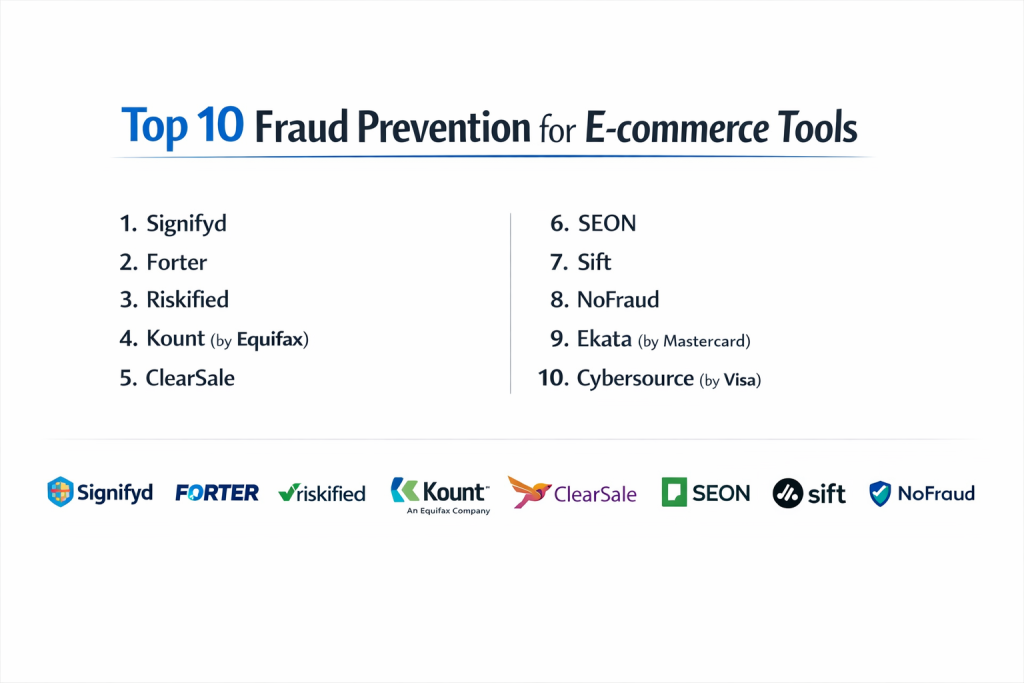
Top 10 Fraud Prevention for E-commerce Tools
1 — Signifyd
Signifyd is a market leader known for pioneered the “Chargeback Guarantee” model, essentially providing insurance for e-commerce transactions. It is designed for merchants who want to outsource their fraud risk entirely.
- Key features:
- 100% financial guarantee against fraudulent chargebacks.
- Automated order flow for instant approvals.
- Agent console for manual reviews when necessary.
- Deep data insights into why orders were declined.
- Integration with major platforms like Shopify, Magento, and Salesforce.
- Dynamic “Decision Center” for custom risk appetite.
- Pros:
- Eliminates the financial uncertainty of fraud losses.
- High approval rates by leveraging a massive merchant network.
- Cons:
- The percentage-based fee on approved orders can be expensive.
- May be less flexible for merchants who want total control over individual rules.
- Security & compliance: SOC 2 Type II, GDPR, PCI DSS Level 1, and ISO 27001.
- Support & community: 24/7 technical support, dedicated implementation managers, and an active user community.
2 — Forter
Forter is an enterprise-grade platform that uses a completely automated, “Identity-Based” approach to decision-making. It focuses on the entire customer journey, not just the checkout.
- Key features:
- Real-time “Approve/Decline” decisions in under 200ms.
- Account Protection to prevent takeovers.
- Policy Abuse protection (returns, coupon, and reseller abuse).
- Smart Claims to automate the chargeback dispute process.
- Forter Trust Cloud for global identity verification.
- Mobile-specific SDKs for in-app fraud prevention.
- Pros:
- Zero manual review required, allowing for total scalability.
- Exceptional at recognizing returning customers across different devices.
- Cons:
- Primarily focused on high-volume enterprise clients.
- Complex integration for smaller, non-standard tech stacks.
- Security & compliance: SOC 2, GDPR, PCI DSS, and ISO 27001.
- Support & community: Enterprise success teams, 24/7 global support, and extensive documentation.
3 — Riskified
Riskified is a prominent competitor to Signifyd, offering a similar chargeback guarantee model but with a heavy emphasis on high-volume retail and complex cross-border transactions.
- Key features:
- Full chargeback coverage for every approved transaction.
- Deco (Alternative Payment) protection.
- Advanced linking of “hidden” relationships between different user accounts.
- “Storefront” protection for account logins.
- Dynamic friction (applying 3DS only when necessary).
- Dispute integration to recover funds from “friendly fraud.”
- Pros:
- Highly accurate for international sales where traditional tools fail.
- Transparent pricing with a focus on increasing merchant revenue.
- Cons:
- Some users report a “black box” feeling regarding why specific orders were declined.
- Not ideal for low-margin businesses due to the guarantee fees.
- Security & compliance: SOC 2, GDPR, PCI DSS, and ISO 27001.
- Support & community: Global 24/7 support and dedicated account management for enterprise.
4 — Kount (by Equifax)
Kount is a versatile fraud prevention tool that offers both automated AI decisions and highly customizable “Rule Engines” for merchants who want a hands-on approach.
- Key features:
- Identity Trust Global Network (billions of interactions).
- Customizable “If/Then” rule builder.
- Real-time link analysis to visualize fraud rings.
- Omnichannel protection (Online, POS, and Phone).
- Advanced “Friendly Fraud” dispute management.
- Integration with over 400 payment processors and gateways.
- Pros:
- Excellent for merchants who want to fine-tune their own risk rules.
- Backed by Equifax’s massive consumer data repository.
- Cons:
- Can require more manual oversight than “set and forget” guarantee tools.
- The user interface can be intimidating for beginners.
- Security & compliance: SOC 2, GDPR, PCI DSS, and HIPAA compliant options.
- Support & community: Professional services for custom setups and 24/7 technical help.
5 — ClearSale
ClearSale is unique in that it combines a powerful AI engine with one of the world’s largest teams of manual fraud analysts to investigate suspicious orders.
- Key features:
- Hybrid approach (AI + Human Review).
- Optional chargeback guarantee tiers.
- Zero “False Positives” guarantee (they promise never to decline a good order).
- Strong focus on secondary reviews for high-ticket items.
- Multi-channel fraud protection.
- Comprehensive performance dashboards.
- Pros:
- Exceptional for high-ticket items (jewelry, electronics) where every sale counts.
- Reduced merchant workload through their internal review team.
- Cons:
- Manual reviews can occasionally lead to a slight delay in order processing.
- Higher cost for the “managed” services tier.
- Security & compliance: SOC 2, GDPR, PCI DSS, and ISO 27001.
- Support & community: 24/7 support in multiple languages and dedicated account managers.
6 — SEON
SEON is a modern, developer-friendly fraud tool that focuses heavily on “Social Signals” and digital footprint analysis.
- Key features:
- Real-time social media account lookups (50+ platforms).
- Email and Phone profiling for instant risk scoring.
- Clean, modern API and browser extension.
- Device fingerprinting with zero latency.
- Transparent “Whitebox” machine learning (it tells you why it scored an order).
- Flexible modular pricing.
- Pros:
- Best-in-class for identifying “fake” users through social media presence.
- Extremely easy for developers to integrate and test.
- Cons:
- Does not offer a chargeback guarantee; you are still responsible for losses.
- May require more technical setup for custom data fields.
- Security & compliance: SOC 2, GDPR, and ISO 27001.
- Support & community: Active GitHub presence, Slack community, and 24/7 email support.
7 — Sift
Sift (formerly Sift Science) is an industry veteran that offers a comprehensive “Digital Trust & Safety” suite, used by brands like Twitter, Airbnb, and DoorDash.
- Key features:
- Dynamic Risk Scoring using real-time ML.
- Content Integrity (prevention of spam/scams on your site).
- Payment Protection to stop credit card fraud.
- Account Defense to block takeovers.
- Workflows to automate manual review tasks.
- Global “Sift Network” for shared intelligence.
- Pros:
- Highly scalable for massive platforms with diverse fraud types.
- Very sophisticated dashboard with deep visualization tools.
- Cons:
- Pricing can be complex and expensive for smaller merchants.
- Can take time to “train” the ML model for niche industries.
- Security & compliance: SOC 2 Type II, GDPR, and PCI DSS.
- Support & community: Enterprise-grade support and an extensive knowledge base.
8 — NoFraud
NoFraud is a simplified, high-performance fraud prevention solution that offers a binary “Pass/Fail” decision and a full chargeback guarantee.
- Key features:
- Real-time decisioning with no manual review required.
- 100% financial guarantee against fraud chargebacks.
- No long-term contracts (month-to-month).
- Simplified “Single Score” view.
- Phone and email verification built-in.
- Managed dispute resolution for approved orders.
- Pros:
- Incredibly easy to set up for Shopify and BigCommerce users.
- Very aggressive at approving orders that other tools might flag.
- Cons:
- Fewer customization options for enterprise-level “Power Users.”
- Primarily focused on the North American and European markets.
- Security & compliance: PCI DSS, GDPR, and SOC 2.
- Support & community: Direct access to fraud analysts and 24/7 email support.
9 — Ekata (by Mastercard)
Ekata (formerly Whitepages Pro) provides the underlying “Identity Data” that many other fraud tools use, but also offers its own specialized APIs for e-commerce.
- Key features:
- Global Identity Provider (IP, Email, Phone, Address).
- Transaction Risk API for pre-authorization checks.
- Confidence Scores for identity verification.
- Network Signals from the Mastercard ecosystem.
- Historical data on identity usage across the web.
- Developer-first documentation.
- Pros:
- The “source of truth” for identity data globally.
- Very low latency and extremely high data reliability.
- Cons:
- It is a data provider, not a full-service fraud “workflow” tool.
- Requires a technical team to build a system around the data.
- Security & compliance: SOC 2, GDPR, ISO 27001, and PCI DSS.
- Support & community: Enterprise-level documentation and technical account management.
10 — Cybersource (by Visa)
Cybersource is a veteran in the payment and fraud space, offering one of the most comprehensive ecosystems in the world through the Visa network.
- Key features:
- Decision Manager (300+ variables).
- Native integration with Visa’s transaction data.
- Omnichannel payment and fraud processing.
- Global reach in 190+ countries.
- Account Updater to keep saved cards valid.
- Managed Risk Services for outsourced review.
- Pros:
- The most “all-in-one” solution for payments and fraud.
- Incredible global footprint and multi-currency support.
- Cons:
- Interface can feel dated and “bank-like” compared to modern SaaS.
- Implementation can be slow and requires significant technical effort.
- Security & compliance: PCI DSS Level 1, SOC 2, GDPR, and ISO 27001.
- Support & community: 24/7 global support and extensive corporate training.
Comparison Table
| Tool Name | Best For | Platform(s) Supported | Standout Feature | Rating |
| Signifyd | Outvoiced Risk | Shopify, Magento, SF | 100% Chargeback Guarantee | 4.8 / 5 |
| Forter | Enterprise Scale | SaaS, Headless, App | Total Automation (No Review) | 4.7 / 5 |
| Riskified | Cross-Border Retail | SaaS, API | High-Approval Guarantee | 4.6 / 5 |
| Kount | Custom Rules | All (400+ Gateways) | Equifax Identity Trust | 4.5 / 5 |
| ClearSale | High-Ticket Goods | Shopify, Adobe, BC | Hybrid AI + Human Review | 4.6 / 5 |
| SEON | Social Profiling | API, Chrome Ext. | Social Media Footprint | 4.4 / 5 |
| Sift | Diverse Platforms | API, Cloud | Digital Trust & Safety Suite | 4.5 / 5 |
| NoFraud | SMB Simplicity | Shopify, BigCommerce | No-Contract Guarantee | 4.7 / 5 |
| Ekata | Data Enrichment | API-first | Mastercard Global Identity | 4.3 / 5 |
| Cybersource | Global Enterprise | Visa Network | Unified Payments & Fraud | 4.2 / 5 |
Evaluation & Scoring of Fraud Prevention for E-commerce
| Criteria | Weight | Evaluation Rationale |
| Core Features | 25% | Accuracy of ML, device fingerprinting, and rule flexibility. |
| Ease of Use | 15% | Dashboard intuitiveness and speed of decision-making. |
| Integrations | 15% | Native support for e-commerce platforms and gateways. |
| Security & Compliance | 10% | Adherence to GDPR, SOC 2, and PCI standards. |
| Performance | 10% | Latency of the API and uptime reliability. |
| Support & Community | 10% | Quality of documentation and 24/7 technical help. |
| Price / Value | 15% | ROI based on fraud savings vs. software fees. |
Which Fraud Prevention Tool Is Right for You?
Small to Mid-Market vs. Enterprise
For solo users and SMBs, the biggest hurdle is time. You don’t have the resources to manually review orders. Therefore, a “Guarantee” model like NoFraud or Signifyd is usually best; it gives you peace of mind and allows you to focus on marketing. Enterprise users, however, often prefer Forter or Sift, where the focus is on a high-speed, headless API that can integrate with complex, custom-built storefronts and handle millions of monthly transactions.
Budget and Value
If you are budget-conscious, look for a “Pay-as-you-go” or “Per-transaction” model. SEON is excellent for this, as it allows you to start small and pay only for the signals you need. For larger merchants, a percentage-of-sales model (typical of the guarantee providers) might seem expensive, but when you factor in the cost of lost inventory, shipping, and chargeback fees, the ROI often justifies the premium.
Technical Depth vs. Simplicity
If you want simplicity, choose a tool with a “One-Click” Shopify app integration. NoFraud and Signifyd excel here. If you have a team of developers and want to build a custom risk-scoring system, Ekata (for data) or SEON (for social signals) provide the best technical depth and clean API documentation to build something unique.
Security and Compliance Requirements
If you are selling globally, GDPR and PCI compliance are mandatory. All the tools on this list meet these standards. However, if you are in a highly regulated industry like healthcare or finance, Kount or Cybersource offer specialized compliance features (like HIPAA or AML checks) that are not typically found in standard retail-focused fraud tools.
Frequently Asked Questions (FAQs)
What is a “False Positive” in fraud prevention?
A false positive occurs when a legitimate customer’s order is incorrectly flagged and declined as fraud. This results in lost revenue and a poor customer experience.
What is a Chargeback Guarantee?
It is a service where the fraud software provider assumes the financial liability for any fraudulent orders they approve. If a chargeback occurs, they reimburse the merchant.
Does fraud software slow down my website?
Most modern tools (like Forter or SEON) use asynchronous APIs or lightweight scripts that process in the background, typically taking less than 200ms, which is imperceptible to the user.
Can these tools stop “Friendly Fraud”?
While difficult to block (since the customer is legitimate), tools like Riskified and ClearSale provide “Compelling Evidence” reports to help you win the bank dispute.
Do I need an IT team to install these?
For platforms like Shopify or BigCommerce, most tools have “no-code” apps. For custom-built websites, a developer will be needed to integrate the API.
How does “Device Fingerprinting” work?
It collects non-sensitive data about a user’s hardware (screen resolution, battery level, OS version) to create a unique ID that identifies them even if they use a VPN.
Is manual review still necessary?
For most merchants, AI is sufficient. However, for extremely high-ticket items, a “Hybrid” model like ClearSale (AI + Human) provides an extra layer of security.
What is the “Network Effect”?
It’s the idea that if a fraudster is caught on “Merchant A’s” site, the software immediately blocks them on “Merchant B’s” site because they share the same intelligence network.
How much do these tools typically cost?
Pricing varies from $0.05 per transaction to 0.5% – 2% of the total order value for “Guarantee” models.
Can I use multiple fraud tools at once?
Yes. Some merchants use a data provider like Ekata to gather info, and then feed that into a rule-engine like Kount for the final decision.
Conclusion
In the current e-commerce landscape, fraud prevention is no longer a luxury—it is a foundational requirement for business survival. The “best” tool is rarely the one with the most features, but rather the one that aligns with your specific risk tolerance, product category, and technical capabilities.
For those who want to eliminate worry and outsource the entire problem, the Chargeback Guarantee models of Signifyd or NoFraud are unbeatable. For technical teams building the next great marketplace, the API-first approach of Forter or SEON provides the necessary flexibility. Ultimately, the goal is to create a “Invisible Shield”—one that is impenetrable to fraudsters but completely transparent to your loyal customers.