Introduction
Fraud Detection Platforms are advanced security ecosystems designed to identify, prevent, and mitigate fraudulent activities in real-time. These platforms act as a digital sentry, monitoring trillions of data points—from transaction amounts and IP addresses to behavioral biometrics like mouse movements and typing speed. Unlike traditional security tools that rely on static rules, modern fraud detection systems leverage Artificial Intelligence (AI) and Machine Learning (ML) to adapt to the ever-evolving tactics of cybercriminals. They create a “single source of truth” by unifying data across the entire customer journey, from account creation and login to final checkout and fund transfer.
In the current digital landscape, these platforms are critical for business survival. As organized crime groups increasingly use Generative AI to launch sophisticated phishing and synthetic identity attacks, companies can no longer rely on manual reviews or simple blocklists. Fraud detection platforms allow businesses to reduce financial losses from chargebacks, protect their brand reputation, and—crucially—ensure a frictionless experience for legitimate customers. By automating the decision-making process, these tools help organizations strike the perfect balance between high-security barriers and smooth user journeys.
Key Real-World Use Cases
- Account Takeover (ATO) Prevention: Detecting when a legitimate user’s credentials have been compromised by analyzing deviations in login behavior or device patterns.
- Ecommerce Transaction Monitoring: Blocking stolen credit card usage and reducing high-cost chargebacks for online merchants.
- Synthetic Identity Detection: Identifying “frankenstein” identities created from a mix of real and fake data during the onboarding process.
- Authorized Push Payment (APP) Scams: Protecting bank customers from social engineering attacks where they are tricked into sending money to a fraudster.
- Promo and Loyalty Abuse: Preventing bad actors from creating thousands of fake accounts to exploit referral bonuses or discount codes.
What to Look For (Evaluation Criteria)
When evaluating a platform, prioritize Real-Time Processing Latency; a delay of even a few seconds can ruin the customer experience. Look for Explainable AI (XAI), which tells your analysts why a transaction was flagged, rather than just giving a “black box” score. Additionally, Consortium Data—the ability to see fraud patterns identified by other companies in the same network—is a massive competitive advantage in stopping cross-merchant attacks.
Best for:
Fraud Detection Platforms are most beneficial for Chief Risk Officers (CROs), Fraud Analysts, and Ecommerce Managers. They are essential for financial institutions, fintech startups, online marketplaces, and global retailers who process high volumes of digital transactions and face strict regulatory requirements like AML (Anti-Money Laundering).
Not ideal for:
Small local businesses with very low online transaction volumes or those who operate primarily through cash or physical point-of-sale systems. If you have a highly niche customer base and a handful of transactions per day, the “native” fraud tools provided by payment processors like Shopify or Square may be sufficient without the need for a standalone platform.
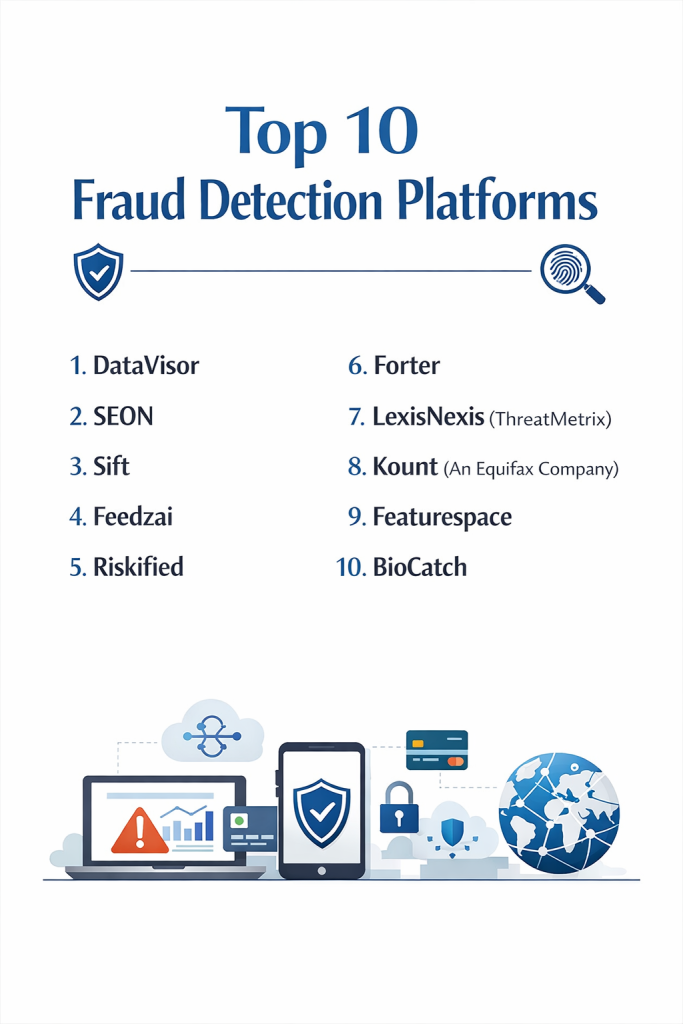
Top 10 Fraud Detection Platforms
1 — DataVisor
DataVisor is a leading AI-powered platform known for its “Unsupervised Machine Learning” (UML) approach. It is designed for large-scale enterprises that need to catch “unknown unknowns”—new fraud patterns that haven’t been seen before.
- Key features:
- Patented Unsupervised Machine Learning that detects coordinated attacks without historical labels.
- Unified Fraud and AML (FRAML) architecture for a holistic view of risk.
- Real-time “Knowledge Graph” to visualize links between suspicious accounts and devices.
- AI Agents that automate rule tuning and repetitive investigation tasks.
- Advanced Case Management with interactive checklists for analysts.
- Support for millisecond-level scoring across billions of events.
- Pros:
- Exceptional at finding new, evolving fraud rings that rule-based systems miss.
- Reduces the manual workload for risk teams through high-level AI automation.
- Cons:
- Higher technical barrier for initial data integration.
- Can be “overkill” for smaller businesses with simple fraud profiles.
- Security & compliance: SOC 2 Type II, GDPR, HIPAA, and PCI-DSS compliant; supports multi-factor authentication and granular audit logs.
- Support & community: Dedicated enterprise success managers, extensive technical documentation, and proactive model tuning services.
2 — SEON
SEON is a modern, modular fraud prevention tool that specializes in “Digital Footprint” analysis. It is highly popular among fintechs and mid-market companies due to its transparency and ease of integration.
- Key features:
- Real-time social media and digital footprint lookups based on email/phone.
- Device fingerprinting that identifies “bot” behavior and emulator usage.
- Fully transparent “Whitebox” machine learning that explains every risk score.
- API-first architecture that allows developers to snap modules into existing flows.
- Multi-layered IP and proxy detection.
- Flexible, no-code rule builder for non-technical fraud managers.
- Pros:
- Incredibly fast to set up (often within hours) compared to enterprise suites.
- Affordable, transparent pricing that scales with usage.
- Cons:
- Lacks the deep “Consortium Data” of larger players like LexisNexis.
- May struggle with the hyper-complex AML needs of global “Tier 1” banks.
- Security & compliance: GDPR compliant; uses high-level data encryption and secure API authentication.
- Support & community: Excellent chat support, a public community for fraud fighters, and clear API docs.
3 — Sift
Sift (formerly Sift Science) is a powerhouse in the marketplace and app economy. It uses a massive global network of data to protect the entire “User Journey,” from account creation to payment and content posting.
- Key features:
- “Global Trust Network” analyzing data from over 34,000 sites and apps.
- Content Integrity module to stop spam and fraudulent listings.
- Dynamic friction: Only triggers MFA for high-risk users, keeping others frictionless.
- Automated workflow engine to “block,” “watch,” or “accept” users.
- Behavioral biometrics to identify bot-driven account takeovers.
- Comprehensive dashboard with deep visual analytics.
- Pros:
- The massive data network makes it excellent for cross-merchant protection.
- Very user-friendly interface for analysts and business owners.
- Cons:
- Pricing can become expensive as transaction volume scales.
- Some users find the “black box” nature of its global scores frustrating.
- Security & compliance: SOC 2 Type II, GDPR, and PCI-DSS compliant; robust encryption and SSO.
- Support & community: Strong online resource library and dedicated account management for enterprise tiers.
4 — Feedzai
Feedzai is an “AI-native” platform built specifically for banks and payment processors. It focuses on “RiskOps”—unifying fraud, AML, and compliance into a single, high-speed operational environment.
- Key features:
- Pulse engine for real-time transaction monitoring at massive scale.
- “Fair AI” tools to ensure models are not biased against specific demographics.
- Integrated Fraud and AML (FRAML) capabilities.
- Behavioral biometrics that build “DNA” profiles for every customer.
- Visual Link Analysis for complex investigations into money laundering rings.
- AutoML that allows internal teams to build and deploy their own models.
- Pros:
- One of the fastest processing speeds in the industry (ideal for instant payments).
- Highly scalable for the world’s largest financial institutions.
- Cons:
- Very high cost of entry; strictly an enterprise-level solution.
- Requires a significant internal team to manage and tune the platform.
- Security & compliance: ISO 27001, SOC 2, GDPR, and HIPAA compliant; high-tier banking security standards.
- Support & community: 24/7 global support and specialized consulting for banking transitions.
5 — Riskified
Riskified is a unique player in the ecommerce space because it offers a “Chargeback Guarantee.” They take the full financial risk of fraud, allowing merchants to focus entirely on growth.
- Key features:
- 100% Chargeback Guarantee: If Riskified approves a fraud transaction, they pay for it.
- Decisive “Yes/No” decisions in real-time, removing the need for manual review.
- PSD2 optimization for seamless European payment compliance.
- Account protection to stop ATO before it leads to a purchase.
- Policy abuse protection (to stop “returns fraud” or “wardrobing”).
- Integration with major ecommerce platforms like Magento and Shopify.
- Pros:
- Completely eliminates the financial risk of fraud for the merchant.
- Boosts revenue by approving “borderline” transactions that other tools might decline.
- Cons:
- You lose some control over your own risk appetite; Riskified’s decision is final.
- Not suitable for businesses that want to manage their own fraud operations.
- Security & compliance: PCI-DSS Level 1, GDPR, and SOC 2 compliant; uses military-grade encryption.
- Support & community: High-touch account management and clear financial reporting.
6 — Forter
Forter is a leader in “Identity-Based” commerce protection. It treats every transaction as a step in a longer relationship, focusing on the person behind the screen rather than just the credit card number.
- Key features:
- “Identity Graph” that connects billions of data points globally.
- Fully automated decisioning with zero manual review needed.
- Smart Routing to reduce false declines at the bank level (Issuer optimization).
- Protection for “New Account” creation and “Loyalty Program” logins.
- Dynamic 3DS (3D Secure) that only appears when absolutely necessary.
- Deep analytics into “False Positive” rates to improve conversion.
- Pros:
- Exceptional at reducing “False Declines,” which are often more costly than actual fraud.
- Extremely fast, low-latency decisions.
- Cons:
- High premium pricing tailored for large retailers.
- Can be difficult to “tweak” the underlying logic if you have niche business rules.
- Security & compliance: SOC 2, GDPR, and PCI-DSS compliant; focuses heavily on consumer data privacy.
- Support & community: Top-tier enterprise support and regular “Fraud Fighter” summits.
7 — LexisNexis (ThreatMetrix)
LexisNexis Risk Solutions offers ThreatMetrix, a legendary platform that combines digital identity intelligence with physical data (like public records). It is the “heavy hitter” for identity verification.
- Key features:
- “Digital Identity Network” that identifies users across billions of transactions.
- Behavioral Biometrics (LexisNexis BehavioSec) integrated into the core platform.
- Integration with physical identity data (SSNs, addresses, phone records).
- Sophisticated bot detection and mitigation.
- Case management for high-complexity investigative teams.
- Role-based access and detailed audit trails for regulatory compliance.
- Pros:
- Unmatched depth in “Identity Verification”—knowing exactly who a person is.
- Trusted by the world’s largest banks and government agencies.
- Cons:
- The user interface can feel dated and “clunky” compared to modern SaaS tools.
- Implementation can take many months due to the complexity of the data sets.
- Security & compliance: FIPS, SOC 2, GDPR, and HIPAA compliant; high-security data centers.
- Support & community: Massive global support infrastructure and professional services.
8 — Kount (An Equifax Company)
Kount is an industry veteran that balances machine learning with a massive “Identity Trust Global Network.” Since its acquisition by Equifax, it has added even deeper financial data to its risk scoring.
- Key features:
- “Omniscore” AI-driven risk rating for every transaction.
- Chargeback management and dispute automation tools.
- Account Takeover (ATO) protection using behavioral signals.
- Identity Trust Global Network (billions of signals across 75+ industries).
- Data-rich dashboards for business intelligence and “What-if” testing.
- Built-in inventory and policy abuse modules.
- Pros:
- Excellent balance of features for mid-market and enterprise businesses.
- Strong “Self-Service” capabilities for teams that want to build their own rules.
- Cons:
- The integration between the original Kount and Equifax data can sometimes feel siloed.
- Reporting can be complex to set up initially.
- Security & compliance: PCI-DSS, SOC 2, and GDPR compliant; uses enterprise SSO.
- Support & community: Extensive webinar library and a solid customer success team.
9 — Featurespace
Featurespace is famous for its “ARIC Risk Hub,” which uses “Adaptive Behavioral Analytics.” It is designed for banks and payment providers who need to understand “normal” behavior to spot “abnormal” fraud.
- Key features:
- Self-learning machine learning models that adapt without manual intervention.
- Real-time “Profile” creation for every customer, merchant, and device.
- Low false-positive rates due to the “Behavioral” focus.
- Support for “Convergence”—managing Credit Risk, Fraud, and AML in one hub.
- Explainable AI that provides natural-language reasons for every alert.
- Scalable for high-throughput real-time payment networks.
- Pros:
- Incredible accuracy; it often has the lowest false-positive rate in head-to-head tests.
- Very strong for “Scam” detection where a user is being tricked into doing something unusual.
- Cons:
- Requires a high volume of data to reach its full “learning” potential.
- Implementation is a major strategic project, not a quick plugin.
- Security & compliance: ISO 27001, SOC 2, and GDPR compliant; rigorous banking-grade security.
- Support & community: High-level strategic support and a focus on long-term partnerships.
10 — BioCatch
BioCatch is the specialized leader in “Behavioral Biometrics.” While most platforms look at what data a user enters, BioCatch looks at how they enter it—how they hold their phone, how they type, and how they navigate.
- Key features:
- Analysis of 2,000+ behavioral parameters (keystrokes, mouse, touch, accelerometer).
- Detection of “Social Engineering” by identifying “hesitation” or “instruction-following” behavior.
- Mule account detection by identifying “non-human” or “script-like” navigation.
- Passive liveness detection (checks if a user is a real human without annoying “captchas”).
- Mobile-first behavioral signals for banking apps.
- Continuous authentication throughout the entire session, not just at login.
- Pros:
- Impossible to “steal” or “spoof” behavior, making it the ultimate defense against ATO.
- Invisible to the user; it provides security without adding any friction.
- Cons:
- Primarily a “layer” of fraud detection; usually needs to be paired with a transaction monitor.
- Can be a “privacy concern” for some users (though data is anonymized).
- Security & compliance: SOC 2 Type II and GDPR compliant; data is tokenized and never stored as raw biometrics.
- Support & community: Expert-led implementation and deep research into the “Psychology of Fraud.”
Comparison Table
| Tool Name | Best For | Platform(s) Supported | Standout Feature | Rating |
| DataVisor | Complex Enterprises | Cloud / Web | Unsupervised ML (UML) | 4.8/5 |
| SEON | Startups & Fintechs | Cloud / API | Digital Footprint Lookup | 4.7/5 |
| Sift | Marketplaces / Apps | Web / Mobile | Content & Content Integrity | 4.6/5 |
| Feedzai | Large Global Banks | Cloud / On-Prem | High-Speed “RiskOps” | 4.5/5 |
| Riskified | Ecommerce Merchants | Web / API | 100% Chargeback Guarantee | 4.8/5 |
| Forter | Retail Brands | Web / Cloud | Issuer-Level Optimization | 4.4/5 |
| LexisNexis | ID Verification | Web / API | Digital + Physical Identity Data | 4.3/5 |
| Kount | Mid-Market / Retail | Cloud / Web | Equifax Financial Intelligence | 4.4/5 |
| Featurespace | Scam Detection | Cloud / Hybrid | Adaptive Behavioral Analytics | 4.7/5 |
| BioCatch | Behavioral Defense | Mobile / Web | “Invisible” Behavioral Biometrics | 4.8/5 |
Evaluation & Scoring of Fraud Detection Platforms
| Criteria | Weight | Evaluation Method |
| Core features | 25% | Real-time ML, explainable scoring, and behavioral tracking. |
| Ease of use | 15% | Intuitive case management and “no-code” rule builders. |
| Integrations | 15% | Native plugins for Shopify/Salesforce and robust API docs. |
| Security & compliance | 10% | SOC 2, GDPR, and data residency (especially for EU/UK). |
| Performance | 10% | Millisecond latency and ability to handle “Peak Season” spikes. |
| Support & community | 10% | Availability of “Fraud Analysts-as-a-Service” and documentation. |
| Price / value | 15% | ROI based on fraud prevented vs. cost of false declines. |
Which Fraud Detection Platform Is Right for You?
Solo Users vs. SMB vs. Mid-Market vs. Enterprise
For solo users and micro-businesses, don’t buy a platform—stick to the built-in fraud tools in Stripe or Shopify. SMBs should look for SEON, as its modular “pay-for-what-you-use” model and simple API make it the most accessible. Mid-Market companies usually need a mix of automation and control, making Kount or Sift the ideal middle ground. Enterprises and banks have no choice but to go with high-scale, heavy-duty platforms like DataVisor, Feedzai, or LexisNexis to manage their massive risk profiles.
Budget-Conscious vs. Premium Solutions
If you are budget-conscious, SEON is widely considered the best value due to its lack of “setup fees” and transparent pricing. If you have a larger budget and want to completely eliminate “Risk Anxiety,” a premium solution like Riskified is worth every penny, as it turns your fraud management into a fixed, predictable insurance cost.
Feature Depth vs. Ease of Use
This is the classic trade-off. LexisNexis has incredible feature depth (physical records, behavioral data, public records), but it is complex to navigate. On the other hand, Sift and Forter prioritize ease of use, offering beautiful dashboards that any business owner can understand with minimal training.
Integration and Scalability Needs
If you are scaling rapidly, ensure your chosen platform supports SCIM for user management and has a global cloud presence. If you operate in the EU, look for tools that help with PSD2/SCA (Strong Customer Authentication) compliance. If you use a specific legacy system (like an old mainframe bank system), Featurespace or Feedzai are better choices as they have significant experience with on-premises and hybrid deployments.
Security and Compliance Requirements
This is non-negotiable. If you handle European data, GDPR is your primary concern—look at SoSafe (for training) or SEON (for detection) who have strong EU roots. If you are in finance, SOC 2 Type II is the bare minimum. If you are in healthcare, ensure your vendor will sign a BBA for HIPAA compliance.
Frequently Asked Questions (FAQs)
1. What is a “False Positive” in fraud detection?
A false positive occurs when a legitimate customer’s transaction is incorrectly flagged as fraud and blocked. This is often more damaging than fraud itself because it results in lost revenue and a frustrated customer who may never return.
2. How does machine learning find fraud?
ML models look for patterns. For example, if a “customer” enters their credit card number 10x faster than a human can type, or if a single device is linked to 50 different bank accounts, the ML flags this as “bot-like” or “fraudulent” behavior.
3. Do these tools slow down the checkout process?
Modern platforms like Forter and Sift operate in under 200 milliseconds. This is faster than a human can blink, meaning the user experience remains completely seamless and frictionless.
4. What is “Explainable AI”?
Many older AI tools give a score (e.g., 95/100) without saying why. Explainable AI provides a “Reason Code” (e.g., “Mismatched IP/Shipping Address” or “Velocity of Account Creation”), helping human analysts make faster decisions.
5. Can I use more than one fraud tool?
Yes. Many enterprises use a “Layered Approach.” They might use BioCatch for behavioral signals at login and DataVisor for transaction monitoring at checkout.
6. What is a “Chargeback Guarantee”?
Offered by companies like Riskified, this is a model where the vendor pays the merchant for any fraudulent transaction they missed. It essentially turns fraud detection into a form of insurance.
7. How is “Synthetic Identity Fraud” detected?
Since these identities are made of partially real data, they pass basic checks. Platforms detect them by looking for “Thin Credit Files” or by noticing that the same social security number is being used with different names across a network.
8. Do I need an internal team of fraud analysts?
For small/mid businesses, tools like CybeReady (autonomous) or Forter (fully automated) remove the need for analysts. Large banks will always need an internal team for complex investigations and “edge cases.”
9. Are these platforms GDPR compliant?
Most are. They use “Data Anonymization” and “Tokenization,” meaning they analyze the patterns of the data without ever seeing or storing the actual sensitive PII (Personally Identifiable Information).
10. How much does fraud detection software cost?
Pricing varies wildly. Some charge a few cents per transaction; others charge a flat annual fee (starting around $10,000 to $50,000+); and some charge a percentage of the total transaction volume.
Conclusion
Fraud detection is no longer a static “wall” around your business; it is a dynamic, intelligent system that must grow as fast as the criminals attacking you. The “best” platform is the one that fits your specific business model—whether you need the 100% Guarantee of Riskified, the Behavioral Invisible Defense of BioCatch, or the Identity Depth of LexisNexis.
Ultimately, choosing a platform is about protecting your bottom line while respecting your customers’ time. By moving away from rigid rules and embracing AI-driven behavioral analytics, you can turn security into a competitive advantage rather than a hurdle.