Introduction
Fraud Case Management Tools are centralized software platforms designed to help organizations investigate, track, and resolve suspicious activities. While fraud detection systems act as the “radar” that flags potential threats, case management tools serve as the “mission control” where human analysts perform the deep-dive investigations. These platforms aggregate data from various sources—transaction logs, user behavior profiles, and external watchlists—into a single workspace. By providing structured workflows, digital evidence lockers, and collaboration features, these tools ensure that every suspicious alert is handled systematically, documented for regulatory purposes, and resolved efficiently.
The importance of dedicated case management has intensified as fraud schemes become more sophisticated and data-heavy. Without a centralized system, investigators often find themselves “alt-tabbing” between dozens of internal databases and spreadsheets, leading to fragmented insights and slower response times. Fraud case management tools solve this by providing a unified view of a suspect’s history, linking related cases through link analysis, and automating the administrative burden of reporting. In industries like banking and e-commerce, where every second counts, these tools are the difference between stopping a massive account takeover and suffering a total loss.
Key Real-World Use Cases
Fraud Case Management tools are instrumental in various high-stakes scenarios:
- Banking Fraud Investigations: Investigating suspicious wire transfers or ATM withdrawals by viewing a customer’s total financial footprint in one screen.
- E-commerce Chargeback Management: Aggregating order history and shipping data to contest fraudulent chargebacks or identify “friendly fraud.”
- Internal Insider Threat Detection: Managing investigations into employee misconduct, such as unauthorized data access or embezzlement.
- Insurance Claim Reviews: Coordinating between field adjusters and office analysts to identify staged accidents or exaggerated medical claims.
- Digital Identity Theft: Tracking the use of stolen credentials across multiple accounts to map out the extent of a systemic breach.
What to Look For (Evaluation Criteria)
When selecting a fraud case management solution, consider these essential capabilities:
- Unified Data Visualization: Can the tool display complex relationships between entities (emails, IPs, devices) in a visual “spider-web” or graph format?
- Workflow Automation: Does the platform allow you to automate repetitive tasks, such as sending notifications to customers or flagging accounts?
- Collaboration Tools: Can multiple investigators work on a single case simultaneously with real-time updates and internal chat logs?
- Audit Trails and Reporting: Does the system record every action taken by an analyst to ensure compliance with legal and regulatory standards?
Best for:
- Financial Institutions: Banks and credit unions that must maintain strict AML/KYC compliance and investigate complex money laundering.
- E-commerce Merchants: Large retailers managing high transaction volumes and high chargeback rates.
- Insurance Providers: Companies needing to coordinate multi-stage investigations into complex claims.
- Professional Fraud Analysts: Specialized roles that require deep-dive investigation features like link analysis.
Not ideal for:
- Micro-businesses: A small local shop with very few digital transactions can likely manage alerts via a simple spreadsheet or CRM.
- Firms with Zero Investigation Needs: If your fraud prevention is purely automated and “set-and-forget” with no human review, a case manager is unnecessary.
- Isolated Data Environments: These tools require data integration to be effective; if your internal data cannot be shared across systems, the tool’s value is limited.
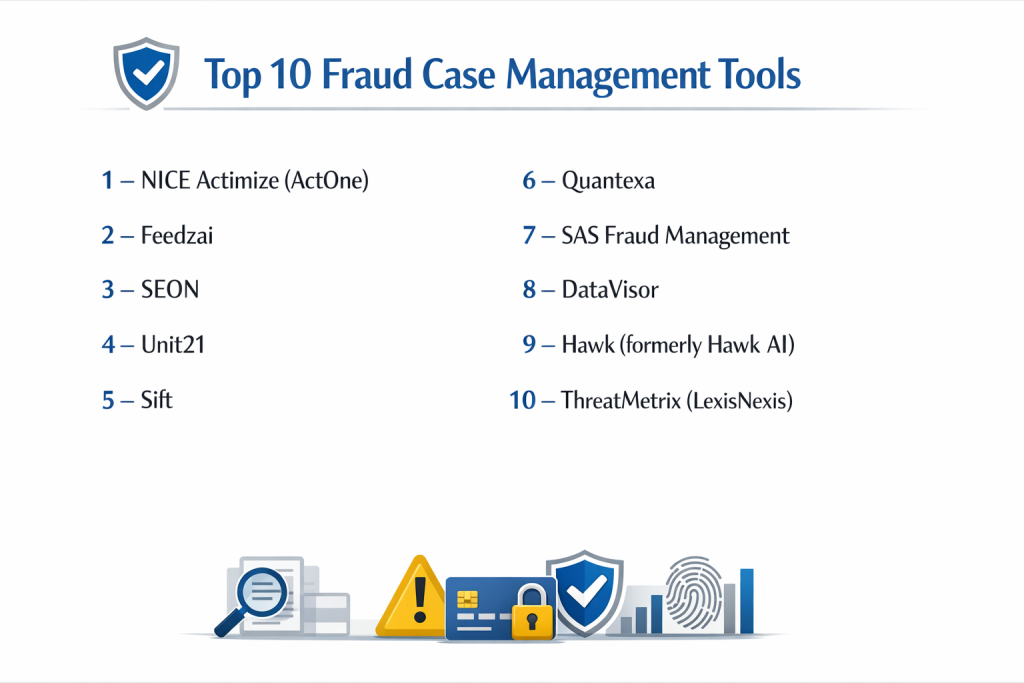
Top 10 Fraud Case Management Tools
1 — NICE Actimize (ActOne)
NICE Actimize is a global leader in the financial crime space. Its ActOne platform is a high-end investigation management system designed for large-scale financial institutions.
Key features:
- Unified Investigation Workspace: Consolidates alerts from fraud, AML, and compliance into a single view.
- Intelligent Automation: Automates the gathering of evidence and preliminary research for analysts.
- Entity Resolution: Uses graph technology to identify when different accounts belong to the same suspicious person.
- Adaptive Workflows: Dynamically changes the investigation steps based on the risk level of the case.
- Visual Storyboarding: Allows analysts to build a visual timeline of the fraud event for better reporting.
Pros:
- Exceptional scalability for organizations processing billions of data points.
- Very strong at breaking down “silos” between fraud and AML departments.
Cons:
- Extremely high cost and complex implementation process.
- The user interface can feel overwhelming for smaller, less specialized teams.
Security & compliance: SOC 2, ISO 27001, PCI DSS compliant, and follows strict bank-grade encryption protocols.
Support & community: 24/7 global enterprise support, dedicated account managers, and an extensive user certification program.
2 — Feedzai
Feedzai is an AI-first platform that emphasizes real-time fraud management. Its case management module is designed to help analysts make faster, smarter decisions using machine learning insights.
Key features:
- Genome Link Analysis: A powerful visual tool that connects seemingly unrelated transactions to reveal fraud rings.
- Explainable AI: Provides a clear “reason code” for why a case was flagged, helping analysts understand the AI’s logic.
- Segment-of-One Profiling: Creates a unique behavioral profile for every customer to highlight anomalies.
- Omnichannel Support: Manages fraud cases across mobile, web, and physical point-of-sale locations.
- Real-time Alerting: Analysts are notified of high-risk cases the millisecond they are detected.
Pros:
- The visual link analysis is among the best in the industry for catching organized fraud rings.
- Modern, sleek UI that reduces investigator fatigue.
Cons:
- Primarily focused on banking and payments; may lack features for general insurance fraud.
- Requires a high level of data maturity to fully leverage the AI capabilities.
Security & compliance: SOC 2 Type II, GDPR compliant, and ISO 27001 certified.
Support & community: High-touch onboarding, a dedicated customer success portal, and regular developer workshops.
3 — SEON
SEON is a modern, flexible tool known for its “fraud fighter” approach, offering deep data enrichment and a highly accessible case management interface.
Key features:
- Social Signals Enrichment: Automatically pulls data from 50+ social media platforms to verify a user’s identity.
- Digital Footprinting: Tracks device fingerprints, IP locations, and browser data within the case file.
- Custom Rule Engine: Allows analysts to create and test fraud rules in a “sandbox” environment before going live.
- Team Collaboration: Includes internal commenting, case assignment, and status tracking for teams.
- Browser Extension: Allows investigators to perform manual “spot checks” directly from their web browser.
Pros:
- Very easy to set up; teams can be investigating cases within hours rather than months.
- The data enrichment features provide context that other tools often miss.
Cons:
- Better suited for “transactional” fraud than long-term “regulatory” investigations.
- Advanced reporting can be less granular than some legacy enterprise competitors.
Security & compliance: GDPR, SOC 2, and uses AES-256 encryption for data at rest.
Support & community: Excellent digital documentation, 24/7 live chat support, and a transparent product roadmap.
4 — Unit21
Unit21 is a no-code platform for risk and compliance, designed to give fraud teams the power to build their own case management workflows without needing IT support.
Key features:
- No-Code Workflow Builder: Drag-and-drop interface for creating custom investigation steps.
- Integrated SAR Filing: Streamlines the submission of Suspicious Activity Reports (SARs) to regulators.
- Entity Link Analysis: Visualizes connections between users, devices, and transactions.
- Automated Evidence Collection: Pulls in external data (like sanctions lists) automatically into the case.
- Audit-Proof Logs: Records every single change made by an analyst for regulatory scrutiny.
Pros:
- Empowers non-technical compliance officers to customize the platform.
- Exceptional at handling the “regulatory” side of fraud, such as SAR filings.
Cons:
- As a newer entrant, it may lack some of the deepest “big data” processing power of legacy tools.
- The flexibility can be a double-edged sword, requiring careful planning to avoid messy workflows.
Security & compliance: SOC 2 Type II, PCI DSS, and fully compliant with US/EU AML regulations.
Support & community: Responsive customer success team and a growing library of “best practice” workflow templates.
5 — Sift
Sift is a popular choice for high-growth tech companies and e-commerce giants, focusing on the concept of “Digital Trust & Safety.”
Key features:
- Sift Score: A machine-learning score that dynamically updates within the case management view.
- Consensus Network: Leverages data from thousands of other Sift customers to identify known bad actors.
- Visual Case Timeline: Shows a historical view of every interaction a user has had with the brand.
- Bulk Case Resolution: Allows analysts to resolve hundreds of similar cases with one click.
- Device Fingerprinting: Detailed technical data on the specific hardware used by the suspect.
Pros:
- The global “network effect” is incredibly powerful for stopping professional fraud rings.
- Very user-friendly and designed for fast-paced e-commerce teams.
Cons:
- Less focused on “financial crime” (AML/SARs) and more on “commercial fraud” (Account Takeover/Promo Abuse).
- Pricing can become expensive as transaction volumes grow.
Security & compliance: SOC 2 Type II, GDPR, and ISO 27001.
Support & community: Large community of “Trust & Safety” professionals and extensive self-service resources.
6 — Quantexa
Quantexa is the premier tool for “Contextual Decisioning,” specializing in massive-scale data fusion for major global banks and government agencies.
Key features:
- Network Discovery: Automatically creates a massive graph of how people, organizations, and addresses are linked.
- Dynamic Scoring: Recalculates risk scores in real-time as new data points enter the network.
- Natural Language Processing: Can ingest unstructured data (like news articles or notes) into case files.
- Entity Resolution at Scale: Resolves millions of entities to find the “single view” of a person.
- Advanced Alerting: Only flags cases when the “context” of a transaction changes, reducing noise.
Pros:
- Unrivaled for investigating complex, multi-layered criminal organizations and shell companies.
- Provides a level of “big picture” context that standard transaction monitoring can’t match.
Cons:
- Highly technical; requires a team of data scientists/engineers to manage and tune.
- Extremely high entry price.
Security & compliance: Bank-grade security, SOC 2, and specialized for high-level government data standards.
Support & community: Professional services for implementation and high-tier enterprise support.
7 — SAS Fraud Management
SAS is a veteran in the analytics space, providing a highly stable and mathematically robust platform for fraud investigation.
Key features:
- Advanced Predictive Modeling: Uses SAS’s world-class analytics engine to predict fraud before it occurs.
- Real-time Scoring Engine: Analyzes transactions in milliseconds.
- Centralized Case Management: A rigorous, audit-heavy workspace for investigating enterprise-wide fraud.
- Automated Alert Triage: Prioritizes cases so analysts always work on the highest-value threats first.
- Governance and Compliance: Deep features for documenting regulatory adherence.
Pros:
- Known for its mathematical precision and reliability in high-stakes banking environments.
- Offers one of the most stable and mature platforms on the market.
Cons:
- The user interface can feel dated and less “agile” than modern SaaS tools.
- Implementation often requires significant professional services and internal training.
Security & compliance: SOC 1/2/3, ISO 27001, and fully compliant with global financial mandates.
Support & community: Global presence with 24/7 support and a massive network of certified SAS professionals.
8 — DataVisor
DataVisor uses unsupervised machine learning (UML) to identify new fraud patterns without needing historical labels or training data.
Key features:
- Global Intelligence Network: Shares anonymous threat signals across its entire customer base.
- Knowledge Graph: A visual representation of how different accounts are collaborating in a fraud attack.
- Proactive Protection: Specifically designed to catch “mass account creation” and “bot attacks.”
- Unified Case Interface: Manages the entire lifecycle of a case from detection to final resolution.
- Scalable Data Ingestion: Can handle petabytes of data from mobile apps and web platforms.
Pros:
- Excellent at catching “unknown-unknowns”—new fraud schemes that haven’t been seen before.
- Very strong at stopping modern, bot-driven fraud attacks.
Cons:
- The “unsupervised” nature can sometimes make it harder to explain why a case was flagged to a regulator.
- Best suited for digital platforms with very high user counts.
Security & compliance: SOC 2 Type II, GDPR, and uses multi-layered data encryption.
Support & community: Strong onboarding program and a dedicated team of fraud experts for consulting.
9 — Hawk (formerly Hawk AI)
Hawk is a European-based provider focusing on “Augmented Intelligence” for anti-money laundering and fraud case management.
Key features:
- AI-Powered Triage: Filters out false positives before they even reach the analyst’s desk.
- Cloud-Native Architecture: Offers high performance and easy scaling without needing on-premise hardware.
- Collaborative Investigations: Allows different financial institutions to share “risk signals” securely.
- Regulatory Reporting: Automated generation of SARs and other compliance documents.
- User Behavioral Analytics: Tracks how a user’s behavior changes over time to spot account takeovers.
Pros:
- Highly effective at reducing “false positive” noise, which is the biggest pain point for investigators.
- Modern, easy-to-use interface that appeals to the “new generation” of compliance officers.
Cons:
- Still expanding its presence outside of Europe; global support footprint is smaller than SAS or NICE.
- Focus is heavily slanted toward AML rather than e-commerce fraud.
Security & compliance: ISO 27001, SOC 2, and strictly compliant with European BaFin and GDPR standards.
Support & community: High-touch customer success and localized support in key markets.
10 — ThreatMetrix (LexisNexis)
ThreatMetrix, now part of LexisNexis Risk Solutions, is a massive platform that focuses on “Identity Intelligence” to drive its case management engine.
Key features:
- Digital Identity Network: Leverages a database of billions of device and persona profiles.
- Trust Tagging: Allows analysts to “tag” devices or users as trusted or fraudulent across the network.
- Dynamic Policy Engine: Create complex investigation rules based on location, device, and behavior.
- Case Management UI: A centralized workspace that pulls in LexisNexis’s vast public records data.
- Bot Detection: Specialized tools to identify and investigation automated fraud attacks.
Pros:
- Access to the LexisNexis data ecosystem is a massive advantage for verifying identities.
- Very strong at identifying the “physical” device behind a digital fraud attempt.
Cons:
- The platform is massive and can be difficult to navigate for simple teams.
- Pricing is generally geared toward high-volume enterprise clients.
Security & compliance: SOC 2, ISO 27001, and adheres to strict global data privacy regulations.
Support & community: Enterprise-level support with a global reach and professional services.
Comparison Table
| Tool Name | Best For | Platform(s) Supported | Standout Feature | Rating |
| NICE Actimize | Large Banks | On-Prem / Cloud | Unified Fraud & AML | 4.5 |
| Feedzai | Visual Link Analysis | Cloud (SaaS) | Genome Visualizer | 4.6 |
| SEON | Digital Footprinting | SaaS / Browser | Social Media Enrichment | 4.8 |
| Unit21 | No-Code Workflows | Cloud (SaaS) | Integrated SAR Filing | 4.7 |
| Sift | E-commerce / Tech | SaaS (Cloud) | Sift Consensus Network | 4.6 |
| Quantexa | Big Data Context | Cloud / Hybrid | Network Discovery AI | N/A |
| SAS Fraud Mgmt | Analytics / Math | Cloud / On-Prem | Predictive Analytics | 4.4 |
| DataVisor | Catching Bots | Cloud (SaaS) | Unsupervised ML | 4.5 |
| Hawk | Reducing Noise | Cloud (SaaS) | AI Alert Triage | N/A |
| ThreatMetrix | Identity Intelligence | Cloud (SaaS) | LexisNexis Data Access | 4.3 |
Evaluation & Scoring of Fraud Case Management Tools
| Criterion | Weight | Evaluation Focus |
| Core Features | 25% | Case tracking, link analysis, and workflow automation. |
| Ease of Use | 15% | UI design, analyst speed, and dashbord clarity. |
| Integrations | 15% | Ability to pull data from internal DBs and external APIs. |
| Security & Compliance | 10% | SOC 2/ISO status and regulatory reporting features. |
| Performance | 10% | Real-time speed and data processing reliability. |
| Support | 10% | Availability of help, documentation, and onboarding. |
| Price / Value | 15% | ROI based on time saved and fraud losses prevented. |
Which Fraud Case Management Tool Is Right for You?
Solo Users vs SMB vs Mid-Market vs Enterprise
There are no Solo Users for fraud case management as these are team-based tools. SMBs should look at SEON or Sumsub (if verifying identities) for their low barrier to entry and ease of use. Mid-Market firms requiring more structured workflows should consider Unit21 or Sift. Large Enterprises—specifically multi-national banks—will almost always require the deep, audit-heavy power of NICE Actimize, Quantexa, or SAS.
Budget-Conscious vs Premium Solutions
If you are on a Budget, SEON offers a very transparent, volume-based pricing model that is easy to forecast. If you are a Premium institution where missing a single money-laundering case could result in a billion-dollar fine, the high cost of NICE Actimize or Quantexa is a necessary expense for “best-in-class” protection.
Feature Depth vs Ease of Use
For Ease of Use, SEON and Sift are the clear winners with modern, intuitive interfaces that require very little training. For Feature Depth, if you need to perform complex “Network Analysis” or “Entity Resolution” across millions of legacy records, you will need the more technical and less user-friendly tools like Quantexa or SAS.
Integration and Scalability Needs
If you need to Integrate quickly into a modern tech stack (AWS/GCP), Unit21 and Hawk offer the most flexible cloud-native options. For Scalability in terms of absolute transaction volume, Feedzai and ThreatMetrix are designed to handle the massive peaks seen by global payment processors and retailers.
Security and Compliance Requirements
If your primary need is Regulatory Compliance (SARs, AML, audit trails), NICE Actimize and Unit21 provide the most automated features for filing reports with government bodies. For firms with strict Data Sovereignty requirements (keeping data in a specific country), on-premise or hybrid solutions from SAS or Actimize are preferred.
Frequently Asked Questions (FAQs)
What is the difference between Fraud Detection and Case Management?
Detection is the automated process of flagging a transaction as suspicious. Case Management is the workspace where a human investigator reviews those flags and makes a final decision.
Why do I need a separate tool for case management?
Using spreadsheets or general CRMs for fraud is risky; they lack audit trails, specialized data visualization (link analysis), and the security needed for sensitive financial data.
How does “Link Analysis” help?
It visually shows connections between different accounts (e.g., three different names using the same device ID), which is the most effective way to identify organized fraud rings.
Can these tools help reduce False Positives?
Yes. Tools like Hawk and Unit21 use AI to filter out obvious “safe” transactions, allowing your human team to focus only on the truly suspicious cases.
How long does it take to implement these tools?
SaaS tools like SEON can be live in a few days. Enterprise platforms like SAS or Actimize can take 6–12 months due to the complexity of integrating with legacy banking systems.
Are these tools compliant with GDPR?
Yes, leading tools provide features to mask PII (Personally Identifiable Information) and ensure that data is handled according to global privacy laws.
Do I need a data scientist to run these tools?
For modern SaaS tools like SEON or Sift, no. However, for “Big Data” platforms like Quantexa or SAS, having a data scientist or engineer is highly recommended.
What is an “Audit Trail” in fraud management?
It is a permanent, unchangeable record of every action an analyst took—what they looked at, what they changed, and why they closed a case. This is vital for regulatory audits.
Can these tools automate SAR filing?
Some tools (like Unit21 and Actimize) can automatically pre-fill and submit Suspicious Activity Reports (SARs) directly to regulators like FinCEN.
What is “Identity Intelligence”?
It is the use of billions of data points (device IDs, email age, social media presence) to determine if the digital person you are dealing with is a real human or a bot.
Conclusion
Choosing a Fraud Case Management Tool is a decision that impacts both your bottom line and your regulatory safety. , the volume of data is simply too large for any human team to manage through manual methods. Whether you choose the agile, data-rich approach of SEON, the no-code flexibility of Unit21, or the institutional power of NICE Actimize, the goal remains the same: to give your investigators the best possible “view” of the truth.
The “best” tool for your company is the one that bridges the gap between your automated detection and your human expertise. By centralizing your data, automating your workflows, and visualizing your threat landscape, you move from being reactive to being proactive—stopping fraud before it can do lasting damage to your business or your customers.