Introduction
Food Safety Compliance (HACCP) Software is a digital tool that helps food businesses manage their Hazard Analysis and Critical Control Point (HACCP) plans. HACCP is a systematic, preventive approach to food safety that identifies and controls physical, chemical, and biological hazards. This software moves the entire HACCP process—from monitoring temperatures and documenting corrective actions to managing audits and staff training—from clipboards and spreadsheets into a centralized, cloud-based system.
It is critically important because it transforms food safety from a reactive chore into a proactive, manageable process. In an industry where a single mistake can lead to product recalls, brand damage, or consumer illness, this software ensures consistency, accuracy, and traceability. Key real-world use cases include a restaurant chain automating daily temperature logs for all its refrigerators, a food manufacturer documenting every corrective action when a processing parameter deviates, a farm tracking batch information from harvest through distribution, and a facility seamlessly preparing for a third-party audit by having all records digitized and ready.
When choosing a HACCP software tool, users should look for: Core HACCP Functionality (the ability to create plans, set CCPs, and log monitoring data), Ease of Use for frontline staff, Real-time Reporting & Alerts, Strong Audit Trail capabilities, Mobile Accessibility for on-the-floor checks, and Integration Potential with other systems like ERP or sensors.
Best for: This software is indispensable for Food Safety Managers, Quality Assurance (QA) Teams, and Operations Directors within food manufacturing plants, large restaurant groups, food distributors, cafeteria services, and any business required to have a formal HACCP or food safety plan. It benefits companies of all sizes that need to systematize their compliance.
Not ideal for: A very small, single-location food stand or a micro-producer with a simple, low-risk product (like pre-packaged tea) may not yet need dedicated HACCP software. For these businesses, a well-maintained paper-based HACCP plan or simple digital checklists might be a sufficient and more cost-effective starting point to meet basic regulatory requirements.
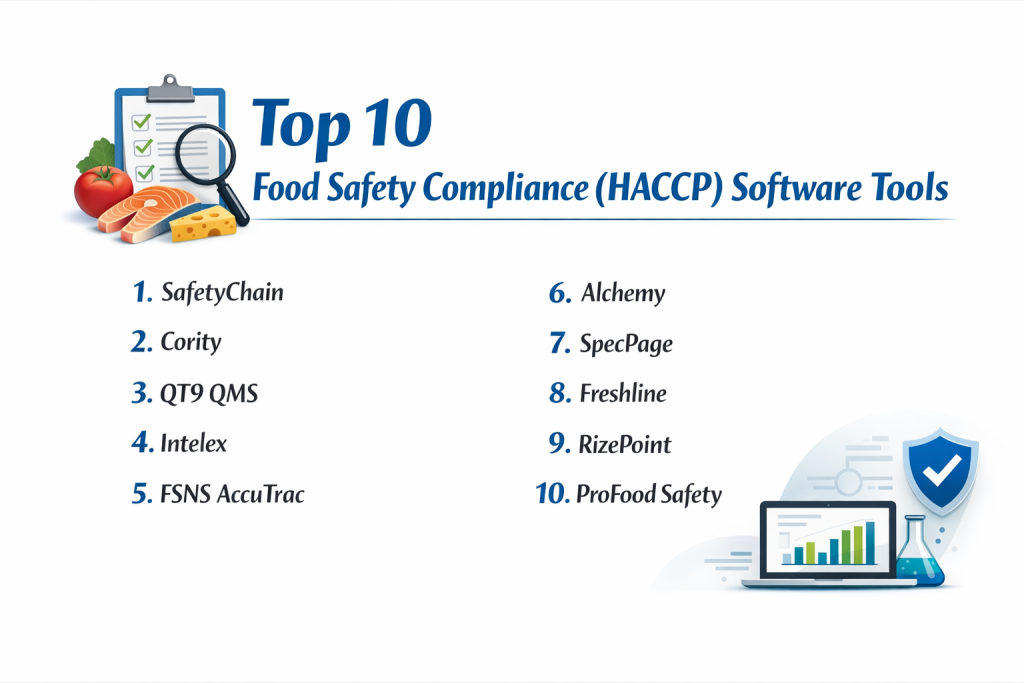
Top 10 Food Safety Compliance (HACCP) Software Tools
1 — SafetyChain
SafetyChain is a comprehensive Quality Management System (QMS) platform built for food and beverage manufacturers. It goes beyond basic HACCP to integrate quality, safety, and compliance across the entire supply chain.
Key features:
- End-to-end HACCP plan management with dynamic CCP monitoring.
- Real-time data collection via mobile devices and direct PLC/equipment integration.
- Advanced supplier quality management and COA verification.
- Powerful analytics dashboard with predictive insights into quality trends.
- Automated corrective and preventive action (CAPA) workflows.
- Full audit management suite for internal, customer, and third-party audits.
Pros:
- Unmatched depth for enterprise-scale manufacturing and complex supply chains.
- True real-time visibility from the plant floor to the executive dashboard.
- Drives operational improvement by connecting compliance data to production outcomes.
Cons:
- Implementation can be extensive and requires significant internal resources.
- Pricing is at the enterprise level, putting it out of reach for most SMBs.
- Can be overly complex for businesses seeking only basic HACCP logging.
Security & compliance: Enterprise-grade security with SOC 2 Type II certification, robust encryption, detailed audit logs, and adherence to global data privacy regulations.
Support & community: Offers dedicated customer success managers, implementation consultants, and 24/7 support for enterprise clients. Has an active user community for knowledge sharing.
2 — Zip HACCP
Zip HACCP is a user-friendly, mobile-first platform designed to simplify HACCP compliance for food production facilities of all sizes, with a strong focus on the meat and poultry industry.
Key features:
- Digital HACCP plan builder with pre-built templates for various regulations.
- Mobile app for frontline employees to perform checks and log data simply.
- Automated task scheduling and reminder alerts for monitoring activities.
- Instant corrective action triggers when a deviation occurs.
- Cloud-based reporting for managers and ready-to-print audit logs.
- Equipment management tools to track calibration and maintenance.
Pros:
- Excellent ease of use and adoption by hourly employees with minimal training.
- Strong industry-specific functionality for USDA-FSIS regulated facilities.
- Rapid implementation compared to more complex enterprise systems.
Cons:
- Less extensive as a full QMS compared to platforms like SafetyChain.
- Integration capabilities with other business systems may be more limited.
- Primarily focused on North American markets and regulations.
Security & compliance: Cloud security with data encryption, secure login, and role-based access. Complies with industry-standard data protection practices.
Support & community: Known for responsive, industry-savvy customer support. Provides onboarding training and maintains a library of support resources.
3 — iAuditor by SafetyCulture
iAuditor is a versatile inspection platform adopted widely for food safety. It uses customizable digital checklists to perform HACCP checks, audits, and inspections on mobile devices.
Key features:
- Vast library of free, customizable food safety and HACCP checklist templates.
- Offline mobile capability for data collection in areas without Wi-Fi.
- Automated report generation with photos, annotations, and digital signatures.
- Issue escalation and assignment for immediate corrective actions.
- Analytics and insights dashboard to track performance over time.
- Integration with hundreds of apps via Zapier and an open API.
Pros:
- Extremely flexible and adaptable to almost any food safety process or audit.
- Low barrier to entry with a free tier for small teams and simple pricing.
- Ideal for businesses that also need to manage non-food safety inspections (e.g., safety, maintenance).
Cons:
- Requires more configuration to build a complete HACCP plan vs. dedicated systems.
- Can become fragmented if not carefully managed as a centralized system.
- Primarily a powerful data collection tool, not a native HACCP plan management suite.
Security & compliance: Enterprise-level security features available, including SSO, advanced encryption, and compliance with GDPR, HIPAA, and other frameworks. Varies by plan.
Support & community: Extensive online help center, video tutorials, and community forum. Premium support is available for business plans.
4 — Alchemy
Alchemy is a training and compliance platform focused on the food manufacturing and retail sectors. It combines HACCP and food safety task management with a strong integrated employee training system.
Key features:
- HACCP monitoring and verification task management.
- Integrated digital learning management system (LMS) with food safety courses.
- Skills tracking to ensure employees are trained for specific tasks and CCPs.
- Customizable checklists for pre-operational inspections and sanitation.
- Audit and incident management tools.
- Multi-language support for diverse workforces.
Pros:
- Unique strength in linking compliance tasks directly to employee training and certification.
- Excellent for standardizing processes across multiple sites or franchises.
- Reduces risk by ensuring only qualified staff perform critical tasks.
Cons:
- The core focus on training integration may mean less depth in advanced HACCP analytics.
- Pricing structure is more suited to mid-sized and larger organizations.
- May have more features than needed for a company only seeking pure HACCP logging.
Security & compliance: Provides secure cloud hosting, data encryption, and access controls. Specific certifications like SOC 2 should be confirmed with the vendor.
Support & community: Offers implementation services, dedicated account management for key accounts, and standard customer support channels.
5 — FoodLogiQ
FoodLogiQ is a supply chain transparency and compliance platform. Its HACCP and food safety management tools are part of a larger system designed to connect brands with their suppliers for end-to-end traceability.
Key features:
- HACCP and food safety plan management with digital monitoring.
- Supplier management portal for document collection and approval.
- Digital traceability from source to consumer, enabling rapid recalls.
- SmartAction workflows to manage non-conformances and corrective actions.
- Compliance dashboard for a holistic view of supplier and internal performance.
- Integration with IoT sensors for automated temperature monitoring.
Pros:
- Ideal for brands that need to manage compliance across a complex supplier network.
- Powerful traceability features that go far beyond basic HACCP.
- Strong focus on data-driven insights to improve the entire supply chain.
Cons:
- Platform breadth can be overwhelming for a single facility focused only on internal HACCP.
- Pricing is oriented towards medium and large enterprises.
- Implementation is a strategic project due to its supply-chain-wide scope.
Security & compliance: Enterprise-grade security with a focus on data integrity for the supply chain. Likely includes SOC 2 and other certifications (confirm with vendor).
Support & community: Provides strategic customer success management, tailored onboarding, and access to a user community focused on supply chain challenges.
6 — Cority
Cority (born from the merger of Medgate and Cority) is an enterprise-scale Environmental, Health, Safety, and Quality (EHSQ) software. Its food safety module is part of a robust platform for highly regulated industries.
Key features:
- Comprehensive HACCP and quality management within a full EHSQ suite.
- Advanced risk assessment and management tools.
- Sophisticated CAPA (Corrective and Preventive Action) management with root cause analysis.
- Extensive audit management with scheduling, checklists, and findings tracking.
- Highly configurable workflows and business rules.
- Enterprise-level business intelligence and reporting.
Pros:
- “Single source of truth” for organizations managing integrated safety, health, environmental, AND quality.
- Extremely powerful for large, global companies in highly regulated sectors.
- Deep configurability and scalability to match complex organizational structures.
Cons:
- Significant investment in terms of time, money, and internal expertise required.
- Not a niche food safety tool; it is a broad EHSQ platform with a food safety component.
- Can be too heavy for companies focused solely on HACCP compliance.
Security & compliance: Industry-leading security with certifications like ISO 27001, SOC 2, and adherence to global privacy laws. Built for enterprise risk management.
Support & community: Global support network, dedicated implementation teams, and a mature user community and conference for enterprise clients.
7 — Kitchendocs
Kitchendocs is a cloud-based food safety management system tailored for the restaurant, hospitality, and catering industries, emphasizing simplicity and daily operational use.
Key features:
- Digital HACCP-based food safety management system with daily logs.
- Smart task scheduling for cleaning, temperature checks, and allergen management.
- Document storage for supplier certificates, recipes, and training records.
- Allergen control and menu management tools.
- Manager verification and reporting dashboard.
- Designed for use on tablets and smartphones in a kitchen environment.
Pros:
- Excellent fit for the daily rhythm of restaurants and commercial kitchens.
- Very intuitive for kitchen managers and staff to adopt.
- Covers all essential food safety bases without unnecessary complexity.
Cons:
- Less suited for complex manufacturing or supply chain traceability needs.
- May lack the deep analytical power of manufacturing-focused platforms.
- Primarily serves the hospitality sector.
Security & compliance: Cloud-based with standard security protocols, data encryption, and secure login. Specific high-level certifications may vary.
Support & community: Provides UK-based customer support, online training materials, and is known for responsive service to the hospitality industry.
8 — MeazureUp
MeazureUp (formerly Genesis R&D) is a toolset from ESHA Research, well-known in the food industry. It focuses on the intersection of product development, nutritional labeling, and HACCP-based safety.
Key features:
- HACCP plan development tools integrated with formulation software.
- Allergen tracking and labeling from ingredient level through finished product.
- Nutritional analysis and label generation.
- Supplier ingredient specification management.
- Task scheduling for safety and quality checks.
- Reporting for compliance and audits.
Pros:
- Unique value for product development teams who need to build safety into recipes from day one.
- Strong integration between HACCP, allergens, and labeling—a critical compliance triangle.
- Trusted name in food formulation and regulatory compliance.
Cons:
- Core strength is in formulation, with HACCP as a connected module rather than a standalone powerhouse.
- May not be the best choice for operations-focused safety management in a plant or restaurant.
- Learning curve associated with its comprehensive formulation features.
Security & compliance: Follows standard data security practices for SaaS applications. Specific enterprise security certifications should be verified.
Support & community: Backed by ESHA’s extensive food science and regulatory support team, knowledge base, and training webinars.
9 — ERA
ERA Environmental Management Solutions offers a compliance platform that includes a HACCP module, particularly strong for food and beverage companies with significant environmental reporting needs.
Key features:
- HACCP and food safety plan management.
- Integrated environmental compliance tracking (air, water, waste).
- Corrective action tracking and task management.
- Audit scheduling and management.
- Centralized document control.
- Dashboard reporting for both safety and environmental metrics.
Pros:
- Powerful for food companies that need to manage both food safety and environmental permits/reporting.
- Eliminates data silos between EHS and Quality departments.
- Configurable to match specific regulatory requirements across different regions.
Cons:
- Broad EHS focus means it may lack some niche HACCP-specific features of dedicated tools.
- Best value is realized when used for its combined EHS and Quality purpose.
- Enterprise pricing and implementation model.
Security & compliance: Enterprise security features are standard, likely including audit trails and data encryption. Inquire about specific certifications like ISO.
Support & community: Provides implementation consulting, training, and standard software support tailored to compliance professionals.
10 — Qualio
Qualio is a modern, cloud-based Quality Management System (QMS) built for life sciences, but increasingly adopted by innovative food tech, supplement, and beverage companies facing FDA-like regulations.
Key features:
- Document Control for managing HACCP plans, SOPs, and policies.
- Training Management to ensure staff competency on CCPs.
- Audit Management for internal and external audits.
- Supplier Management for qualifying and monitoring vendors.
- Deviation and CAPA management with electronic workflows.
- Designed to meet FDA 21 CFR Part 11 and similar electronic record requirements.
Pros:
- Exceptional ease of use and modern interface compared to legacy QMS platforms.
- Built for a culture of quality and continuous improvement.
- Ideal for food companies in regulated niches (e.g., medical foods, novel ingredients).
Cons:
- Priced and designed for the life science/tech sector, which may be overkill for traditional food.
- Less specific pre-built content for standard food HACCP than industry-native tools.
- Younger company with a smaller but growing track record in mainstream food.
Security & compliance: Built with FDA 21 CFR Part 11 in mind, featuring electronic signatures, audit trails, and validation support. SOC 2 Type II certified.
Support & community: Offers a customer success team, extensive online academy, and a community portal for users in regulated industries.
Comparison Table
| Tool Name | Best For | Platform(s) Supported | Standout Feature |
|---|---|---|---|
| SafetyChain | Large food & beverage manufacturers | Cloud, Web, Mobile | Enterprise-scale QMS with real-time production integration |
| Zip HACCP | Food production facilities, especially meat/poultry | Cloud, iOS, Android | Mobile-first simplicity for frontline USDA-FSIS compliance |
| iAuditor | Businesses needing flexible inspections across safety/quality | iOS, Android, Web | Versatile checklist platform with a massive template library |
| Alchemy | Food manufacturing & retail with a focus on training | Cloud, Web, Mobile | Deep integration of compliance tasks with LMS and skills tracking |
| FoodLogiQ | Brands managing complex supplier networks | Cloud, Web, Mobile | Supply chain transparency and traceability alongside compliance |
| Cority | Large enterprises in highly regulated industries | Cloud, Web, Mobile | Integrated EHSQ platform for holistic risk management |
| Kitchendocs | Restaurants, catering, hospitality businesses | Cloud, Web, Mobile | Daily food safety management built for kitchen operations |
| MeazureUp | Product development & formulation teams | Desktop, Cloud | HACCP integrated with formulation, allergen, and labeling tools |
| ERA | Food companies with significant environmental compliance needs | Cloud, Web | Combined EHS and Quality management in one platform |
| Qualio | Food tech, supplement, and innovative food companies | Cloud, Web | Modern QMS built for FDA-style regulations and ease of use |
Note: Specific ratings from major software review platforms were not included as per the content guidelines.
Evaluation & Scoring of Food Safety Compliance (HACCP) Software
To choose objectively, evaluate potential software against this weighted rubric. The scores will highlight which tool best aligns with your operational priorities.
| Criteria | Weight | What to Look For |
|---|---|---|
| Core Features | 25% | Essential HACCP tools: plan creation, CCP monitoring, corrective action workflows, audit trails, reporting. Does it cover your specific regulatory framework (USDA, FDA, SQF, BRC)? |
| Ease of Use | 15% | Interface clarity for both managers setting up the system and frontline employees using it daily. High usability drives consistent adoption and accurate data. |
| Integrations & Ecosystem | 15% | Ability to connect with sensors (thermometers), ERP/MRP systems, laboratory information systems, or other business software to automate data flow. |
| Security & Compliance | 10% | Data protection, role-based access, a reliable audit trail for records, and adherence to standards like FDA 21 CFR Part 11 for electronic records if required. |
| Performance & Reliability | 10% | Cloud uptime, mobile app stability (especially offline functionality), and system speed. Compliance can’t wait for a system to load. |
| Support & Community | 10% | Quality of implementation help, training resources, and ongoing technical support. An active user community can be invaluable for best practices. |
| Price / Value | 15% | Total cost (subscription, implementation, training) weighed against the ROI in time saved, reduced risk, audit readiness, and operational insights. |
Which Food Safety Compliance (HACCP) Software Tool Is Right for You?
The right tool is the one that fits your specific food safety mission. Use this guide to narrow your search.
- Solo Users/SMB vs. Mid-Market vs. Enterprise: A small cafe or butcher shop needs simplicity and value. iAuditor or Kitchendocs are great starts. A growing mid-sized processor needs more structure and scalability. Zip HACCP or Alchemy are strong contenders. Large manufacturers or multinationals require enterprise power, integration, and global support, making SafetyChain, Cority, or FoodLogiQ the typical choices.
- Budget-Conscious vs. Premium Solutions: If budget is the primary constraint, start with iAuditor’s flexible plans or seek out niche tools with transparent pricing. If food safety is a core strategic pillar, invest in a premium platform like SafetyChain or Qualio that delivers deeper insights, automation, and a stronger foundation for growth and innovation.
- Feature Depth vs. Ease of Use: A complex spice manufacturer needs deep risk analysis and traceability (FoodLogiQ, SafetyChain). A franchise restaurant group needs a system that hundreds of employees can use correctly every day (Alchemy, Kitchendocs). Never sacrifice usability for features; unused features add zero value.
- Integration and Scalability Needs: Do you need live data from oven sensors? Integrate with your NetSuite ERP? Manage 50 new suppliers? If yes, prioritize platforms with strong APIs and a history of integration like SafetyChain or Cority. If you’re a single site, standalone usability may be more important.
- Security and Compliance Requirements: Most tools offer baseline security. If you operate under FDA 21 CFR Part 11 or need validated electronic records for GFSI audits (SQF, BRC), you must choose a platform like Qualio or SafetyChain that is designed and validated for this purpose from the ground up.
Frequently Asked Questions (FAQs)
1. What’s the main difference between HACCP software and using paper logs?
The key difference is proactive control vs. reactive recording. Software provides real-time alerts for deviations, ensures data can’t be lost or fabricated, automates reporting, and creates a searchable, audit-ready digital trail. Paper is passive and prone to human error.
2. Can this software help us pass a third-party audit (like SQF or BRC)?
Absolutely. In fact, that’s a primary benefit. It centralizes all required records (monitoring logs, corrective actions, training, calibrations) in one place. Auditors can be given controlled access, dramatically reducing the pre-audit scramble and demonstrating a systematic, controlled process.
3. How much does HACCP software typically cost?
Costs vary widely. Simple checklist apps can start at ~$30/user/month. Robust single-facility systems often range from $200-$800 per month. Full enterprise platforms with multiple modules can run into tens of thousands of dollars annually, plus implementation fees.
4. How long does implementation take?
It ranges from a few days for a simple, cloud-based tool in a single location to 6-18 months for a full enterprise QMS rollout across multiple global sites. Most mid-market implementations take 1-3 months of focused effort.
5. What’s the biggest challenge when implementing this software?
Cultural change and user adoption. The technology is often easier to implement than changing long-standing habits. Involving frontline staff early, providing ample training, and demonstrating how the software makes their jobs easier are critical to success.
6. Do we need IT expertise to manage this software?
Modern cloud-based (SaaS) solutions require minimal internal IT. The vendor manages servers, security, and updates. Your focus will be on configuring the system, managing users, and generating reports—tasks typically handled by the Food Safety or QA Manager.
7. Can the software integrate with our temperature probes and sensors?
The leading platforms (SafetyChain, FoodLogiQ) offer direct integration with IoT sensors, automating data collection and eliminating manual entry errors. This is a key feature to ask about if you have critical monitoring points.
8. What happens to our data if we cancel our subscription?
This is a crucial contract question. Reputable vendors should provide a way to export all your historical data in a usable format (like CSV or PDF) upon termination. Always confirm this before signing.
9. Is this software only for huge factories?
No. While the most complex systems are for large plants, streamlined versions exist for every size business. Even a small restaurant can benefit from a digital system like Kitchendocs to manage logs, training, and audits more reliably than paper.
10. What’s a good first step if we’re not ready for full software?
Begin by digitizing your most problematic paper process. Use a general-purpose tool like iAuditor to create a digital checklist for daily fridge temps or pre-op inspections. This builds comfort with digital workflows and clearly shows the benefits before a larger investment.
Conclusion
Choosing a Food Safety Compliance (HACCP) Software is a strategic investment in your brand’s integrity, operational efficiency, and peace of mind. From the enterprise depth of SafetyChain to the kitchen-floor practicality of Kitchendocs, and from the supply-chain vision of FoodLogiQ to the modern quality focus of Qualio, there is a system designed to meet the unique demands of your segment of the food industry.
Remember, the “best” software isn’t the one with the most features; it’s the one that becomes a reliable, everyday part of your team’s routine. It should make compliance easier, not harder. It should provide clarity, not complexity. By carefully weighing your operational scale, regulatory landscape, team’s needs, and growth trajectory against the strengths outlined here, you can select a platform that doesn’t just store records—it actively builds a stronger, safer, and more trustworthy food business.