Introduction
Fleet Management Tools are specialized software platforms designed to coordinate, oversee, and optimize an organization’s vehicle assets. These systems act as a centralized hub, collecting data from GPS hardware, vehicle engine sensors, and driver mobile apps to provide a real-time overview of the fleet’s health and activities. By digitizing what used to be a paper-heavy industry, fleet management software allows companies to track vehicle locations, monitor fuel consumption, automate maintenance schedules, and ensure driver safety through behavioral analysis.
The implementation of a fleet management tool is critical for any business that relies on transportation to deliver value. In an era of volatile fuel prices and strict environmental regulations, these tools provide the data necessary to minimize operational waste. Key real-world use cases include optimizing delivery routes to save time and fuel, tracking vehicle diagnostics to prevent costly engine failures before they happen, and maintaining compliance with Electronic Logging Device (ELD) mandates for driver hours-of-service. When evaluating tools, users should look for GPS tracking accuracy, robust diagnostic reporting, mobile accessibility for drivers, and seamless integration with fuel cards and maintenance vendors.
Best for: Fleet managers, operations directors, and business owners in industries such as logistics, construction, field services (plumbing/HVAC), and passenger transportation. It is essential for companies of all sizes managing anywhere from five to five thousand vehicles.
Not ideal for: Individual car owners tracking a personal vehicle, or businesses that rely entirely on third-party shipping providers (like FedEx or UPS) where they do not own or lease the transport assets.
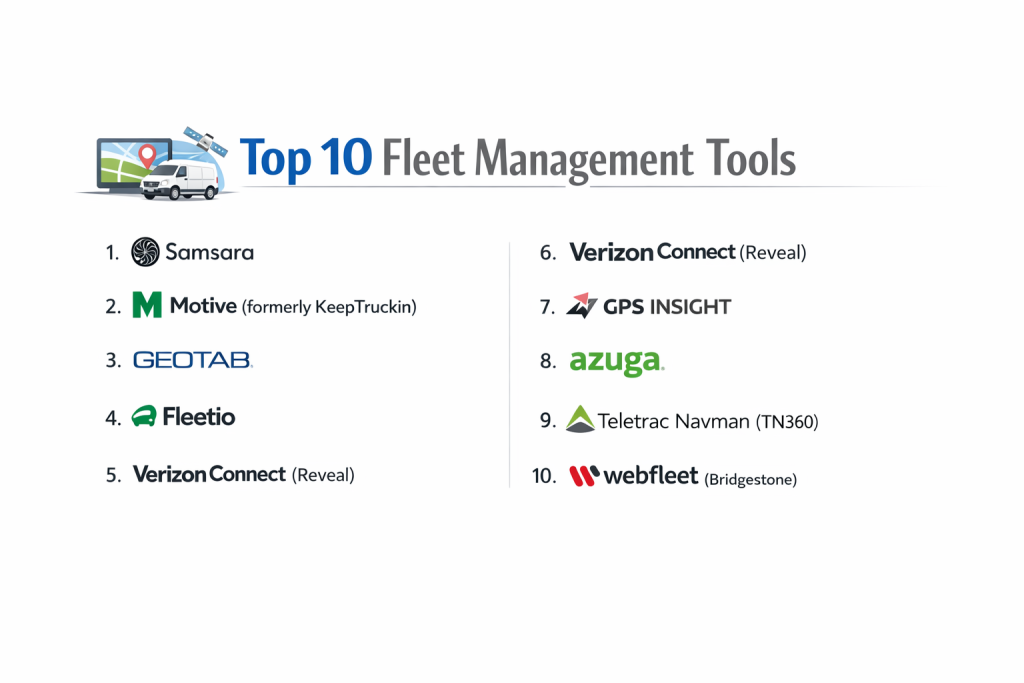
Top 10 Fleet Management Tools
1 — Samsara
Samsara is a leading cloud-based platform that combines fleet management with industrial IoT, offering an all-in-one solution for operations that value real-time data and high-definition video safety.
- Key features:
- AI Dash Cams: Real-time detection of distracted driving, tailgating, and rolling stops.
- Real-time GPS Tracking: Industry-leading refresh rates for precise vehicle location.
- Electronic Logging Device (ELD): Simplified, FMCSA-compliant logging for hours-of-service.
- Vehicle Diagnostics: Instant alerts for engine fault codes and battery health.
- Route Optimization: Dynamic tools to plan and adjust routes based on live traffic.
- Pros:
- The most intuitive and modern user interface in the industry.
- Exceptional mobile app experience for both drivers and managers.
- Cons:
- Pricing is generally higher than budget-focused competitors.
- Contract terms can be rigid, often requiring multi-year commitments.
- Security & compliance: SOC 2 Type II, GDPR, HIPAA-ready, and AES-256 encryption.
- Support & community: 24/7 technical support, dedicated account managers for enterprise, and a robust online training portal.
2 — Motive (formerly KeepTruckin)
Motive has evolved from a popular ELD app into a comprehensive fleet platform known for its ease of use and strong focus on driver safety and compliance.
- Key features:
- Safety Hub: Uses AI to score driver performance and identify coaching opportunities.
- Automated IFTA Reporting: Simplifies the calculation of fuel taxes across jurisdictions.
- Asset Tracking: Specialized hardware for tracking trailers and construction equipment.
- Motive Card: An integrated fuel card that automatically tracks and categorizes spend.
- Smart Dashcams: Captures high-definition video of critical safety events.
- Pros:
- One of the most driver-friendly mobile apps, leading to high adoption rates.
- Strong “all-in-one” ecosystem including fuel management and spend tracking.
- Cons:
- Customer support response times can be inconsistent during peak periods.
- Some advanced AI features require higher-tier, more expensive plans.
- Security & compliance: SOC 2, GDPR, and FMCSA-certified ELD hardware.
- Support & community: Extensive knowledge base, webinars, and tiered customer support.
3 — Geotab
Geotab is an engineering-heavy platform recognized for its deep data diagnostics and an open API that allows for massive customization and integration.
- Key features:
- Active Tracking: High-frequency data logging for precise accident reconstruction.
- Marketplace: Access to hundreds of third-party Add-Ins and Add-Ons.
- EV Suitability Assessment: Tools to help fleets transition to electric vehicles.
- Advanced IOX Expansion: Allows for peripheral connections like salt spreaders or temperature sensors.
- Fuel Management: Deep integration with various engine types for accurate consumption data.
- Pros:
- Unrivaled for data-hungry fleets that need deep engine-level insights.
- Extremely flexible; if you can dream of a custom report, Geotab can build it.
- Cons:
- The software interface (MyGeotab) has a steeper learning curve than Samsara.
- Relying on third-party resellers for support can lead to a fragmented experience.
- Security & compliance: FIPS 140-2 validated, FedRAMP authorized, ISO 27001, and GDPR.
- Support & community: Large reseller network, Geotab Community forums, and extensive SDK documentation.
4 — Fleetio
Fleetio takes a “software-first” approach, focusing heavily on maintenance management and the total cost of ownership rather than just hardware-based tracking.
- Key features:
- Maintenance Workflow: Automates service reminders and tracks repair histories.
- Outsourced Maintenance: Direct integration with over 50,000 national repair shops.
- Fuel Integration: Automatically imports fuel transactions to calculate MPG.
- Inspections: Digital DVIRs (Driver Vehicle Inspection Reports) that trigger repair tasks.
- Inventory Management: Tracks parts and tires in your own shop.
- Pros:
- The best tool for managing the “financial” and “mechanical” health of a fleet.
- Agnostic hardware approach; integrates with many GPS providers like Geotab or Samsara.
- Cons:
- Not a native GPS hardware manufacturer; you must pay for a separate GPS subscription.
- Lower-tier plans can be restrictive for growing businesses.
- Security & compliance: SOC 2 Type II, SSO support, and data encryption.
- Support & community: Rapid email and chat support, comprehensive help center, and regular product updates.
5 — Verizon Connect (Reveal)
Verizon Connect combines the reliability of a global telecom giant with a mature fleet management suite designed for reliability and scale.
- Key features:
- Live Map: Color-coded vehicle icons to distinguish between moving, idling, and stopped.
- Driver Scorecards: Compares drivers across the organization to incentivize safety.
- Field Service Dispatch: Tools to assign jobs and track progress for service technicians.
- Asset Tracking: Ruggedized hardware for non-powered assets.
- Geofencing: Instant alerts when vehicles enter or exit unauthorized areas.
- Pros:
- Very stable platform backed by Verizon’s extensive network infrastructure.
- Excellent for field service businesses that need a mix of GPS and job dispatching.
- Cons:
- Implementation and onboarding can feel corporate and slow.
- Contractual terms are historically known for being long and difficult to exit.
- Security & compliance: ISO 27001, SOC 2, and GDPR.
- Support & community: Dedicated onboarding specialists, 24/7 support, and local field representatives.
6 — GPS Insight
GPS Insight is a versatile solution that caters to small-to-midmarket businesses with a focus on ease of deployment and actionable insights.
- Key features:
- Smart Alerts: Customizable notifications for speeding, long idling, or odd-hours use.
- Field Service Management: Integrates work order management directly with fleet data.
- Driver Coaching: In-cab alerts for drivers when they exceed safety thresholds.
- Fuel Card Sync: Combines location data with fuel spend to prevent fraud.
- Landmarks: Easy tagging of customer sites for automated arrival/departure reports.
- Pros:
- Flexible contract options compared to larger enterprise players.
- Strong balance of features without the overwhelming complexity of an enterprise ERP.
- Cons:
- The desktop UI is functional but feels a bit dated compared to Samsara.
- Advanced video telematics features are newer and less proven than competitors.
- Security & compliance: SOC 2 Type II and encrypted data storage.
- Support & community: High-touch customer service and an online learning academy.
7 — Azuga
Azuga is a leader in “gamified” fleet management, using rewards and social competition to encourage better driving habits.
- Key features:
- Driver Rewards: Built-in system to give drivers gift cards based on safety scores.
- Plug-and-Play OBDII: Extremely easy hardware installation that takes seconds.
- Azuga Coach: Online training modules automatically assigned to low-scoring drivers.
- Predictive Maintenance: Uses engine data to forecast when a part might fail.
- Fleet Sustainability: Reports on idling and CO2 emissions to meet green goals.
- Pros:
- High driver engagement due to the rewards and gamification aspect.
- Faster ROI for companies struggling with high accident rates or fuel waste.
- Cons:
- The “reward” culture might not fit every corporate environment.
- Limited deep customization compared to Geotab.
- Security & compliance: GDPR, SSO, and standard encryption.
- Support & community: 24/7 technical support and a library of fleet safety resources.
8 — Teletrac Navman (TN360)
Teletrac Navman’s TN360 uses AI-driven data analysis to turn raw fleet information into visual, actionable business stories.
- Key features:
- AI Search Engine: Allows managers to ask questions in plain English (e.g., “Which drivers are speeding?”).
- Smart Dashcams: Monitors for smoking, eating, and mobile phone use in the cab.
- Job Management: Comprehensive suite for dispatching and proof-of-delivery.
- Compliance Manager: Centralized dashboard for ELD, IFTA, and DVIR.
- Maintenance Planning: Real-time odometer and engine hour tracking.
- Pros:
- The AI search feature makes finding specific data incredibly fast.
- Excellent for large global fleets that need a single, unified view across regions.
- Cons:
- The platform can feel “heavy” for a small business with only a few vans.
- Hardware costs for the full AI suite can be substantial.
- Security & compliance: ISO 27001, SOC 2, and HIPAA.
- Support & community: Global presence with local support teams in most major markets.
9 — Quartix
Quartix offers a straightforward, “no-nonsense” GPS tracking solution that is ideal for small businesses that don’t need complex engine diagnostics.
- Key features:
- Vehicle Tracking: Simple, real-time map views and daily trip logs.
- Driver Timesheets: Automatically generated logs based on ignition status.
- Safe Speed Reports: Compares driver speed to the average speed of other vehicles on that road.
- Geofencing: Simple boundary alerts for depots and job sites.
- Mobile App: Basic but effective app for tracking on the go.
- Pros:
- Transparent, low-cost pricing with no hidden fees.
- One of the few providers that offers monthly contracts with no long-term tie-ins.
- Cons:
- Lacks advanced features like dashcams, AI coaching, or deep maintenance tools.
- Not suitable for large enterprises with complex compliance needs.
- Security & compliance: GDPR compliant and encrypted data.
- Support & community: Direct phone and email support with a strong reputation for friendliness.
10 — Webfleet (Bridgestone)
Webfleet is one of the world’s most established telematics providers, offering a highly reliable and professional suite for logistics and service fleets.
- Key features:
- Professional Navigation: Routes vehicles based on weight, height, and cargo.
- Tire Pressure Monitoring (TPMS): Integration with Bridgestone sensors for tire health.
- Order Management: Two-way communication for job instructions and status.
- Asset Tracking: Specialized tracking for trailers and cold-chain containers.
- OptiDrive 360: Provides real-time feedback to the driver on the device.
- Pros:
- Best-in-class truck-specific navigation to avoid low bridges or narrow roads.
- Deep expertise in tire management, which is a top-three expense for fleets.
- Cons:
- The hardware ecosystem is more proprietary than some modern competitors.
- Can be complex to set up for smaller, non-logistics businesses.
- Security & compliance: ISO 27001, SOC 2, and GDPR.
- Support & community: Extensive global network of certified installation and support partners.
Comparison Table
| Tool Name | Best For | Platform(s) Supported | Standout Feature | Rating (Gartner) |
| Samsara | Large Enterprises | Cloud / Mobile | AI Safety Dash Cams | 4.6 / 5 |
| Motive | Safety & Compliance | Cloud / Mobile | Driver-First Mobile App | 4.5 / 5 |
| Geotab | Data Power Users | Cloud / API | Deep Engine Diagnostics | 4.4 / 5 |
| Fleetio | Maintenance Pros | Cloud / Mobile | Maintenance Shop Network | 4.7 / 5 |
| Verizon Reveal | Field Services | Cloud / Mobile | High-Resolution Maps | 4.2 / 5 |
| GPS Insight | Mid-Market Biz | Cloud / Mobile | Work Order Integration | 4.3 / 5 |
| Azuga | Gamification/SMB | Cloud / Mobile | Safety Rewards Program | 4.5 / 5 |
| TN360 | Global Logistics | Cloud / Mobile | AI Data Search Engine | 4.1 / 5 |
| Quartix | Budget-Conscious | Cloud / Mobile | No-Contract Options | N/A |
| Webfleet | Trucking & Tires | Cloud / Mobile | Truck-Specific Navigation | 4.4 / 5 |
Evaluation & Scoring of Fleet Management Tools
| Category | Weight | Evaluation Logic |
| Core Features | 25% | GPS accuracy, ELD compliance, diagnostics, and dashcam tech. |
| Ease of Use | 15% | Intuitiveness for managers and simplicity of the driver app. |
| Integrations | 15% | API availability and native links to fuel cards and maintenance. |
| Security & Compliance | 10% | SOC 2 status, GDPR, data encryption, and regulatory certifications. |
| Performance | 10% | Data refresh rates and hardware durability in harsh environments. |
| Support & Community | 10% | Training quality, response times, and documentation depth. |
| Price / Value | 15% | ROI potential via fuel savings and reduction in insurance premiums. |
Which Fleet Management Tool Is Right for You?
Solo Users vs SMB vs Mid-Market vs Enterprise
If you are a Solo User or an SMB with under 10 vehicles, you should prioritize simplicity and cost. Quartix or Azuga are excellent entry points because they are easy to install and don’t require an IT team. Mid-Market companies with 50-100 vehicles should look at Motive or GPS Insight, which provide a balanced mix of safety and field service tools. Enterprises with complex needs must choose Samsara, Geotab, or Webfleet for their scalability, advanced security, and ability to manage multi-regional compliance.
Budget and Value
For those on a tight Budget, Quartix offers the lowest entry price with zero-contract options. However, if you look at Value, a more expensive tool like Samsara or Azuga often pays for itself by lowering insurance premiums through video evidence and reducing fuel costs by 10-15%. Always calculate the ROI—a tool that costs $30/month but saves $100 in fuel is a better value than a $15 tool that only tracks location.
Technical Depth vs Simplicity
If you have a dedicated data analyst or maintenance manager, you want Technical Depth. Geotab is the king of data; it allows you to see every sensor reading the engine provides. If you want Simplicity so your drivers don’t complain about the “spy in the cab,” Motive or Fleetio offer cleaner interfaces that focus on helping the driver do their job rather than just monitoring them.
Integration and Scalability Needs
If you plan to grow, avoid “closed” systems. Geotab and Samsara have the best Integrations, allowing you to pipe fleet data into your accounting, HR, or custom-built software. For Scalability, look for cloud-native tools that can handle an unlimited number of vehicles without slowing down the map or reporting dashboard.
Security and Compliance Requirements
If you operate in the government space or a highly regulated industry, Security is non-negotiable. Geotab is particularly strong here with its FedRAMP authorization. For Compliance, ensure the hardware is FMCSA-certified for ELD if you are in the US, or meets local driving-hour regulations in your specific country.
Frequently Asked Questions (FAQs)
1. What is an ELD and do I need one?
An Electronic Logging Device (ELD) automatically records driving time. If your drivers are required to keep “Records of Duty Status” (RODS) under FMCSA rules, you legally need an ELD-certified fleet tool.
2. Can fleet management software lower my insurance?
Yes. Many insurers offer “Telematics Discounts” for fleets that use dashcams and GPS tracking, as it significantly reduces risk and provides evidence in the event of an accident.
3. How much does fleet management software cost?
Pricing typically ranges from $15 to $50 per vehicle, per month. There is also an upfront cost for hardware, though some companies include the hardware for free with a multi-year contract.
4. Is it hard to install the tracking hardware?
No. Most tools use “Plug-and-Play” devices that snap into the vehicle’s OBD-II port. Only specialized equipment or AI dashcams usually require professional hard-wired installation.
5. How does the software track fuel consumption?
It pulls data directly from the vehicle’s engine computer (ECM) or by integrating with your fuel card provider to match fuel transactions with the vehicle’s location and odometer.
6. Can I track non-vehicle assets like trailers or generators?
Yes. Most providers like Samsara and Verizon Connect offer specialized “Asset Trackers” with long-life batteries designed to sit on trailers for months or years.
7. Does the “Spy in the cab” hurt driver morale?
It can if not managed well. The best fleets use these tools for “Driver Coaching” and rewards (like Azuga) rather than just punishment, framing it as a tool for driver safety and exoneration.
8. What is a “Geofence”?
A geofence is a virtual boundary on a map. You can set the software to alert you the moment a vehicle enters a customer site or leaves the depot after hours.
9. Can I monitor electric vehicles (EVs) with these tools?
Yes. Modern platforms like Geotab and Webfleet have specific features for EVs, tracking battery state-of-charge, charging status, and range anxiety alerts.
10. How long do these contracts usually last?
Industry standard is a 36-month contract, especially if the hardware is provided “free” upfront. However, companies like Quartix offer monthly or annual options for smaller fleets.
Conclusion
Choosing the right Fleet Management Tool is a transformational step for any transport-dependent business. It moves an organization from “guessing” to “knowing.” The “best” tool is the one that aligns with your biggest pain point: if you struggle with accidents, the AI cameras of Samsara or the rewards of Azuga are your best bet. If you struggle with high repair bills, the mechanical focus of Fleetio is the answer.
Ultimately, fleet management is about protecting your three most valuable assets: your vehicles, your drivers, and your reputation. By centralizing your data and automating your compliance, you gain the freedom to focus on growing your business rather than just maintaining it. Start by identifying your fleet size and primary goals, then use the scores in this guide to begin your shortlist of trials.