Introduction
A Fitness Coaching Platform is specialized software that helps fitness professionals manage and grow their coaching business online. Think of it as an all-in-one digital toolbox that replaces handwritten workout cards, scattered spreadsheets for billing, and endless back-and-forth emails. It brings client management, program design, video content, and payment processing together in one streamlined online space.
These platforms are important because they allow coaches to work effectively beyond the walls of a gym. They save massive amounts of administrative time, create a professional and consistent client experience, and open up new revenue streams by enabling online training and digital product sales. Real-world use includes a personal trainer building custom workout plans for remote clients, a yoga teacher hosting a library of on-demand classes for subscribers, or a nutrition coach tracking client food logs and providing feedback through a dedicated app.
When choosing a platform, fitness professionals should prioritize a few key things: ease of use for both you and your clients, versatile program delivery (live, on-demand, hybrid), client engagement tools like messaging and habit tracking, integrated payment processing, and scalability to grow your client base without technical headaches.
Best for: These platforms are designed for independent personal trainers, online fitness coaches, yoga/Pilates instructors, nutrition coaches, small boutique gym studios, and larger fitness businesses looking to digitize their services. They benefit anyone who wants to deliver structured fitness or wellness guidance outside of traditional in-person sessions.
Not ideal for: These platforms are generally overkill for a recreational gym-goer just looking to log their own workouts (a simple fitness tracker app would suffice). They are also not designed for large, corporate wellness programs needing enterprise-level HR integrations, or for physical therapists requiring strict clinical documentation and HIPAA compliance for medical rehab.
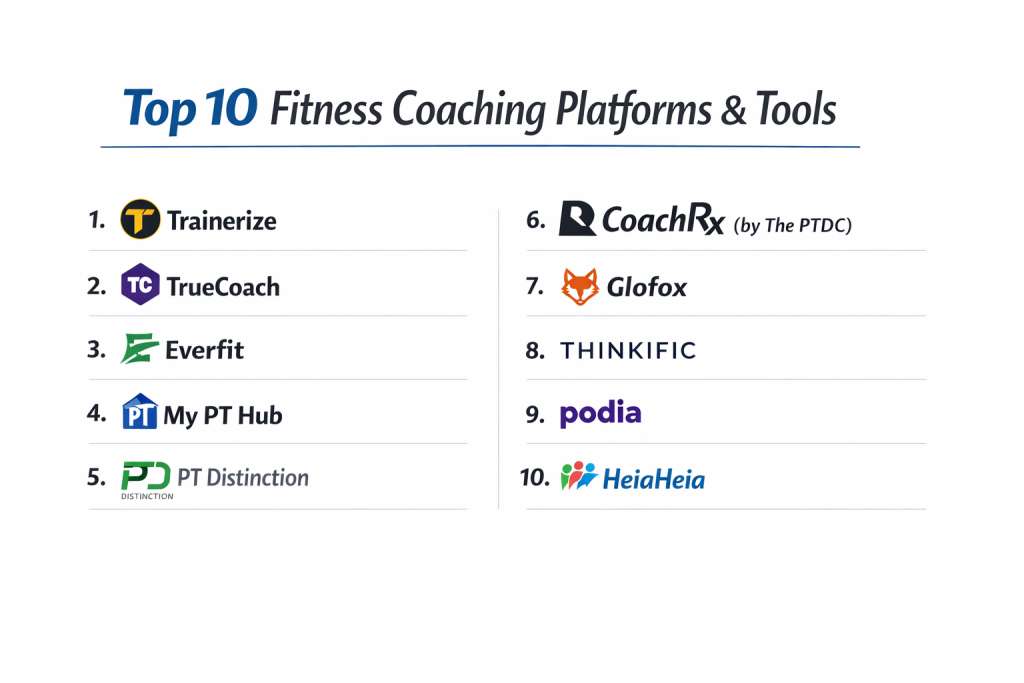
Top 10 Fitness Coaching Platforms Tools
1 — Trainerize
Trainerize is a comprehensive platform focused on client management and workout delivery. It’s a favorite among personal trainers who want to build detailed, periodized training programs and track client metrics closely.
Key features:
- Advanced workout builder with exercise library, video demonstrations, and superset/circuit creation.
- Client metrics tracking for weight, measurements, progress photos, and custom data points.
- Integrated nutrition logging (meal tracking) and habit tracking tools.
- Built-in messaging and in-app chat for client communication.
- Billing and payment processing for recurring training packages.
- White-label mobile app (clients use your branded app, not Trainerize’s).
- Fitness assessments and workout notes.
Pros:
- Extremely powerful and flexible for designing complex, professional training programs.
- The white-label app provides a premium, branded experience that helps coaches stand out.
Cons:
- Can have a steeper learning curve due to its depth of features.
- The interface, while functional, can feel busy compared to more minimalist platforms.
Security & compliance: Standard data encryption for payments and user data. Not designed for protected health information (HIPAA).
Support & community: Extensive knowledge base, email support, and a large, active community of trainers on social media groups. Offers webinars and training.
2 — TrueCoach
TrueCoach is built with a sharp focus on the coach-client workflow, prioritizing simplicity, clarity, and accountability. It’s known for its clean interface and efficient tools for delivering workouts and feedback.
Key features:
- Clean, intuitive workout builder and calendar view for clients.
- Excellent video feedback tool: clients can upload form videos, coaches can draw on them and comment.
- Simple yet effective progress tracking (bodyweight, PRs, custom metrics).
- Integrated to-do lists and habit tracking for clients.
- Basic nutrition template creation (not a full macro tracker).
- Secure in-app messaging and notification system.
- Straightforward subscription and billing management.
Pros:
- Unmatched for providing form feedback and fostering coach-client communication.
- Extremely user-friendly for both coaches and clients, minimizing tech confusion.
Cons:
- Lacks built-in nutrition tracking or a content library for on-demand workouts.
- Fewer “business” features (like marketing tools or a website builder) compared to some competitors.
Security & compliance: Industry-standard security practices for a SaaS platform. Not HIPAA compliant.
Support & community: Renowned for fast, helpful, and human customer support. Has a strong community of dedicated users.
3 — Everfit
Everfit is a modern platform that combines robust coaching tools with strong business automation features. It’s designed for coaches who want to systematize their service delivery and client onboarding.
Key features:
- Smart workout builder with drag-and-drop simplicity and an extensive exercise library.
- Automated client onboarding sequences with questionnaires and intake forms.
- Client portal with workout calendar, messaging, and progress tracking.
- Integrated nutrition coaching with customizable templates and food logging.
- Automated billing, invoicing, and contract management.
- Marketing features like lead capture forms and email campaigns.
- Branded client mobile app.
Pros:
- Excellent automation saves coaches significant time on administrative tasks.
- Strong blend of coaching tools and business management features in one place.
Cons:
- Pricing can be higher than more basic platforms.
- The breadth of features can be overwhelming for a coach just starting their online business.
Security & compliance: Uses secure cloud infrastructure and encryption. Not a HIPAA-compliant platform.
Support & community: Offers onboarding packages, email and chat support, and regular training webinars.
4 — My PT Hub
My PT Hub is an all-in-one platform popular in the UK and globally, offering a wide range of features from workout delivery to website building and client CRM.
Key features:
- Comprehensive workout and nutrition plan builder.
- Integrated client management (CRM) and booking/scheduling system.
- Built-in website builder with templates specifically for fitness professionals.
- Payment processing and direct debit management.
- Client app with workout logging, messaging, and progress photo uploads.
- Business reporting and analytics dashboard.
- Exercise library with pre-built workout templates.
Pros:
- Truly all-in-one, potentially eliminating the need for separate website, booking, and payment tools.
- Good value for the sheer volume of features included, especially for solopreneurs.
Cons:
- The interface can feel cluttered, and some features may not be as polished as best-in-class standalone tools.
- Occasional reports of slower customer support response times during peak periods.
Security & compliance: Complies with GDPR and uses standard data protection measures. Not HIPAA compliant.
Support & community: Provides support via email and chat, a help center, and community Facebook groups.
5 — PT Distinction
PT Distinction is a platform built specifically for personal trainers, with a strong emphasis on creating a professional client experience and streamlining business operations.
Key features:
- Professional workout program design with periodization planning.
- Client lifestyle and habit tracking beyond just fitness.
- Automated session notes and fitness assessment reports.
- Integrated billing, invoice reminders, and package management.
- Customizable client portal and branded mobile app.
- Tools for tracking client attendance and session history.
- Marketing resources and email templates.
Pros:
- Creates a very professional and organized experience for clients, enhancing perceived value.
- Strong focus on the business side of training, helping with invoices, reminders, and reporting.
Cons:
- Can be more expensive than some entry-level platforms.
- The nutrition component is more template-based than a detailed tracking system.
Security & compliance: Standard web application security protocols. Not designed for medical/ HIPAA data.
Support & community: Offers UK and US-based phone support, training resources, and a user community.
6 — CoachRx (by The PTDC)
CoachRx is designed with a focus on community and group coaching. It’s an excellent choice for coaches who run challenges, group programs, or want to foster interaction among their clients.
Key features:
- Strong group/community features with feed, chat, and announcement tools.
- Flexible program delivery for both individuals and groups.
- Workout and nutrition plan builder.
- Client check-ins and progress tracking.
- Integrated payments for subscriptions and one-time offers.
- Simple email marketing and broadcast tools.
- Clean, user-friendly interface.
Pros:
- Best-in-class for building an engaged community or running successful group challenges.
- Very intuitive and easy for both coaches and clients to learn and use.
Cons:
- Lacks some of the advanced programming complexity of platforms like Trainerize.
- Fewer business automation features compared to platforms like Everfit.
Security & compliance: Standard SaaS security. Not HIPAA compliant.
Support & community: Developed by The Personal Trainer Development Center, with strong educational resources and community support.
7 — Glofox
Glofox is a platform geared towards brick-and-mortar gym studios and fitness businesses that need to manage in-person classes, memberships, and online offerings simultaneously.
Key features:
- Full-featured gym management software (class scheduling, booking, waitlists).
- Membership management and automated billing.
- Integrated point-of-sale (POS) for retail and drop-ins.
- Custom branded member mobile app.
- Tools for delivering on-demand and live-streamed content to members.
- Reporting and business analytics.
- CRM for leads and member management.
Pros:
- Perfect hybrid solution for studios wanting to seamlessly bridge in-person operations and digital content.
- Powerful back-office management for memberships, scheduling, and finances.
Cons:
- Overkill and too expensive for a solo online-only coach.
- The coaching/program delivery features are not as deep as dedicated online coaching platforms.
Security & compliance: PCI compliant for payments. Uses secure data handling practices.
Support & community: Offers 24/7 phone support, onboarding, and a customer success team.
8 — Thinkific
Thinkific is a powerful online course platform that fitness professionals can adapt to sell pre-recorded workout programs, nutrition guides, and other digital products. It’s for coaches who focus on scalable digital products.
Key features:
- Drag-and-drop course builder for organizing video, text, and PDF content.
- Flexible pricing (one-time, subscriptions, payment plans, bundles).
- Built-in quizzes, discussions, and completion certificates.
- Customizable website and sales pages.
- Marketing tools like coupons, affiliates, and email integrations.
- Detailed student progress and revenue analytics.
- Strong focus on creating a seamless student learning experience.
Pros:
- Unbeatable for creating and selling beautiful, structured online courses and digital programs.
- Allows for incredible scalability—you sell the same program to hundreds without extra work.
Cons:
- Lacks direct workout logging, habit tracking, and live interaction tools of coaching-specific platforms.
- Not designed for ongoing, one-on-one coaching relationships with continuous feedback.
Security & compliance: SOC 2 compliant, with robust security for hosting digital content and processing payments.
Support & community: Extensive knowledge base, email/chat support, and a large community of course creators.
9 — Podia
Podia is an all-in-one platform for selling digital products, memberships, and online courses. Like Thinkific, it’s adapted by fitness pros who prioritize digital products over one-on-one coaching.
Key features:
- Sell digital downloads, online courses, and membership communities from one platform.
- Simple, intuitive website and storefront builder.
- Integrated email marketing tools.
- Live chat and webinar hosting capabilities.
- Community/forum features for members.
- Zero transaction fees on all plans.
- Clean, minimal interface focused on creator experience.
Pros:
- Extremely easy to use to get a digital product store up and running quickly.
- “No transaction fees” policy can save significant money as sales volume grows.
Cons:
- Lacks fitness-specific features like exercise libraries, workout builders, or metric tracking.
- Best for “set-and-forget” products, not for managing ongoing coaching clients.
Security & compliance: Standard e-commerce and data security. Offers GDPR compliance tools.
Support & community: Known for fast, friendly support via live chat and email. Helpful resource library.
10 — HeiaHeia
HeiaHeia is a unique platform from Finland that blends social fitness tracking with coaching tools. It’s great for coaches who want to motivate clients through social features and team challenges.
Key features:
- Social fitness feed where clients can log workouts and cheer each other on.
- Team and challenge creation to foster group motivation.
- Workout library and plan builder for coaches.
- Integration with 100+ fitness apps and wearables (Polar, Garmin, Strava, etc.).
- Basic nutrition tracking.
- Coaching tools to monitor client activity and provide comments.
- Focus on overall well-being and lifestyle, not just gym workouts.
Pros:
- Excellent for creating a fun, motivating, and community-oriented training environment.
- Unparalleled wearable/app integration reduces manual logging for clients.
Cons:
- Less focused on detailed, periodized strength programming.
- The social nature may not suit clients who prefer a private coaching experience.
Security & compliance: Follows EU/GDPR data protection standards rigorously.
Support & community: Responsive support and an active, global user community focused on well-being.
Comparison Table
| Tool Name | Best For | Platform(s) Supported | Standout Feature | Rating |
|---|---|---|---|---|
| Trainerize | Personal trainers building complex programs & wanting a white-label app. | Web, iOS, Android | White-label branded mobile app & advanced programming. | N/A |
| TrueCoach | Coaches prioritizing form feedback, simplicity, and clear communication. | Web, iOS, Android | Video feedback tools & ultra-clean user interface. | N/A |
| Everfit | Coaches wanting to automate their business and client onboarding. | Web, iOS, Android | Business automation & systematized onboarding. | N/A |
| My PT Hub | Solo fitness pros needing an all-in-one (website, CRM, coaching) solution. | Web, iOS, Android | All-in-one platform with website builder & CRM. | N/A |
| PT Distinction | Trainers focused on a highly professional client experience & business management. | Web, iOS, Android | Professional client reporting & business admin tools. | N/A |
| CoachRx | Coaches running group challenges and building client communities. | Web, iOS, Android | Community/group engagement features. | N/A |
| Glofox | Brick-and-mortar studios adding online/hybrid services. | Web, iOS, Android | Hybrid gym management + digital content delivery. | N/A |
| Thinkific | Coaches selling scalable online courses & pre-recorded programs. | Web | Best-in-class online course creation & sales. | N/A |
| Podia | Fitness creators selling digital products, courses, & memberships simply. | Web | Ease of use & zero transaction fees. | N/A |
| HeiaHeia | Coaches fostering motivation through social features & wearable integration. | Web, iOS, Android | Social feed & extensive wearable/app integration. | N/A |
Evaluation & Scoring of Fitness Coaching Platforms
| Evaluation Category | Weight | What to Look For |
|---|---|---|
| Core Features | 25% | Does it have the right tools for your service? (e.g., workout builder, nutrition tracking, habit logging). How flexible is the program delivery (1-on-1, group, on-demand)? |
| Ease of Use | 15% | Is the interface intuitive for you and your clients? Will it take more time to manage the tech than to coach? |
| Integrations & Ecosystem | 15% | Does it connect to tools you use? (PayPal/Stripe, email marketing like Mailchimp, wearables, Zoom for live calls). |
| Security & Compliance | 10% | Are payments processed securely (PCI compliance)? If handling sensitive health data, is it appropriate? (Most are not HIPAA compliant). |
| Performance & Reliability | 10% | Is the platform fast and stable? Do clients experience glitches or downtime when accessing their workouts? |
| Support & Community | 10% | Can you get help when you need it? Is there a knowledge base or user community for troubleshooting and ideas? |
| Price / Value | 15% | Does the cost align with the features and the revenue you expect to generate? Watch for transaction fees or limits on clients. |
Which Fitness Coaching Platforms Tool Is Right for You?
- Solo Coach vs. Small Team vs. Enterprise Studio: A solo online coach might prioritize ease and cost (TrueCoach, CoachRx). A small team of trainers needs client management and consistent branding (Trainerize, Everfit). An enterprise studio or gym requires hybrid management (Glofox) or a platform that scales for many coaches.
- Budget-Conscious vs. Premium Solutions: Starting out? Look for affordable platforms with core features, but watch client limits. Established and scaling? Premium solutions offer white-label apps, automation, and business tools that save time and elevate your brand, justifying a higher fee.
- Feature Depth vs. Ease of Use: This is a key trade-off. Power-user platforms (Trainerize) offer incredible control but require learning. Simplified platforms (TrueCoach, Podia) get you started fast but may lack advanced customization. Be honest about your tech comfort and your clients’ needs.
- Integration and Scalability Needs: Ask: “Where will my business be in a year?” If you plan to sell digital products, choose a platform built for that (Thinkific, Podia). If you’ll add group coaching, ensure the platform supports it seamlessly. Avoid tools that will box you in.
- Security and Compliance Requirements: For most fitness coaching, secure payment processing is the main concern. If you are a clinical exercise physiologist or work with medically-referred clients, you must ensure your platform is HIPAA-compliant—most on this list are not.
- Your Primary Service Model: This is the biggest decider.
- 1-on-1 Coaching: TrueCoach, Trainerize, Everfit.
- Group Challenges/Communities: CoachRx, HeiaHeia.
- Pre-recorded Programs/Courses: Thinkific, Podia.
- Hybrid (In-Person + Online): Glofox, My PT Hub.
Frequently Asked Questions (FAQs)
1. How much do these platforms typically cost?
Costs range from $20-$100+ per month. Pricing is usually based on the number of active clients you have or the features you need. Many offer monthly and discounted annual plans.
2. Can I move my clients from one platform to another?
Yes, but it can be cumbersome. You can usually export client data (names, emails), but workout programs and historical logs often cannot be transferred. It’s best to choose carefully from the start.
3. Do these platforms process payments, or do I need another service?
Most have integrated payment processing (via Stripe or PayPal) so you can charge clients directly through the platform. Some charge an additional transaction fee on top of payment processor fees.
4. Can I create my own exercise video library?
Absolutely. All major platforms allow you to upload your own exercise demonstration videos, which is crucial for creating a personalized, branded experience.
5. Is there a contract or can I cancel monthly?
Most modern platforms operate on a monthly subscription you can cancel anytime. Some offer discounts for paying annually upfront. Always check the terms before signing up.
6. Do my clients need to download an app?
Usually, yes. Most platforms have a companion mobile app (either their own or a white-label version of yours) that clients use to view workouts, log data, and message you.
7. Can I try a platform before committing?
Almost all offer a free trial, typically 7-30 days. This is essential. Use it to build a sample program and even onboard a “test” client to see the full experience.
8. What’s the biggest mistake new online coaches make?
Choosing a platform based on features they think they need rather than the simplicity their first clients need. Starting with an overly complex system can paralyze you and confuse clients.
9. Can I use these platforms for nutrition coaching?
Yes, but capability varies. Some have full meal logging (Trainerize), others offer template-based plans (TrueCoach), and some are more basic. If nutrition is core to your service, choose a platform that supports it well.
10. How do I get clients to actually use the platform?
Onboarding is key. Walk them through it on a quick video call. Keep initial instructions simple. Use the platform’s messaging for all communication to make it a habit. The easier you make it, the higher the adherence.
Conclusion
Selecting the right Fitness Coaching Platform is a foundational step in building a successful modern coaching business. It’s the digital space where your expertise meets your client’s effort. The right tool can automate administrative tasks, deepen client relationships, and open doors to new revenue models, while the wrong one can create frustration and hold you back.
The key insight is that the “best” platform does not exist in isolation. The optimal choice is entirely dependent on your specific coaching style, target clientele, and business goals. A platform perfect for a strength coach delivering detailed one-on-one programming would be a poor fit for a yoga teacher selling an on-demand video library, and vice versa.
Success lies in clearly defining your primary service model and choosing a tool that excels at facilitating exactly that. By prioritizing the experience for both you and your client—valuing simplicity, communication, and scalability—you can select a platform that becomes an invisible engine for growth, allowing you to focus on what you do best: coaching.