Introduction
Financial Risk Management Software is a specialized category of enterprise technology designed to identify, analyze, and mitigate potential threats to an organization’s capital and earnings. These threats can stem from a variety of sources, including market volatility, credit defaults, liquidity shortages, and operational failures. In the past, managing these risks involved siloed spreadsheets and manual calculations. Modern financial risk management platforms, however, utilize advanced mathematical models, real-time data streaming, and Artificial Intelligence (AI) to provide a centralized view of an organization’s “risk appetite.” By aggregating data from global markets and internal ledgers, these tools allow CFOs and Risk Officers to predict how a sudden change in interest rates or a geopolitical event might impact their bottom line.
The importance of this software cannot be overstated. In a global economy characterized by rapid shifts, the ability to stress-test financial positions in seconds rather than days is a massive competitive advantage. These platforms ensure that institutions remain solvent during market shocks and help them comply with stringent global regulations like Basel III or Solvency II. Beyond mere defense, financial risk software enables “risk-informed” decision-making, helping companies identify where they can afford to take more aggressive positions to drive growth while maintaining enough capital buffer to satisfy stakeholders and regulators.
Key Real-World Use Cases
Financial risk management software is applied across various scenarios to maintain organizational stability:
- Market Risk Analysis: Simulating the impact of currency fluctuations or stock market crashes on a multi-billion dollar investment portfolio.
- Credit Scoring & Monitoring: Assessing the likelihood that a counterparty or a borrower will default on their obligations in real-time.
- Liquidity Stress Testing: Ensuring a bank or corporation has enough liquid cash to survive a “bank run” or a sudden freeze in credit markets.
- Regulatory Compliance: Automatically generating the complex reports required by central banks to prove the institution is holding enough “capital at risk.”
- Operational Risk Tracking: Monitoring internal processes to prevent losses caused by human error, system failures, or fraudulent activities.
What to Look For (Evaluation Criteria)
When selecting a risk management platform, decision-makers should evaluate:
- Modeling Flexibility: Can the tool handle complex derivatives, fixed income, and equities, or is it limited to a specific asset class?
- Data Integration: How easily can the software pull real-time feeds from providers like Bloomberg or Reuters and internal ERP systems?
- Scenario Engine: The ability to run “What-If” scenarios (e.g., “What happens if the Euro drops by 10%?”) across the entire portfolio.
- Regulatory Coverage: Does the vendor provide pre-built templates for localized and international financial regulations?
Best for:
- Chief Risk Officers (CROs) and CFOs: In banking, insurance, and large-cap corporations who need a consolidated view of risk exposure.
- Investment Managers: Looking to optimize portfolio returns while staying within specific risk mandates.
- Compliance Officers: Tasked with meeting the rigorous reporting standards of global financial authorities.
- Treasury Departments: In multinational firms managing complex foreign exchange (FX) and interest rate risks.
Not ideal for:
- Early-Stage Startups: Who may have very simple financial structures that can be managed with basic accounting software and manual oversight.
- Non-Financial Small Businesses: That do not hold significant debt, foreign currency, or complex investment portfolios.
- Boutique Agencies: Whose primary risk is operational (staffing) rather than financial or market-based.
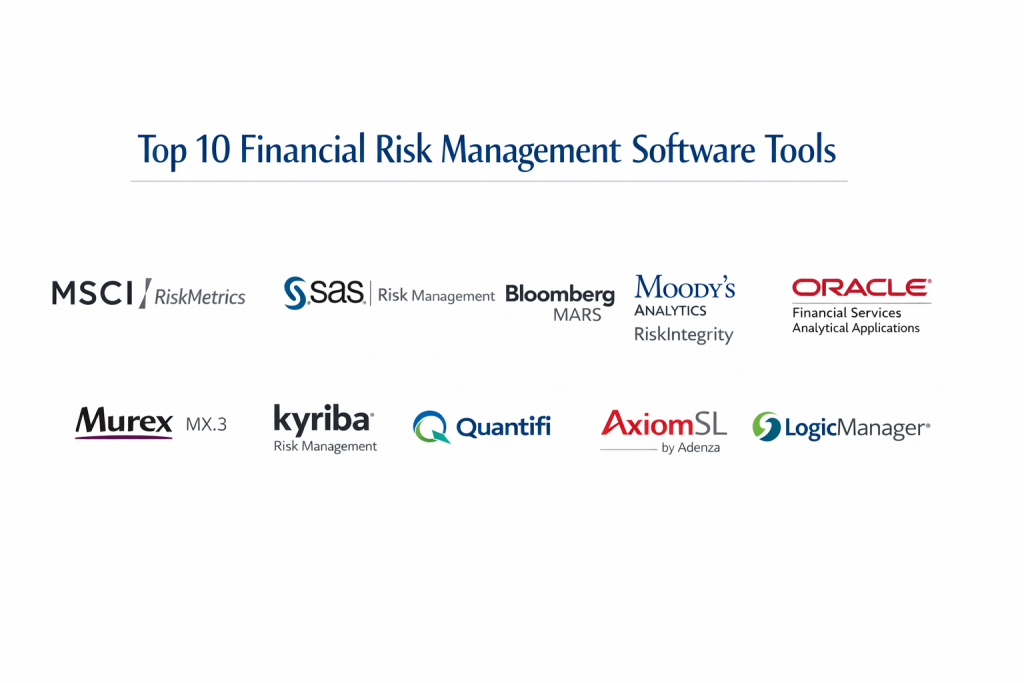
Top 10 Financial Risk Management Software Tools
1 — MSCI (RiskMetrics)
RiskMetrics, developed by MSCI, is widely considered the industry standard for multi-asset class market risk analytics. It is used by the world’s largest asset managers, banks, and hedge funds to provide a consistent framework for risk measurement.
Key features:
- Multi-Asset Coverage: Supports everything from simple equities to complex structured products and private equity.
- Value-at-Risk (VaR): Industry-leading models for calculating potential losses over a specific timeframe.
- Stress Testing: Extensive library of historical and hypothetical scenarios (e.g., 2008 Financial Crisis simulation).
- Climate Risk Integration: Includes tools to assess how climate change might impact asset valuations.
- RiskReporting: Automated, high-level dashboards for board-level and regulatory reporting.
Pros:
- The “Gold Standard” reputation makes results highly credible to regulators and investors.
- Access to MSCI’s massive proprietary datasets and historical market data.
Cons:
- Extremely high cost, typically reserved for Tier-1 financial institutions.
- Steep learning curve requiring specialized quantitative knowledge to operate effectively.
Security & compliance: SOC 2 Type II, ISO 27001, and fully compliant with Basel and Solvency reporting requirements.
Support & community: Dedicated quantitative support teams, global user conferences, and a vast library of academic research.
2 — SAS (Risk Management)
SAS is a global leader in analytics and AI. Their risk management suite is known for its incredible processing power and its ability to handle massive datasets for credit, market, and operational risk.
Key features:
- SAS Risk Stratum: A unified platform that provides a single point of entry for all risk-related data.
- Regulatory Content: Rapidly updated modules for IFRS 9, CECL, and Basel III/IV.
- High-Performance Analytics: Capable of processing millions of records in seconds using in-memory computing.
- Model Risk Management: Tools to govern the lifecycle of the mathematical models themselves.
- Credit Risk Modeling: Sophisticated scoring engines for retail and commercial lending.
Pros:
- Unmatched scalability for organizations with massive transaction volumes.
- Highly customizable; the platform can be tailored to the specific internal logic of any bank.
Cons:
- Implementation is a significant project that often requires specialized SAS consultants.
- The software can feel “heavy” and requires significant internal IT resources.
Security & compliance: ISO 27001, SOC 1/2, GDPR, and HIPAA compliant.
Support & community: Extensive SAS communities, specialized training certifications, and 24/7 global support.
3 — Bloomberg (MARS)
Bloomberg’s Multi-Asset Risk System (MARS) leverages the power of the Bloomberg Terminal to provide front-to-back risk management for traders and risk managers.
Key features:
- Terminal Integration: Seamless data flow from the world’s most popular financial data platform.
- Pricing & Valuation: Direct access to Bloomberg’s industry-leading pricing models for fixed income and derivatives.
- Collateral Management: Integrated tools to manage margin requirements and collateral movement.
- Intraday Risk: Monitor risk levels in real-time as market prices move throughout the trading day.
- Scenario Analysis: Pre-built “shocks” based on real-time news events and economic data.
Pros:
- If your team already uses Bloomberg Terminals, the workflow integration is seamless.
- Real-time data updates mean your risk view is never “stale.”
Cons:
- Monthly costs are high and tied to the Bloomberg ecosystem.
- Not as focused on “Operational Risk” as specialized GRC platforms.
Security & compliance: SOC 2 Type II, ISO 27001, and compliant with major global financial regulations.
Support & community: 24/7 “Instant Bloomberg” chat support and dedicated product specialists.
4 — Moody’s Analytics (RiskIntegrity)
Moody’s Analytics provides a suite of tools focused heavily on credit risk, economic forecasting, and regulatory compliance, particularly for insurance and banking sectors.
Key features:
- RiskIntegrity for IFRS 17: A specialized tool for the latest insurance accounting standards.
- Economic Forecasting: Access to Moody’s world-class economic scenarios and projections.
- CreditLens: A modern, cloud-native credit lifecycle management tool.
- Impairment Analysis: Automated tools for calculating expected credit losses (ECL).
- Climate Risk: Tools to measure the financial impact of physical and transition risks.
Pros:
- Integration with Moody’s legendary credit ratings and research.
- Excellent at bridging the gap between accounting standards and risk management.
Cons:
- Can be fragmented; you may need multiple Moody’s products to get a “full” risk view.
- User interface can be more technical and less “modern” than newer SaaS startups.
Security & compliance: ISO 27001, SOC 2, and localized regulatory compliance in 100+ countries.
Support & community: Deep academic support, webinars, and global client advisory services.
5 — Oracle (Financial Services Analytical Applications)
Oracle’s Financial Services Analytical Applications (OFSAA) is a massive suite designed to manage risk, performance, and compliance for the world’s largest banking groups.
Key features:
- Enterprise Risk Management: Covers credit, market, and operational risk in one integrated stack.
- Liquidity Risk Management: Advanced tools for LCR (Liquidity Coverage Ratio) and NSFR calculations.
- AML & Fraud: Native integration with Oracle’s financial crime and anti-money laundering tools.
- Profitability Management: Aligning risk management with business unit performance.
- Unified Data Model: Ensures that “the risk team” and “the finance team” are looking at the same numbers.
Pros:
- Stability and performance that comes with the Oracle database architecture.
- Ideal for mega-banks that need to consolidate hundreds of different data sources.
Cons:
- Extremely complex to deploy and maintain.
- Very expensive, with a total cost of ownership that includes database licenses.
Security & compliance: FFIEC, SOC 1/2, ISO 27001, and GDPR compliant.
Support & community: Global Oracle support network and a vast library of technical implementation guides.
6 — Murex (MX.3)
Murex is a specialist in the capital markets space. Its flagship platform, MX.3, is designed to handle the high-velocity risk management needs of trading desks and treasury departments.
Key features:
- Front-to-Back-to-Risk: Integrates trading, back-office settlement, and risk management.
- Greeks & Sensitivities: High-performance calculation of derivative risk factors (Delta, Gamma, Vega, etc.).
- FRTB Compliance: Specialized modules for the Fundamental Review of the Trading Book regulations.
- Real-Time Limits Monitoring: Automatically blocks trades that would exceed pre-set risk limits.
- Hedge Accounting: Integrated tools to manage and report on hedging relationships.
Pros:
- Widely considered the best platform for complex derivatives and treasury risk.
- High calculation speed for intraday risk monitoring.
Cons:
- Primarily focused on capital markets; not a “general” corporate risk tool.
- Requires a very high level of technical and financial expertise to implement.
Security & compliance: ISO 27001 and compliant with global capital market regulations (EMIR, MiFID II).
Support & community: Dedicated client services and specialized Murex consulting partners worldwide.
7 — Kyriba (Risk Management)
Kyriba is primarily known for treasury management, but its risk module is a top-tier choice for corporations (rather than banks) needing to manage FX and interest rate risk.
Key features:
- FX Exposure Management: Automatically identifies currency exposure from ERP data.
- Hedge Accounting: Streamlines compliance with ASC 815 and IFRS 9.
- Value-at-Risk for Corporates: Simplified VaR models tailored for corporate treasury.
- Derivative Management: Track and value FX forwards, options, and swaps.
- Sensitivity Analysis: Visualize how currency swings will impact the P&L.
Pros:
- Much easier to use than bank-centric tools like SAS or Murex.
- Excellent integration with corporate ERPs like SAP and Oracle NetSuite.
Cons:
- Lacks the deep “Credit Risk” modeling for loan portfolios found in Moody’s or SAS.
- Not designed for investment banks or complex hedge funds.
Security & compliance: SOC 1/2 Type II, ISO 27001, and GDPR compliant.
Support & community: Strong online community, “Kyriba Academy” for training, and 24/7 enterprise support.
8 — Quantifi
Quantifi is a provider of analytics, trading, and risk management solutions that are known for being more modern and flexible than the legacy giants.
Key features:
- Cross-Asset Risk: Unified view across OTC derivatives, fixed income, and FX.
- Cloud-Native Architecture: Faster deployment and easier updates than on-premise systems.
- Advanced Analytics: Proprietary models for credit and market risk that are highly regarded by quants.
- Scenario Manager: Flexible tool for building custom “Black Swan” events.
- Scalable Performance: Uses grid computing to handle complex Monte Carlo simulations.
Pros:
- More agile and easier to integrate than the older legacy platforms.
- Highly praised for its modern technology stack and ease of API integration.
Cons:
- Smaller brand footprint than MSCI or Bloomberg.
- Support is centralized, which may not suit firms requiring massive on-site teams.
Security & compliance: SOC 2 Type II and GDPR compliant.
Support & community: Direct access to quantitative analysts and responsive technical support.
9 — AxiomSL (by Adenza)
AxiomSL (now part of Adenza/Nasdaq) is the leader in “Regulatory Risk.” Its primary focus is ensuring that the data used for risk management meets the strict requirements of global regulators.
Key features:
- Data Integrity: “Lineage” tools that show exactly where every number in a risk report came from.
- ControllerView: A platform that automates the generation of reports for 50+ countries.
- Capital & Liquidity: Tools for LCR, NSFR, and stress testing.
- Shareholding Disclosures: Monitors and reports on large equity positions to meet legal requirements.
- Strategic Risk: Aligning regulatory capital requirements with business strategy.
Pros:
- The best tool for auditability; you can “drill down” from a final report to the raw data.
- Very strong at handling the complex data-mapping needed for global compliance.
Cons:
- Focused more on “reporting” than on real-time “trading risk.”
- The interface is functional but can be difficult for non-technical users.
Security & compliance: ISO 27001, SOC 2, and global banking regulatory compliance.
Support & community: Extensive regulatory expertise and global implementation partners.
10 — LogicManager
LogicManager is an Enterprise Risk Management (ERM) tool that focuses on the “Governance, Risk, and Compliance” (GRC) aspect rather than just quantitative modeling.
Key features:
- Risk Heat Maps: Visual representations of financial and operational risks.
- Audit Management: Streamlines internal and external financial audits.
- Incident Management: Track and report on financial losses or near-misses.
- Compliance Frameworks: Pre-built libraries for COSO, ISO, and more.
- Vendor Risk Management: Assess the financial stability and risk of your suppliers.
Pros:
- Excellent for qualitative risk and “Operational Risk” management.
- Much more affordable than the quantitative tools like MSCI or Murex.
Cons:
- Lacks the “Heavy Math” (Monte Carlo, Greeks) needed for market risk.
- Not suitable for high-frequency trading environments.
Security & compliance: SOC 2 Type II, GDPR, and HIPAA compliant.
Support & community: “Customer for Life” program with high-touch support and training.
Comparison Table
| Tool Name | Best For | Platform(s) Supported | Standout Feature | Rating |
| MSCI RiskMetrics | Asset Managers | Cloud / Hybrid | VaR & Climate Risk | 4.6 |
| SAS Risk | Large Banks | On-Prem / Cloud | Massive Scale Analytics | 4.5 |
| Bloomberg MARS | Front-Office Trading | Bloomberg Terminal | Terminal Data Sync | N/A |
| Moody’s Analytics | Credit & Insurance | Cloud / SaaS | Economic Forecasting | 4.3 |
| Oracle OFSAA | Global Mega-Banks | On-Prem / Hybrid | Unified Data Model | N/A |
| Murex MX.3 | Treasury & Derivatives | Hybrid / Cloud | Real-Time Greeks | N/A |
| Kyriba | Corporate Treasury | Cloud (SaaS) | ERP Integration | 4.2 |
| Quantifi | Agility & Quants | Cloud-Native | Modern API Stack | 4.7 |
| AxiomSL | Regulatory Reporting | Cloud / Hybrid | Data Lineage & Audit | N/A |
| LogicManager | Operational/GRC Risk | Cloud (SaaS) | Risk Heat Mapping | 4.8 |
Evaluation & Scoring of Financial Risk Management Software
| Criterion | Weight | Evaluation Focus |
| Core Features | 25% | VaR, Stress testing, Credit scoring, and Market risk. |
| Ease of Use | 15% | Dashboard UI, search functionality, and report creation. |
| Integrations | 15% | Real-time market data feeds and ERP connectivity. |
| Security & Compliance | 10% | SOC 2 status, encryption, and regulatory templates. |
| Performance | 10% | Calculation speed and system reliability/uptime. |
| Support | 10% | Quantitative support, training, and documentation. |
| Price / Value | 15% | ROI through capital savings and loss prevention. |
Which Financial Risk Management Software Tool Is Right for You?
Solo Users vs SMB vs Mid-Market vs Enterprise
There are no Solo Users for this category of software, as financial risk management is an institutional function. SMBs and Mid-Market firms should focus on LogicManager or Kyriba, which provide excellent risk oversight without the multi-million dollar price tag. Enterprises—specifically Tier-1 banks and global investment firms—require the “industrial strength” of SAS, MSCI, or Oracle.
Budget-Conscious vs Premium Solutions
If you are Budget-Conscious, LogicManager provides the best “bang for your buck” for general risk and compliance. However, if you are a “Premium” institution managing billions of dollars, the cost of MSCI or Bloomberg is a necessary investment to ensure you are using the same models as your counterparties and regulators.
Feature Depth vs Ease of Use
For Ease of Use, Kyriba and Quantifi stand out for their modern, user-friendly interfaces. If you need Feature Depth—specifically for exotic derivatives or complex regulatory capital calculations—you must accept the complexity of Murex or AxiomSL, which are designed for power users and quants.
Integration and Scalability Needs
If your primary need is Market Data Integration, Bloomberg MARS is unbeatable. If your need is Scalability across millions of retail bank accounts, SAS is the industry leader. For Corporate ERP Integration, Kyriba is the gold standard.
Security and Compliance Requirements
Every tool on this list meets high security standards. However, for Auditability, AxiomSL is the most impressive, providing clear data lineage. For Banking Compliance (Basel III/IV), SAS and Oracle provide the most pre-built regulatory logic.
Frequently Asked Questions (FAQs)
What is Value-at-Risk (VaR)?
VaR is a statistical technique used to measure the level of financial risk within a firm or portfolio over a specific time frame. For example, “We have a 95% confidence that our loss won’t exceed $1M tomorrow.”
What is the difference between Market Risk and Credit Risk?
Market Risk is the risk of losses due to changes in market prices (stocks, FX, rates). Credit Risk is the risk that a borrower or counterparty will fail to pay back what they owe.
Can these tools predict a financial crisis?
They cannot predict the timing of a crisis, but they allow you to “Stress Test” your portfolio to see if you would survive a 20% market drop or a sudden spike in interest rates.
How long does implementation take?
For a corporate SaaS tool like Kyriba, it can take 3–6 months. For an enterprise banking system like Oracle or SAS, it can take 12–24 months.
Do I need a “Quant” to use this software?
For the enterprise tools (MSCI, Murex, SAS), yes—you usually need staff with advanced degrees in mathematics or finance. For corporate tools (Kyriba, LogicManager), a standard finance background is usually sufficient.
What is “Stress Testing”?
It is a simulation technique used to determine the stability of a given instrument or financial entity. It involves testing beyond normal operational capacity, often to a breaking point.
Can this software prevent fraud?
Tools like SAS and Oracle have specific modules for “Operational Risk” and “AML” that can identify patterns indicative of internal or external fraud.
Is cloud-based risk software secure?
Yes. Modern SaaS providers use bank-grade encryption and are subject to rigorous SOC 2 audits. In many cases, cloud security is superior to aging on-premise servers.
What is “Greeks” in risk management?
The “Greeks” (Delta, Gamma, Vega, etc.) are dimensions of risk involved in taking a derivative position. They measure how a price change in an underlying asset impacts the derivative’s value.
What is IFRS 9?
It is an international accounting standard that dictates how financial assets are classified and how “Expected Credit Losses” must be calculated and reported.
Conclusion
The selection of a Financial Risk Management Software platform is one of the most consequential decisions a financial leader can make. In an era of instant information and extreme market sensitivity, “hoping for the best” is not a strategy. Whether you choose the analytical depth of MSCI, the scalability of SAS, or the corporate agility of Kyriba, the goal remains the same: transparency and resilience.
The “best” tool is the one that aligns with your institution’s specific risk profile and technical maturity. For most, the path to success involves a platform that balances quantitative power with practical usability. By centralizing your risk data and automating your stress tests, you move from a reactive posture to a strategic one—ensuring that when the next market shock arrives, your organization is prepared to weather the storm.