Introduction
Execution Management Systems (EMS) are high-performance software platforms designed for traders to interact with financial markets with maximum speed and precision. Unlike a standard brokerage app, an EMS is built for the “hot seat” of professional trading, providing direct market access (DMA), advanced order types, and real-time data streaming across multiple liquidity pools. These systems allow traders to route orders to various exchanges, dark pools, and electronic communication networks (ECNs) simultaneously, seeking out the best possible price and execution speed. By centralizing market connectivity, an EMS acts as the primary engine for executing complex investment strategies across equities, futures, options, and foreign exchange.
The importance of a robust EMS lies in its ability to mitigate “slippage”—the difference between the expected price of a trade and the price at which it actually executes. In a landscape dominated by high-frequency trading (HFT) and algorithmic models, even a few milliseconds of latency can cost a firm millions. Modern EMS platforms provide built-in Transaction Cost Analysis (TCA) and sophisticated algorithms (like VWAP, TWAP, and POV) to ensure that large orders do not disrupt market prices. For the professional trader, an EMS is the difference between reactive manual entry and proactive, optimized execution that protects the alpha generated by their investment research.
Key Real-World Use Cases
Execution Management Systems are essential for high-stakes financial operations:
- Algorithmic Execution: Breaking a massive $50 million buy order into thousands of smaller pieces throughout the day to hide market intent and minimize price impact.
- Multi-Asset Arbitrage: Simultaneously monitoring and trading correlated assets across different global exchanges to capture fleeting price discrepancies.
- Liquidity Aggregation: Viewing a “consolidated tape” of all available buy and sell orders for a specific stock across a dozen different dark pools and public exchanges.
- Risk Perimeter Management: Setting hard limits on trade sizes and total exposure to prevent “fat-finger” errors or unauthorized trading activity.
- Compliance Archiving: Automatically logging every microsecond of order history, cancellations, and fills to meet rigorous regulatory requirements like MiFID II.
What to Look For (Evaluation Criteria)
When selecting an EMS, traders and IT departments should focus on these critical factors:
- Latency and Throughput: The “speed to market.” How many microseconds does the system take to process an order and receive a confirmation?
- Broker Neutrality: Does the platform allow you to connect to any broker of your choice, or are you locked into a specific provider’s liquidity?
- Algorithm Library: Does the system provide high-quality, pre-built execution algorithms, and can you customize them with your own logic?
- Stability and Redundancy: Given that a minute of downtime can be catastrophic, what are the failover protocols and historical uptime of the platform?
Best for:
- Hedge Fund Traders and Asset Managers: Who need to execute large-scale, multi-broker orders with minimal market impact.
- Proprietary Trading Firms: Focused on high-frequency or latency-sensitive strategies where speed is the primary competitive edge.
- Sell-Side Desks: Institutions providing liquidity to clients who require advanced routing and internal crossing capabilities.
- Execution-Only Desks: Centralized trading hubs within large corporations or family offices that handle high-volume turnover.
Not ideal for:
- Long-Term Retail Investors: Who place only a few trades per month and are better served by the basic interfaces provided by retail brokers.
- Passive Portfolio Managers: Who primarily rebalance once a quarter and do not require real-time, low-latency execution tools.
- Small Startups with Low Volume: Where the high monthly “seat fees” of a professional EMS would outweigh any potential savings from better execution.
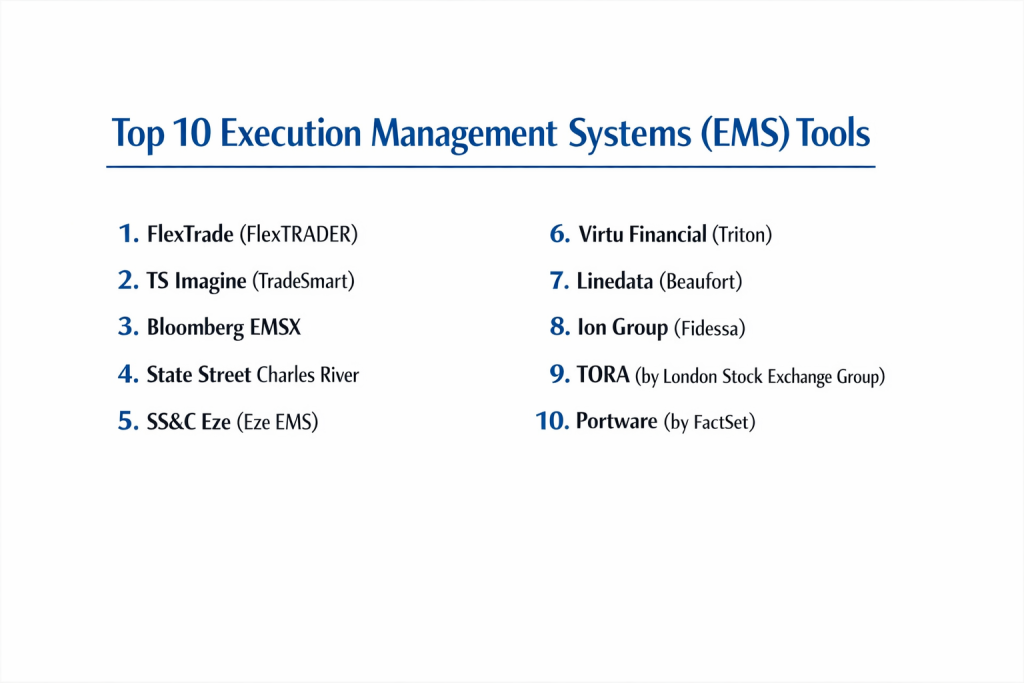
Top 10 Execution Management Systems (EMS) Tools
1 — FlexTrade (FlexTRADER)
FlexTrade is a pioneer in the EMS space, offering a highly customizable, broker-neutral platform that is widely considered the “Ferrari” of execution systems for multi-asset trading.
Key features:
- Truly Broker Neutral: Connects to over 200 liquidity providers and brokers globally.
- FlexAlgo: A robust framework for developing, testing, and deploying proprietary execution algorithms.
- Cross-Asset Support: Full functionality for equities, FX, options, futures, and fixed income in a single interface.
- Open Architecture: Extensive APIs for integrating with proprietary alpha models and downstream Order Management Systems (OMS).
- Real-Time TCA: Integrated Transaction Cost Analysis that allows traders to adjust strategies mid-execution.
Pros:
- Unmatched customization; the system can be tailored to the specific “look and feel” of any trading desk.
- Exceptional high-performance handling of massive order volumes during peak market volatility.
Cons:
- High complexity requires a significant learning curve and dedicated internal support.
- Among the most expensive options in the market, often requiring a substantial implementation fee.
Security & compliance: SOC 2 Type II, ISO 27001, and fully compliant with SEC, FINRA, and MiFID II reporting standards.
Support & community: 24/7 global support desks in major financial hubs, dedicated technical account managers, and private user forums.
2 — TS Imagine (TradeSmart)
Born from the merger of TradingScreen and Imagine Software, TS Imagine provides a cloud-native SaaS EMS that combines powerful execution with integrated risk management.
Key features:
- Cloud-First SaaS: No on-premise hardware required; accessible from anywhere with a secure connection.
- Pre-Trade Risk: Integrated risk checks that prevent orders from being sent if they violate pre-defined limits.
- Global Liquidity Reach: Access to a vast network of brokers and dark pools through a single API.
- Staged Order Workflow: Seamlessly handles orders “staged” from an OMS for execution.
- Consolidated Data Feed: Aggregates market data from hundreds of sources into a unified view.
Pros:
- Fast deployment cycles compared to traditional on-premise EMS solutions.
- Strong “all-in-one” feel, bridging the gap between execution and risk oversight.
Cons:
- Being cloud-based, it may not satisfy the ultra-low latency requirements of HFT firms.
- Customization options are slightly more rigid than FlexTrade’s open-code approach.
Security & compliance: SOC 2, GDPR compliant, and utilizes high-grade end-to-end encryption for all order flow.
Support & community: Robust digital documentation, 24/5 customer support, and regular webinars on market connectivity.
3 — Bloomberg EMSX
EMSX is the execution management module integrated directly into the Bloomberg Terminal. It is likely the most widely used EMS in the world due to the ubiquity of Bloomberg in finance.
Key features:
- Terminal Integration: Seamlessly move from news and research to execution without leaving the Bloomberg environment.
- Broker Connectivity: One-click access to thousands of brokers who are already on the Bloomberg network.
- Staging and Routing: Easy drag-and-drop functionality for moving orders between different trading desks.
- Integrated Chat: Use Bloomberg IB (Instant Bloomberg) to communicate directly with brokers alongside your execution screen.
- Free (with Terminal): Included in the cost of a standard Bloomberg subscription, making it highly cost-effective for existing users.
Pros:
- Extremely low friction for setup; if you have a Terminal, you have an EMS.
- The “Network Effect” makes it easy to find and connect with any counterparty globally.
Cons:
- Not as customizable or “fast” as specialized standalone systems like FlexTrade.
- You are locked into the Bloomberg ecosystem and its specific interface constraints.
Security & compliance: SOC 2, ISO 27001, and leverages Bloomberg’s massive global security infrastructure.
Support & community: 24/7 “Help Help” button support and a massive community of over 300,000 professional users.
4 — State Street Charles River (Crd.com)
Charles River Development (CRD) offers a comprehensive platform that is often used as an OEMS (Order and Execution Management System), heavily favored by large-scale buy-side firms.
Key features:
- Unified OEMS: Eliminates the “sync” issues between the portfolio manager’s order and the trader’s execution.
- Advanced Fixed Income: One of the strongest systems for trading complex bonds and credit instruments.
- Compliance Engine: Automated real-time checking of trades against client mandates and legal restrictions.
- Inventory Management: Live tracking of what the firm owns to facilitate immediate selling or hedging.
- Execution Quality Suite: Sophisticated tools for measuring and proving “Best Execution” to regulators.
Pros:
- Best-in-class for large asset managers who need a single platform for the entire investment lifecycle.
- Very strong data management and security capabilities.
Cons:
- Can be very “slow” and cumbersome for fast-paced proprietary trading desks.
- Known for having a complex and sometimes frustrating user interface.
Security & compliance: FFIEC regulated, SOC 1/2, and global regulatory reporting modules built-in.
Support & community: Extensive enterprise support, dedicated account teams, and an annual user conference.
5 — SS&C Eze (Eze EMS)
Formerly known as RealTick, Eze EMS is a high-performance, broker-neutral platform that excels in usability and fast execution for equities and options.
Key features:
- Customizable Hotkeys: Designed for rapid manual entry and adjustments during fast-moving markets.
- Integrated News and Alerts: Real-time data feeds that trigger alerts directly on the trading ticket.
- Option Chains: Sophisticated visual tools for trading complex multi-leg option strategies.
- Global Connectivity: Direct market access to over 50 countries and hundreds of brokers.
- API Suite: Support for C#, C++, and Java for firms wanting to build custom front-ends.
Pros:
- Widely praised for having one of the most intuitive and “snappy” user interfaces in the business.
- Excellent balance of features for both small hedge funds and larger institutional desks.
Cons:
- While broker-neutral, the setup for new broker connections can sometimes be slower than competitors.
- Fixed income capabilities are not as deep as Charles River or Bloomberg.
Security & compliance: SOC 2 Type II, ISO 27001, and GDPR compliant.
Support & community: Highly rated customer success team and a comprehensive online client portal.
6 — Virtu Financial (Triton)
Triton is a broker-neutral EMS provided by Virtu, a global leader in market making and execution services. It is particularly strong in algorithmic trading and TCA.
Key features:
- Virtu Frontier Algos: Direct access to some of the world’s most advanced liquidity-seeking algorithms.
- Embedded TCA: Virtu’s famous analytics are baked directly into the execution workflow.
- Multi-Asset Capability: Robust support for global equities, FX, and derivatives.
- Customizable Workspaces: Multi-monitor support with “sticky” windows for high-speed monitoring.
- Strategy Automation: Tools to automate the “working” of orders based on specific volume or time parameters.
Pros:
- Benefit from Virtu’s deep expertise in market structure and liquidity.
- Superior analytics that help traders prove they are getting the best possible price.
Cons:
- Some firms may have concerns about using an EMS provided by a major market maker (potential conflict of interest).
- The interface is highly technical and aimed at professional quants.
Security & compliance: SOC 2, SEC/FINRA compliant, and utilizes bank-grade encryption for all data transit.
Support & community: Expert-level support from staff who understand market microstructure intimately.
7 — Linedata (Beaufort)
Linedata Beaufort is an EMS tailored for the buy-side, focusing on streamlining the workflow between the trading desk and the back office.
Key features:
- Workflow Automation: Reduces manual steps in the order lifecycle from creation to settlement.
- Cross-Asset Coverage: Supports a wide array of instruments, including niche derivatives.
- Modular Design: Firms can choose specific modules to build a bespoke execution environment.
- Compliance Oversight: Pre-built rulesets for major global jurisdictions.
- Interoperability: Designed to “play nice” with existing third-party OMS and accounting systems.
Pros:
- Excellent for mid-market firms that need a reliable, solid EMS without the “Mega-Firm” price tag.
- Very responsive customer service and a focus on long-term partnerships.
Cons:
- Lacks the extreme low-latency performance required for HFT.
- The algorithm library is not as extensive as FlexTrade or Virtu.
Security & compliance: ISO 27001 and GDPR compliant.
Support & community: Personalized onboarding and a dedicated client portal for technical support.
8 — Ion Group (Fidessa)
Fidessa (now part of Ion) is a legendary name in the equities space, providing the backbone for many of the world’s largest sell-side trading desks.
Key features:
- Sell-Side Dominance: Specifically built for the high-volume needs of brokerage firms.
- Global Connectivity: One of the most mature and stable broker networks in existence.
- Market Making Tools: Specialized features for firms that provide quotes and manage risk.
- Complex Order Management: Handles care orders, DMA, and algorithmic flow in one screen.
- Low Latency Architecture: Built on a robust, time-tested performance engine.
Pros:
- Unmatched reliability; it is the “old faithful” of the institutional trading world.
- Deep feature set for managing client order flow and internal crossing.
Cons:
- The software can feel very dated and “heavy” compared to modern SaaS tools.
- The company has faced criticism regarding its support and pricing models after the Ion acquisition.
Security & compliance: SOC 1/2, ISO 27001, and fully compliant with all global exchange regulations.
Support & community: Massive global presence with support staff in every major financial time zone.
9 — TORA (by London Stock Exchange Group)
TORA is a cloud-based multi-asset OEMS that has gained significant traction for its modern architecture and specialized focus on Asian markets and crypto.
Key features:
- True Multi-Asset: One of the first to treat crypto-assets with the same institutional rigor as equities.
- Global Desktop: A single login gives access to liquidity in the US, Europe, and Asia.
- AI-Powered Algos: Uses machine learning to improve routing and execution over time.
- Pairs Trading: Built-in tools for executing complex spread and pair strategies.
- Unified OEMS: Tight integration between portfolio management and execution.
Pros:
- Excellent for global funds that require a “follow-the-sun” trading model.
- Modern, sleek interface that is much faster to navigate than legacy systems.
Cons:
- Still relatively “new” in the US and European markets compared to giants like Bloomberg.
- The breadth of features can be overwhelming for smaller, single-strategy desks.
Security & compliance: SOC 2, ISO 27001, and leverages the security infrastructure of the LSE Group.
Support & community: Strong presence in Asia and North America with 24/7 technical help.
10 — Portware (by FactSet)
Portware is FactSet’s flagship EMS, famous for its “thinking” algorithms and its ability to handle extremely high-volume automated trading.
Key features:
- Portware Enterprise: A highly scalable version for the world’s largest asset managers.
- Alpha Analysis: Tools to correlate execution quality with the original investment thesis.
- Automated Trading Engine: Can be programmed to work thousands of orders based on complex logic.
- FactSet Integration: Direct access to FactSet’s massive fundamental and alternative data libraries.
- Multi-Broker Algos: Agnostic routing to any broker-provided algorithm in the market.
Pros:
- Ideal for firms that want to automate the majority of their “routine” trades.
- Data integration with FactSet provides a unique edge in pre-trade analysis.
Cons:
- High cost of ownership and complex technical requirements.
- Not as agile for manual, “fast-twitch” day trading as Eze EMS.
Security & compliance: SOC 2, ISO 27001, and GDPR compliant.
Support & community: High-touch enterprise support and access to FactSet’s global research network.
Comparison Table
| Tool Name | Best For | Platform(s) Supported | Standout Feature | Rating |
| FlexTrade | Multi-Asset Customization | On-Prem / Hybrid | FlexAlgo Framework | 4.8 |
| TS Imagine | Cloud-Native Risk/EMS | SaaS (Cloud) | Integrated Risk Checks | 4.6 |
| Bloomberg EMSX | Existing Bloomberg Users | Terminal (Desktop) | Terminal Integration | 4.7 |
| Charles River | Institutional Buy-Side | On-Prem / Cloud | Unified OEMS Workflow | 4.3 |
| SS&C Eze | Fast Equities/Options | Desktop / API | Intuitive UI/Hotkeys | 4.6 |
| Virtu Triton | Analytics-Heavy Trading | Desktop / Cloud | Integrated Virtu Algos | N/A |
| Linedata | Mid-Market Buy-Side | Cloud / Hybrid | Workflow Automation | N/A |
| Ion Fidessa | Sell-Side Desks | On-Prem / Hybrid | Global Broker Network | N/A |
| TORA | Global/Crypto Funds | SaaS (Cloud) | Advanced Pairs Trading | 4.5 |
| Portware | High-Volume Automation | On-Prem / Cloud | FactSet Data Integration | 4.4 |
Evaluation & Scoring of Execution Management Systems (EMS)
| Criterion | Weight | Evaluation Focus |
| Core Features | 25% | Multi-asset support, algo library, and DMA connectivity. |
| Ease of Use | 15% | UI responsiveness, hotkey customization, and search. |
| Integrations | 15% | API robustness and connectivity to OMS/Back-office. |
| Security & Compliance | 10% | SOC 2 status, encryption, and audit log granularity. |
| Performance | 10% | Latency, throughput, and historical system uptime. |
| Support | 10% | 24/7 coverage and technical expertise of staff. |
| Price / Value | 15% | License fees vs. slippage reduction and ROI. |
Which Execution Management Systems (EMS) Tool Is Right for You?
Solo Users vs SMB vs Mid-Market vs Enterprise
There are essentially no Solo Users for professional EMS platforms due to the extreme cost and connectivity requirements; most individuals use retail platforms like Interactive Brokers. SMB Hedge Funds should look toward SS&C Eze or TS Imagine, which offer high power with manageable deployment. Mid-Market Firms requiring global reach should consider TORA. Large Enterprises with thousands of users and billions in AUM must look at the “Big Three”: FlexTrade, Charles River, or Bloomberg EMSX.
Budget-Conscious vs Premium Solutions
If you are already paying for a Bloomberg Terminal, EMSX is the ultimate “Budget-Conscious” choice because it is technically free. If you have a Premium Budget and your survival depends on micro-second execution, the investment in FlexTrade or Fidessa is mandatory. These systems pay for themselves by reducing slippage on large trades.
Feature Depth vs Ease of Use
For Ease of Use, SS&C Eze and TORA are the modern winners, offering sleek interfaces that feel like 2026, not 1996. For Feature Depth, FlexTrade is unrivaled; if you can dream of a trading scenario, you can build it in FlexTrade, provided you have the technical staff to do so.
Integration and Scalability Needs
Firms that want to eliminate the “wall” between the portfolio manager and the trader should prioritize a Unified OEMS like Charles River or TORA. If your desk is already a FactSet shop, the scalability and data integration of Portware make it the logical choice for growth.
Security and Compliance Requirements
Every tool on this list is built for the highly regulated world of institutional finance. However, for firms with the most stringent Security requirements, Charles River and FlexTrade offer the most robust on-premise or private-cloud options, ensuring your data never touches a public server.
Frequently Asked Questions (FAQs)
What is the difference between an EMS and an OMS?
An Order Management System (OMS) focuses on the “what” (portfolio allocation and compliance). An Execution Management System (EMS) focuses on the “how” (speed, routing, and market connectivity).
Can an EMS help me find “Hidden” liquidity?
Yes. Modern EMS platforms connect to “Dark Pools”—private exchanges where orders are not publicly displayed—allowing you to trade large blocks without alerting the market.
What is “Broker Neutrality” and why does it matter?
A broker-neutral EMS allows you to send trades to any broker. This is vital so that you can always choose the broker with the best current price or the most effective algorithms.
How does an EMS help with MiFID II?
Under MiFID II, firms must prove they took “all sufficient steps” to obtain the best result for their clients. An EMS logs all market data at the time of trade to prove this “Best Execution.”
What is “Slippage”?
Slippage is the loss in value when a trade executes at a worse price than expected. A professional EMS uses algorithms to minimize this cost.
Do I need special hardware to run an EMS?
Legacy systems like Fidessa often require dedicated servers. Modern systems like TS Imagine or TORA are cloud-based and run via a secure web browser or a light desktop client.
What is a “VWAP” algorithm?
VWAP (Volume Weighted Average Price) is a common algorithm in an EMS that executes a trade gradually throughout the day to ensure the final price matches the day’s average volume price.
Can I trade Crypto on a professional EMS?
Yes. TORA and FlexTrade have pioneered institutional crypto execution, allowing you to trade Bitcoin and Ethereum alongside traditional stocks and bonds.
What are “Hotkeys” and why do traders use them?
Hotkeys are keyboard shortcuts that allow a trader to buy, sell, or cancel an order in milliseconds without using a mouse. They are a staple feature of systems like Eze EMS.
What is “Latency”?
Latency is the delay between a signal and a response. In an EMS, “Low Latency” means the system can process market data and send orders faster than the competition.
Conclusion
Selecting the right Execution Management System (EMS) is perhaps the most critical technical decision for a professional trading desk. In a world where market windows open and close in the blink of an eye, your EMS is your primary weapon. Whether you choose the limitless customization of FlexTrade, the ubiquity of Bloomberg EMSX, or the modern cloud agility of TS Imagine, the goal remains constant: optimal execution.
The “best” tool is the one that disappears into your workflow, allowing you to focus on strategy while it handles the brutal complexity of global market connectivity. For the institutional buy-side, the trend is moving toward Unified OEMS solutions that simplify the tech stack. For the high-speed prop shop, the focus remains on ultra-low latency. Ultimately, a superior EMS doesn’t just execute trades; it preserves the value of your best ideas.