Introduction
An Employee Engagement Platform is software that helps a company listen to its workers. In the past, a company might have asked for feedback once a year in a long meeting or a paper survey. These modern platforms change that by using quick, digital check-ins. They allow employees to share their opinions, recognize their coworkers for a job well done, and track their own professional goals.
These tools are important because they give management a clear picture of the “health” of their company culture. When leaders know that a specific team is feeling burnt out or that another team feels ignored, they can fix the problem before people start to quit. This saves the company money and creates a better place for everyone to work.
Key Real-World Use Cases
- Gathering Feedback: Using short “pulse” surveys to see how people feel about a new company policy or office change.
- Coworker Recognition: Letting employees send digital shout-outs or points to each other for helping out on a project.
- Checking Morale: Spotting signs of stress in a department so managers can offer support before it leads to turnover.
- Goal Alignment: Making sure every worker understands how their daily tasks help the whole company succeed.
Evaluation Criteria
When looking for a tool, you should check for anonymity first. People will only tell the truth if they know their boss won’t know exactly who said what. You should also look for ease of use—if the tool is hard to navigate, no one will use it. Finally, check for integrations, which means the tool should work inside the apps your team already uses, like email or chat programs.
Best for:
- Growing Companies: Businesses adding many new people who want to keep their original friendly culture.
- Large Corporations: Organizations with hundreds of staff who need an organized way to hear from everyone.
- Remote Teams: Companies where people work from home and need a digital way to stay connected to their coworkers.
Not ideal for:
- Very Small Shops: If you only have five employees, it is better to just talk to them in person.
- Fixed Mindsets: Companies that collect feedback but never plan to change anything based on what they hear. This can actually make employees feel more ignored.
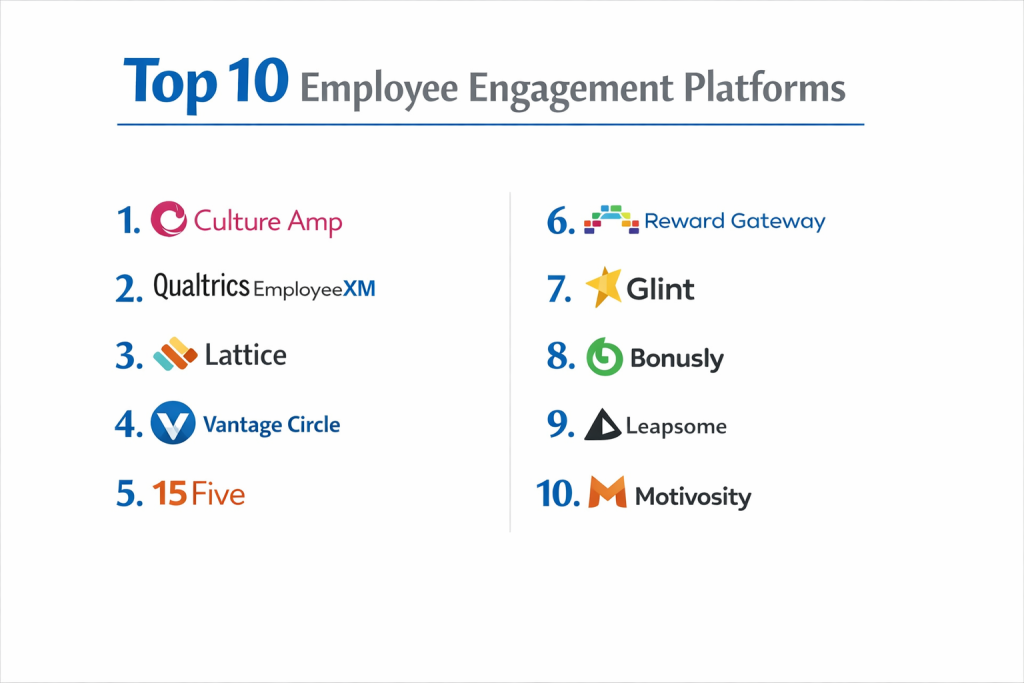
Top 10 Employee Engagement Platforms
1 — Lattice
Lattice is a tool that connects how well a person is doing their job with how happy they feel at work. It is designed for companies that want to move away from old-style annual reviews and toward constant, helpful conversations.
- Key Features:
- Scheduled pulse surveys to track team mood.
- 360-degree feedback where peers and bosses all give input.
- Goal tracking (OKRs) to keep everyone focused on the same targets.
- A “Praise” wall where employees can publicly thank each other.
- Private meeting agendas for one-on-one talks between managers and staff.
- Analytics that show which departments are the happiest.
- Pros:
- Very clean and simple design that is easy to learn.
- Combines performance reviews and engagement in one place.
- Cons:
- It can be expensive if you only want the survey features.
- Setup takes time because there are many settings to adjust.
- Security & Compliance: SOC 2 Type II, GDPR compliant, and uses SSO (Single Sign-On) for safe logins.
- Support & Community: High-quality help articles and a large community of HR professionals who share advice.
2 — Culture Amp
Culture Amp is known for being very scientific. It was built by people who study psychology and data to make sure the survey questions are fair and provide real insights.
- Key Features:
- Pre-made survey templates backed by research.
- Deep data analysis that compares your results to other companies.
- Tools to help improve diversity and inclusion.
- “Text Analytics” that reads employee comments and groups them by topic.
- Action plans that tell managers exactly what to do next.
- Pros:
- Excellent for large companies that need to prove their progress with data.
- The surveys are designed to be “unbiased” and very professional.
- Cons:
- The many charts and graphs can be overwhelming for small teams.
- It is one of the more expensive options on the market.
- Security & Compliance: ISO 27001, SOC 2, and HIPAA compliant for healthcare data.
- Support & Community: Offers a “Culture First” community for users to learn from each other.
3 — 15Five
This tool is based on a simple idea: employees take 15 minutes to write an update, and managers take 5 minutes to read it. It focuses on the relationship between a boss and their direct reports.
- Key Features:
- Weekly “Check-ins” that ask about wins and challenges.
- A “High Five” feature for peer-to-peer appreciation.
- Career growth tracking to help employees plan their future.
- Training modules to help managers become better leaders.
- Anonymous surveys to get the “honest truth” from the team.
- Pros:
- Creates a very regular habit of communication.
- Focuses on coaching and helping people grow, not just “grading” them.
- Cons:
- Some employees may feel that a weekly update is too much work.
- Not as strong in deep data analytics as some other tools.
- Security & Compliance: SOC 2 Type II and GDPR compliant.
- Support & Community: Offers a “15Five Academy” with videos and lessons for managers.
4 — Workleap Officevibe
Officevibe is built for simplicity. It is meant to be a “set it and forget it” tool that automatically checks in with employees so HR doesn’t have to do it manually.
- Key Features:
- Automated weekly surveys that take only a minute to finish.
- A “Safe Space” feedback portal for anonymous comments.
- Simple charts that show 10 different areas of engagement.
- Meeting templates for managers.
- “Good Vibes” cards for quick coworker recognition.
- Pros:
- One of the easiest tools to set up and use right away.
- Very strong focus on keeping employees anonymous.
- Cons:
- It does not have as many “extra” features for performance reviews.
- Reporting is simple, which might not be enough for very large corporations.
- Security & Compliance: SOC 2 and GDPR compliant; data is stored securely in the cloud.
- Support & Community: Good online documentation and email support for all users.
5 — Workday Peakon Employee Voice
Peakon is a heavy-duty tool used by very large global companies. It uses smart technology to listen to thousands of employees at once and give the CEO a summary of what needs to change.
- Key Features:
- Real-time dashboards that update as soon as someone answers a survey.
- Support for over 50 languages for global teams.
- Automatic “Manager Insights” that highlight specific problems in a team.
- Benchmarking against thousands of other businesses in your industry.
- Advanced security for huge amounts of data.
- Pros:
- Can handle massive amounts of data without slowing down.
- Great if you already use Workday for your other HR needs.
- Cons:
- Can be very expensive for small or medium businesses.
- The design feels more like “corporate software” and less like a modern app.
- Security & Compliance: ISO 27001, SOC 2, GDPR, and HIPAA.
- Support & Community: 24/7 technical support for large enterprise clients.
6 — BambooHR
BambooHR is mainly a place to store employee records, but it has a built-in module for engagement. This is perfect for companies that want one single software for everything.
- Key Features:
- eNPS (Net Promoter Score) surveys to see if workers would recommend the company.
- Satisfaction surveys with open text boxes for comments.
- Employee self-service portal where they can see their own info.
- Simple performance check-ins.
- Automatic reminders for birthdays and anniversaries.
- Pros:
- You don’t have to buy a second piece of software if you already use BambooHR.
- Very friendly and easy-to-understand interface.
- Cons:
- The engagement surveys are basic and cannot be customized very much.
- Does not have the deep data science found in tools like Culture Amp.
- Security & Compliance: SOC 2 Type II and GDPR compliant.
- Support & Community: Excellent customer service and a helpful user forum.
7 — Qualtrics EmployeeXM
Qualtrics is a very powerful platform used for “Experience Management.” It tracks the entire journey of an employee, from the day they apply for a job to the day they leave the company.
- Key Features:
- Candidate experience surveys (for people applying for jobs).
- Onboarding surveys for new hires.
- Exit surveys for people leaving the company.
- 360-degree feedback for managers and leaders.
- Predictive analytics that can guess who might be planning to quit.
- Pros:
- Offers the most control over how surveys are designed.
- Can connect employee data to customer data to see how mood affects sales.
- Cons:
- Very difficult to learn; you may need a trained expert to run it.
- The pricing is complex and can get very high.
- Security & Compliance: FedRAMP (for government use), ISO 27001, SOC 2, and GDPR.
- Support & Community: Offers “Qualtrics Basecamp,” an online school for learning the software.
8 — Bonusly
Bonusly is different because it focuses on rewards. It works like a social media feed where employees give each other small amounts of “points” that can be traded for real gift cards.
- Key Features:
- A public feed where everyone can see who is being recognized.
- Gift cards for places like Amazon, Starbucks, and Target.
- Automatic points for birthdays and work anniversaries.
- Analytics that show who the most helpful people in the office are.
- Fun “hashtags” to link recognition to company values.
- Pros:
- Very high participation because employees enjoy getting rewards.
- Great for building a positive, “thank you” culture.
- Cons:
- It is not a survey tool, so it won’t tell you why people are unhappy.
- The cost of the gift cards is an extra expense on top of the software.
- Security & Compliance: SOC 2 Type II and GDPR compliant.
- Support & Community: Easy-to-read help center and friendly email support.
9 — WorkTango
WorkTango is a “full-service” engagement tool. It combines surveys, rewards, and performance tracking into one system. It is meant to be the only tool a manager needs to lead their team.
- Key Features:
- Pulse surveys with real-time results for managers.
- A rewards marketplace for employee recognition.
- Goal setting and tracking for the whole year.
- DEI (Diversity, Equity, and Inclusion) analytics.
- Feedback tools specifically for one-on-one meetings.
- Pros:
- Good for companies that want surveys and rewards in the same app.
- Highly flexible and can be customized to fit your specific company.
- Cons:
- Because it does so many things, it can be a bit confusing at first.
- Some of the screens look a bit dated compared to newer apps.
- Security & Compliance: SOC 2 Type II and GDPR compliant.
- Support & Community: Assigns a dedicated “Success Manager” to help larger companies.
10 — Motivosity
Motivosity is designed to make workers feel like they are part of a community. It focuses on making the workplace more social and ensuring that everyone feels noticed.
- Key Features:
- Interest groups where employees can talk about hobbies (like hiking or gaming).
- Peer-to-peer recognition with a “small dollar” allowance.
- Personality profiles to help coworkers understand each other.
- Pulse surveys and eNPS tracking.
- Leadership tools to help managers have better conversations.
- Pros:
- Very effective at making remote teams feel “closer.”
- Transparent pricing that is easy to understand.
- Cons:
- The social feed can sometimes be a distraction from work.
- Not as much deep data analysis for large HR departments.
- Security & Compliance: SOC 2 compliant and follows GDPR rules.
- Support & Community: Active user groups and a helpful customer support team.
Comparison Table
| Tool Name | Best For | Platform(s) Supported | Standout Feature | Rating |
| Lattice | Growth-stage tech | Web, iOS, Android | Syncs reviews & surveys | 4.7/5 |
| Culture Amp | Data-heavy HR | Web, iOS, Android | Research-backed questions | 4.6/5 |
| 15Five | Manager habits | Web, iOS, Android | Weekly 15-minute updates | 4.5/5 |
| Workleap | Ease of use | Web, Slack, Teams | Fully automated surveys | 4.7/5 |
| Workday Peakon | Global enterprise | Web, iOS, Android | Real-time AI summaries | 4.4/5 |
| BambooHR | SMBs with HRIS | Web, iOS, Android | Built into employee records | 4.5/5 |
| Qualtrics | Deep analytics | Web, iOS, Android | Full lifecycle tracking | 4.3/5 |
| Bonusly | Daily recognition | Web, Slack, Teams | Gift card rewards | 4.8/5 |
| WorkTango | All-in-one needs | Web, iOS, Android | Survey & Reward hybrid | 4.4/5 |
| Motivosity | Social connection | Web, iOS, Android | Employee interest groups | 4.7/5 |
Evaluation & Scoring
We evaluated these tools based on a “Weighted Scoring Rubric.” This means some categories are more important than others when calculating the final grade.
| Criteria | Weight | What We Looked For |
| Core Features | 25% | Can it do surveys, recognition, and goal tracking? |
| Ease of Use | 15% | Is the button to give feedback easy to find? |
| Integrations | 15% | Does it connect to Slack, Teams, or Gmail? |
| Security | 10% | Does it have SOC 2 and GDPR certifications? |
| Performance | 10% | Is the app fast and does it work on phones? |
| Support | 10% | Is there a human to talk to if the software breaks? |
| Price / Value | 15% | Is the cost fair for the features you get? |
Which Employee Engagement Tool Is Right for You?
Choosing a tool depends on the size of your company and what you want to fix. You do not need the most expensive software to get good results. You only need a tool that your workers will actually use.
For Small Businesses (Under 50 Workers)
If your company is small, you may not need a complex system. A simple tool that lets you send a quick survey once a month is often enough. Look for:
- Low Cost: Many tools offer a free version for small teams.
- Easy Setup: You should not need an IT expert to start using it.
- All-in-One Options: If you already use a system for payroll or vacation tracking (like BambooHR), check if it has a feedback tool built-in. This keeps everything in one place.
For Mid-Sized Companies (50 to 500 Workers)
As a company grows, it becomes harder for managers to talk to everyone. You need a tool that helps you see patterns across different departments. Look for:
- Manager Support: Tools like 15Five that give managers tips on how to talk to their teams.
- Peer Recognition: Features that let workers say “thank you” to each other publicly. This helps build a friendly culture without management having to do all the work.
- Integration: The tool should work inside the apps your team already uses, like Slack or Microsoft Teams. If it is too hard to find, people will stop using it.
For Large Enterprises (Over 500 Workers)
Large companies have a lot of data. You need a tool that can handle thousands of answers and turn them into clear reports. Look for:
- Deep Privacy: It must be impossible for a boss to figure out who wrote a specific comment. Workers in large companies often fear speaking up unless they are 100% sure they are anonymous.
- Detailed Sorting: You should be able to look at results by office location, job title, or how long someone has worked at the company.
- Strict Security: The tool must follow law-grade security rules (like ISO or SOC 2) to protect employee personal information.
For Remote or Field Workers
If your workers are not at a desk (like drivers, cleaners, or nurses), a computer-based tool will not work. Look for:
- Mobile Apps: The tool must work well on a phone.
- Short Surveys: People on the move do not have time for 20 questions. They need surveys they can finish in 30 seconds.
- Text Alerts: The ability to send a survey link through a text message instead of an email.
Frequently Asked Questions (FAQs)
1. Do these tools really make employees work harder?
Not exactly. These tools don’t “force” people to work harder. Instead, they help remove the things that make people unhappy (like bad communication). When people are less frustrated, they naturally do a better job.
2. Is it really anonymous?
In most tools, yes. If a team is very small (like 3 people), the software usually hides the results so the manager can’t guess who said what. This is called a “visibility threshold.”
3. How often should we send surveys?
Most experts suggest a “pulse” survey every week or every two weeks. This keeps the feedback fresh. If you only ask once a year, you are getting old news.
4. Can we use these tools for remote workers?
Yes. In fact, these tools are most helpful for remote workers because they don’t have a water cooler or a breakroom to talk in. It gives them a digital place to feel connected.
5. What is the difference between a pulse survey and an annual survey?
An annual survey is very long (50+ questions) and happens once a year. A pulse survey is very short (2-5 questions) and happens often. Pulse surveys are better for catching problems quickly.
6. Do we need an IT expert to set this up?
For most modern tools, no. You usually just need to upload a list of employee emails. However, very large tools like Qualtrics might need a bit more technical help.
7. How much do these platforms cost?
Most cost between $3 and $12 per employee, per month. Some have a setup fee. It is usually a small price to pay compared to the cost of hiring someone new if an old employee quits.
8. Will employees find this annoying?
They might at first if the surveys are too long. The key is to keep them short and—most importantly—show the employees that you are actually changing things based on their answers.
9. Can I see who is giving coworker “points” or “praise”?
Yes, recognition is usually public. This is because public “thank yous” make the whole team feel better, not just the person getting the praise.
10. What if we get bad feedback?
Bad feedback is actually a good thing. It means your employees trust you enough to tell the truth. It gives you a “to-do list” of what needs to be fixed to make the company better.
Conclusion
Finding the right employee engagement platform is about matching the tool to your company’s needs. If you are a small team, look for simplicity and low cost. If you are a global corporation, look for high security and deep data reports.
The most important thing to remember is that a tool cannot fix a bad culture on its own. It is just a thermometer—it tells you if the “room” is too hot or too cold. It is still up to the leaders to turn the dial and make things better.