Introduction
A drug discovery platform is an integrated suite of software tools and data resources designed to accelerate and de-risk the complex process of finding new medicines. It’s a digital ecosystem that brings together computational chemistry, biology data, predictive modeling, and project management to help scientists go from a biological target (like a protein causing disease) to a promising drug candidate faster and with better odds of success.
The importance of these platforms is immense. The traditional drug discovery process is astronomically expensive, slow, and fraught with failure. Modern platforms combat this by using artificial intelligence (AI) to predict how molecules will behave, virtual screening to test millions of compounds in a computer, and data analytics to prioritize the best experiments. They connect siloed data, enable collaboration, and turn scientific intuition into data-driven decisions, potentially saving years and hundreds of millions of dollars per project.
Key real-world uses include a computational chemist using AI to design novel molecules that perfectly fit a disease target, a biologist analyzing high-throughput screening data to find “hits,” or a project team managing the pipeline of dozens of potential drugs from early discovery through preclinical testing.
When choosing a drug discovery platform, you should look for its core scientific capabilities (like virtual screening or AI design), the quality and breadth of its integrated data (chemical, biological, genomic), ease of use for scientists (not just IT specialists), collaboration features, and how well it scales from early research to later stages. The ability to integrate with your existing lab instruments and data systems is also crucial.
Best for: These platforms are essential for computational chemists, medicinal chemists, biologists, and project leaders in pharmaceutical companies, biotechnology startups, academic research institutions, and contract research organizations (CROs). They benefit organizations aiming to innovate in small-molecule drug discovery, biologics, and increasingly, gene and cell therapies.
Not ideal for: Researchers focused solely on very late-stage clinical trial management (where clinical trial platforms are better). Labs working only on basic, early-stage biology without compound design. Organizations with a one-time, simple analysis need may use standalone point solutions instead of an integrated platform.
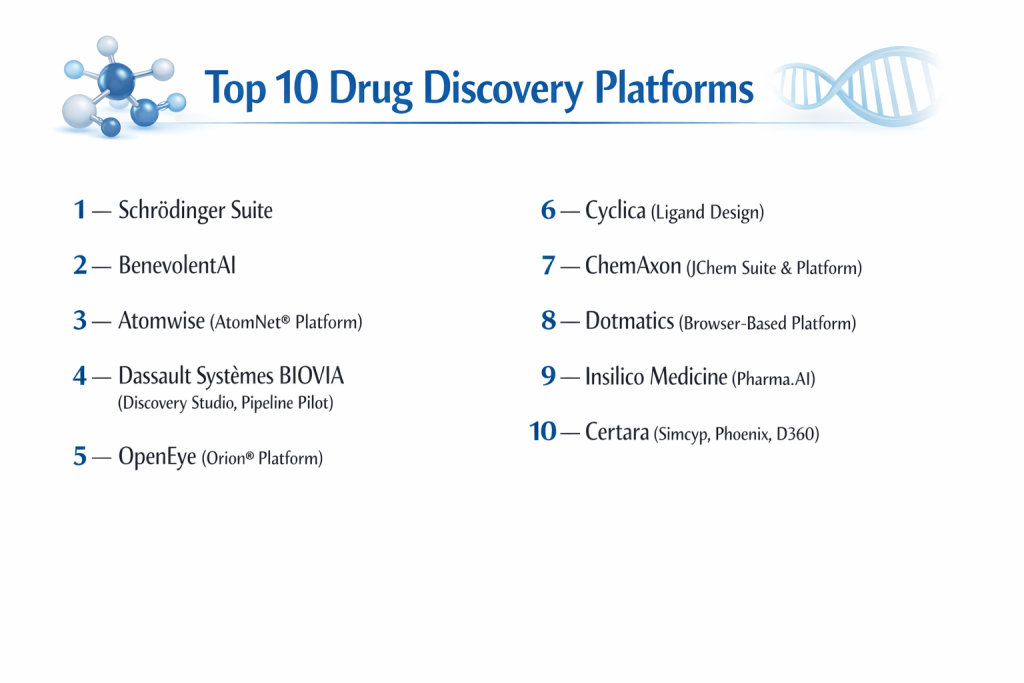
Top 10 Drug Discovery Platforms
Here is a detailed look at ten of the most influential and capable platforms shaping the future of drug discovery.
1 — Schrödinger Suite
The Schrödinger Suite is a comprehensive, physics-based computational platform that is an industry standard for molecular modeling and simulation. It’s known for rigorous scientific accuracy and depth.
Key features:
- Physics-Based Methods: Utilizes first-principles, physics-based calculations (like FEP+) for highly accurate prediction of protein-ligand binding affinities, a gold-standard in the field.
- Integrated Desktop & Cloud: Offers powerful desktop applications (Maestro) combined with scalable cloud-based computing (LiveDesign) for running large simulations.
- End-to-End Workflow: Covers the entire early discovery process: target analysis, virtual screening, lead optimization, and property prediction.
- Extensive Scientific Force Fields: Develops and uses its own highly trusted force fields (like OPLS) for simulating molecular interactions.
- Macrocycle & Antibody Modeling: Strong capabilities for modeling complex molecules like macrocycles and biologics, including antibody design.
- Materials Science Suite: Extends its powerful engine to materials science and chemical development.
Pros:
- Unmatched Scientific Rigor: Its physics-based approaches are considered the most accurate for critical decisions, reducing costly experimental dead-ends.
- Deep Industry Penetration & Trust: Used as a validation tool by a vast number of pharmaceutical companies, making it a safe, credible choice.
- Comprehensive Science Coverage: From small molecules to antibodies, it handles a wide range of drug discovery challenges.
Cons:
- High Cost & Steep Learning Curve: Licensing is expensive, and using its advanced features requires significant expertise in computational chemistry.
- Computationally Intensive: High-accuracy methods like FEP+ require substantial cloud or cluster computing resources, adding to cost.
- Can Be Less Agile for AI Exploration: While integrating ML, its core strength is in precise simulation rather than ultra-high-throughput AI screening of billions of molecules.
Security & compliance: Enterprise-grade security for its cloud platform (LiveDesign), including data encryption, SSO, and audit trails. Can be deployed in compliant environments, though specific validation for regulated GxP work is typically client-led.
Support & community: Renowned for its exceptional scientific support team. Hosts annual user group meetings and has a large, expert community in both industry and academia.
2 — BenevolentAI
BenevolentAI is an end-to-end AI-powered drug discovery platform. It starts with novel target identification using biomedical knowledge graphs and extends through to molecule design, representing a fully AI-driven approach.
Key features:
- Biomedical Knowledge Graph: Integrates and reasons over vast, disparate public and proprietary data (literature, patents, omics data) to propose novel disease targets and mechanisms.
- Target Identification Engine: Uses AI to uncover previously unknown or underappreciated biological targets with strong disease links.
- AI-Driven Molecule Design: Its chemistry AI designs novel molecules optimized for the identified target, synthesizability, and safety.
- Integrated Lab Data Integration: Incorporates results from internal biological and chemical experiments to continuously refine its AI models.
- End-to-End Pipeline: Manages the progression of programs from hypothesis to candidate, all within a unified AI-centric framework.
- Partnered & Proprietary Pipelines: Works both in partnerships with pharma and on its own internal drug programs.
Pros:
- Novel Target Discovery: Its core differentiator is the ability to find new starting points for diseases with high unmet need, moving beyond established biology.
- Closed-Loop AI Learning: The integration of wet-lab data creates a powerful feedback cycle that improves AI predictions over time.
- Platform Validation by Internal Pipeline: Its credibility is bolstered by advancing its own AI-generated programs into clinical trials.
Cons:
- “Black Box” Concerns: Like many complex AI systems, the rationale behind some target or molecule suggestions can be difficult to fully interpret.
- Partnership-Focused Access: For external organizations, access is typically through major multi-program collaborations, not traditional software licensing.
- Less Suited for “Me-Too” Chemistry: The platform’s strength is in innovation; it may be over-engineered for straightforward optimization of known chemical series.
Security & compliance: As a platform handling highly sensitive IP and biological data, it employs stringent security protocols. Its specific compliance certifications are tailored to its partnership model and internal R&D.
Support & community: Engagement is through deep, strategic partnerships with dedicated joint teams. It has a growing profile in the AI drug discovery community through publications and conferences.
3 — Atomwise (AtomNet® Platform)
Atomwise uses deep learning convolutional neural networks (its AtomNet® technology) for ultra-high-throughput virtual screening. It specializes in predicting how small molecules will interact with protein targets.
Key features:
- AtomNet® Deep Learning: A structure-based AI model trained on millions of experimental data points to predict binding.
- Massive Virtual Screening: Can screen libraries of billions of make-on-demand or virtual compounds in a matter of days.
- Target Agnostic: Can model any protein target with a known or predicted 3D structure, including challenging ones.
- Turnkey Partnership Model: Companies provide a target; Atomwise performs the screen and returns a shortlist of prioritized, purchasable hit compounds.
- Focus on Novel Chemical Matter: Excels at finding unexpected, non-obvious starting points outside known patent space.
- Integration with CROs: Has partnerships with synthesis and testing CROs to rapidly validate computational hits.
Pros:
- Unparalleled Screening Scale & Speed: Its ability to evaluate billions of compounds is a transformative advantage over traditional methods.
- Proven Hit-Finding Success: Has a strong public track record of identifying validated hits for difficult targets across multiple partnerships.
- Low-Risk, Pay-for-Success Models: Often works on milestone-based deals, reducing upfront risk for partners.
Cons:
- Service-Centric, Not Software: Access is primarily through a collaborative service or partnership, not as a self-service software platform you license.
- Limited Control & Transparency: Partners rely on Atomwise’s internal pipeline and AI models; there’s less ability to tweak or interrogate the core algorithm.
- Primarily for Early Hit ID: Its core offering is focused on the very first step; optimization and later-stage work require other tools or further collaboration.
Security & compliance: As a service provider handling confidential target information, it has strong data security and IP protection frameworks in place, governed by partnership agreements.
Support & community: Interaction is channeled through partnership managers and scientific collaboration teams. It is a prominent and active member of the AI drug discovery ecosystem.
4 — Dassault Systèmes BIOVIA (Discovery Studio, Pipeline Pilot)
The BIOVIA portfolio from Dassault Systèmes offers both deep point solutions and a workflow automation platform, integrated into a broader digital ecosystem for life sciences.
Key features:
- Discovery Studio: A comprehensive desktop application for molecular modeling, simulation, and biotherapeutics design.
- Pipeline Pilot: A visual, drag-and-drop scientific workflow platform that automates data analysis, modeling, and reporting, connecting diverse tools and data sources.
- Integrated Materials & Formulation: Unique connection to materials and formulation science, useful for complex modalities and drug product development.
- 3DEXPERIENCE Platform Integration: Can be part of the larger platform connecting discovery data to process development, manufacturing, and quality.
- Broad Scientific Methods: Includes tools for QSAR, pharmacophore modeling, protein modeling, and antibody sequence analysis.
- Extensible & Scriptable: Highly customizable through scripting and component development.
Pros:
- Workflow Automation Powerhouse: Pipeline Pilot is exceptional for automating repetitive data analysis and building custom decision-making protocols.
- Enterprise-Level Integration: Fits into a strategic vision of connected data from discovery through commercialization.
- Deep & Broad Science: Covers a very wide range of computational techniques in one vendor’s portfolio.
Cons:
- Complexity & Fragmentation: The product portfolio can be complex to navigate, and integrating the various tools requires expertise.
- High Total Cost of Ownership: Enterprise licensing and the need for specialist administrators make it a major investment.
- User Experience Variance: Some components have dated interfaces, and the overall scientist experience can be less seamless than modern unified platforms.
Security & compliance: Part of Dassault Systèmes’ enterprise security framework. Suitable for deployment in secure, regulated environments. Offers audit trails and data governance features.
Support & community: Backed by a global enterprise support organization. Has established user communities and conferences for both Discovery Studio and Pipeline Pilot.
5 — OpenEye (Orion® Platform)
OpenEye, a Cadence company, is known for its rigorous focus on computational method development, speed, and scalability. Its Orion® platform is a cloud-native toolkit built for large-scale molecular design.
Key features:
- Focus on Speed & Scalability: Algorithms are engineered for performance, enabling large-scale virtual screening and free-energy calculations on cloud infrastructure.
- Orion® Cloud Native Platform: A pure SaaS environment with pay-as-you-go pricing, eliminating IT overhead.
- Leading Free Energy Perturbation (FEP): Offers fast, reliable FEP calculations for accurate binding affinity prediction as a managed service.
- Toolkit Philosophy: Provides a set of powerful, interoperable components (for docking, shape similarity, etc.) that experts can combine flexibly.
- Strong in Cheminformatics & Design: Excellent toolkits for molecular design, library enumeration, and molecular shape analysis.
- Hybrid & Quantum Computing Ready: Actively involved in research for next-generation computing applications in chemistry.
Pros:
- Computational Performance: Its tools are consistently among the fastest and most efficient in benchmarks.
- Modern, Cloud-First Approach: Orion® offers a compelling SaaS model that scales elastically with project needs.
- Transparent & Predictable SaaS Pricing: Pay-per-use models on Orion® can be more accessible than large upfront licenses.
Cons:
- Less “Out-of-the-Box” Workflow: Requires more assembly and expertise to build end-to-end workflows compared to guided platforms.
- Primarily for Computational Experts: The toolkit approach is powerful but has a steeper learning curve for non-specialists.
- Smaller Market Share: While highly respected, it has a smaller overall user community than some established desktop giants.
Security & compliance: The Orion® cloud platform is built on AWS with robust security. Data is encrypted, and the company is proactive about compliance standards relevant to life sciences IP.
Support & community: Known for very strong, scientifically savvy technical support. Has a dedicated and expert user base, particularly in computational chemistry groups.
6 — Cyclica (Ligand Design)
Cyclica focuses on a polypharmacology-aware approach to drug discovery. Its platform predicts how compounds interact with the entire human proteome to optimize for efficacy and safety early on.
Key features:
- Proteome-Wide Screening: Uses AI to predict a molecule’s interaction profile across thousands of human protein structures, not just the primary target.
- Polypharmacology Optimization: Helps design molecules with desired multi-target profiles (for efficacy) while avoiding undesirable off-targets (for safety).
- Differentiated Safety Prediction: Flags potential safety liabilities (like hERG, kinase off-targets) much earlier in the design process.
- Integrated Affinity & Property Prediction: Combines binding predictions with ADMET (Absorption, Distribution, Metabolism, Excretion, Toxicity) property forecasts.
- Partnership & Licensing Model: Access is typically gained through collaboration to screen libraries or design compounds for specific projects.
- Data-Driven Target Identification: Can also propose new targets for existing compounds or natural products.
Pros:
- Holistic View of Compound Effects: Moving beyond “one target, one drug” to a systems biology view can de-risk later-stage failure.
- Early De-risking for Safety: Identifying problematic off-targets before synthesis saves significant time and resources.
- Novel Repurposing Opportunities: Can find new uses for existing compounds by revealing unknown interactions.
Cons:
- Predictive Model Limitations: Accuracy depends on the quality of proteome-wide models, which is an immense scientific challenge.
- Service-Leaning Access: Like many AI-native companies, primary access is through partnerships rather than self-service software.
- Niche Positioning: Its core value proposition is most critical for specific discovery paradigms focused on polypharmacology or severe safety concerns.
Security & compliance: Maintains high security standards for confidential partner data. Specific certifications are aligned with its biotech partnership business model.
Support & community: Engages via scientific collaboration within partnerships. It is an active contributor to the polypharmacology and AI drug discovery scientific discourse.
7 — ChemAxon (JChem Suite & Platform)
ChemAxon is a foundational provider of cheminformatics tools and libraries. Its strength lies in managing, searching, and visualizing chemical information, serving as the “chemical intelligence” layer for many discovery platforms.
Key features:
- Industry-Standard Cheminformatics: Provides robust, reliable tools for chemical structure search, registration, standardization, and naming (like IUPAC).
- JChem Cartridge & Engines: Embeddable chemistry toolkits that power chemical intelligence in many third-party and in-house databases and applications.
- MarvinSuite: A comprehensive set of desktop tools for drawing, modeling, property prediction, and reactions.
- Compound Library Management: Excellent for building, curating, and searching corporate compound collections and virtual libraries.
- Extensive API & Integrations: Designed to be integrated into almost any IT environment or scientific workflow.
- Calculator Plugins: A wide array of plugins for predicting physicochemical and ADMET properties.
Pros:
- De Facto Standard for Chemistry Intelligence: Its tools are embedded in countless pharma IT systems, ensuring reliability and interoperability.
- Developer-Friendly & Flexible: Its APIs and components are designed for integration, making it a favorite for building custom solutions.
- Critical Foundational Layer: Often the unseen but essential backbone that enables other, more flashy applications to work correctly.
Cons:
- Not a Complete Discovery Platform: It is a toolkit and component provider, not an out-of-the-box workflow platform for end-user scientists.
- Requires Development Effort: To create user-facing applications, significant in-house IT or development resources are needed.
- User Interface Variance: While powerful, some end-user desktop tools have a utilitarian, less modern feel.
Security & compliance: Provides the tools for secure chemical data management. Final security and compliance depend on how the tools are implemented and deployed within the client’s secure IT environment.
Support & community: Has a very strong, long-standing community of users and developers. Known for good technical support and annual user meetings focused on cheminformatics.
8 — Dotmatics (Browser-Based Platform)
Dotmatics offers a unified, browser-based platform that focuses on integrating scientific data, streamlining workflows, and providing analytics across the discovery continuum, from biology to chemistry.
Key features:
- Unified Browser-Based Interface: Provides a single, web-accessible platform for biologists, chemists, and project managers to access all project data.
- Scientific Data Management: Core strength in capturing, managing, and searching diverse data types: assays, compounds, sequences, images.
- Visualization & Analytics: Strong tools for interactive data visualization, graphing, and generating insights from integrated datasets.
- Electronic Lab Notebook (ELN) & LIMS: Includes integrated modules for ELN and lab inventory management (LIMS), connecting the digital and physical lab.
- Workflow & Study Management: Helps organize and track the progress of experiments and projects.
- Extensive Integrations: Connects with a wide range of instruments, data sources, and third-party software (like Schrödinger).
Pros:
- Excellent for Data Integration & Collaboration: Breaks down data silos between biology and chemistry teams effectively.
- Scientist-Friendly Web Access: Lowers IT barriers; scientists can access and analyze data from anywhere.
- Broad Functional Coverage: Covers data management, analysis, and basic informatics needs in one commercially supported platform.
Cons:
- Less Depth in Cutting-Edge Computation: While it integrates external tools, its native molecular design and AI capabilities are not its primary strength compared to specialized platforms.
- Can Be Configurable but Complex: Tailoring the platform to specific needs can require professional services or admin expertise.
- Performance with Massive Datasets: May face challenges with the ultra-large datasets generated by some modern screening technologies.
Security & compliance: Enterprise-grade cloud or on-premise deployment options with robust security, SSO, and audit trails. Used in regulated GLP/GMP environments.
Support & community: Provides global commercial support and professional services. Has a large and active user community with annual symposia.
9 — Insilico Medicine (Pharma.AI)
Insilico Medicine’s Pharma.AI platform is a prominent example of a generative AI-driven platform, using AI not just to predict but to create novel molecular structures and biological hypotheses from scratch.
Key features:
- Generative Chemistry AI (Chemistry42): Uses generative adversarial networks (GANs) and reinforcement learning to invent novel, optimal molecular structures meeting multiple constraints.
- Target Identification AI (PandaOmics): Analyzes multi-omics data and textual information to identify and prioritize novel drug targets with associated biomarkers.
- Clinical Trial Prediction AI (InClinico): Predicts clinical trial outcomes to help design better trials and de-risk development.
- End-to-End AI Pipeline: Aims to connect AI from target discovery through candidate generation.
- Partnered & Internal Drug Pipelines: Validates its platform by advancing internally generated programs into the clinic.
- Focus on Aging & Age-Related Diseases: Has a strong research focus on longevity and diseases like fibrosis, oncology, and immunology.
Pros:
- True Generative Molecular Design: Can propose entirely new chemical matter that human chemists might not conceive, exploring novel chemical space.
- Rapid Hypothesis Generation: Can generate multiple target and molecule hypotheses at unprecedented speed for a given disease area.
- Full-Spectrum AI Ambition: One of the few platforms publicly aiming to cover the entire discovery and development value chain with AI.
Cons:
- High “Black Box” Nature: The generative process can be difficult to steer or explain chemically, raising questions about synthesizability and IP strategy.
- Early-Stage Validation: While promising, the ultimate validation—approved drugs from its platform—is still years away.
- Partnership-Based Access Model: For external use, it operates primarily through collaborative partnerships rather than software licensing.
Security & compliance: Implements stringent security for its AI models and partner data. Its compliance focus is aligned with its hybrid R&D company and partnership structure.
Support & community: Engagement is through deep R&D collaborations. It is a highly visible and prolific contributor to AI drug discovery literature and conferences.
10 — Certara (Simcyp, Phoenix, D360)
Certara provides a platform focused on model-informed drug discovery and development (MID3), using quantitative methods to predict human pharmacokinetics and pharmacodynamics.
Key features:
- Physiologically-Based Pharmacokinetics (PBPK): Simcyp™ simulator is the industry leader for predicting how drugs are absorbed, distributed, metabolized, and excreted in virtual human populations.
- Pharmacokinetic/Pharmacodynamic (PK/PD) Modeling: Phoenix™ WinNonlin® is the standard for non-compartmental analysis and PK/PD modeling of preclinical and clinical data.
- Scientific Data Visualization & Analysis: D360 is an informatics platform for searching, visualizing, and analyzing integrated discovery data.
- Biomarker & Clinical Trial Simulation: Tools to model disease progression and predict clinical trial outcomes.
- Regulatory Science Integration: Platforms are widely used to support regulatory submissions to agencies like the FDA and EMA.
- Focus on Translation: Specializes in bridging the gap between preclinical data and human outcomes, de-risking late-stage failure.
Pros:
- Regulatory-Endorsed Translation: Its PBPK and modeling approaches are widely accepted by regulators, adding critical credibility.
- De-Risks Clinical Development: Provides the best-in-class tools to predict human dose, formulation impact, and drug-drug interactions early on.
- Integrated Quantitative Platform: Combines data analysis, modeling, and simulation in a connected suite.
Cons:
- Later-Stage Focus: Its greatest value is realized when you have compound data to model; it’s less about the initial design of molecules.
- Specialized User Base: Requires expertise in pharmacokinetics, pharmacology, and quantitative modeling.
- High Cost: The software licenses and need for specialist modelers represent a significant investment.
Security & compliance: Software is used in highly regulated GxP environments. Certara provides validation support and its cloud offerings adhere to industry security standards.
Support & community: Offers strong scientific support and consulting services. Has a massive user base in pharma and regulatory agencies, with well-attended global user group meetings.
Comparison Table
| Tool Name | Best For | Platform(s) Supported | Standout Feature | Rating |
|---|---|---|---|---|
| Schrödinger Suite | Large Pharma & Biotech needing rigorous physics-based simulation | Desktop (Maestro), Cloud (LiveDesign) | Gold-standard FEP+ for binding affinity prediction | 4.7/5 |
| BenevolentAI | AI-native discovery for novel target & molecule identification | Cloud Platform (Partnership access) | End-to-end AI from knowledge graph to molecule design | 4.5/5 |
| Atomwise | Ultra-high-throughput virtual screening for hit identification | Cloud Service (Partnership model) | Screening billions of compounds with AtomNet® AI | 4.6/5 |
| Dassault BIOVIA | Enterprise workflow automation & integrated modeling | Desktop, Server (Pipeline Pilot) | Pipeline Pilot scientific workflow automation | 4.4/5 |
| OpenEye Orion® | Computational chemists wanting scalable, cloud-native toolkits | Cloud (SaaS) | High-performance, pay-as-you-go cloud toolkits | 4.3/5 |
| Cyclica | Early polypharmacology & safety profiling | Cloud Platform (Partnership access) | Proteome-wide off-target prediction & polypharmacology design | 4.2/5 |
| ChemAxon | Cheminformatics foundation & chemical data management | Desktop, Server, Embedded | Industry-standard chemical intelligence toolkits | 4.5/5 |
| Dotmatics | Integrated data management & collaboration for multi-disciplinary teams | Web Browser (Cloud/On-prem) | Unified data platform for biologists & chemists | 4.3/5 |
| Insilico Pharma.AI | Generative AI for novel molecule & target invention | Cloud Platform (Partnership access) | Generative AI for de novo molecular design | 4.4/5 |
| Certara | Model-informed drug development & translational prediction | Desktop, Cloud | Leading PBPK (Simcyp) & PK/PD modeling for human translation | 4.7/5 |
Evaluation & Scoring of Drug Discovery Platforms
To find the right system, weigh its performance in these key areas based on your organization’s stage and strategy.
| Evaluation Category | Weight | What to Look For | Top Performer Example |
|---|---|---|---|
| Core Features | 25% | Scientific depth (AI, simulation, modeling), data breadth, coverage of discovery stages (target → candidate). | Schrödinger, Certara |
| Ease of Use | 15% | Intuitive for scientists (chemists, biologists), minimal coding required, good visualization and workflows. | Dotmatics, OpenEye Orion® |
| Integrations & Ecosystem | 15% | API availability, connections to ELN/LIMS, instrument data, commercial and proprietary databases. | Dotmatics, ChemAxon |
| Security & Compliance | 10% | IP protection, data encryption, audit trails, deployment options for secure/regulated work. | All Enterprise Vendors |
| Performance & Reliability | 10% | Speed of calculations, platform uptime, ability to handle massive datasets and cloud scaling. | OpenEye Orion®, Schrödinger |
| Support & Community | 10% | Quality of scientific & technical support, training, active user community for knowledge sharing. | Schrödinger, ChemAxon |
| Price / Value | 15% | Total cost (license, services, compute) vs. ROI in accelerated timelines and reduced experiment cost. | OpenEye Orion® (SaaS), Partnership Models |
Which Drug Discovery Platform Is Right for You?
Your choice is dictated by your organization’s size, stage, scientific focus, and risk tolerance.
- Academic Labs & Solo Researchers: You need low-cost, accessible tools. OpenEye Orion® (pay-per-use) or core components from ChemAxon or BIOVIA (through academic discounts) are key. Cloud credits for Schrödinger or Amazon Omics may also be relevant.
- Biotech Startups (SMB): You need speed, focus, and to de-risk specific steps. Partner with an AI service provider (Atomwise, Cyclica, Insilico) for hit ID or design. Use Dotmatics to manage early data. Consider OpenEye Orion® for scalable computation.
- Mid-Market Biotech/Pharma: You need a balanced, integrated platform. Dotmatics provides excellent data unification. Schrödinger offers deep computational rigor. Certara becomes critical as compounds advance. A hybrid strategy is common.
- Large Pharmaceutical Enterprises: You need enterprise-scale, validated, and integrated solutions. You likely use Schrödinger and Certara as standards, ChemAxon as a foundation, Dotmatics for data flow, and engage in multiple AI partnerships (BenevolentAI, Insilico) for innovation.
Budget-conscious vs. premium solutions: OpenEye Orion®’s SaaS model offers flexibility. Partnership models with AI firms transfer upfront cost to success-based milestones. Schrödinger and Certara represent major capital investments but are considered cost-of-doing-business for large players.
Feature depth vs. ease of use: Schrödinger and computational toolkits offer immense depth for experts. Dotmatics and modern SaaS platforms prioritize accessibility for broader teams of scientists.
Integration and scalability needs: If connecting diverse data is the pain point, Dotmatics and Pipeline Pilot excel. For sheer computational scalability, cloud-native OpenEye Orion® and Schrödinger LiveDesign lead. AI platforms require integration of their outputs into your chemistry workflow.
Security and compliance requirements: All enterprise vendors support secure deployments. For late-stage work supporting regulatory filings, Certara‘s tools are validated for this purpose. IP protection is paramount in all AI and data partnerships.
Frequently Asked Questions (FAQs)
1. What’s the difference between a traditional modeling platform and an AI platform?
Traditional platforms (like Schrödinger) use physics-based rules and simulations. AI platforms use machine learning models trained on vast datasets to find patterns and make predictions, often excelling at speed and identifying non-obvious patterns but sometimes acting as a “black box.”
2. Can an AI platform replace medicinal chemists?
No. AI is a powerful tool that augments chemists. It generates ideas and prioritizes options, but human expertise is crucial for judging synthesizability, interpreting complex data, understanding IP landscape, and making final strategic decisions.
3. How do I justify the high cost of these platforms?
Build a business case based on ROI: reduced cycle times (months saved), increased success rates (fewer failed compounds synthesized and tested), and more efficient use of expensive lab resources (FTEs, assays). Pilot projects with clear metrics are key.
4. Is cloud-based deployment safe for our confidential IP?
Reputable vendors use enterprise-grade security on major cloud providers (AWS, Azure, GCP) with encryption, strict access controls, and contractual IP protection. The risk is often lower than maintaining insecure on-premise systems.
5. How long does it take to implement and get value from a platform?
Point solutions or SaaS tools (like OpenEye Orion®) can provide value in days/weeks. Enterprise platform rollouts (like Dotmatics, Schrödinger suite-wide) can take 6-18 months for full integration and user adoption.
6. Can we build our own platform instead of buying?
It’s possible but extremely challenging. It requires deep expertise in software engineering, cheminformatics, data science, and UI/UX, and the ongoing cost of maintenance and updates often outweighs the initial perceived savings.
7. How do we handle data from partnerships with AI firms?
Clear legal agreements are essential. Define IP ownership (for inputs, outputs, and background knowledge), data usage rights, and publication policies upfront. Ensure there’s a plan for data repatriation at the project’s end.
8. What’s more important: the best algorithms or the best data?
They are symbiotic. The best algorithms are useless with poor-quality, biased data. Clean, well-organized, and extensive proprietary data is a massive competitive advantage that can make even standard algorithms perform exceptionally for you.
9. Do we need one unified platform or a “best-in-breed” mix?
Most organizations use a mix. A unified data platform (like Dotmatics) is crucial for collaboration, but you will likely also license specialized tools for modeling (Schrödinger), AI (via partnership), and translation (Certara).
10. What’s the biggest mistake in selecting a platform?
Choosing based on a flashy demo or a single feature without involving the end-user scientists in the evaluation. If the platform isn’t adopted by the chemists and biologists, it will fail regardless of its technical capabilities.
Conclusion
Selecting a drug discovery platform is a strategic decision that aligns with your organization’s scientific ambition and operational reality. The landscape is diverse, spanning the rigorous simulation of Schrödinger, the data-unifying power of Dotmatics, the generative AI of Insilico Medicine, and the translational science of Certara.
There is no single winner. A large pharmaceutical company will use a completely different stack than a three-person biotech startup. The key is to honestly assess your primary bottleneck: Is it finding a novel starting point? Optimizing molecules efficiently? Predicting human outcomes? Or simply managing the data you already have?
The best platform is the one that solves your most critical problem, fits within your technical and financial means, and—above all—will be embraced by your scientists. By focusing on specific needs rather than generic checklists, you can invest in technology that genuinely accelerates the noble and arduous journey of bringing new medicines to patients.