Introduction
Digital Identity Wallets are secure mobile or web applications that allow individuals and organizations to store, manage, and share verified personal information digitally. Think of them as a high-security version of a physical wallet, but instead of leather and card slots, they use advanced cryptography to hold digital versions of government IDs, professional credentials, health records, and banking details. These wallets operate on the principle of Self-Sovereign Identity (SSI), meaning the user—not a central database provider—owns their data and decides exactly who gets to see it. When a user needs to prove their identity, they share a “verifiable credential” from the wallet, which the receiving party can instantly validate without contacting the original issuer.
The importance of digital identity wallets has skyrocketed as our lives move further online. They solve the “identity crisis” of the internet: the reliance on insecure passwords and the constant over-sharing of personal data. By using these wallets, organizations can eliminate the risks associated with storing sensitive customer data (since the data stays in the user’s wallet), while individuals enjoy a “one-click” verification experience that is more secure than physical cards. Whether it is opening a bank account, proving age at a store, or accessing government services, these tools provide a seamless, tamper-proof bridge between the physical and digital worlds.
Key Real-World Use Cases
Digital identity wallets are transforming how we interact across multiple sectors:
- Passwordless Authentication: Logging into corporate systems or websites using a secure biometric handshake from the wallet instead of a vulnerable password.
- Reusable KYC in Banking: Completing identity verification once and reusing that verified “stamp” to open accounts at other financial institutions instantly.
- Digital Travel Credentials: Storing e-passports and visas in a wallet to breeze through automated airport gates and hotel check-ins.
- Verified Employee Onboarding: Instantly proving degrees, certifications, and previous work history to a new employer without manual background checks.
- Healthcare Portability: Carrying verified immunization records or prescriptions that can be shared securely with any doctor or pharmacist globally.
What to Look For (Evaluation Criteria)
When evaluating digital identity wallets, particularly for enterprise adoption, consider these four factors:
- Interoperability: Does the wallet follow open standards like W3C Verifiable Credentials and DID (Decentralized Identifiers) so it can talk to other systems?
- User Experience (UX): Is the interface simple enough for a non-technical person to manage their most sensitive documents without getting locked out?
- Security Architecture: Does it use “Zero-Knowledge Proofs” (allowing you to prove you are over 18 without revealing your actual birth date)?
- Ecosystem Support: How many issuers (governments, banks, universities) actually support sending credentials to this specific wallet?
Best for:
- Governments and Public Sector: Organizations aiming to digitize national IDs and driver’s licenses for citizen services.
- Financial Institutions: Banks looking to reduce KYC costs and friction through reusable, pre-verified identities.
- High-Security Enterprises: Companies that need to manage secure access for employees and contractors across multiple locations.
- Health and Education Providers: Institutions that issue high-value credentials like medical licenses or diplomas.
Not ideal for:
- Local Small Retailers: A business that only needs a simple loyalty card program likely doesn’t need a full-scale decentralized identity infrastructure.
- Simple Social Media Apps: If the only requirement is an email address and a nickname, a digital identity wallet adds unnecessary friction for the user.
- Environments without Smartphones: Since these wallets are primarily mobile-first, they are not ideal for populations without reliable access to modern mobile devices.
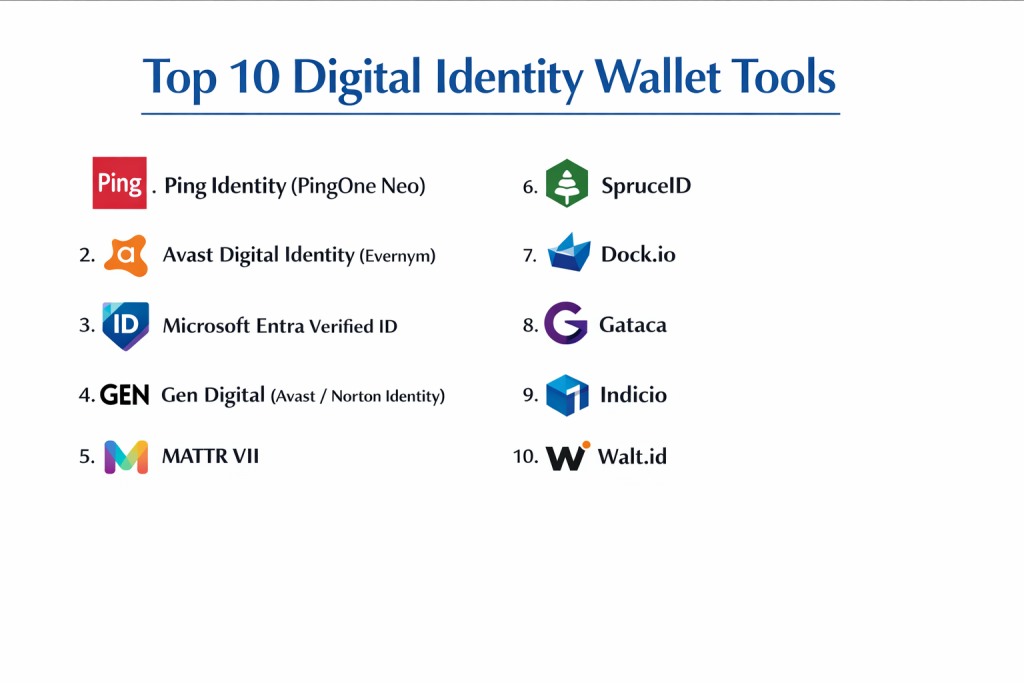
Top 10 Digital Identity Wallets Tools
1 — Ping Identity (PingOne Neo)
Ping Identity is a veteran in the identity space. Their PingOne Neo solution is a leading enterprise-grade platform that allows businesses to issue and verify digital credentials with ease.
Key features:
- Standards-Based Framework: Built on W3C and OpenID Connect (OIDC) standards for maximum interoperability.
- Easy Credential Issuance: A simplified portal for businesses to turn employee or customer data into verifiable credentials.
- Privacy-First Design: Uses decentralized identity principles so that user data is never stored centrally by Ping.
- Dynamic Linking: Allows credentials to be updated in real-time if a user’s status changes (e.g., a professional license expires).
- Native Integration: Plugs directly into the broader PingOne Cloud platform for a total identity lifecycle solution.
Pros:
- Backed by one of the most trusted names in enterprise identity management.
- Excellent documentation for developers looking to integrate identity wallets into existing apps.
Cons:
- Primarily geared toward large enterprises; can be cost-prohibitive for smaller organizations.
- The feature set is so broad that it may require a dedicated architect to implement correctly.
Security & compliance: SOC 2 Type II, ISO 27001, GDPR compliant, and FIPS 140-2 validated encryption.Support & community: 24/7 global support, an extensive developer portal, and a massive community of IAM (Identity & Access Management) professionals.
2 — Avast Digital Identity (Evernym)
Following the acquisition of Evernym, Avast has become a powerhouse in the SSI (Self-Sovereign Identity) world, offering the “Connect.me” wallet and a robust infrastructure for developers.
Key features:
- Hyperledger Indy/Aries Integration: Built on the most respected open-source foundations for decentralized identity.
- Connect.me Wallet: A white-label-ready mobile app for users to manage their digital credentials securely.
- Zero-Knowledge Proofs (ZKP): Allows users to share specific attributes (like “over 21”) without revealing all their data.
- Verity Flow: A low-code tool for businesses to design credential issuance and verification workflows.
- Cross-Cloud Support: Works across different cloud providers and blockchain networks.
Pros:
- One of the most mature SSI implementations in the market today.
- High emphasis on true decentralization, giving users total control over their data.
Cons:
- SSI concepts can be difficult for non-technical business leaders to grasp initially.
- Setup of a “trust anchor” on a public ledger can be a complex technical hurdle.
Security & compliance: SOC 2, GDPR, and heavily audited open-source cryptography.Support & community: Deep ties to the Linux Foundation and Hyperledger communities; excellent enterprise-grade support.
3 — Microsoft Entra Verified ID
Microsoft entered the decentralized identity market with a splash, integrating Verified ID into its massive Entra (formerly Azure AD) ecosystem.
Key features:
- Azure Integration: Allows existing Azure AD customers to issue credentials based on current employee data with a few clicks.
- Microsoft Authenticator Support: Uses the ubiquitous Microsoft Authenticator app as the user’s identity wallet.
- Global Scalability: Leverages Microsoft’s global cloud infrastructure for high-availability verification.
- Open Standards: Fully supports W3C Verifiable Credentials and ION (Identity Overlay Network).
- Developer SDKs: Comprehensive libraries for building identity verification into web and mobile applications.
Pros:
- If your organization is already in the Microsoft 365 ecosystem, this is the easiest path to digital identity.
- Eliminates the need for users to download a “new” app if they already use Authenticator.
Cons:
- Some purists argue it is “too centralized” because of its reliance on the Microsoft ecosystem.
- Feature updates are often tied to broader Azure release cycles.
Security & compliance: ISO 27001, SOC 1/2/3, GDPR, and HIPAA compliant.Support & community: World-class enterprise support and the massive Microsoft Tech Community forums.
4 — Gen Digital (Avast/Norton Identity)
Gen (the parent company of Norton and Avast) provides a consumer-centric identity wallet designed to protect individuals from identity theft in a user-friendly way.
Key features:
- Integrated Privacy Guard: Monitors for leaks of personal data on the dark web alongside the identity wallet.
- Verified Credentials Storage: Can store digital versions of passports, driver’s licenses, and health cards.
- Biometric Lock: Uses FaceID/TouchID to ensure only the owner can unlock and share credentials.
- Secure Sharing: Encrypted peer-to-peer sharing of documents between users or to businesses.
- One-Click Sign-in: Simplifies the creation of new accounts on websites by sharing verified profile data.
Pros:
- Very high “ease of use” score; designed for the average consumer, not just tech experts.
- Strong brand trust due to the Norton/Avast heritage in cybersecurity.
Cons:
- Less focus on “enterprise-to-enterprise” credentialing compared to Ping or Microsoft.
- Some features are locked behind a consumer subscription model.
Security & compliance: Varies by region; generally follows GDPR and CCPA standards with high-end device encryption.Support & community: Extensive consumer-grade support via chat and phone; large user base.
5 — MATTR VII
Based in New Zealand, MATTR is a leading innovator that provides the foundational building blocks for digital trust ecosystems, widely used in government projects.
Key features:
- Bespoke Wallet SDKs: Allows organizations to build their own branded identity wallets rather than using a generic app.
- Mobile Driving License (mDL) Support: Specifically designed to meet ISO standards for digital government IDs.
- OIDC Bridge: Connects modern verifiable credentials to legacy login systems easily.
- Privacy-Preserving Tech: Uses advanced “Selective Disclosure” so users don’t over-share data.
- Multi-Tenant Platform: Designed for large-scale deployments where multiple organizations need to interact.
Pros:
- Highly flexible; the SDK-first approach is perfect for governments wanting to launch “National Identity Wallets.”
- Deeply involved in international standards bodies, ensuring long-term future-proofing.
Cons:
- Primarily a developer-facing tool; requires an internal engineering team to build the final product.
- Smaller brand recognition in the US compared to Silicon Valley giants.
Security & compliance: ISO 27001, GDPR, and SOC 2 Type II.Support & community: High-touch technical support and a reputation for being a “partner-first” organization.
6 — SpruceID
SpruceID focuses on the intersection of web3 and decentralized identity, known for their work on “Sign-In with Ethereum” and decentralized storage.
Key features:
- SpruceID Wallet: A cross-platform wallet for storing verifiable credentials and decentralized identifiers.
- Kepler Storage: Decentralized personal storage where users can keep their private data under their own keys.
- Cross-Chain Identity: Bridges identity between traditional web systems and various blockchain networks.
- DIDKit: A comprehensive toolkit for developers to implement decentralized identity in any programming language.
- Self-Custody First: Built with the philosophy that users should have absolute control over their keys and data.
Pros:
- Excellent for organizations that are active in the web3, crypto, or decentralized storage spaces.
- Very developer-friendly with highly modular, open-source components.
Cons:
- The “web3” terminology can be off-putting or confusing for traditional corporate compliance officers.
- Higher technical barrier to entry for end-users compared to consumer apps.
Security & compliance: Open-source audits, GDPR compliant, and focused on cryptographic self-custody.Support & community: Active Discord and GitHub communities; professional support available for enterprise partners.
7 — Dock.io
Dock provides a specialized blockchain and a suite of tools for organizations to issue and manage high-integrity digital credentials.
Key features:
- Dedicated Blockchain: Uses its own PoS (Proof of Stake) blockchain specifically optimized for identity.
- Dock Wallet: A dedicated app for users to receive and store credentials for free.
- API-Driven Issuance: A simple API that allows any website to start issuing digital diplomas or certifications.
- Fraud Prevention: Instant verification ensures that credentials haven’t been tampered with or revoked.
- Low Transaction Fees: Optimized blockchain design makes issuing thousands of credentials very affordable.
Pros:
- Great for educational institutions and professional bodies needing to issue thousands of “Digital Diplomas.”
- Transparent, predictable pricing model compared to complex cloud providers.
Cons:
- Reliance on a specific blockchain (Dock Network) might be a concern for some risk-averse enterprises.
- Ecosystem is smaller than the Hyperledger or Microsoft Entra networks.
Security & compliance: GDPR compliant; blockchain-based immutability and high-end device encryption.Support & community: Active online forums, clear documentation, and a responsive core development team.
8 — Gataca
Gataca is a European leader that provides a “full-stack” decentralized identity solution, focusing on making compliance easy for EU companies.
Key features:
- Gataca Wallet: A user-friendly mobile app that supports the European Self-Sovereign Identity Framework (ESSIF).
- Single Sign-On (SSO) with SSI: Replaces traditional passwords with a secure “scan-to-login” wallet experience.
- Automated Onboarding: Businesses can automate KYC/KYB by requesting verified credentials from the user’s wallet.
- GDPR Compliance Suite: Built-in tools to help businesses comply with “Right to be Forgotten” while using decentralized data.
- Credential Exchange: Secure, encrypted pipes for moving data between issuers, holders, and verifiers.
Pros:
- Perfectly aligned with the European eIDAS 2.0 regulations and the EU Identity Wallet initiative.
- Very easy for companies to integrate into their existing web portals.
Cons:
- Strongest focus is on the European market; may have fewer integrations in North America or Asia.
- The wallet app’s UI is functional but less “polished” than high-end consumer apps like Norton.
Security & compliance: ISO 27001, GDPR, and eIDAS compliant.Support & community: Strong European presence with localized support and a focus on government/academic partnerships.
9 — Indicio
Indicio is a specialized firm that provides the “Indicio Proven” suite, focusing on making decentralized identity easy to deploy in high-stakes industries like air travel and finance.
Key features:
- Indicio Proven Mobile Wallet: A white-label wallet app that can be customized for specific industry needs.
- Global Network: Operates the Indicio Network, a stable and governed decentralized ledger for identity.
- Mediator Services: Ensures that mobile wallets can receive credentials even when they are offline or behind firewalls.
- Enterprise Mediation: Tools for large companies to manage thousands of identity “connections” securely.
- Training and Onboarding: Provides one of the industry’s most respected workshops for getting teams up to speed.
Pros:
- Known for having some of the highest technical reliability in the decentralized identity space.
- Excellent choice for complex, multi-stakeholder projects like international travel corridors.
Cons:
- Primarily an “infrastructure and consulting” firm; less focus on a standalone consumer-brand app.
- Requires a significant strategic commitment from the adopting organization.
Security & compliance: SOC 2, GDPR, and deep adherence to Hyperledger Aries security standards.Support & community: Professional 24/7 support and a very active role in the decentralized identity standards community.
10 — Walt.id
Walt.id is an open-source-first provider that offers a wide range of tools for decentralized identity, used widely by developers and startups across the globe.
Key features:
- Open Source Core: Most of their foundational tools are available on GitHub for anyone to audit or build upon.
- IDP (Identity Provider) Kit: Allows businesses to bridge traditional logins with verifiable credentials.
- Cloud Wallet: A web-based identity wallet for users who don’t want to download a mobile app.
- NFT Integration: Can treat digital identity and credentials similarly to NFTs for various web3 use cases.
- Multi-Protocol Support: Supports Hyperledger, Ethereum, and other major decentralization protocols.
Pros:
- The best “low-cost” starting point for developers who want to build their own identity solutions.
- Highly modular; you can pick and choose just the components you need (e.g., just the issuer or just the wallet).
Cons:
- The “DIY” nature of open-source means it lacks the “polished, out-of-the-box” feel of Microsoft or Ping.
- Enterprise support is available but requires a separate commercial contract.
Security & compliance: GDPR compliant, open-source transparency, and follows the latest security standards for verifiable credentials.Support & community: Massive community on Discord and GitHub; very active and helpful for developers.
Comparison Table
| Tool Name | Best For | Platform(s) Supported | Standout Feature | Rating |
| Ping Identity | Large Enterprise IAM | iOS, Android, Cloud | Native PingOne Integration | 4.8 |
| Avast (Evernym) | True SSI Implementation | iOS, Android, API | Hyperledger Indy Leadership | 4.7 |
| Microsoft Entra | Azure AD Ecosystems | iOS, Android (Authenticator) | Frictionless Microsoft Sync | 4.6 |
| Gen (Norton) | Individual Consumers | iOS, Android | Dark Web Leak Monitoring | 4.5 |
| MATTR VII | Gov & Public Sector | iOS/Android SDK, Cloud | mDL & ISO Standard Focus | N/A |
| SpruceID | Web3 & Self-Custody | Web, Mobile, Decentralized | Sign-In with Ethereum | N/A |
| Dock.io | Education & Certificates | Web, iOS, Android | Low-Fee Blockchain Issuance | 4.4 |
| Gataca | EU-Based Compliance | iOS, Android, Web | eIDAS 2.0 & ESSIF Ready | 4.6 |
| Indicio | Travel & Complex Finance | iOS, Android, Cloud | High-Reliability Governance | N/A |
| Walt.id | Startups & Developers | Open Source, Cloud, Mobile | Ultimate Modular Flexibility | 4.7 |
Evaluation & Scoring of Digital Identity Wallets
| Criterion | Weight | Evaluation Focus |
| Core Features | 25% | SSI support, Zero-Knowledge Proofs, and credential storage depth. |
| Ease of Use | 15% | User interface design, onboarding speed, and biometric integration. |
| Integrations | 15% | Connectivity to legacy IAM systems, CRMs, and global standards. |
| Security & Compliance | 10% | Encryption standards, GDPR/SOC 2 status, and self-custody keys. |
| Performance | 10% | Verification speed, offline capabilities, and cloud uptime. |
| Support | 10% | Documentation quality, developer SDKs, and enterprise help. |
| Price / Value | 15% | Cost of issuance/verification vs. fraud reduction and efficiency. |
Which Digital Identity Wallet Tool Is Right for You?
Solo Users vs SMB vs Mid-Market vs Enterprise
Solo users looking to protect their own identity should stick with consumer-friendly apps like Gen (Norton) or Avast. SMBs looking to verify customers without a huge IT budget will find Dock.io or Walt.id to be accessible starting points. Mid-Market firms requiring a professional investigation and case management flow should look at Gataca or Indicio. Enterprises with massive existing user bases should prioritize Microsoft Entra or Ping Identity for their ability to scale and integrate with existing employee directories.
Budget-Conscious vs Premium Solutions
If you are Budget-Conscious, the open-source tools from Walt.id or the low-fee blockchain issuance from Dock.io are the clear winners. For Premium solutions where you need end-to-end consulting, high-availability guarantees, and 24/7 global support, Ping Identity and Indicio provide the enterprise-grade service that justifies their higher licensing costs.
Feature Depth vs Ease of Use
If you prioritize Ease of Use for your customers, Gen (Norton) and Microsoft Authenticator (Entra) are the best bets because people already know how to use them. If you need Feature Depth—such as the ability to issue complex, multi-tiered credentials for international travel or specialized government services—MATTR VII and Avast (Evernym) offer the most advanced cryptographic features.
Integration and Scalability Needs
For those who need to Integrate with a modern cloud-native stack, SpruceID and ComplyAdvantage (as a data provider) are built for developers. For Scalability, Microsoft Entra is unparalleled, as it can leverage the same global infrastructure that powers Microsoft 365 for hundreds of millions of people.
Security and Compliance Requirements
If you have the most rigid Security and Compliance requirements (e.g., you are a government or a Tier 1 bank), you should focus on MATTR VII or Gataca. These platforms are built from the ground up to satisfy specific regional mandates like eIDAS 2.0 in Europe or mDL standards in North America.
Frequently Asked Questions (FAQs)
What is a Verifiable Credential?
It is a digital version of a physical credential (like a license) that is cryptographically signed by the issuer. This allows a third party to verify its authenticity without contacting the issuer.
Is a Digital Identity Wallet the same as a Crypto Wallet?
They use similar technology (cryptography and keys), but a crypto wallet stores financial assets, while an identity wallet stores personal data and “claims” about who you are.
Can I use a Digital Identity Wallet if I lose my phone?
Most wallets offer a “recovery” feature, often involving a secret phrase or a cloud backup of encrypted data, allowing you to restore your identity on a new device.
What are Zero-Knowledge Proofs (ZKP)?
It is a way to prove something is true without sharing the underlying data. For example, you can prove you are over 18 without showing your birth certificate or name.
Is my data stored on a blockchain?
In most modern wallets, NO. Your personal data is stored only on your phone. The blockchain is only used to store the “public key” of the issuer so their signature can be verified.
Do governments accept these digital IDs?
Many do and more are joining. Countries in the EU and several US states (like Arizona and Colorado) are already launching digital versions of driver’s licenses and national IDs.
Are digital wallets safer than physical ones?
Generally, yes. They are protected by biometrics and encryption. If someone steals your physical wallet, they have your ID. If they steal your phone, they still can’t unlock your digital wallet.
Can a company “revoke” my digital credential?
Yes. If a university finds out a student cheated, they can “revoke” the digital diploma in the student’s wallet, and it will show as “invalid” when scanned.
Is this the same as “Log in with Google”?
No. “Log in with Google” is centralized—Google knows every site you visit. A digital identity wallet is decentralized; no central company tracks your login history.
How much does it cost a business to use these tools?
Pricing usually depends on the volume of credentials issued or verified. It can range from a few cents per verification to large annual enterprise licenses.
Conclusion
The transition to Digital Identity Wallets represents one of the most significant shifts in internet history—the move from centralized, password-reliant silos to a world of user-controlled, verified data. In 2026, the question is no longer if your organization will adopt digital credentials, but which ecosystem you will join. Whether you opt for the seamless enterprise integration of Microsoft Entra, the privacy-first purity of Avast (Evernym), or the open-source flexibility of Walt.id, the benefits are clear: reduced fraud, lower compliance costs, and a far better experience for your users.
Ultimately, the “best” digital identity wallet is the one that your ecosystem—your customers, your partners, and your regulators—is most likely to trust and use. By choosing a platform that prioritizes open standards and user privacy, you are building a foundation for digital trust that will last for decades.