Introduction
A Digital Banking Platform (DBP) is the technological foundation that allows financial institutions to deliver banking services through digital channels, such as mobile apps and web browsers. Unlike traditional core banking systems that handle back-office ledgers, a DBP is the “experience layer” that interacts directly with the customer. These platforms orchestrate everything from account opening and remote check deposits to real-time payments and personalized financial management tools. By decoupling the user interface from the rigid, legacy core systems, digital banking platforms enable banks and credit unions to innovate quickly, deploying new features like “Buy Now, Pay Later” (BNPL) or crypto-assets without overhauling their entire infrastructure.
The importance of a robust DBP cannot be overstated. As consumer behavior shifts toward mobile-first interactions, banks that rely on clunky, outdated interfaces face rapid customer attrition. A modern platform provides a “360-degree view” of the customer, leveraging data analytics to offer the right product at the right time. Furthermore, these platforms are critical for operational efficiency; by automating routine tasks like address changes or card replacements, they significantly reduce the burden on physical branch staff and call centers. In the current landscape, a digital banking platform is not just a secondary channel—it is the primary gateway through which a financial institution builds trust and drives revenue.
Key Real-World Use Cases
Digital banking platforms power the modern financial ecosystem through several critical applications:
- Frictionless Onboarding: Enabling a new customer to open a fully functional checking account in under three minutes using AI-driven ID verification.
- Omnichannel Consistency: Allowing a user to start a mortgage application on a smartphone and finish it on a desktop with a bank agent seeing exactly where they left off.
- Personalized Financial Insights: Using transaction data to provide “nudge” notifications, such as alerting a user of a subscription price hike or suggesting a savings goal.
- Banking-as-a-Service (BaaS): Allowing traditional banks to “rent out” their charter to fintech startups by providing the underlying digital infrastructure.
- Instant Payments: Integrating with networks like FedNow or RTP to facilitate real-time money transfers 24/7/365.
What to Look For (Evaluation Criteria)
When choosing a DBP, financial leaders should evaluate vendors based on:
- API Openness: The platform must have a “headless” or API-first architecture to easily integrate with third-party fintechs (like Plaid or Alloy).
- Microservices Architecture: Ensure the platform is built on modular components so that one part of the system can be updated without taking the whole bank offline.
- Security & Fraud Orchestration: Look for native integrations with behavioral biometrics and real-time fraud detection engines.
- Time-to-Market: The ability to deploy new features in weeks rather than years through “low-code” configuration tools.
Best for:
- Tier 1 and Tier 2 Banks: Seeking to stay competitive with “neobanks” by offering a world-class mobile experience.
- Credit Unions and Community Banks: Looking for a “bank-in-a-box” solution that provides enterprise-grade tech without a massive internal dev team.
- Fintech Startups: Needing a robust, compliant front-end to launch niche banking products quickly.
- Digital Transformation Officers: Tasked with migrating legacy customers to lower-cost digital channels.
Not ideal for:
- Non-Financial Entities: Who may only need a simple payment gateway rather than a full banking ledger and compliance suite.
- Ultra-Niche Investment Firms: Where interactions are exclusively high-touch, manual, and do not require consumer-facing digital interfaces.
- Small Businesses with No Tech Budget: Who might be better served by a simple white-label app provided by their existing core processor.
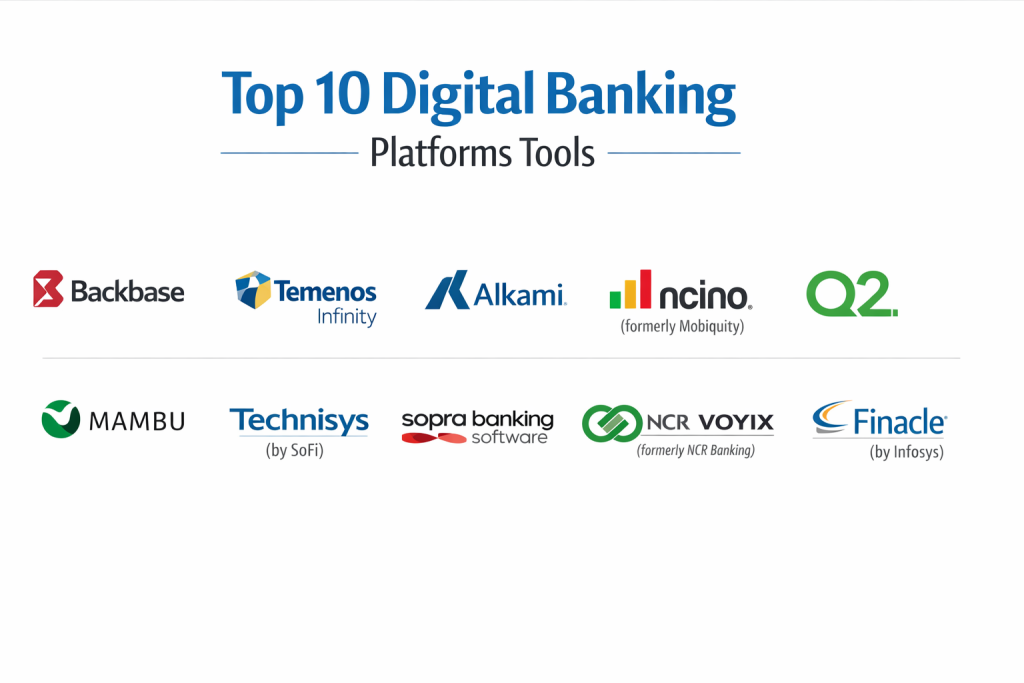
Top 10 Digital Banking Platforms Tools
1 — Backbase
Backbase is a global leader in “Engagement Banking,” focusing on the orchestration of the customer journey across all touchpoints. It is designed for large institutions that want to build a unified experience for retail, business, and wealth management.
Key features:
- Engagement Banking Platform: A single codebase to manage retail, SME, and corporate banking.
- Widget-Based Architecture: Allows for rapid UI customization using pre-built components.
- Customer Journey Orchestrator: Maps out the entire lifecycle from lead to loyalty.
- Cross-Silo Integration: Connects multiple legacy cores into one unified digital front-end.
- Model Bank Templates: “Out-of-the-box” versions for different regions to speed up local deployment.
Pros:
- Highly flexible; it allows banks to “buy” the foundation and “build” their unique differentiators on top.
- Exceptional at managing complex, high-net-worth customer journeys.
Cons:
- High total cost of ownership (TCO) makes it better suited for larger institutions.
- Implementation requires a high degree of technical expertise or certified partners.
Security & compliance: ISO 27001, SOC 2 Type II, GDPR, and PSD2 compliant.
Support & community: Backbase Academy for developer certification, global user conferences, and 24/7 enterprise support.
2 — Temenos Infinity
Temenos Infinity is a cloud-native, cloud-agnostic digital banking solution that focuses on high-scale performance and “Explainable AI” to drive customer engagement.
Key features:
- Explainable AI (XAI): Provides transparent reasons for credit decisions and product recommendations.
- Microservices Framework: Ensures high availability and independent scaling of features.
- Temenos Exchange: A marketplace of 100+ pre-integrated third-party fintech apps.
- Low-Code Development: Allows business analysts to design workflows without deep coding.
- Global Compliance Templates: Pre-configured for over 150 countries.
Pros:
- Massive scalability; capable of handling hundreds of millions of accounts.
- The XAI feature is a significant advantage for meeting regulatory transparency requirements.
Cons:
- The vastness of the product ecosystem can be overwhelming for smaller banks.
- Can be difficult to customize if the bank doesn’t use the Temenos Core.
Security & compliance: SOC 1/2/3, ISO 27001, and HIPAA compliant.
Support & community: Temenos Learning Community (TLC) provides extensive documentation and peer-to-peer forums.
3 — Alkami
Alkami is a leading North American provider specifically tailored to the needs of credit unions and regional banks. It is known for its deep focus on user experience and data-driven marketing.
Key features:
- Single Sign-On (SSO) Ecosystem: Seamlessly connects third-party services like insurance or tax prep.
- Data Telemetry: Provides actionable insights into member behavior and financial health.
- Advanced Business Banking: Robust tools for ACH, wire transfers, and user permissions for SMEs.
- Extensible SDK: Allows banks to develop their own “mini-apps” within the Alkami framework.
- Member Sentiment Tracking: Integrated tools to gauge user satisfaction in real-time.
Pros:
- Widely considered to have one of the best “Member Experiences” in the credit union space.
- Strong focus on the North American regulatory and core-integration environment.
Cons:
- Limited presence outside of the United States.
- Less focus on the “Wealth Management” segment compared to Backbase.
Security & compliance: SOC 2 Type II and FFIEC compliant; rigorous third-party auditing.
Support & community: Very active client community and dedicated regional training sessions.
4 — nCino (formerly Mobiquity)
nCino, famous for its commercial lending platform, acquired Mobiquity to offer a comprehensive “End-to-End” digital banking experience. It leverages the Salesforce ecosystem to provide a 360-degree view of the customer.
Key features:
- Salesforce Integration: Native connectivity to the world’s leading CRM.
- Digital Onboarding: Streamlined account opening for both retail and commercial clients.
- Unified Platform: Bridges the gap between the loan origination system and the deposit account.
- Human-Centric Design: Focused on reducing friction in high-value transactions.
- Cloud-Native Scalability: Built for rapid deployment across global markets.
Pros:
- Perfect for banks already using nCino for lending, as it creates a seamless employee/client experience.
- Strong “Relationship Banking” features that prioritize long-term customer value.
Cons:
- Requires a Salesforce license, which can increase the overall cost.
- The “Digital Banking” side is still being more deeply integrated with their legacy lending tools.
Security & compliance: SOC 2 Type II, ISO 27001, and GDPR compliant.
Support & community: nCino University and a massive ecosystem of Salesforce consultants.
5 — Q2
Q2 is an Austin-based platform that prides itself on “Strengthening Communities” by providing community banks and credit unions with tech that rivals global giants. It is a leader in the BaaS (Banking-as-a-Service) space.
Key features:
- Q2 Innovation Studio: An open environment for third-party developers to build on the platform.
- Centrix Fraud Suite: Integrated high-end fraud detection and prevention.
- BaaS & Embedded Finance: Enables non-banks to offer financial products via the Q2 ledger.
- Treasury Management: One of the strongest commercial banking suites for mid-market clients.
- Smart Banking: AI-driven personalized offers and financial wellness tools.
Pros:
- Leading-edge tech for commercial/business banking, often surpassing larger rivals.
- The Innovation Studio allows banks to “self-innovate” at a very high level.
Cons:
- The platform’s UI can be a bit more “functional” than “sleek” in some legacy modules.
- Complex setups may require significant internal project management.
Security & compliance: FFIEC regulated, SOC 2 Type II, and PCI DSS compliant.
Support & community: Q2 Trustview portal for transparency and a very active annual user conference.
6 — Mambu
Mambu is a “Composable Banking” platform. It isn’t a traditional DBP with a pre-set UI; instead, it provides the powerful cloud-native engine and APIs that allow banks to build their own bespoke front-ends.
Key features:
- Cloud-Native Core & Engine: Built from day one for AWS, Azure, and Google Cloud.
- API-First Design: Thousands of endpoints to connect any front-end or third-party tool.
- Product Factory: Create new loan or deposit products in minutes via configuration.
- Real-Time Ledger: Instant processing of all transactions without “end-of-day” batches.
- Multi-Tenant SaaS: Ensures all customers are always on the latest version of the software.
Pros:
- The fastest way for a “Neobank” or a greenfield project to go to market.
- Total freedom over the user interface and customer experience.
Cons:
- Not a “turnkey” solution; you must build or buy a separate UI layer.
- Requires a strong internal engineering team to manage the integrations.
Security & compliance: ISO 27001, SOC 2 Type II, and GDPR compliant.
Support & community: Excellent developer documentation and a global network of “Composable” partners.
7 — Technisys (by SoFi)
Technisys, now a part of SoFi, offers the Cyberbank platform. It is a next-gen digital core and engagement platform that supports the creation of “dynamic” financial products.
Key features:
- Cyberbank Digital: A powerful UI/UX layer for web and mobile.
- Cyberbank Core: A cloud-native core that allows for “structural” product flexibility.
- Dynamic Product Definition: Allows for products like “hybrid” accounts (part savings, part investment).
- AI-Driven Personalization: Tailors the app interface to individual user habits.
- Multi-Country Support: Strong presence and localization in Latin America and North America.
Pros:
- Backed by SoFi, ensuring high levels of investment and fintech-forward thinking.
- Exceptional at managing “Product Agility”—changing interest rates or fees instantly.
Cons:
- Still gaining traction in the European market compared to Temenos or Backbase.
- Implementation can be complex due to the “Core+Digital” dual nature.
Security & compliance: SOC 2 Type II and various localized Latin American and US certifications.
Support & community: High-touch implementation teams and a growing developer ecosystem.
8 — Sopra Banking Software
Sopra is a European powerhouse that offers the Sopra Banking Platform (SBP). It is a highly modular solution that covers everything from retail banking to specialized lending and payments.
Key features:
- Modular Ecosystem: Pick only the components you need (e.g., just the Digital Front-End).
- Marketplace Integration: 200+ partners available for rapid feature expansion.
- Instant Payments Ready: Native support for SEPA Instant and other global networks.
- Specialized Lending: Strong modules for auto finance and equipment leasing.
- Cloud-First Strategy: Deployment options across all major cloud providers or on-prem.
Pros:
- Deep expertise in European regulations (PSD2, etc.) and complex cross-border banking.
- Excellent for institutions that need “Specialized Finance” alongside retail banking.
Cons:
- The platform can feel slightly more “traditional” in its workflow design.
- North American support is growing but not as extensive as domestic rivals like Alkami.
Security & compliance: ISO 27001, GDPR, and EBA (European Banking Authority) compliant.
Support & community: Large European footprint with dedicated local support in multiple languages.
9 — NCR Voyix (formerly NCR Banking)
NCR Voyix is a veteran in the banking world, providing the digital “connect” between physical ATMs, branch self-service, and mobile banking. It is a favorite for banks seeking a “Physical-to-Digital” bridge.
Key features:
- Total Channel Integration: Connects digital banking with ATM and Branch transactions.
- Teradata Analytics: Leverages powerful data warehousing for deep customer insights.
- Self-Service Banking: Industry-leading tools for remote deposit and card management.
- Business Banking Suite: Scalable tools for micro-businesses up to large corporations.
- Unified Security: Consistent fraud prevention across physical and digital touchpoints.
Pros:
- Unbeatable if your bank still has a large physical footprint (ATMs/Branches).
- Very stable, mature platform with high reliability ratings.
Cons:
- Innovation can sometimes feel slower than the “fintech-first” cloud natives.
- The system is a bit “heavier” and may have a longer update cycle.
Security & compliance: FFIEC, SOC 2 Type II, and PCI DSS compliant.
Support & community: One of the largest field-service and support organizations in the world.
10 — Finacle (by Infosys)
Finacle is a global heavyweight used by some of the largest banks in the world. It is highly regarded for its technological depth and its ability to handle massive, complex global operations.
Key features:
- Blockchain-Ready: Native support for distributed ledger applications.
- Advanced Analytics Engine: Real-time processing for hyper-personalized marketing.
- DevOps Friendly: Designed for continuous integration and continuous deployment (CI/CD).
- Multi-Currency/Multi-Entity: Perfect for global banks operating across time zones.
- Finacle App Center: A vast marketplace for third-party innovation.
Pros:
- Incredible technological depth; if you need it, Finacle likely has a module for it.
- Proven at a scale that few other platforms can match.
Cons:
- Requires a very large and sophisticated IT team to operate and customize.
- The UI/UX layer often requires significant work to meet modern “minimalist” standards.
Security & compliance: ISO 27001, SOC 1/2, GDPR, and localized global compliance.
Support & community: Global 24/7 support and a massive ecosystem of Infosys consultants.
Comparison Table
| Tool Name | Best For | Platform(s) Supported | Standout Feature | Rating |
| Backbase | Engagement Banking | Cloud / Hybrid | Journey Orchestrator | N/A |
| Temenos Infinity | Global Scalability | Cloud-Native | Explainable AI (XAI) | N/A |
| Alkami | Credit Unions | Cloud (SaaS) | Member Data Telemetry | N/A |
| nCino | Salesforce Users | Cloud (SaaS) | End-to-End Lending Sync | N/A |
| Q2 | Commercial & BaaS | Cloud / Hybrid | Innovation Studio | N/A |
| Mambu | Neobanks / Devs | Cloud (API-First) | Composable Engine | N/A |
| Technisys | Product Agility | Cloud-Native | Dynamic Core/Digital | N/A |
| Sopra Banking | European/Specialty | Cloud / On-Prem | SEPA/Specialized Finance | N/A |
| NCR Voyix | Physical/Digital Mix | Cloud / Hybrid | ATM/Branch Integration | N/A |
| Finacle | Global Tier 1 Banks | Cloud / On-Prem | Blockchain/Global Scale | N/A |
Evaluation & Scoring of Digital Banking Platforms
| Criterion | Weight | Evaluation Focus |
| Core Features | 25% | Account opening, payments, lending, and SME tools. |
| Ease of Use | 15% | Consumer mobile UX and back-office admin simplicity. |
| Integrations | 15% | API maturity, marketplace depth, and core connectivity. |
| Security & Compliance | 10% | Fraud prevention, encryption, and regulatory certifications. |
| Performance | 10% | Uptime, transaction speed, and cloud-native scaling. |
| Support | 10% | Training, documentation, and enterprise SLAs. |
| Price / Value | 15% | ROI through efficiency and customer retention. |
Which Digital Banking Platform Is Right for You?
Solo Users vs SMB vs Mid-Market vs Enterprise
If you are a Small Community Bank or Credit Union, tools like Alkami or Q2 are the best fit. They understand the regional landscape and provide a community-focused experience out of the box. Mid-Market institutions with international aspirations will find Technisys or Sopra to be highly adaptable. Large Enterprises (Tier 1 Global Banks) almost certainly require the power of Finacle, Temenos, or Backbase to manage the immense complexity of their operations.
Budget-Conscious vs Premium Solutions
For those with strict budgets, a “bank-in-a-box” SaaS model from Alkami or Q2 is often the most cost-effective because it minimizes the need for internal developers. Premium solutions like Backbase require a higher upfront investment in professional services but offer the highest degree of “brand uniqueness” and long-term customer engagement ROI.
Feature Depth vs Ease of Use
If your priority is Ease of Use (getting a great app live quickly), Backbase (with its widgets) and Alkami are the winners. If your priority is Feature Depth (handling complex treasury management or multi-country blockchain transactions), Finacle and Temenos are the technological giants of the industry.
Integration and Scalability Needs
For banks that want to become a Fintech Hub, an API-first platform like Mambu or Q2 (with Innovation Studio) is essential. If you are looking to scale globally without worrying about your servers, the Cloud-Native architectures of Mambu, Technisys, and Temenos are designed for infinite horizontal scaling.
Security and Compliance Requirements
Every tool on this list meets bank-grade standards. However, if you are in Europe, Sopra has the best localized compliance. If you are in the US, Alkami and NCR Voyix have the longest track records with the FFIEC and other domestic regulators. For institutions needing “Explainable” AI to satisfy regulators on why a loan was denied, Temenos is the clear leader.
Frequently Asked Questions (FAQs)
What is the difference between Digital Banking and Core Banking?
Core Banking is the “Back-Office” ledger (processing balances and transactions). Digital Banking is the “Front-Office” engagement layer (the app, the website, and the customer experience).
Can these platforms work with a legacy core system?
Yes. Most modern DBPs are designed to “overlay” legacy systems, using middleware or APIs to pull data from the old core and display it in a modern interface.
What is “Banking-as-a-Service” (BaaS)?
It is when a bank uses its digital platform to allow third-party companies (like Uber or Amazon) to offer financial services to their own customers.
How long does it take to implement a DBP?
A “SaaS” implementation for a small bank can take 4–6 months. A custom enterprise build for a global bank can take 12–24 months.
Are digital banking platforms secure?
Yes. They use multi-factor authentication (MFA), behavioral biometrics, end-to-end encryption, and are subject to the same regulatory audits as physical banks.
Do these platforms support crypto-assets?
Many (like Backbase and Technisys) now offer modules or integrations that allow customers to buy, sell, and hold digital assets within their banking app.
What is “Engagement Banking”?
It is a shift away from “Transactional Banking” (just moving money) toward “Relationship Banking” (providing advice, insights, and a better overall experience).
Can I build my own app on top of these platforms?
Yes, most (especially Mambu and Q2) offer robust SDKs and APIs that allow your internal team to build a completely custom front-end.
Do these systems handle business/commercial banking?
Yes, though some (like Q2 and Sopra) are known for having much deeper commercial features than those focused primarily on retail consumers.
What is “Cloud-Native”?
It means the software was built specifically to run in the cloud, allowing it to be more resilient, scale automatically, and update without downtime.
Conclusion
The financial services landscape is defined by the quality of the digital interface. A bank’s mobile app is no longer a utility; it is the brand. Choosing a Digital Banking Platform is one of the most consequential decisions a financial leader can make. Whether you opt for the Engagement-first approach of Backbase, the AI-powered depth of Temenos, or the Community-focused reliability of Alkami, the goal is the same: to create a frictionless, human-centric financial journey.
The “best” platform is not the one with the most features, but the one that aligns with your institution’s specific DNA. If you are a developer-heavy neobank, Mambu is your engine. If you are a regional leader focused on member loyalty, Alkami is your partner. Focus on API openness and customer engagement, and you will build a digital bank that is not only competitive today but resilient for the decades to come.