Introduction
Demand planning tools are specialized software applications that help businesses forecast future customer demand for products. By analyzing historical sales data, market trends, seasonality, and external factors, these tools allow companies to predict exactly how much inventory they need to meet customer needs without overstocking. In essence, they act as the “crystal ball” of the supply chain, transforming raw data into actionable insights that drive production, procurement, and distribution strategies.
The importance of demand planning has skyrocketed in recent years. In a global economy defined by volatility, having an accurate forecast is the difference between profitability and massive waste. Efficient demand planning reduces “stockouts” (running out of a product), which preserves customer loyalty, and minimizes “excess inventory,” which frees up vital working capital. By aligning sales expectations with operational capacity, these tools ensure that every link in the supply chain moves in harmony, ultimately lowering costs and improving the bottom line.
Key Real-World Use Cases
- New Product Launches: Using “attribute-based” modeling to predict the success of a new item based on similar past launches.
- Promotion Planning: Simulating the impact of a Black Friday sale or a “Buy One Get One” event on inventory levels.
- Seasonality Adjustments: Automatically ramping up production for winter gear in July or sunblock in January.
- Supply Chain Resilience: Identifying potential shortages early enough to source materials from alternative suppliers.
What to Look For (Evaluation Criteria)
When evaluating demand planning software, the primary factor is Statistical Accuracy. The tool should offer multiple forecasting algorithms (Best Fit) that automatically select the most accurate model for each product. Collaboration Features are also essential; the software must allow Sales, Finance, and Operations teams to contribute their insights to a “consensus forecast.” Furthermore, look for Ease of Integration with your existing ERP (Enterprise Resource Planning) and Scalability, ensuring the tool can handle thousands of SKUs (Stock Keeping Units) across multiple locations.
Best for: Supply chain managers, demand planners, CFOs, and operations directors. It is essential for mid-market to enterprise-level manufacturers, retailers, and distributors dealing with complex product portfolios and multi-channel sales.
Not ideal for: Very small businesses or solo entrepreneurs with predictable, low-volume sales. For these users, a well-managed spreadsheet or the basic inventory module within a standard accounting package (like QuickBooks) is usually sufficient and more cost-effective.
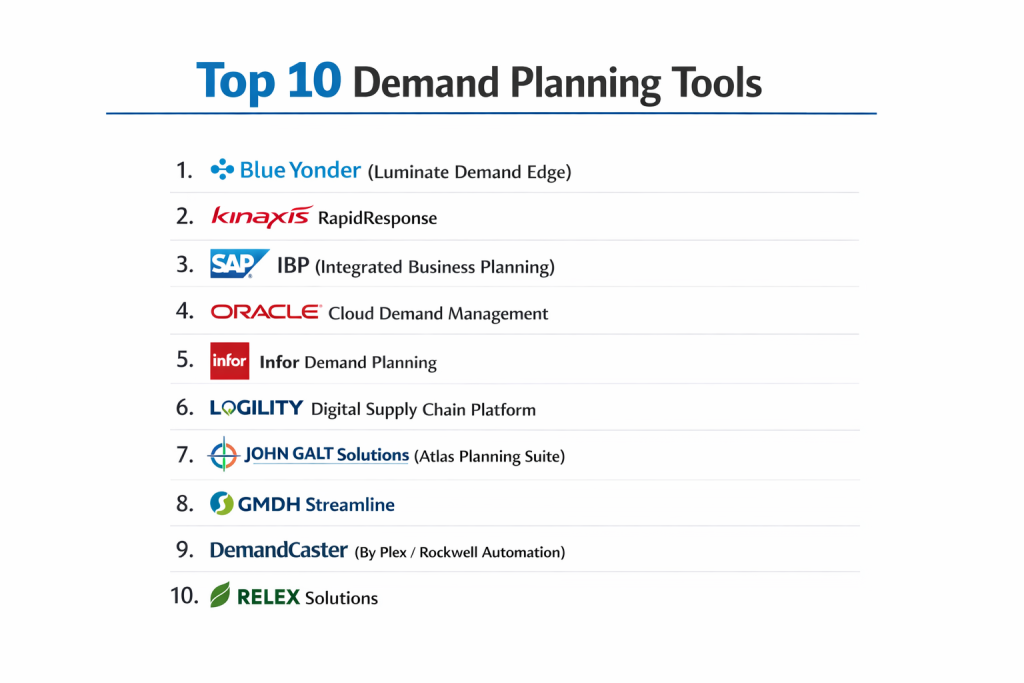
Top 10 Demand Planning Tools
1 — Blue Yonder (Luminate Demand Edge)
Blue Yonder is a powerhouse in the supply chain space, offering a cognitive AI-led platform that senses and responds to market changes in real-time.
- Key features:
- AI and Machine Learning-based demand sensing.
- Incorporation of external “big data” (weather, social media trends).
- Probabilistic forecasting to manage uncertainty.
- Automated “Best Fit” algorithm selection.
- Advanced promotion and event modeling.
- Seamless integration with warehouse and transportation modules.
- Pros:
- Industry-leading accuracy for highly volatile consumer goods.
- Exceptional ability to process massive datasets across global networks.
- Cons:
- Significant financial investment required for licensing and implementation.
- High technical complexity necessitates specialized staff.
- Security & compliance: ISO 27001, SOC 2 Type II, and GDPR compliant. Features robust SSO and end-to-end encryption.
- Support & community: Extensive enterprise support, global consulting network, and a deep library of training resources via Blue Yonder University.
2 — Kinaxis RapidResponse
Kinaxis is renowned for its “concurrent planning” technology, which allows all parts of the supply chain to see the impact of a change in demand instantly.
- Key features:
- Concurrent planning across demand, supply, and inventory.
- Instant “what-if” scenario analysis.
- Multi-tier demand visibility.
- Collaborative consensus demand planning.
- Automated anomaly detection and alerting.
- Advanced analytics for demand volatility.
- Pros:
- Unmatched speed in simulating the effects of demand shifts.
- Breaks down silos by connecting planners across the globe in real-time.
- Cons:
- The interface can be intimidating for users accustomed to simpler tools.
- Best suited for very large organizations; smaller firms may find it “over-engineered.”
- Security & compliance: SOC 2, ISO 27001, and HIPAA compliant where applicable.
- Support & community: High-touch account management and an active user community through the Kinaxis Knowledge Network.
3 — SAP IBP (Integrated Business Planning)
For companies already running SAP S/4HANA, SAP IBP for Demand is the logical choice for deeply integrated, enterprise-wide planning.
- Key features:
- Real-time integration with SAP ERP data.
- Advanced statistical forecasting models.
- Demand sensing for short-term accuracy.
- Collaborative planning through SAP Jam integration.
- Exception-based alerts and monitoring.
- Full integration with Sales & Operations Planning (S&OP).
- Pros:
- Total data consistency within the SAP ecosystem.
- Highly scalable for the world’s largest multinational corporations.
- Cons:
- Implementation is notoriously long and expensive.
- Requires a dedicated SAP IT team for ongoing maintenance and updates.
- Security & compliance: Complies with all major global standards including SOC 1, SOC 2, and ISO 27001.
- Support & community: Massive global ecosystem of certified partners and a vast online community (SAP Community).
4 — Oracle Cloud Demand Management
Part of the Oracle Fusion Cloud suite, this tool provides a modern, user-friendly interface backed by Oracle’s powerful database and AI capabilities.
- Key features:
- Embedded Machine Learning for automated forecasting.
- Visual analytics and customizable dashboards.
- Integrated demand-to-supply execution.
- New product introduction (NPI) forecasting.
- Multidimensional planning views (Product, Geography, Time).
- Automated cleansing of historical sales data.
- Pros:
- Very strong visual reporting and data exploration tools.
- Frequent quarterly updates bring new AI features automatically.
- Cons:
- Can be difficult to integrate with non-Oracle ERP systems.
- The licensing model can be complex and expensive for mid-sized firms.
- Security & compliance: High-level FedRAMP, SOC, and ISO certifications.
- Support & community: 24/7 global support and an extensive “Cloud Customer Connect” portal.
5 — Infor Demand Planning
Infor offers a highly specialized demand planning solution that is particularly strong in the manufacturing and distribution industries.
- Key features:
- Highly granular statistical modeling.
- Synchronized demand and supply planning.
- Market intelligence integration.
- Promotion and lifecycle management.
- Multi-level forecasting (family, brand, SKU).
- Integrated S&OP workflows.
- Pros:
- Industry-specific templates that speed up the “time-to-value.”
- Excellent at handling the complexities of wholesale distribution.
- Cons:
- Some users find the UI less modern than competitors like Kinaxis or Blue Yonder.
- Customer support responsiveness can vary by region.
- Security & compliance: ISO 27001 and GDPR compliant; utilizes AWS (Amazon Web Services) security infrastructure.
- Support & community: Solid documentation and a dedicated “Infor Concierge” for customer support.
6 — Logility Digital Supply Chain Platform
Logility is a leader in using AI to drive “autonomous” planning, helping companies reduce the manual workload of their demand planners.
- Key features:
- AI-driven demand sensing and shaping.
- Autonomous forecasting with self-correcting algorithms.
- Causal factor analysis (impact of price, weather, etc.).
- Product life cycle management from launch to sunset.
- Multi-enterprise collaboration features.
- Strong “Best Fit” statistical engine.
- Pros:
- Exceptional at automating routine forecasting tasks to free up human planners.
- Strong track record in the retail and apparel sectors.
- Cons:
- The learning curve for the advanced AI modules can be steep.
- Integration with older, “on-premise” ERPs can be challenging.
- Security & compliance: SOC 2 Type II certified with robust data privacy controls.
- Support & community: High-quality onboarding services and a dedicated “Logility University” for users.
7 — John Galt Solutions (Atlas Planning Suite)
John Galt Solutions focuses on helping companies climb the “maturity curve,” moving from spreadsheets to advanced AI-driven planning.
- Key features:
- Scalable Atlas Planning platform.
- Strong emphasis on S&OP and IBP.
- AI and Machine Learning forecast accuracy.
- Demand-driven material requirements planning (DDMRP).
- Collaborative portal for partners and suppliers.
- Rapid implementation methodology.
- Pros:
- Highly flexible and easier to implement than the giant ERP-based suites.
- Exceptional customer service and a “partner” approach to client success.
- Cons:
- Lacks the massive global marketing presence of SAP or Oracle.
- Some advanced customizations may require more “hands-on” help.
- Security & compliance: SOC 2 compliant and follows standard web security protocols.
- Support & community: Known for very high customer satisfaction and personalized support.
8 — GMDH Streamline
GMDH Streamline is a modern, fast-growing tool that leverages AI to provide enterprise-level forecasting at a price point accessible to mid-market companies.
- Key features:
- AI-based time-series forecasting.
- Integrated inventory optimization.
- Dynamic simulation of lead times and order cycles.
- Automatic data synchronization with multiple ERPs (NetSuite, Microsoft Dynamics).
- Multi-user collaborative environment.
- Clear visual representation of stockout risks.
- Pros:
- Extremely fast setup—some companies go live in just weeks.
- Very intuitive UI that feels like a modern web app.
- Cons:
- Lacks some of the deep “multi-tier” manufacturing logic of Kinaxis.
- Smaller partner network for local on-site implementation.
- Security & compliance: GDPR compliant and utilizes encrypted cloud storage.
- Support & community: Rapidly growing online community and responsive technical support via chat and email.
9 — Demand Caster (By Plex/Rockwell Automation)
Demand Caster is a cloud-based solution that bridges the gap between high-level planning and the shop floor, making it a favorite for manufacturers.
- Key features:
- Sales and Operations Planning (S&OP) focus.
- Requirements planning and inventory optimization.
- Direct integration with manufacturing execution systems (MES).
- Capacity planning and scheduling.
- Multi-location demand aggregation.
- Automated replenishment suggestions.
- Pros:
- Perfectly tailored for the “Make-to-Stock” and “Make-to-Order” manufacturing models.
- Strong integration with the Plex Smart Manufacturing Platform.
- Cons:
- Not as strong for pure retail or service-based demand planning.
- The reporting engine can be less flexible than standalone BI tools.
- Security & compliance: Adheres to SOC 2 and Rockwell Automation’s rigorous cybersecurity standards.
- Support & community: Good documentation and integration with Rockwell’s global support network.
10 — RELEX Solutions
RELEX is a specialist in the retail and grocery space, where managing perishable goods and complex promotions is critical.
- Key features:
- Unified retail planning (Demand, Merchandising, Supply).
- Fresh food-specific forecasting (shelf-life aware).
- Space and floor planning integration.
- Weather-based demand forecasting.
- Promotion and markdown optimization.
- Extremely high-speed data processing (In-memory).
- Pros:
- The undisputed leader for grocery and high-volume retail.
- Massive impact on reducing food waste and improving availability.
- Cons:
- Very niche-focused; not ideal for heavy industrial manufacturing.
- Significant effort required to manage the high volume of retail data.
- Security & compliance: ISO 27001, SOC 2, and GDPR compliant.
- Support & community: Strong presence in Europe and North America with dedicated retail experts.
Comparison Table
| Tool Name | Best For | Platform(s) Supported | Standout Feature | Rating |
| Blue Yonder | Global Retail/CPG | Cloud (Azure) | AI Demand Sensing | 4.8 / 5 |
| Kinaxis | Complex Mfg | Cloud/Web | Concurrent Planning | 4.7 / 5 |
| SAP IBP | SAP Enterprises | Cloud/Web | ERP Integration | 4.4 / 5 |
| Oracle Cloud | Large Enterprise | Cloud | ML Visual Analytics | 4.5 / 5 |
| Infor | Distribution | Cloud/Web | Industry Templates | 4.2 / 5 |
| Logility | Fashion/Retail | Cloud/Web | Autonomous Planning | 4.6 / 5 |
| John Galt | S&OP Maturity | Cloud/Web | Flexibility & Support | 4.7 / 5 |
| GMDH Streamline | Mid-Market | Cloud/Web | Fast Implementation | 4.6 / 5 |
| Demand Caster | Manufacturing | Cloud/Web | MES Integration | 4.3 / 5 |
| RELEX | Grocery/Retail | Cloud/Web | Perishable Logic | 4.9 / 5 |
Evaluation & Scoring of Demand Planning Tools
Selecting a demand planning tool requires a balanced look at technical capability versus organizational fit. Below is our weighted scoring rubric based on industry standards.
| Category | Weight | Score Logic |
| Core Features | 25% | Accuracy of algorithms, AI/ML inclusion, and NPI handling. |
| Ease of Use | 15% | UI design, mobile accessibility, and learning curve for planners. |
| Integrations | 15% | Depth of connection with ERP, TMS, and WMS systems. |
| Security & Compliance | 10% | Certifications (SOC 2, ISO) and data encryption standards. |
| Performance & Reliability | 10% | Speed of calculation and system uptime (SLAs). |
| Support & Community | 10% | Quality of documentation and availability of expert consultants. |
| Price / Value | 15% | ROI potential relative to the cost of ownership. |
Which Demand Planning Tool Is Right for You?
Small to Mid-Market vs. Enterprise
If you are an SMB or Mid-Market company, the massive price tags and multi-year implementation times of SAP or Oracle will likely be prohibitive. For this segment, GMDH Streamline or John Galt Solutions offer the best balance of sophisticated AI and manageable complexity. Enterprise users, conversely, need the “heavy lifting” capability and multi-language/multi-currency support found in Blue Yonder or Kinaxis.
Budget and Value
When evaluating budget, consider more than just the license fee. A “cheap” tool that provides an inaccurate forecast is more expensive in the long run than a premium tool that reduces inventory costs by 15%. For those seeking the highest ROI per dollar, Logility and GMDH consistently score high for their ability to automate labor-intensive tasks.
Technical Depth vs. Simplicity
Do you have a team of Ph.D. data scientists? If so, you will appreciate the technical depth and algorithmic transparency of Blue Yonder. However, if your demand planners are also managing purchasing and warehouse tasks, you need Simplicity. RELEX and Remix-style modern web interfaces allow users to get the information they need without digging through complex technical menus.
Security and Compliance Requirements
If you operate in highly regulated sectors like pharmaceuticals or defense, security is paramount. Ensure your chosen tool is SOC 2 Type II certified and offers robust Audit Logs. Oracle and SAP are the gold standards here, as they have built their entire reputation on meeting the world’s strictest corporate governance and security requirements.
Frequently Asked Questions (FAQs)
1. What is the difference between demand planning and forecasting?
Forecasting is the mathematical calculation of future sales. Demand planning is the broader process that includes the forecast, plus adjustments for promotions, marketing plans, and supply constraints to reach a consensus plan.
2. Can these tools replace my current ERP?
No. Demand planning tools are “best-of-breed” solutions that sit on top of your ERP. They pull data from the ERP, do the “math,” and then send the plan back to the ERP for execution.
3. How long does implementation typically take?
For mid-market tools like Streamline, 1–3 months. For enterprise suites like SAP IBP or Blue Yonder, expect 9–18 months depending on the complexity of your data.
4. What is “Demand Sensing”?
Demand sensing is the use of AI to analyze very recent data (days or hours) to detect immediate shifts in consumer behavior, allowing for much more accurate short-term replenishments.
5. How much can these tools improve accuracy?
Most companies moving from spreadsheets to an AI-driven tool see a 15–30% improvement in forecast accuracy, which often leads to a 10–20% reduction in inventory levels.
6. Do I need a clean data history to start?
While “clean” data is better, most modern tools have “data cleansing” algorithms that automatically identify and remove outliers, like one-off bulk orders, to prevent them from skewing the future forecast.
7. Is a cloud-based tool better than on-premise?
Yes. Cloud-based tools (SaaS) allow for much faster updates, easier collaboration between remote teams, and better security than most companies can provide on their own.
8. Can these tools handle “New Product Introduction” (NPI)?
Yes. Advanced tools use “Lifecycle Management” and “Attribute-based forecasting” to model a new product’s demand by comparing it to similar products in the past.
9. What is “Consensus Planning”?
This is a feature where different departments (Sales, Marketing, Finance) enter their own estimates, and the tool helps them resolve differences to create a single, agreed-upon “consensus” number.
10. How do these tools handle promotions?
They allow planners to “lift” the baseline forecast by a certain percentage or volume based on historical data from similar past promotions, ensuring you don’t run out of stock during a sale.
Conclusion
Demand planning tools have evolved from simple calculators into sophisticated AI engines that serve as the heartbeat of modern commerce. Whether you are managing a global grocery chain or a mid-sized manufacturing plant, the ability to predict the future with even a slight increase in accuracy can save your organization millions.
When choosing the “best” tool, remember that it is not about the most features; it is about the right fit for your specific data maturity and business model. If you are a grocery retailer, RELEX is unparalleled. If you are a complex manufacturer, Kinaxis is the leader. For those looking for agility and speed, GMDH Streamline or John Galt are excellent choices. Ultimately, the goal is to move away from “gut feel” and toward a data-driven future where the right product is always in the right place at the right time.