Introduction
Deception Technology is a proactive security strategy that uses decoys—servers, applications, credentials, or data—to trick cybercriminals into revealing themselves. Unlike traditional defenses like firewalls that act as “walls,” deception tools act as “landmines.” They create a digital hall of mirrors where an attacker cannot distinguish between a real database and a trap designed to alert the Security Operations Center (SOC).
The importance of this technology lies in its ability to detect lateral movement and insider threats with near-zero false positives. If a normal employee has no reason to touch a “fake” financial spreadsheet, any interaction with that file is a high-fidelity signal of malicious intent. This drastically reduces “dwell time”—the period a hacker spends unnoticed in your system—from months to minutes.
Key Real-World Use Cases
- Ransomware Mitigation: Decoy file shares can trigger an immediate lockout the moment a ransomware strain tries to encrypt them.
- Active Directory Protection: Seeded “fake” admin credentials in memory can trap attackers attempting to escalate privileges.
- IoT/OT Security: Since specialized devices like MRI machines or factory robots are hard to secure with agents, deception tools mimic them to catch hackers targeting legacy hardware.
- Threat Intelligence: Watching how an attacker interacts with a decoy provides a “front-row seat” to their tactics, techniques, and procedures (TTPs).
Evaluation Criteria
When choosing a tool, prioritize the realism of decoys, ease of deployment (automated vs. manual), and integration with your existing SIEM or EDR platforms. High-interaction decoys (which behave like real operating systems) offer better intelligence but require more management than low-interaction tokens.
Best for: Large enterprises with mature security teams, financial institutions, healthcare providers, and critical infrastructure (ICS/OT) sectors that need to detect stealthy, sophisticated attackers.
Not ideal for: Very small businesses with no dedicated IT security staff or organizations that haven’t yet mastered “basic” security like patching and multi-factor authentication.
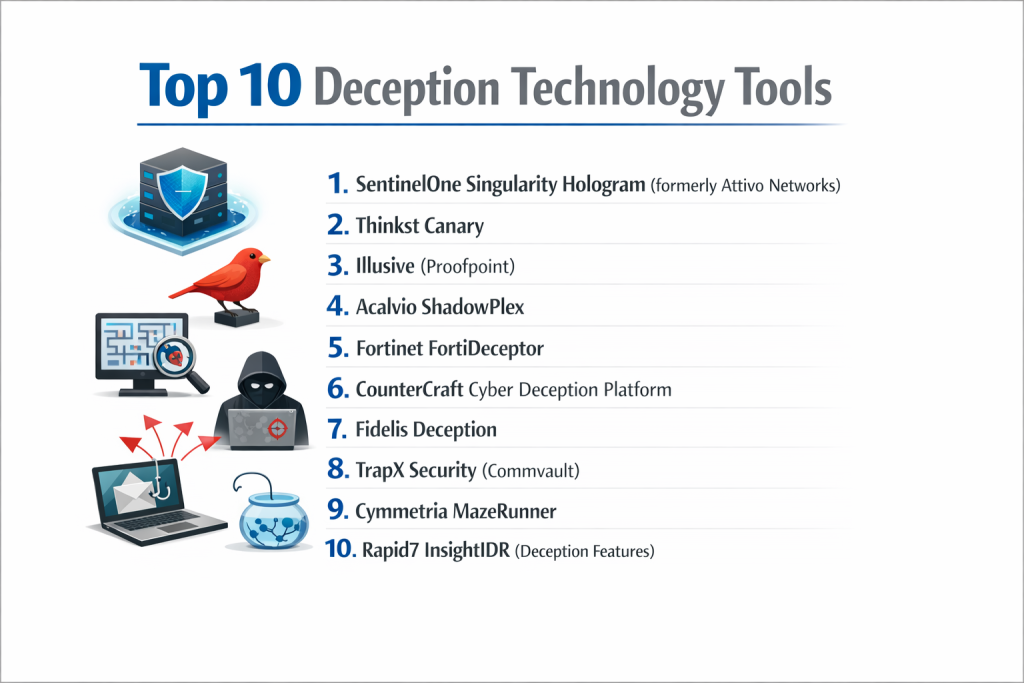
Top 10 Deception Technology Tools
1 — SentinelOne Singularity Hologram (formerly Attivo Networks)
SentinelOne’s acquisition of Attivo Networks integrated world-class deception into a leading XDR platform. It focuses heavily on identity-based deception and protecting Active Directory.
- Key Features:
- Identity Deception: Creates fake credentials and lures that lead attackers into a sandbox.
- ADSecure: Specifically hides real Active Directory objects and shows “shadow” objects to attackers.
- Broad Surface Coverage: Covers IT, OT, IoT, and even POS (Point of Sale) systems.
- Automated Forensics: Provides a detailed report of the attacker’s actions within the decoy.
- Global Scalability: Managed through the Singularity cloud console.
- Pros:
- Excellent at stopping lateral movement before it reaches critical data.
- Deep integration with EDR makes “detect to respond” times incredibly fast.
- Cons:
- Can be expensive as part of a larger SentinelOne license.
- The sheer depth of the identity protection features can be overwhelming for smaller teams.
- Security & Compliance: SOC 2, GDPR, HIPAA, and ISO 27001 compliant.
- Support & Community: High-quality enterprise support, active user community, and extensive documentation.
2 — Thinkst Canary
Thinkst Canary is the “gold standard” for simple, effective deception. It is designed to be set up in minutes and stay quiet until it is truly needed.
- Key Features:
- Canary Tokens: Tiny digital “tripwires” (like a fake PDF or URL) that alert you when opened.
- Hardware & Virtual Birds: Physical or virtual decoys that look like NAS drives, routers, or servers.
- Zero False Positives: Because no one should touch them, every alert is legitimate.
- Customizable Profiles: Can mimic a wide range of devices from SCADA controllers to web servers.
- Easy Management: A clean, web-based dashboard with instant notifications via Slack, email, or SMS.
- Pros:
- The most user-friendly tool on the list; no “expert” training required.
- Extremely low maintenance; “set it and forget it.”
- Cons:
- Primarily a detection tool; lacks the deep “active engagement” or “tarpit” features of more complex platforms.
- Not designed for large-scale “adversary simulation.”
- Security & Compliance: Audit logs, SSO, and GDPR compliant.
- Support & Community: Famous for responsive support and a very popular public blog.
3 — Illusive (Proofpoint)
Acquired by Proofpoint, Illusive focuses on the “endpoint” and “identity” layers. It is built to shrink the attack surface by cleaning up real credentials while seeding fake ones.
- Key Features:
- Attack Surface Manager: Finds and removes old, vulnerable credentials left on real laptops.
- Shadow Proxies: Transparently redirects attackers from a real asset to a decoy.
- Agentless Deployment: Requires no permanent software on the user’s computer.
- Active Directory Monitoring: Detects when someone is “scouting” the AD for targets.
- Real-time Forensics: Captures screenshots and memory dumps from the attacker’s machine.
- Pros:
- The “Credential Wash” feature provides immediate security value even before deception starts.
- Very stealthy; it is nearly impossible for an attacker to detect the “Illusions.”
- Cons:
- Now part of Proofpoint’s larger suite, which may affect standalone purchase options.
- Requires a good understanding of Active Directory to get the most out of it.
- Security & Compliance: SOC 2 Type II, GDPR, and ISO 27001.
- Support & Community: Professional enterprise onboarding and 24/7 technical support.
4 — Acalvio ShadowPlex
Acalvio is a leader in “Autonomous Deception.” It uses AI to automatically design and deploy decoys that look like they belong in your specific network.
- Key Features:
- Deception Projection: Projects hundreds of decoys into the network from a single central server.
- AI-Driven Strategy: Learns your network and places lures where they are most likely to be found.
- Fluid Deception: Decoys change over time to prevent attackers from “mapping” them.
- Hybrid Cloud Support: Protects AWS, Azure, and Google Cloud alongside on-premise servers.
- MITRE ATT&CK Mapping: All alerts are mapped directly to known hacking techniques.
- Pros:
- Massive scale with very low “human” effort due to AI automation.
- One of the best options for complex, multi-cloud environments.
- Cons:
- The high level of automation can feel like a “black box” to some admins.
- High price point suited for large enterprises.
- Security & Compliance: SOC 2, HIPAA, and GDPR compliant.
- Support & Community: White-glove deployment and high-end enterprise support.
5 — Fortinet FortiDeceptor
Fortinet integrates deception into their “Security Fabric.” It is highly effective for organizations that already use Fortinet firewalls and networking gear.
- Key Features:
- OT/IoT Decoys: Includes specialized decoys for medical devices, factory sensors, and power grids.
- Automated Quarantine: Can automatically tell a FortiGate firewall to block an attacker’s IP.
- Lure Deployment: Seeds “breadcrumbs” (like RDP connections or browser history) on real endpoints.
- Centralized Management: Managed through the familiar Fortinet dashboard.
- Custom Decoy Images: You can upload your own OS images to make decoys 100% realistic.
- Pros:
- Seamless response; the tool doesn’t just watch, it shuts the door.
- Great for “air-gapped” networks where cloud access isn’t allowed.
- Cons:
- Best features are locked behind the Fortinet ecosystem.
- The interface can be complex for those unfamiliar with Fortinet’s “Fabric” logic.
- Security & Compliance: ISO 27001, GDPR, and SOC 2.
- Support & Community: Supported by FortiGuard Labs and a massive global reseller network.
6 — CounterCraft Cyber Deception Platform
CounterCraft is built for “Active Defense.” It is often used by government and national security agencies to engage with adversaries for long periods.
- Key Features:
- Digital Twins: Creates a complete, fake replica of your sensitive business environments.
- Time-Wasting Tarpits: Slows attackers down by making them wait for fake data to load.
- Direct Interaction: Allows defenders to “chat” with or manipulate the attacker in real-time.
- Threat Intelligence Pulse: Generates custom intel reports based on local attacks.
- Internal/External Support: Can be used to catch threats inside the network or “lure” them from the web.
- Pros:
- Unrivaled for deep “threat hunting” and behavioral analysis.
- High-interaction decoys are incredibly realistic.
- Cons:
- Requires a highly skilled SOC team to manage the “engagement” process.
- Too complex for organizations just looking for simple alerts.
- Security & Compliance: GDPR, SOC 2, and specialized defense standards.
- Support & Community: Specialist-led onboarding and dedicated threat intelligence teams.
7 — Fidelis Deception
Fidelis offers deception as part of their “Elevate” XDR platform, focusing on deep network visibility and preventing lateral movement.
- Key Features:
- Automatic Terrain Mapping: Maps your network to understand which assets need protection.
- Breadcrumb Seeding: Automatically places fake files and passwords across the organization.
- AD Intercept: Stops attackers from querying Active Directory to find users.
- Vulnerability-Based Decoys: Deploys decoys that look like they have the specific bugs hackers are searching for.
- IoT/Cloud Support: Extends traps into containerized environments and smart devices.
- Pros:
- “Vulnerability-based” deception is smart; it sets traps exactly where hackers are most likely to bite.
- Strong emphasis on stopping ransomware at the “reconnaissance” stage.
- Cons:
- The platform is broad, and buying “just” deception can be tricky.
- User interface feels a bit “dated” compared to cloud-native competitors.
- Security & Compliance: FedRAMP, SOC 2, and HIPAA.
- Support & Community: Strong presence in the government and military sectors.
8 — TrapX Security (Commvault)
Now part of Commvault, TrapX (DeceptionGrid) is known for its “agentless” approach and its specialized use in healthcare and manufacturing.
- Key Features:
- Agentless Traps: No software required on endpoints; traps are projected into unused IP addresses.
- Industry-Specific Decoys: Pre-built templates for SWIFT (banking), PACS (healthcare), and SCADA.
- Attack Path Visualization: Shows exactly how a hacker moved from a lure to a decoy.
- Dynamic Deception: Automatically refreshes decoys after they are “burned” (discovered).
- Integration Hub: Connects with over 40 different security vendors for automated response.
- Pros:
- Low impact on network performance because it uses unused IP space.
- The best pre-configured “templates” for niche industries like hospitals.
- Cons:
- Transition to Commvault has changed the focus more toward data backup/recovery.
- Can be difficult to manage in highly dynamic, “fluid” IP environments.
- Security & Compliance: HIPAA, SOC 2, and GDPR.
- Support & Community: Mature enterprise support and a large historical user base.
9 — Cymmetria MazeRunner
MazeRunner is a pioneer in “Community-driven” deception, providing a platform that is highly customizable and often favored by “Red Teams.”
- Key Features:
- Lure Crafting: Highly customizable credentials that can be tailored to specific user roles.
- Low-Interaction Decoys: Lightweight traps that alert on basic port scans.
- Forensic Evidence Collection: Automatically records all SSH or RDP sessions on decoys.
- Scalable Architecture: Can manage thousands of decoys from a single console.
- Open API: Allows developers to build their own custom “traps” into the system.
- Pros:
- Very flexible for security teams that like to “tweak” their defenses.
- Great for identifying “Living-off-the-Land” (LotL) attacks.
- Cons:
- Not as much automation as Acalvio or SentinelOne.
- Smaller community and fewer out-of-the-box integrations.
- Security & Compliance: GDPR and ISO 27001.
- Support & Community: Strong documentation for technical users; email-based support.
10 — Rapid7 InsightIDR (Deception Features)
While not a dedicated “platform” like others, Rapid7 integrates deception directly into its SIEM. This makes it a great “entry-point” for mid-market companies.
- Key Features:
- Honey Users: Fake accounts in Active Directory that alert you the moment they are logged into.
- Honey Credentials: Fake passwords placed in memory or files on real workstations.
- Honey Files: Files that, when opened, send an alert to the InsightIDR dashboard.
- Honey Pots: Basic network traps that look like vulnerable servers.
- Unified Alerting: Deception alerts appear right alongside your log-based security alerts.
- Pros:
- No extra tool to manage; it’s already part of your SIEM.
- Best “bang for buck” for teams already using the Rapid7 ecosystem.
- Cons:
- Not as “deep” as a dedicated platform; decoys are lower-interaction.
- Limited ability to “engage” or “tarpit” an attacker.
- Security & Compliance: SOC 2 Type II, HIPAA, and GDPR.
- Support & Community: Excellent training, a huge user base, and a top-tier incident response team.
Comparison Table
| Tool Name | Best For | Platform(s) Supported | Standout Feature | Rating (Expert) |
| SentinelOne | Identity & AD Security | All (Hybrid/Cloud) | ADSecure (Identity Cloaking) | 4.8 / 5 |
| Thinkst Canary | SMB / Low Maintenance | Hardware / Virtual | Zero False Positives | 4.9 / 5 |
| Illusive | Credential Hygiene | Windows / Linux | Credential Removal & Lures | 4.7 / 5 |
| Acalvio | Autonomous Scale | Cloud / IT / OT | AI-Powered Decoy Projection | 4.6 / 5 |
| Fortinet | OT/IoT Environments | Network Appliance | Hardware Fabric Integration | 4.5 / 5 |
| CounterCraft | Threat Intelligence | Cloud / On-Prem | Adversary Engagement | 4.7 / 5 |
| Fidelis | Ransomware Defense | All | Vulnerability-Based Decoys | 4.4 / 5 |
| TrapX | Healthcare / Manufacturing | Agentless | Pre-built Industry Templates | 4.3 / 5 |
| Cymmetria | Red Teams / Customization | All | Forensic Session Recording | 4.2 / 5 |
| Rapid7 | Mid-Market / SIEM Users | Cloud-native | Integrated Honey Credentials | 4.5 / 5 |
Evaluation & Scoring of Deception Technology Tools
To evaluate these tools effectively, we used a weighted scoring rubric that prioritizes the core value of deception: high-fidelity detection without operational headaches.
| Category | Weight | Evaluation Rationale |
| Core Features | 25% | Variety of decoys (Identity, Network, IoT) and realism of interaction. |
| Ease of Use | 15% | Time required to deploy lures and manage the alert dashboard. |
| Integrations | 15% | Ability to talk to EDR/SIEM/SOAR for automated blocking. |
| Security/Compliance | 10% | Support for GDPR, HIPAA, and “Stealth” (hiding the tool from hackers). |
| Performance | 10% | Impact on network latency and “agent” weight on endpoints. |
| Support | 10% | Quality of documentation and “Red Team” expertise of the vendor. |
| Price / Value | 15% | Cost per decoy/user relative to the reduction in “dwell time.” |
Which Deception Technology Tool Is Right for You?
Choosing a deception tool is less about “which is best” and more about “which fits your team’s skill level.”
By Organization Type
- Solo Users & Freelance IT: Thinkst Canary is your only real choice. It provides enterprise-grade protection with zero “learning curve.”
- Small-to-Mid Businesses (SMB): Rapid7 or Fortinet are excellent because they build deception into tools you likely already own (SIEM/Firewall).
- Mid-Market & Financials: Illusive or SentinelOne provide the identity-focused protection that keeps modern “ransomware-as-a-service” groups at bay.
- Global Enterprise & Defense: Acalvio (for scale) or CounterCraft (for intelligence) are the leaders. These tools are built to handle thousands of assets across global regions.
By Technical Need
- Budget-Conscious: If you are on a tight budget, look for Canary Tokens (the free version of Thinkst) or the built-in honey features in your existing EDR.
- Feature Depth vs. Ease of Use: CounterCraft has the most features, but Thinkst Canary is the easiest to use. Acalvio sits in the middle by using AI to automate the “hard parts” of a high-feature tool.
- IoT & OT Focus: If you are a hospital or a factory, Fortinet or TrapX are the strongest contenders due to their library of non-standard device decoys.
Frequently Asked Questions (FAQs)
1. Doesn’t deception technology alert employees by mistake?
No. A well-designed deception tool is invisible to regular users. Unless an employee is actively “scanning” the network or digging through hidden system files, they will never see a decoy.
2. Can hackers tell a decoy from a real server?
Modern high-interaction decoys are very realistic. They have running processes, realistic file names, and fake web traffic. Advanced tools like Acalvio even use AI to make sure decoys “blend in” with your local naming conventions.
3. Is this just a “Honeypot”?
Deception technology is the modern evolution of the honeypot. While a honeypot is usually one single “trapped” server, deception is a distributed layer of thousands of traps across the entire company.
4. Does it replace my Antivirus?
No. Antivirus (EPP) blocks known threats. Deception (Active Defense) catches unknown threats and hackers who have already stolen a real password and are “walking” through your network.
5. How much “lag” does it add to the network?
Almost none. Most tools are “agentless” or use “low-interaction” lures that only send a packet when they are touched. They don’t scan your network constantly like a vulnerability scanner would.
6. Is it hard to set up?
Tools like Thinkst Canary take 5 minutes. Enterprise platforms like SentinelOne or Fidelis take several weeks to fully tune and integrate with your security team’s workflow.
7. Is it expensive?
It varies widely. Simple tokens can be free, while a full enterprise-wide deployment can cost six figures. However, compared to the $4M+ average cost of a data breach, it is often seen as a high-value investment.
8. Can I use it in the Cloud?
Yes! Most modern tools project “fake” S3 buckets, fake Azure AD users, and fake Lambda functions to catch attackers who have breached your cloud perimeter.
9. What is “Lateral Movement”?
This is when a hacker gets into one computer (like a receptionist’s laptop) and tries to “move” to a more important computer (like a server). Deception is the best tool for catching this “sideways” movement.
10. What’s the biggest mistake people make?
Setting up decoys and then ignoring the alerts. Because deception alerts have almost zero false positives, you must have a plan to respond the second a “Canary” sings.
Conclusion
The “castle and moat” strategy of cybersecurity is dead. Modern attackers don’t “break in”—they “log in” using stolen credentials. This is why Deception Technology has become a non-negotiable part of a mature security stack.
When choosing your tool, remember:
- If you want peace of mind with zero effort, go with Thinkst Canary.
- If you want to secure your cloud and identity layer, look at SentinelOne or Illusive.
- If you have complex industrial or IoT needs, Fortinet is the leader.
The “best” tool is the one your team will actually monitor. Deception works because it turns the attacker’s own curiosity against them. By placing a few well-designed traps, you can finally stop playing catch-up and start leading the hunt.