Introduction
Debt Collection Software is a specialized category of financial technology designed to automate and streamline the process of recovering unpaid funds from individuals or businesses. At its core, these platforms replace manual spreadsheets and fragmented communication methods with a centralized system of record. They integrate with accounting software and banking cores to identify delinquent accounts, then orchestrate a series of automated “dunning” actions—such as emails, SMS, and automated voice calls—based on the age and severity of the debt. Beyond simple messaging, modern debt collection tools use artificial intelligence and predictive modeling to determine the “propensity to pay,” allowing agencies and internal credit teams to prioritize high-value accounts.
The importance of this software is underscored by the complex legal landscape governing debt recovery. With regulations like the Fair Debt Collection Practices Act (FDCPA) and Regulation F imposing strict limits on how and when a debtor can be contacted, manual errors can lead to massive fines and litigation. Debt collection software provides a “compliance shield” by automating frequency caps, time-of-day restrictions, and mandatory disclosures. By providing borrowers with self-service payment portals, these tools also reduce the friction of repayment, often leading to higher recovery rates and lower operational costs compared to traditional “call-heavy” methods.
Key Real-World Use Cases
Debt collection platforms are used across diverse sectors to stabilize cash flow and manage accounts receivable:
- Accounts Receivable (AR) Automation: Small and medium businesses use these tools to automatically follow up on unpaid B2B invoices without damaging client relationships.
- Banking and Credit Unions: Financial institutions manage delinquent personal loans, credit cards, and mortgages while maintaining strict regulatory audit trails.
- Healthcare Revenue Cycle: Medical offices recover unpaid patient balances by navigating complex insurance and self-pay split-billing scenarios.
- Third-Party Collection Agencies: Large-scale agencies use high-volume dialers and multi-client reporting to manage millions of accounts on behalf of creditors.
- Utility and Telecom Collections: Managing high-volume, low-balance accounts with automated disconnect notices and payment arrangement workflows.
What to Look For (Evaluation Criteria)
When evaluating debt collection software, decision-makers should focus on these four critical areas:
- Compliance Guardrails: Does the system automatically enforce “Quiet Times,” contact frequency limits, and state-specific disclosure requirements?
- Omnichannel Communication: Can the platform pivot between email, SMS, WhatsApp, and ringless voicemail within a single automated workflow?
- Self-Service Portals: Is there a mobile-friendly site where debtors can set up their own payment plans or “Promise to Pay” without speaking to an agent?
- Integration Depth: Does the tool connect natively with your existing ERP (NetSuite, SAP), CRM (Salesforce), or core banking system to ensure data is updated in real-time?
Best for:
- Accounts Receivable Managers: Who need to reduce Days Sales Outstanding (DSO) and automate repetitive follow-ups.
- Compliance Officers: Who require unalterable audit logs and automated adherence to local and federal debt laws.
- Collection Agencies: Looking for high-performance dialers and multi-tenant reporting capabilities.
- Fintech Startups: Needing API-first solutions to build debt recovery into their mobile lending apps.
Not ideal for:
- General Bookkeepers: Who only manage a handful of clients and can handle follow-ups via standard email or accounting software.
- High-Touch Relationship Managers: Where debt is recovered through personal negotiation and bespoke legal settlements rather than automated workflows.
- Retailers with No Credit Terms: Businesses that operate on a “pay-at-time-of-service” basis and do not carry an accounts receivable book.
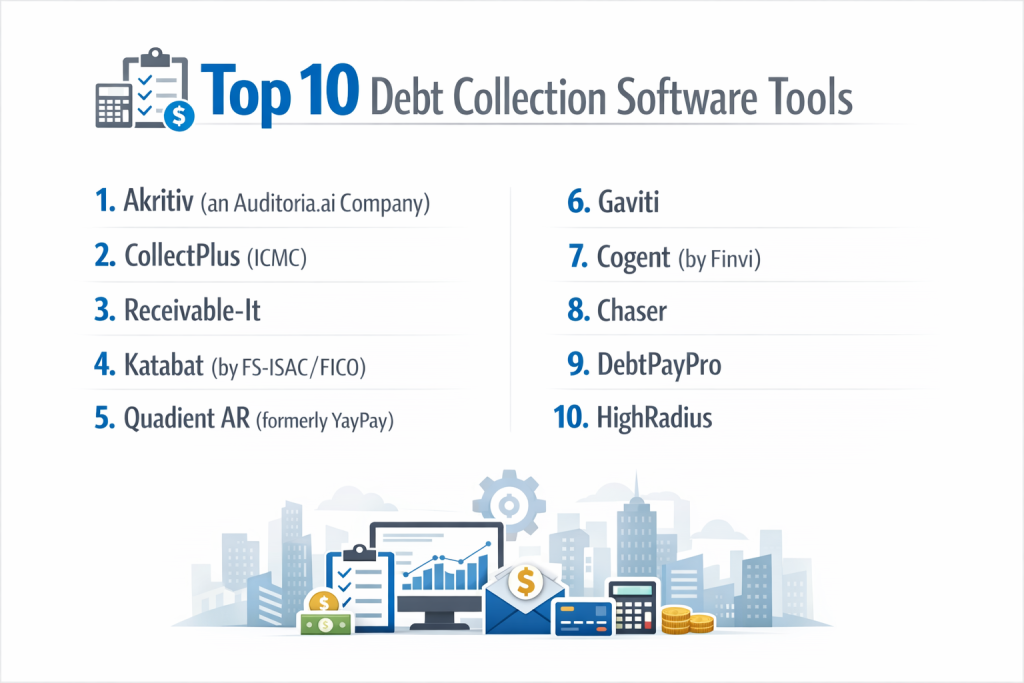
Top 10 Debt Collection Software Tools
1 — Akritiv (an Auditoria.ai Company)
Akritiv is an enterprise-grade platform that leverages Artificial Intelligence to transform the accounts receivable process. It focuses on large-scale B2B debt recovery through autonomous “Smart Bots.”
Key features:
- Autonomous AR Bots: AI assistants that handle initial inquiries and simple disputes via email.
- Predictive Risk Scoring: Identifies which customers are likely to become delinquent before they miss a payment.
- Automated Dispute Management: Categorizes and routes disputes to the correct department for faster resolution.
- Global Cash Application: Matches incoming payments to invoices across multiple currencies and banks.
- Executive Dashboards: High-level visibility into DSO (Days Sales Outstanding) and cash flow forecasts.
Pros:
- Drastically reduces manual labor by handling routine follow-ups without human intervention.
- Excellent at managing complex B2B relationships where “customer experience” is sensitive.
Cons:
- May be overly complex for smaller firms with straightforward collections needs.
- Implementation requires a high degree of integration with existing ERP systems.
Security & compliance: SOC 2 Type II, ISO 27001, and GDPR compliant; features end-to-end encryption.
Support & community: Enterprise-level support with dedicated account managers and comprehensive documentation.
2 — CollectPlus (ICMC)
CollectPlus is a veteran in the space, offering a robust, traditional debt collection suite that is highly favored by third-party agencies and law firms specializing in debt recovery.
Key features:
- Comprehensive Legal Tracking: Specialized modules for managing litigation, judgments, and wage garnishments.
- Automated Credit Bureau Reporting: Direct integrations to report payment history to major credit bureaus.
- Multi-Client Reporting: Allows agencies to give their clients (creditors) real-time access to their specific portfolios.
- Configurable Dunning Workflows: Step-by-step automation for letters, calls, and legal notices.
- Built-in Dialer: Integrated telephony for high-volume outbound calling campaigns.
Pros:
- One of the best tools for legal debt recovery and court-ordered collection processes.
- Highly stable platform with decades of industry feedback incorporated into its workflows.
Cons:
- The user interface can feel dated compared to modern SaaS-first startups.
- Steep learning curve for staff who are not familiar with traditional collection agency software.
Security & compliance: HIPAA and FDCPA compliant; features secure audit logs for regulatory examinations.
Support & community: Strong legacy user base and responsive phone-based technical support.
3 — Receivable-It
Receivable-It is a modern, cloud-native platform designed for small-to-mid-market businesses that want to automate their AR without a heavy IT lift.
Key features:
- One-Click ERP Integration: Native connectors for QuickBooks, Xero, and Sage.
- Branded Payment Portal: A secure site where customers can pay via Credit Card or ACH.
- SMS Dunning: Automated text message reminders for past-due invoices.
- Promise-to-Pay Tracking: Automatically halts dunning actions once a customer commits to a payment date.
- Customer Communication History: A centralized thread of every email and call made to a debtor.
Pros:
- Extremely fast to set up; businesses can be automated in under an hour.
- Very affordable for SMBs that are graduating from manual spreadsheets.
Cons:
- Lacks the advanced predictive AI features found in enterprise tools like Akritiv.
- Limited support for international legal collections and garnishments.
Security & compliance: SOC 2 compliant; uses bank-grade encryption for all financial data.
Support & community: Responsive chat-based support and a robust online knowledge base.
4 — Katabat (by FS-ISAC/FICO)
Katabat, now part of the FICO ecosystem, is a premium choice for banks and high-volume lenders. It is known for its “Strategy Engine” which optimizes contact methods for maximum recovery.
Key features:
- Omnichannel Orchestration: Syncs email, SMS, and voice to ensure a consistent message across channels.
- Regulatory Compliance Engine: Automatically updates contact rules based on shifting state and federal laws.
- Machine Learning Scoring: Predicts the best time and channel to contact a specific individual.
- Agent Desktop: A unified view for agents that includes payment history and dispute notes.
- Hardship Workflows: Specific paths for managing COVID-related or natural disaster relief programs.
Pros:
- Superior compliance features that protect large institutions from regulatory fines.
- Data-driven approach significantly increases “First-Call Resolution” and payment rates.
Cons:
- High total cost of ownership (TCO) makes it inaccessible for small agencies.
- Requires a significant data-mapping project during initial implementation.
Security & compliance: SOC 2 Type II, PCI DSS, and HIPAA compliant; high-security banking standards.
Support & community: High-touch enterprise support and involvement in major fintech communities.
5 — Quadient AR (formerly YayPay)
Quadient AR is a leader in the mid-market space, offering a visually stunning platform that focuses on making the collections process collaborative between sales and finance teams.
Key features:
- Predictive Payor Behavior: Categorizes customers as “Slow Payers,” “Fast Payers,” or “At Risk.”
- Salesforce Integration: Allows sales reps to see if their accounts are behind on payments without leaving their CRM.
- Automated Statement Delivery: Batches and sends monthly statements automatically.
- Global Portals: Supports multi-language and multi-currency payment environments.
- Task Management: Automatically creates “To-Do” lists for collectors based on account priority.
Pros:
- The most intuitive and modern user interface in the industry.
- Bridges the gap between “Finance” and “Sales,” reducing internal friction over collections.
Cons:
- Less focus on the “legal/litigation” side of debt collection than tools like CollectPlus.
- Can be expensive as the number of users or invoices scales.
Security & compliance: SOC 2 Type II and GDPR compliant.
Support & community: Extensive webinars, an active customer success program, and 24/7 support.
6 — Gaviti
Gaviti is a specialized AR automation platform that focuses on the B2B space, helping companies with complex invoice structures get paid faster through workflow optimization.
Key features:
- Workflow Designer: A visual tool to build custom follow-up sequences for different types of clients.
- Dispute Workflow: Allows clients to flag specific line items on an invoice for faster resolution.
- Multi-Entity Management: Handles collections across different business units or countries from one dashboard.
- Escalation Management: Automatically routes high-value delinquent accounts to senior managers.
- Performance Analytics: Tracks collector efficiency and cash flow forecasting accuracy.
Pros:
- Excellent for companies with global operations and diverse payment terms.
- High degree of customization for dunning templates and frequency.
Cons:
- Does not include a built-in telephony dialer (relies on integrations).
- Primarily B2B focused; not ideal for high-volume B2C consumer debt.
Security & compliance: SOC 2 and GDPR compliant.
Support & community: Strong onboarding support and regular training sessions for new features.
7 — Cogent (by Finvi)
Cogent is a powerhouse for high-volume, enterprise debt collection and recovery. It is widely used by large law firms and massive collection agencies that need to manage the “litigation lifecycle.”
Key features:
- Integrated Legal Engine: Manages every step from the “Letter of Intent” to the “Writ of Execution.”
- Mass Document Production: Generates thousands of compliant legal filings in minutes.
- Sophisticated Rules Engine: Automates fee calculations, interest accruals, and commission splits.
- Vendor Management: Tracks the performance of outside counsel or secondary agencies.
- Custom Data Mapping: Can ingest data from virtually any creditor format.
Pros:
- The “Gold Standard” for legal collections and high-volume judgment enforcement.
- Extremely powerful automation for complex financial calculations.
Cons:
- The interface is highly technical and requires significant training to master.
- It is a heavy system that is typically overkill for standard corporate AR.
Security & compliance: SOC 2, HIPAA, and GLBA compliant.
Support & community: Robust enterprise support and an active “Finvi” user community.
8 — Chaser
Chaser is a UK-based platform that has gained global popularity for its “human-centric” approach to debt collection, emphasizing polite persistence over aggressive dunning.
Key features:
- Human-Like Email Automation: Emails appear as if they were typed manually by a staff member.
- Custom Schedule Creator: Different dunning paths for “Good Customers” vs. “Repeat Offenders.”
- Credit Checking: Integrated reports to check the creditworthiness of a new client before offering terms.
- Chaser Collections: Access to a professional third-party agency service directly through the app for “stubborn” debts.
- Automated Thank You Notes: Sends a confirmation once a debt is paid to maintain customer goodwill.
Pros:
- Best choice for businesses where preserving the customer relationship is as important as the money.
- Very simple to use and integrates seamlessly with cloud accounting like Xero.
Cons:
- Lacks the deep “Litigation” and “Banking” features of larger enterprise tools.
- Not designed for high-volume B2C debt (e.g., millions of utility bills).
Security & compliance: GDPR compliant; features secure data encryption.
Support & community: Excellent customer service and a wealth of educational content on “Polite Collections.”
9 — DebtPayPro
DebtPayPro is a specialized CRM and automation tool for debt settlement and debt relief companies, rather than the creditors themselves.
Key features:
- Lead Management: Specialized tools for intake and qualifying debtors for relief programs.
- Document E-Signing: Integrated electronic signatures for settlement agreements.
- Trust Account Management: Tracks the funds held in escrow for debt settlements.
- API Connectivity: Connects to lead providers and third-party payment processors.
- Automated Marketing: Email and SMS tools to nurture potential debt-relief clients.
Pros:
- The leading choice for the “Debt Relief” and “Settlement” industry.
- Highly specialized for managing the specific regulations of the relief sector.
Cons:
- Not a general-purpose debt collection tool for creditors or agencies.
- Very niche focus limits its use for general accounts receivable.
Security & compliance: SOC 2 and ISO 27001 compliant.
Support & community: Strong focus on industry-specific training and compliance updates.
10 — HighRadius
HighRadius is an AI-driven “Integrated Receivables” platform that uses “Rivana,” their proprietary AI engine, to automate the entire credit-to-cash lifecycle for Fortune 1000 companies.
Key features:
- AI-Powered Deductions: Automatically identifies valid vs. invalid trade deductions and short-payments.
- Dynamic Credit Limits: Adjusts customer credit limits in real-time based on payment behavior.
- Autonomous Collections: AI determines which accounts to call, which to email, and what the tone should be.
- ERP-Native Integration: Built to sit directly inside SAP, Oracle, and S/4HANA.
- Cash Forecasting: Highly accurate models of when cash will actually hit the bank account.
Pros:
- The absolute pinnacle of AI technology in the debt collection space.
- Unmatched scalability for the world’s largest global enterprises.
Cons:
- Implementation can take 6-12 months and requires significant investment.
- Only suitable for very large organizations with massive transaction volumes.
Security & compliance: SOC 1/2 Type II, ISO 27001, and GDPR compliant.
Support & community: Premier global support and the annual “Radiance” user conference.
Comparison Table
| Tool Name | Best For | Platform(s) Supported | Standout Feature | Rating |
| Akritiv | Large B2B AR | Cloud (SaaS) | Autonomous AR Bots | N/A |
| CollectPlus | Collection Agencies | On-Prem / Cloud | Legal & Litigation Tracking | N/A |
| Receivable-It | Small Businesses | Cloud (SaaS) | One-Click ERP Sync | N/A |
| Katabat | Banks & Lenders | Cloud (SaaS) | Strategy Scoring Engine | N/A |
| Quadient AR | Mid-Market B2B | Cloud (SaaS) | Sales/Finance Collaboration | N/A |
| Gaviti | Global B2B | Cloud (SaaS) | Multi-Entity Management | N/A |
| Cogent | High-Volume Legal | On-Prem / Cloud | Mass Legal Document Prod | N/A |
| Chaser | Relationship-Focused | Cloud (SaaS) | Human-Like Dunning | N/A |
| DebtPayPro | Debt Relief Firms | Cloud (SaaS) | Trust Account Management | N/A |
| HighRadius | Fortune 1000 | Cloud / Hybrid | Rivana AI Engine | N/A |
Evaluation & Scoring of Debt Collection Software
| Criterion | Weight | Evaluation Focus |
| Core Features | 25% | Dunning automation, payment portals, and scoring engines. |
| Ease of Use | 15% | Administrator UI, agent efficiency, and onboarding time. |
| Integrations | 15% | Native ERP/CRM connectors and API robustness. |
| Security & Compliance | 10% | FDCPA/Regulation F guardrails and SOC 2 status. |
| Performance | 10% | System uptime, calculation speed, and mass-mailing reliability. |
| Support | 10% | Training quality, response time, and expert consulting. |
| Price / Value | 15% | ROI through recovery rates vs. total cost of ownership. |
Which Debt Collection Tool Is Right for You?
Solo Users vs SMB vs Mid-Market vs Enterprise
If you are a Solo Entrepreneur or a Small Business, tools like Chaser or Receivable-It are the clear winners. They are inexpensive and focus on “polite” automation that doesn’t require a dedicated credit manager. Mid-Market firms looking to scale their B2B operations will thrive with Quadient AR or Gaviti, which offer better reporting and team collaboration. Large Enterprises and banks should look toward HighRadius, Akritiv, or Katabat, where AI and compliance-at-scale are the primary requirements.
Budget-Conscious vs Premium Solutions
For those on a tight budget, the “freemium” or low-tier plans of Chaser provide excellent value. If your debt recovery volume is high enough that even a 1% increase in recovery pays for the software, then Premium solutions like HighRadius are worth the multi-six-figure investment due to their superior predictive capabilities.
Feature Depth vs Ease of Use
If you need Feature Depth for legal battles, Cogent or CollectPlus are the industry standards, though they require significant training. If you want Ease of Use so that your current staff can start seeing results tomorrow, Quadient AR and Chaser provide the most intuitive dashboards and “ready-to-use” templates.
Integration and Scalability Needs
For companies already using SAP or Oracle, HighRadius offers the most “seamless” experience. If you are a high-growth startup building a custom platform, an API-first approach from a modern SaaS provider like Akritiv or Gaviti will allow your developers to build debt recovery directly into your tech stack.
Security and Compliance Requirements
Agencies and law firms handling healthcare debt must prioritize HIPAA compliance, making CollectPlus or Cogent strong candidates. Banks and institutions that must adhere to the strictest financial regulations will find the compliance engines in Katabat and HighRadius to be their best defense against regulatory scrutiny.
Frequently Asked Questions (FAQs)
What is the difference between AR automation and debt collection software?
AR automation (like Gaviti) focuses on “Early Stage” collections (0-60 days past due) while the relationship is still active. Debt collection software (like CollectPlus) often handles “Late Stage” (90+ days), including legal actions and third-party agencies.
Does this software guarantee I will get paid?
No software can guarantee payment, but most users report a 15-30% increase in recovery rates due to more consistent follow-ups and easier payment options for the debtor.
Can I send text messages (SMS) to debtors legally?
Yes, but under Regulation F, you must have the debtor’s consent and provide a clear “Opt-Out” in every message. Modern software automates this compliance.
What is a ‘Propensity to Pay’ score?
It is an AI-generated number (usually 1-100) that predicts how likely a person is to pay. This helps collectors focus their limited time on the accounts most likely to settle.
Can I keep my current accounting software?
Most modern debt collection tools (like Chaser or Quadient) are designed to “overlay” your existing accounting software (QuickBooks, NetSuite) rather than replace it.
How does AI help in debt collection?
AI can analyze thousands of past interactions to determine the “ideal” time of day to send an email or the specific “tone” (stern vs. helpful) that works best for a particular customer.
What is a ‘White-Label’ payment portal?
It is a payment website that looks like your brand, ensuring the debtor feels safe entering their credit card or bank details on a site they recognize.
Can the software handle international collections?
Tools like HighRadius and Gaviti are designed for “Global” operations, handling different currencies, languages, and local tax laws (like VAT).
What is a ‘Dunning’ letter?
“Dunning” is the process of methodically communicating with a customer to collect a debt. A dunning letter is an automated notice sent at specific intervals (e.g., 7, 15, and 30 days past due).
Is cloud-based software safe for financial data?
Yes. In fact, most cloud providers have higher security standards (SOC 2, ISO 27001) than a typical small-business server.
Conclusion
In the economic landscape of 2026, cash flow is the ultimate lifeblood of any organization. Leaving debt recovery to manual processes is no longer just inefficient—it is a significant business risk. Whether you are a small business looking for the “Polite Persistence” of Chaser, or a global enterprise requiring the “Autonomous AI” of HighRadius, the right Debt Collection Software acts as a force multiplier for your finance team.
When choosing a platform, remember that the “best” tool isn’t necessarily the one with the most features; it’s the one that aligns with your specific customer relationship goals. By automating the routine follow-ups and ensuring total compliance with debt regulations, you free your team to focus on resolving complex disputes and building the partnerships that drive long-term growth.