Introduction
A Customer Experience (CX) Platform is a unified software system that helps businesses manage, analyze, and improve every interaction a customer has with their brand across the entire journey. It goes beyond a single tool like a helpdesk or survey software. Think of it as the central nervous system for customer intelligence, pulling together data from support, marketing, sales, product usage, and feedback to create a complete, 360-degree view of the customer.
This software is critically important because modern customers expect seamless, personalized, and proactive experiences. A disjointed experience—where marketing emails don’t match support conversations, or sales makes promises support can’t keep—drives customers away. CX platforms break down internal data silos, enabling companies to understand customer sentiment in real-time, predict issues before they happen, and empower teams to deliver consistent, exceptional service that builds loyalty and drives revenue growth.
Key real-world use cases include: A retail company identifying a spike in negative feedback about a specific product and proactively issuing a refund before most customers even complain. A SaaS company tracking a user’s journey from sign-up to cancellation, pinpointing the exact feature gap causing churn. A bank unifying a customer’s call center, mobile app, and branch interactions so any agent can provide informed, contextual help instantly. A hotel chain personalizing guest stays based on past preferences collected across multiple touchpoints.
When choosing a platform, users should prioritize several key criteria. Data Unification & 360-Degree View is the core—can it integrate data from all your customer touchpoints into a single profile? Real-Time Analytics & Insights must move beyond historical reporting to provide actionable intelligence. Orchestration & Automation capabilities allow you to trigger personalized actions based on customer behavior. Voice of the Customer (VoC) Tools like surveys and feedback collection are essential. Finally, consider ease of use for frontline teams, scalability, and the strength of the platform’s AI and predictive capabilities.
Best for: These platforms deliver immense value to Chief Customer Officers, VP of Customer Experience, Customer Success leaders, and heads of Marketing and Support in customer-centric organizations. They are critical for B2C industries like retail, travel, hospitality, and financial services, as well as B2B SaaS and subscription companies where retention is paramount. Mid-market and enterprise companies with complex customer journeys and multiple touchpoints benefit most.
Not ideal for: Very small businesses or solopreneurs with a simple, low-volume customer interaction model (e.g., a local contractor). A business with a single, transactional product and no ongoing relationship may find the cost and complexity unjustified. Companies with no digital touchpoints or those that are not yet committed to a data-driven culture will struggle to realize the platform’s full value. In these cases, standalone tools (a basic helpdesk, a survey tool) might be sufficient.
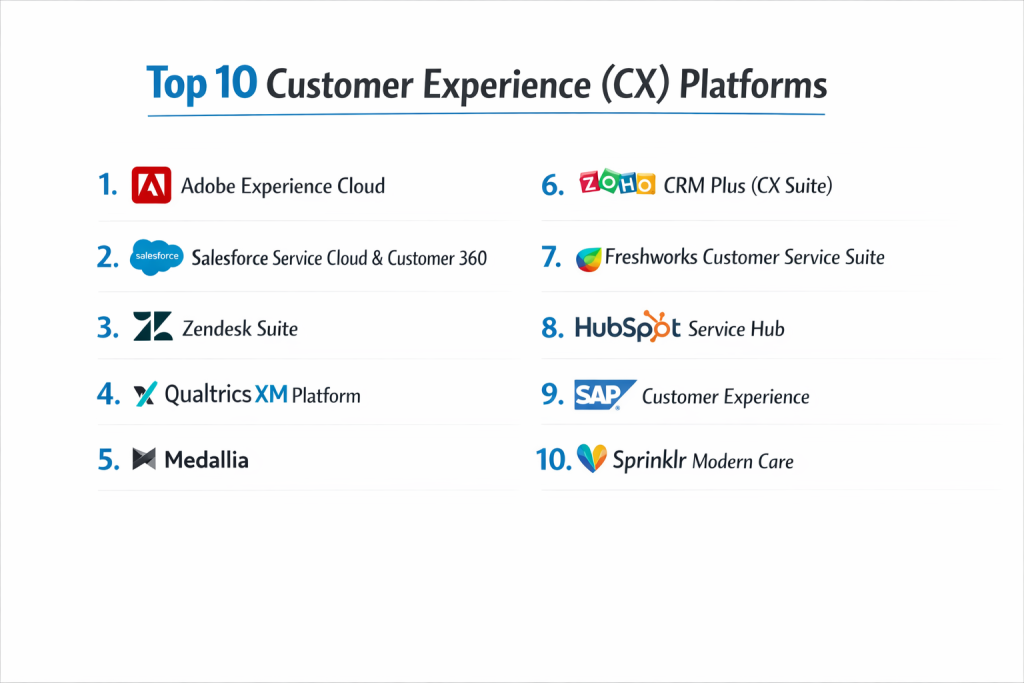
Top 10 Customer Experience (CX) Platforms
1 — Adobe Experience Cloud
Adobe Experience Cloud is a massive, enterprise-grade suite of integrated applications for marketing, advertising, analytics, and commerce. It is a powerhouse for large brands that need to design, manage, and deliver personalized customer experiences across every digital and physical channel at a global scale.
Key features:
- Unified Customer Profile (Real-Time CDP): Creates a single, actionable view of each customer by stitching together data from online, offline, CRM, and second-party sources.
- Journey Orchestration & Automation: Designs and executes real-time, cross-channel customer journeys (email, web, mobile, ads) based on behavior and data.
- Content & Asset Management: Centralized tools (Adobe Experience Manager) to create, manage, and deliver personalized content and digital experiences.
- Advanced Analytics & Attribution: Deep-dive analytics (Adobe Analytics) to measure the impact of experiences across the entire journey.
- B2B & B2C Commerce: Robust platforms (Adobe Commerce) for managing complex online stores and B2B buying experiences.
- AI & Machine Learning (Adobe Sensei): Pervasive AI that powers personalization, predictive analytics, and content intelligence across the suite.
Pros:
- Comprehensive, Integrated Suite: Offers unparalleled breadth and depth for companies wanting an all-in-one experience ecosystem from one vendor.
- Market-Leading Personalization & Content Tools: Unmatched capabilities for creating and delivering dynamic, personalized content experiences at scale.
Cons:
- Extremely High Cost & Complexity: One of the most expensive and complex solutions on the market, requiring significant budget, IT resources, and implementation expertise.
- Potential for “Shelfware”: Its vastness can lead to underutilization if companies don’t have the maturity or resources to leverage it fully.
Security & compliance: Enterprise-grade security with a comprehensive set of certifications (SOC 2, ISO 27001, etc.) and robust data governance tools for global privacy regulations.
Support & community: Supported by Adobe’s global services organization and a vast network of solution partners. Has enormous, but often segmented, user communities for each product.
2 — Salesforce Service Cloud & Customer 360
Salesforce Customer 360 is the overarching architecture that connects Salesforce’s clouds (Service, Marketing, Sales, Commerce). Service Cloud is the core CX hub, designed for companies that want to build customer service and engagement on the world’s leading CRM platform.
Key features:
- Service Cloud Core: Omnichannel case management, knowledge base, live chat, messaging, and a powerful AI assistant (Einstein) for agents.
- Customer 360 Data Model: Unifies customer data from Sales Cloud, Marketing Cloud, MuleSoft, and external sources into a single profile accessible across the platform.
- Digital Engagement Center: Manages high-volume digital customer service across social messaging, WhatsApp, and in-app channels.
- Field Service Management: Schedules, dispatches, and equips mobile field service technicians.
- Experience Cloud: Builds branded customer and partner self-service portals and communities.
- Einstein AI: Embedded AI for predictive case routing, article recommendations, sentiment analysis, and automation.
Pros:
- CRM-Centric Powerhouse: The undisputed leader for companies that want service, support, and engagement deeply integrated with their sales and marketing data in one ecosystem.
- Massive AppExchange Ecosystem: Access to thousands of pre-built third-party apps and integrations, offering near-limitless extensibility.
Cons:
- Cost Can Escalate Quickly: Licensing, implementation, and customization costs can become very high, especially as you add more clouds and features.
- Complexity & Customization: The platform’s flexibility means it often requires significant configuration, admin expertise, or development to match specific workflows.
Security & compliance: Leverages Salesforce’s industry-leading “Trust” infrastructure with robust security, compliance certifications (SOC 2, ISO 27001), and granular data controls.
Support & community: Access to Salesforce support, Trailhead learning platform, a massive global community of admins and developers, and a huge partner network.
3 — Zendesk Suite
Zendesk Suite is a cohesive, user-friendly set of applications built around a unified agent workspace. It is designed for businesses of all sizes that prioritize elegant, efficient customer service and support as the heart of their CX strategy.
Key features:
- Unified Agent Workspace: A single interface to handle conversations from email, chat, voice, social, and messaging apps like WhatsApp and Facebook Messenger.
- Intelligent Ticketing & Automation: Robust workflow automation, AI-powered triage, and smart routing to get queries to the right agent quickly.
- Integrated Knowledge Base & Help Center: Easy-to-use tools to create and optimize self-service content that deflects tickets.
- Conversational Analytics & Insights: Built-in analytics (Explore) and AI (Answer Bot, Content Cues) to understand support drivers and improve efficiency.
- Sunshine Platform (CRM): An open, flexible CRM layer that allows companies to build custom customer profiles and connect any data source.
- Strong Out-of-the-Box Functionality: Known for being quick to set up and use with sensible defaults.
Pros:
- Best-in-Class Usability: Renowned for its intuitive, clean design that agents love, leading to rapid adoption and lower training costs.
- Rapid Time-to-Value: One of the fastest platforms to implement and get running effectively, especially for core support use cases.
Cons:
- Less Native Marketing/Sales Depth: While it has CRM capabilities, it is not a native sales or marketing automation powerhouse like Salesforce or Adobe.
- Advanced Customization Limits: Extremely complex, bespoke business processes might be harder to model compared to highly configurable enterprise platforms.
Security & compliance: A mature cloud provider with strong security, including SOC 2 Type II, ISO 27001, and GDPR compliance tools.
Support & community: Excellent support and a comprehensive help center. Has a very large and active global user community.
4 — Qualtrics XM Platform
Qualtrics is the pioneer and leader in Experience Management (XM). Its platform is designed for organizations that want to move beyond operational data to deeply understand and act on the “why” behind customer (and employee) behavior through sophisticated feedback and research.
Key features:
- Core XM Research Tools: Industry-leading survey design, distribution, and advanced statistical analysis for VoC (Voice of the Customer), VoE (Employee), and market research.
- iQ Text & Sentiment AI: Powerful AI that analyzes open-ended feedback across surveys, reviews, and support interactions to uncover themes and emotion.
- Journey Mapping & Orchestration: Tools to visually map key customer journeys, identify pain points, and trigger automated actions to improve them.
- Predictive Intelligence & Driver Analysis: Identifies which operational metrics (e.g., wait time, product quality) most strongly impact key business outcomes (e.g., retention, NPS).
- Action & Close-the-Loop Workflows: Automatically routes critical feedback to the right teams (e.g., product, ops) and tracks resolution.
- Strong Ecosystem Integrations: Connects experience data (X-data) with operational data (O-data) from systems like Salesforce, SAP, and Adobe.
Pros:
- Unmatched Feedback & Insights Depth: The gold standard for organizations that base their CX strategy on deep, empirical understanding of sentiment and driving factors.
- Predictive & Prescriptive Analytics: Excels at not just reporting what happened, but predicting what will happen and prescribing what to do about it.
Cons:
- Less Focus on Core Service Operations: It is not a native ticketing or contact center system; it’s designed to integrate with and enhance those systems with insights.
- Steep Learning Curve for Advanced Features: Leveraging its full statistical and predictive power requires skilled analysts or data scientists.
Security & compliance: Enterprise-grade security trusted by governments and global brands. Holds FedRAMP authorization, ISO 27001, and other key certifications.
Support & community: Offers high-touch strategic support and a robust academic network. Its community is strong among insights professionals.
5 — Medallia
Medallia is an enterprise-scale Experience Management platform known for its real-time feedback capture and ability to drive action across large, distributed organizations, particularly in hospitality, retail, and financial services.
Key features:
- Real-Time Feedback Capture: Specializes in capturing in-the-moment feedback via SMS, email, QR codes, and kiosks at key journey points (e.g., post-purchase, hotel stay).
- AI-Powered Analytics & Alerts: Advanced text and speech analytics to surface urgent issues from feedback, triggering immediate alerts to frontline managers.
- Frontline Employee Engagement: Tools to share customer feedback directly with store managers, agents, or branch staff to empower local action and coaching.
- Journey Analytics: Analyzes feedback and operational data across journeys to identify systemic breakdowns.
- Integrations for Action: Strong push to integrate with CRM, helpdesk, and operational systems to close the loop.
- Scalable for Global Enterprises: Built to handle millions of feedback points across diverse business units and languages.
Pros:
- Real-Time, Frontline Focus: Exceptional at closing the loop quickly by putting insights directly into the hands of employees who can act on them immediately.
- Proven at Massive Scale: A trusted choice for Fortune 500 companies with vast customer bases and complex operational footprints.
Cons:
- Can Be Costly for Mid-Market: Pricing and implementation are geared toward large enterprises, potentially putting it out of reach for smaller companies.
- Broader Platform vs. Specialization: While expanding, its historical strength is in structured VoC programs; other platforms may have deeper native service or marketing clouds.
Security & compliance: Meets the highest standards for enterprise data security and global compliance, with relevant industry-specific certifications.
Support & community: Provides enterprise-level strategic services and support. Strong user community in its core verticals like hospitality.
6 — Zoho CRM Plus (CX Suite)
Zoho CRM Plus is an integrated suite of applications within the Zoho ecosystem that combines CRM, customer service, marketing automation, analytics, and more. It is a compelling all-in-one solution for small to mid-sized businesses already invested in or considering the Zoho universe.
Key features:
- Unified Zoho Ecosystem: Deeply integrated suite including Zoho CRM (sales), Desk (support), Campaigns (marketing), Analytics, and Connect (collaboration).
- Omnichannel Customer Service (Desk): Manages support tickets from phone, email, chat, social media, and web forms in one place.
- Multichannel Marketing Automation: Creates and automates email, social, and SMS marketing campaigns tied to customer data.
- Built-in Analytics & Reporting: Cross-application analytics to see the full customer lifecycle from lead to support.
- AI Assistant (Zia): Provides predictions, sentiment analysis, and automation suggestions across the suite.
- Exceptional Value: Offers a very broad set of features at a highly competitive price point.
Pros:
- Outstanding Value & Integration: Possibly the best cost-to-feature ratio on the market, with seamless integration between apps that “just work” together.
- Ideal for SMBs & Zoho Users: Perfect for growing businesses that want an affordable, all-in-one system without the complexity of piecing together best-of-breed tools.
Cons:
- Ecosystem Lock-In: Its strengths are most potent within the Zoho walled garden; integrations with major non-Zoho enterprise systems can be less robust.
- Brand Perception: May not carry the same enterprise clout or have as extensive a third-party ecosystem as Salesforce or Adobe.
Security & compliance: Adheres to robust security standards with data encryption and privacy controls. Compliance certifications like SOC 2 are part of its offering.
Support & community: Provides good support and has an extensive knowledge base. Has a large and loyal global user base, particularly among SMBs.
7 — Freshworks Customer Service Suite
Freshworks offers a modern, intuitive suite of customer engagement software, including Freshdesk (support) and Freshchat (messaging). It is known for its fresh user interface, rapid innovation, and appeal to fast-growing companies that value ease of use and quick setup.
Key features:
- Omnichannel Support (Freshdesk): Unified inbox for email, phone, chat, social, and WhatsApp with automation and AI-powered suggestions.
- Proactive Messaging (Freshchat): Live chat and chatbot functionality for sales and support, with targeted messaging based on user behavior.
- Integrated ITSM (Freshservice): IT service management capabilities for internal employee support, often bundled.
- Customer Success (Freshsuccess): Tools for managing customer health scores, onboarding, and renewal risk.
- Freddy AI: A unified AI layer across products for automation, classification, and insights.
- Strong SMB & Mid-Market Focus: Packaged and priced attractively for growing teams.
Pros:
- Modern UX & Fast Innovation: Frequently praised for its clean, modern design and pace of releasing new, user-friendly features.
- Affordable Scalability: Offers a clear growth path from small teams to larger operations without massive price jumps or complexity shocks.
Cons:
- Suite Cohesion: While integrated, the products (Freshdesk, Freshchat, etc.) can sometimes feel like separate tools bolted together rather than a single native platform.
- Advanced Enterprise Features: May lack some of the ultra-granular configuration and global scalability features of legacy enterprise vendors.
Security & compliance: Implements strong security measures and is SOC 2 Type II compliant. Meets standards for data privacy and protection.
Support & community: Known for responsive support. Has an active user community and holds regular user conferences.
8 — HubSpot Service Hub
HubSpot Service Hub is the customer service component of the HubSpot CRM platform. It is designed for companies fully bought into the HubSpot inbound philosophy, offering tight integration with marketing and sales to create a seamless customer journey.
Key features:
- Tight CRM Integration: All service interactions are logged against a contact/company record in the shared HubSpot CRM, visible to sales and marketing.
- Conversational Tools: Shared inbox, live chat, chatbots, and simple ticketing to manage customer conversations.
- Knowledge Base & Feedback: Easy-to-create help docs and integrated customer feedback surveys (NPS, CSAT).
- Customer Portal: Allows customers to view the status of their conversations and access a personalized knowledge base.
- Automation & Playbooks: Workflow automation and standardized playbooks for common service scenarios.
- Reporting & Analytics: Service-specific reporting within the broader HubSpot analytics environment.
Pros:
- Seamless for HubSpot CRM Users: For teams using HubSpot for marketing and sales, the Service Hub provides a frictionless, unified data experience.
- Inbound Philosophy Alignment: Perfect for companies that view service as an opportunity to delight and educate, turning customers into promoters.
Cons:
- Limited Advanced Service Features: Not as feature-rich for complex, high-volume, or B2B enterprise support as specialized platforms like Zendesk or Salesforce.
- Part of a Larger Suite: Best value realized when using multiple HubSpot Hubs; as a standalone service desk, it faces strong competition.
Security & compliance: A established cloud platform with robust security, SOC 2 compliance, and tools for data privacy management.
Support & community: Excellent educational resources (HubSpot Academy), strong community, and standard support channels.
9 — SAP Customer Experience
SAP CX is an enterprise suite focused on unifying customer data, commerce, and service, often as part of a broader SAP S/4HANA or ERP-driven digital transformation. It is the strategic choice for large corporations running SAP as their core business backbone.
Key features:
- SAP Customer Data Platform (CDP): Unifies transactional, behavioral, and consent data from SAP and non-SAP sources.
- Commerce Cloud: A powerful B2B and B2C e-commerce platform integrated with back-office ERP (inventory, finance).
- Service Cloud: Manages omnichannel customer service with a focus on integration with asset and warranty data from ERP.
- Sales & Marketing Cloud: Provides B2B sales and account-based marketing capabilities.
- Real-Time Contextualization: Leverages SAP’s in-memory HANA database to process and act on customer data in real time.
- Industry-Specific Solutions: Deep pre-configured solutions for industries like utilities, manufacturing, and retail.
Pros:
- Deep ERP Integration: The definitive advantage for SAP-centric businesses, ensuring customer experiences are informed by real-time inventory, order, and financial data.
- Enterprise Scale & Governance: Built for the most complex global deployments with strong data governance and compliance tools.
Cons:
- SAP Ecosystem Dependency: Its value and practicality are highest for companies deeply embedded in the SAP technology landscape.
- Complexity & Cost: Typical of large-scale SAP implementations, requiring significant investment and specialized skills.
Security & compliance: Inherits SAP’s enterprise-grade security model and global compliance certifications, meeting stringent industry requirements.
Support & community: Supported by SAP’s global services and partner network. User community is strong within the SAP ecosystem.
10 — Sprinklr Modern Care
Sprinklr Modern Care is a unified platform for large brands to manage customer engagement across all public social and digital messaging channels (Facebook, Twitter, Instagram, WhatsApp, etc.). It focuses on transforming social care into a scalable, efficient, and insights-driven function.
Key features:
- Unified Social & Digital Inbox: A single workspace to manage customer conversations from over 30 social, messaging, and review sites.
- AI-Powered Routing & Insights: Intelligent routing, sentiment analysis, and trend detection to prioritize and understand social conversations.
- Scalable Social Care Workflows: Automation and collaboration tools to handle high volumes of public social interactions efficiently.
- Integrated Advertising & Publishing: Connects care responses with social advertising and content publishing for a coordinated front-office.
- Real-Time Brand Monitoring: Listens to brand mentions across the digital landscape beyond just direct @mentions.
- Advanced Reporting & ROI: Measures the impact of social care on brand sentiment, customer satisfaction, and operational efficiency.
Pros:
- Social & Digital Channel Mastery: The leading platform for companies where social media is a primary customer service and brand management channel.
- From Listening to Engagement to Insights: Closes the loop from monitoring social conversations to engaging at scale and extracting business intelligence.
Cons:
- Channel Specialization: Its core strength is public digital channels; it is not a traditional omni-channel platform for phone, email, or complex B2B support cases.
- Enterprise Focus & Pricing: Geared toward large consumer brands with massive social footprints, making it less relevant for SMBs or B2B companies with low social volume.
Security & compliance: Built for the public social sphere with enterprise-grade security, compliance, and governance tools for regulated industries.
Support & community: Provides strategic services and support for enterprise clients. Strong presence among global consumer brands.
Comparison Table
| Tool Name | Best For | Platform(s) Supported | Standout Feature |
|---|---|---|---|
| Adobe Experience Cloud | Large enterprises needing an all-in-one suite for personalized content, commerce, & journeys. | Cloud | Market-leading content/personalization & integrated marketing/ad tech. |
| Salesforce Service Cloud | Companies wanting CX deeply integrated with the #1 CRM platform. | Cloud | CRM-centric omnichannel service & massive AppExchange ecosystem. |
| Zendesk Suite | Businesses of all sizes prioritizing elegant, efficient, & unified customer service. | Cloud | Best-in-class agent usability & rapid time-to-value. |
| Qualtrics XM Platform | Organizations focused on deep VoC insights, predictive analytics, & experience research. | Cloud | Unmatched feedback intelligence & predictive driver analysis. |
| Medallia | Large enterprises needing real-time feedback to drive frontline action at scale. | Cloud | Real-time VoC capture & frontline employee engagement tools. |
| Zoho CRM Plus | SMBs & mid-market companies wanting an affordable, all-in-one CRM & CX suite. | Cloud | Exceptional value & seamless integration within the Zoho ecosystem. |
| Freshworks Suite | Fast-growing companies valuing modern UX, quick setup, and proactive messaging. | Cloud | Modern, intuitive design & affordable scalability. |
| HubSpot Service Hub | Inbound-focused companies using HubSpot CRM for marketing & sales alignment. | Cloud | Seamless integration with HubSpot’s inbound marketing & sales tools. |
| SAP Customer Experience | Large SAP-centric businesses needing CX integrated with real-time ERP data. | Cloud | Deep, real-time integration with SAP ERP (S/4HANA) for contextual CX. |
| Sprinklr Modern Care | Large consumer brands managing customer engagement at scale on social/digital channels. | Cloud | Mastery of public social & digital messaging channels for care & insights. |
Evaluation & Scoring of Customer Experience (CX) Platforms
To systematically evaluate platforms, use this weighted scoring rubric. Score each tool from 1 (Poor) to 5 (Excellent) for each criterion. Multiply the score by the weight to calculate the weighted score. The tool with the highest total represents the best strategic fit.
| Criteria | Weight | What to Look For | Score (1-5) | Weighted Score |
|---|---|---|---|---|
| Core Features | 25% | 360-degree view/CDP, omnichannel service, journey orchestration, VoC/feedback, analytics depth. | ||
| Ease of Use | 15% | Intuitiveness for agents, admins, and analysts. Quality of the dashboard and reporting interface. | ||
| Integrations & Ecosystem | 15% | Native connectors to your CRM, marketing automation, e-commerce, data warehouse, and communication channels. | ||
| Security & Compliance | 10% | Data security certifications (SOC 2), adherence to privacy laws (GDPR, CCPA), and industry-specific compliance. | ||
| Performance & Reliability | 10% | Platform uptime (SLA), speed of real-time data processing, and scalability to handle your customer interaction volume. | ||
| Support & Community | 10% | Quality of implementation support, customer success management, and the strength of the user community. | ||
| Price / Value | 15% | Total cost of ownership relative to the features, business impact, and scalability provided. | ||
| TOTAL | 100% | FINAL SCORE |
Which Customer Experience (CX) Platform Tool Is Right for You?
The right platform depends on your starting point, primary channels, and strategic goals. Use this guide to find your match.
- By Company Size & Starting Point:
- SMBs / Startups: Prioritize ease, value, and quick wins. Zendesk, Freshworks, Zoho CRM Plus, or HubSpot Service Hub are excellent starting points.
- Mid-Market / Scaling: Need more power and scalability. Zendesk, Freshworks, Qualtrics, or the mid-market tiers of Salesforce and Adobe are strong.
- Enterprise / Global: Require depth, governance, and global scale. Adobe, Salesforce, SAP CX, Qualtrics, and Medallia are the established leaders.
- By Primary CX Focus:
- Unified Support & Service: Zendesk (usability), Salesforce Service Cloud (CRM integration), Freshworks (modern UX).
- Deep Customer Insights & VoC: Qualtrics (research & predictive), Medallia (real-time frontline action).
- Personalized Marketing & Journeys: Adobe Experience Cloud (content & personalization), Salesforce Marketing Cloud (within that ecosystem).
- Social & Digital Channel Mastery: Sprinklr Modern Care.
- Affordable All-in-One Suite: Zoho CRM Plus.
- By Your Existing Tech Stack:
- Heavy Salesforce Users: Salesforce Service Cloud is the natural, integrated choice.
- Adobe or Microsoft Shop: Adobe Experience Cloud or Microsoft Dynamics 365 (not covered in detail here) align well.
- SAP ERP Backbone: SAP Customer Experience offers unmatched back-office integration.
- HubSpot for Marketing/Sales: HubSpot Service Hub completes the circle.
- Best-of-Breed Approach: Look for open platforms with strong APIs like Zendesk or Qualtrics.
- By Budget Priority:
- Value-Conscious: Zoho CRM Plus and Freshworks offer tremendous features for the price.
- Balanced Investment: Zendesk and the core tiers of Salesforce and HubSpot provide strong ROI.
- Enterprise/Strategic Investment: Adobe, Qualtrics, Medallia, and full-scale Salesforce or SAP implementations are major investments.
- By Security & Compliance Needs: Highly regulated industries (finance, healthcare, public sector) must prioritize vendors with FedRAMP, HIPAA, or strong industry-specific compliance (Qualtrics, Salesforce, Adobe, SAP).
Frequently Asked Questions (FAQs)
1. What’s the difference between a CRM and a CX Platform?
A CRM (like Salesforce Sales Cloud) primarily manages the sales pipeline and customer data for commercial teams. A CX Platform is broader, focusing on managing all customer interactions and experiences across support, marketing, product, and service, often using a CRM as one of its core data sources.
2. Do we need a CX platform if we already have a helpdesk and a survey tool?
Yes, if you want to move from reactive to proactive. Isolated tools create data silos. A CX platform connects survey feedback to the support ticket it’s about, links that to the customer’s purchase history, and triggers a marketing campaign to win them back—all automatically.
3. How do we measure the ROI of a CX platform?
Track metrics impacted by improved experiences: increased Customer Lifetime Value (CLV), higher Net Promoter Score (NPS) or Customer Satisfaction (CSAT), reduced customer churn, lower cost to serve (through self-service and efficiency), and increased revenue from cross-sell/up-sell.
4. What is a Customer Data Platform (CDP), and is it part of a CX platform?
A CDP creates a unified, actionable customer database from multiple sources. It is a core component of a modern CX platform. Platforms like Adobe, Salesforce, and SAP have built-in CDPs. For others, you may need to connect a standalone CDP.
5. How long does implementation typically take?
For a focused service hub (Zendesk, Freshworks), 4-12 weeks. For a full-scale enterprise suite (Adobe, Salesforce CX), 6-18 months or more. Complex integrations and data unification are the biggest time drivers.
6. Can small businesses benefit from these platforms?
Absolutely. SMB-focused platforms like Zoho and Freshworks make enterprise-grade CX accessible. The principles of understanding and delighting customers are universal and can be a key competitive advantage.
7. What’s the biggest mistake companies make?
Buying a massive platform without the organizational maturity, data strategy, or change management plan to use it. Start with a clear use case (e.g., unifying support channels) and expand from there.
8. How important is AI in a CX platform?
Critical. AI powers the automation (chatbots, routing), insights (sentiment analysis, prediction), and personalization that make modern CX scalable and proactive. Evaluate the quality and embedded nature of the AI features.
9. Do we need to replace all our existing tools?
Not necessarily. A good CX platform should act as a “system of engagement” that sits atop your “systems of record” (ERP, core CRM). It should integrate with, not always replace, your best-of-breed tools—though consolidation often brings benefits.
10. Who should own the CX platform internally?
It requires cross-functional ownership. A Chief Customer Officer often drives strategy. IT manages integration and security. Heads of Support, Marketing, and Success are key stakeholders for their domains. Governance is essential.
Conclusion
Selecting the right Customer Experience platform is one of the most strategic technology decisions a customer-centric company can make. It is an investment in building a durable competitive advantage based on loyalty and relationships, not just price or product. The landscape offers powerful solutions for every business model, from the SMB seeking an all-in-one suite to the global enterprise orchestrating journeys across dozens of touchpoints.
The critical takeaway is that the “best” platform is defined by your unique customer journey, your existing technology ecosystem, and your company’s operational maturity. A tool that is perfect for a social-media-first consumer brand may be wrong for a complex B2B manufacturer. Success depends on aligning the platform’s strengths with your primary CX challenges.
Ultimately, a CX platform is not just software; it is the operational backbone for a customer-obsessed culture. It turns fragmented data into coherent understanding, reactive service into proactive care, and satisfied customers into loyal advocates. By taking a strategic, staged approach to evaluation—focusing on data unification, actionable insights, and seamless orchestration—you can choose a platform that not only measures experience but actively elevates it, driving growth and building a brand that customers love.