Introduction
Credit Scoring Platforms are specialized software systems that analyze a person’s or business’s financial history to calculate a numerical score that predicts creditworthiness. These platforms are far more than just calculators for the well-known FICO score; they are sophisticated engines that process vast amounts of data—from loan repayment history and credit card usage to newer “alternative data” like utility payments—to generate a risk assessment. Think of them as the digital gatekeepers and decision-support tools for modern lending.
This software is critically important because it creates a standardized, data-driven method for evaluating risk. It enables faster, fairer, and more consistent lending decisions at scale. For lenders, a good score means a lower risk of default. For borrowers, a good score can unlock better interest rates and access to more financial products. Real-world use includes a bank instantly approving a car loan application online, a landlord screening a potential tenant, a credit card company determining a new customer’s credit limit, or a fintech startup using non-traditional data to score someone with a “thin” credit file.
When choosing a platform, you should look for: the accuracy and predictive power of its scoring models, the breadth and depth of data sources it uses, ease of integration into your existing systems, robust compliance and explainability features (especially for regulated industries), customization options to fit your specific risk appetite, and scalability to handle your transaction volume.
Best for: These platforms are essential for Risk Managers, Credit Analysts, Loan Officers, Fintech Product Managers, and Chief Lending Officers. They benefit banks, credit unions, online lenders, credit card issuers, auto finance companies, property management firms, and any business that extends credit or needs to assess financial risk.
Not ideal for: An individual checking their own credit score would use a free consumer service (like those offered by many banks or Credit Karma), not an enterprise scoring platform. A very small business or micro-lender making a handful of subjective, relationship-based decisions per year might not justify the cost. It is a tool for scaling and automating risk decisions, not for occasional, manual reviews.
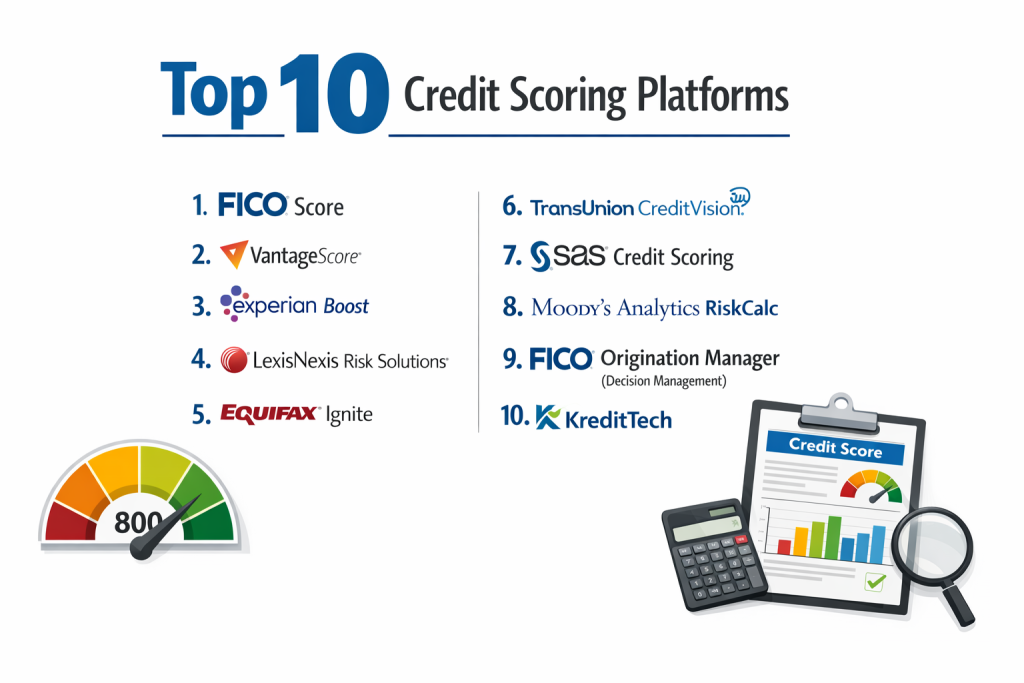
Top 10 Credit Scoring Platforms
1 — FICO Score
The FICO Score is the industry standard and most widely used credit score model in the United States. Developed by the Fair Isaac Corporation, it is the benchmark against which most lenders measure credit risk for consumer lending.
Key features:
- Industry-Specific Scores: Offers tailored models for auto lending (FICO Auto Score), credit cards (FICO Bankcard Score), and mortgage lending (FICO Score 2, 4, & 5).
- FICO Score 10 Suite: The latest model suite, including FICO Score 10 T, which incorporates trended data to show whether a borrower’s behavior is improving or deteriorating.
- Extensive Historical Data: Models are built on decades of credit data from the three major bureaus (Experian, Equifax, TransUnion).
- Regulatory Acceptance: Deeply ingrained in U.S. lending regulations and the mortgage underwriting process.
- Fraud and Identity Tools: Includes the FICO Falcon platform for fraud detection.
- Consistency and Reliability: Provides a stable, well-understood risk indicator.
Pros:
- Universal recognition and trust among lenders, especially in mortgage and auto finance.
- Proven predictive power over a long history of economic cycles.
- Regulatory comfort and established governance.
Cons:
- Can be slow to innovate and incorporate new data sources compared to newer fintech models.
- Individuals with “thin files” or limited credit history may not score well.
- Lenders must often pay to access both the score and the underlying bureau data.
Security & compliance: Operates with high security standards as a core data processor. Models are designed to comply with U.S. credit laws like the Equal Credit Opportunity Act (ECOA).
Support & community: Extensive documentation, white papers, and industry training. A vast ecosystem of consultants and system integrators.
2 — VantageScore
VantageScore is a direct competitor to FICO, created through a joint venture by the three major credit bureaus (Experian, Equifax, and TransUnion). It is designed to be a more consistent and inclusive scoring model.
Key features:
- Single, Consistent Model: Uses one unified model across all three bureaus, aiming to reduce score discrepancies.
- Expanded Credit File Assessment: Can score approximately 40 million more people than conventional models by using alternative data for those with thin files.
- Trended Data Utilization: Leverages month-over-month balance and payment data for a more dynamic view.
- Rapid Updates: The model (now VantageScore 4.0) is updated more frequently to reflect changing consumer behaviors.
- Machine Learning Foundation: Built with modern machine learning techniques for pattern recognition.
- Wide Availability: Rapidly gaining adoption by lenders and is freely provided to consumers by many services.
Pros:
- Scores more people, promoting financial inclusion.
- Reduces confusion by providing greater consistency across the three bureaus.
- Often perceived as more modern and agile in its development.
Cons:
- Still lacks the deep, decades-long track record of FICO in certain lending segments (like mortgages).
- While adoption is growing, FICO remains the dominant required score for many major loan types.
- The business model is tied to the credit bureaus, which can influence perception.
Security & compliance: Adheres to stringent data security protocols of the credit bureaus and is designed for regulatory compliance.
Support & community: Backed by the marketing and support resources of the three major credit bureaus.
3 — Experian Boost
Experian Boost is a unique, consumer-permissioned tool that allows individuals to add positive utility and telecom payment history to their Experian credit file, potentially instantly increasing their FICO Score.
Key features:
- Consumer-Controlled Data Additions: Users connect bank accounts to identify and add on-time cell phone, utility, and streaming service payments.
- Immediate Impact: Can improve a FICO Score instantly upon verification of payments.
- Free Service: No cost to consumers for using the Boost feature.
- Focus on Positive History: Only adds positive payment data; late payments are not added.
- Experian Credit Report Integration: The added data becomes part of the user’s Experian credit report.
- FICO Score 8 Enhancement: Designed to work with the widely used FICO Score 8 model.
Pros:
- Empowers consumers to proactively improve their own scores.
- Effectively addresses the “thin file” problem by creating a more robust credit history.
- Simple, free, and user-friendly for the consumer.
Cons:
- Only impacts the Experian credit file and FICO Score based on it. Lenders using Equifax or TransUnion data won’t see the boost.
- Not all lenders use the specific FICO model that incorporates this “Boost” data.
- Some lenders may view non-traditional data with varying levels of importance.
Security & compliance: Uses bank-level encryption (256-bit SSL) and OAuth protocols for secure bank account linking. Compliant with financial data privacy standards.
Support & community: Supported through Experian’s consumer help center and educational resources.
4 — LexisNexis Risk Solutions
LexisNexis Risk Solutions provides powerful risk intelligence that goes far beyond traditional credit reporting. It is a leader in leveraging alternative data and deep public records for identity verification, fraud prevention, and risk assessment.
Key features:
- Massive Alternative Data Repository: Analyzes data from property records, licenses, insurance claims, utilities, and millions of public records.
- Risk View Reports: Provides nuanced risk insights for thin-file or no-file individuals, ideal for financial inclusion.
- Identity Verification & Fraud Detection: Strong tools to confirm identity and spot synthetic fraud.
- Custom Analytics Solutions: Allows clients to build bespoke risk models using their vast data assets.
- Global Coverage: Extensive data and solutions for international risk assessment.
- Industry-Specific Insights: Deep solutions for banking, insurance, and healthcare.
Pros:
- Unparalleled ability to score and verify individuals who are invisible to traditional credit bureaus.
- Extremely powerful for fraud prevention and identity assurance.
- Provides a holistic, 360-degree view of risk that complements traditional credit scores.
Cons:
- The depth and breadth of data can raise privacy concerns and require careful compliance management.
- Can be complex and expensive to implement and integrate.
- The “black box” nature of some analytics may require explainability efforts for regulated decisions.
Security & compliance: Enterprise-grade security with a strong focus on compliant data handling, subject to regulations like FCRA and GDPR.
Support & community: Offers professional services, dedicated client management, and industry consulting.
5 — Equifax Ignite
Equifax Ignite is a cloud-native, AI-powered platform that allows lenders to build, deploy, and manage custom credit risk models rapidly. It represents the shift from static, one-size-fits-all scores to dynamic, tailored analytics.
Key features:
- No-Code/Low-Code Model Building: Enables data scientists and analysts to create and test models visually without extensive coding.
- Real-Time Decisioning: Deploys models via API for instant risk assessment during application processes.
- Integrated Data Marketplace: Access to Equifax’s core credit data and a curated selection of third-party alternative data sources.
- Model Management & Monitoring: Tools to track model performance, drift, and compliance over time.
- Explainable AI (XAI): Built-in tools to help demystify AI-driven decisions for compliance and customer communication.
- Cloud Scalability: Built on AWS for elastic scaling and reduced IT overhead.
Pros:
- Democratizes advanced analytics, allowing lenders to create proprietary competitive advantages.
- Dramatically reduces the time from model idea to production deployment.
- Facilitates the use of blended traditional and alternative data seamlessly.
Cons:
- Requires in-house data science or analytical expertise to leverage fully.
- Introduces model risk that must be actively managed and governed.
- As a newer platform, it may lack some of the out-of-the-box templates of established systems.
Security & compliance: Cloud security leveraging AWS infrastructure with SOC 2 compliance. Tools support fair lending and model risk management requirements.
Support & community: Supported by Equifax’s data scientists and client success teams, with training and development resources.
6 — TransUnion CreditVision
TransUnion CreditVision focuses on adding a time-based, trended dimension to credit risk analysis. Instead of just a snapshot, it shows how a consumer’s credit balances and payment behaviors have changed over the past 24 months.
Key features:
- Trended Data Attributes: Provides metrics like balance trends, payment patterns, and credit utilization velocity.
- CreditVision Scores: Risk scores built specifically on this trended data, offering a more predictive view.
- Distinguishes Between Revolvers and Transactors: Identifies if a consumer pays off balances each month or carries debt, which predicts future risk.
- Earlier Risk Detection: Can identify signs of financial stress earlier than static, point-in-time models.
- Enhanced Customer Management: Useful for existing customer risk assessment, line management, and retention strategies.
- Industry Solutions: Applied in auto lending, credit cards, and personal loans.
Pros:
- Provides a deeper, more predictive understanding of borrower behavior.
- Helps lenders make better decisions on both originations and existing account management.
- Effectively identifies “rising risk” and “improving risk” consumers that snapshot scores miss.
Cons:
- Adds another data layer and cost to a lender’s process.
- Requires education and buy-in from underwriters and decision-makers used to traditional scores.
- The incremental predictive lift must be justified against the additional expense.
Security & compliance: Maintains TransUnion’s high data security and compliance standards for consumer credit information.
Support & community: Access to TransUnion’s analytics consultants and client support resources.
7 — SAS Credit Scoring
SAS is a powerhouse in advanced analytics. Its credit scoring solutions are part of a broader enterprise platform used by large financial institutions to build, validate, deploy, and monitor the most sophisticated custom scorecards and models.
Key features:
- End-to-End Model Lifecycle Management: Covers everything from data preparation and exploratory analysis to model deployment, monitoring, and regulatory reporting.
- Advanced Statistical & Machine Learning Algorithms: Offers a vast library of modeling techniques for maximum predictive accuracy.
- Seamless Integration with SAS Ecosystem: Works with SAS data management, visualization, and AI tools.
- Strong Governance and Audit Trail: Excellent for highly regulated environments requiring detailed model documentation and validation.
- Scalability: Can handle massive datasets and complex computation.
- Interpretability Tools: Helps explain complex model outcomes.
Pros:
- The gold standard for large institutions needing maximum control, sophistication, and governance.
- Unmatched depth for statisticians and data scientists building cutting-edge models.
- Proven platform for meeting stringent model risk management and regulatory expectations.
Cons:
- Extremely high cost, both in software licensing and the required specialized talent.
- Steep learning curve; not a tool for business analysts or casual users.
- Can be seen as less agile than modern cloud-native, API-first platforms.
Security & compliance: Enterprise-grade security. The platform is built to support compliance with Basel, IFRS 9, SR 11-7, and other global regulations.
Support & community: Extensive professional services, training (SAS Academy), and a global community of expert users.
8 — Moody’s Analytics RiskCalc
Moody’s Analytics RiskCalc is a leading global solution for private company credit risk modeling. It translates financial statement data and qualitative factors into default probabilities and credit scores for small and medium-sized enterprises (SMEs).
Key features:
- Global Coverage: Models tailored for over 100 countries, based on local default experience.
- Financial Statement Analysis: Core models use balance sheet and income statement ratios to predict default.
- Modeling Flexibility: Offers models for different use cases: through-the-cycle, point-in-time, and mid-cycle.
- Moody’s Credit Research Integration: Leverages the deep economic and sector research from Moody’s.
- Credit Benchmarking: Allows lenders to compare a company’s risk profile against its peers.
- Regulatory Capital Calculation: Can help estimate capital requirements under Basel frameworks.
Pros:
- Fills a critical gap for objectively scoring private companies, which lack public debt ratings.
- Brings rigor and consistency to commercial and small business lending.
- Trusted brand name with deep research backing.
Cons:
- Specialized for commercial/SME lending, not for consumer credit.
- Dependent on the availability and quality of financial statement data.
- May require integration with loan origination systems for seamless workflow.
Security & compliance: High security standards for financial data. Models are designed with regulatory standards in mind.
Support & community: Backed by Moody’s Analytics’ global client service and consulting teams.
9 — FICO Origination Manager (Decision Management)
FICO Origination Manager is part of the FICO Decision Management Suite, a platform that allows lenders to orchestrate entire credit decision workflows, not just calculate a score. It’s for automating and optimizing the entire application process.
Key features:
- Centralized Decision Strategy Builder: A visual, drag-and-drop interface to design complex “if-then-else” decision workflows.
- Seamless FICO Score Integration: Easily embeds FICO Scores and other FICO analytics into automated decision streams.
- Multi-Channel Deployment: Manages consistent decisioning across online, mobile, branch, and call center channels.
- Real-Time Testing & Champion/Challenger: Allows safe testing of new strategies (challengers) against the current one (champion) to find improvements.
- Compliance Rules Engine: Builds in regulatory and policy rules to ensure consistent, fair outcomes.
- Customer Communication Management: Automates generation of adverse action notices and other disclosures.
Pros:
- Moves beyond scoring to automate and optimize the entire front-end lending decision.
- Ensures policy consistency and compliance across all touchpoints.
- Powerful for increasing automation rates and reducing manual review backlogs.
Cons:
- Part of a larger, enterprise-level FICO ecosystem, which can mean a significant investment.
- Requires careful design and maintenance of decision strategies.
- Overkill for lenders only looking for a simple score feed.
Security & compliance: Built with enterprise security and audit capabilities. Central to enforcing fair lending and compliance logic.
Support & community: Supported by FICO’s professional services and a network of implementation partners.
10 — KreditTech
KreditTech represents the new wave of API-first, cloud-native credit scoring and decisioning platforms. It caters to digital lenders, fintechs, and banks seeking to quickly deploy modern credit assessment without building in-house infrastructure.
Key features:
- Unified API for Global Data: A single API to pull credit reports and scores from bureaus worldwide, plus access to alternative data sources.
- Pre-Built Decisioning Workflows: Configurable, out-of-the-box decision flows for personal loans, point-of-sale finance, etc.
- No-Code Rules Engine: Allows business users to adjust decision logic without developer help.
- Real-Time Fraud Signals: Integrates fraud detection data into the decisioning process.
- Developer-First Design: Clear documentation, sandbox environments, and fast integration.
- Transparent Pricing: Often based on API calls or decisions, with clear cost scaling.
Pros:
- Extreme speed of integration and deployment (days/weeks, not months).
- Simplifies global expansion by managing integrations with local data providers.
- Lowers the barrier to entry for launching sophisticated credit products.
Cons:
- As a newer fintech, may lack the long-term track record of established players.
- May offer less depth for highly specialized or complex lending scenarios compared to legacy platforms.
- Businesses may trade some level of customization for speed and simplicity.
Security & compliance: Cloud-native security (SOC 2). Manages compliance with data sourcing and consumer reporting laws on behalf of clients in its platform.
Support & community: Tech-focused support with dedicated developer relations and customer success.
Comparison Table
| Tool Name | Best For (target user or scenario) | Platform(s) Supported | Standout Feature | Rating |
|---|---|---|---|---|
| FICO Score | Traditional lenders (mortgage, auto, card) needing the industry standard for regulatory & secondary market acceptance. | API, Batch, Integrated Systems | Universal Recognition & Regulatory Entrenchment | High (Consumer Lending Standard) |
| VantageScore | Lenders seeking consistency across bureaus and to score more consumers, including thin-file applicants. | API, Batch | Consistency Across Bureaus & Financial Inclusion Focus | High |
| Experian Boost | Consumers looking to proactively improve their own Experian-based FICO Score using non-traditional payment data. | Consumer Web/App | Consumer-Permissioned Data for Self-Score Improvement | N/A (Consumer Tool) |
| LexisNexis Risk Solutions | Institutions needing deep due diligence, fraud prevention, and risk assessment beyond traditional credit, especially for thin/no-file. | API, Batch, Platform | Deep Alternative Data & Public Records Intelligence | High |
| Equifax Ignite | Data-savvy lenders wanting to build, test, and deploy their own custom AI credit models quickly on a cloud platform. | Cloud (AWS), API | No-Code Custom Model Development & Management | High (Modern Analytics) |
| TransUnion CreditVision | Lenders wanting a dynamic, trended view of borrower behavior for better risk detection and customer management. | API, Batch | Trended Credit Data & Behavioral Insights | High |
| SAS Credit Scoring | Large banks and institutions requiring maximum model sophistication, governance, and end-to-end lifecycle management. | On-premise, Cloud | Enterprise-Grade Model Lifecycle Management & Governance | High (Enterprise Analytics) |
| Moody’s Analytics RiskCalc | Commercial lenders and banks needing to objectively score the credit risk of private small and medium-sized businesses (SMEs). | Platform, API | Global Private Company Default Probability Models | High (Commercial/SME) |
| FICO Origination Manager | Lenders looking to automate and optimize the entire front-end credit application decisioning workflow. | On-premise, Cloud | Visual Decision Strategy Orchestration & Automation | High |
| KreditTech | Fintechs, digital lenders, and banks wanting a fast, API-first platform to launch and scale credit products globally. | Cloud, API | Unified Global Data API & Rapid Deployment | Medium/High (Fintech Agility) |
Evaluation & Scoring of Credit Scoring Platforms
Score potential tools (1-10) using this rubric. Multiply by the weight to get a total score out of 100.
| Evaluation Category | Weight | What to Look For |
|---|---|---|
| Core Features | 25% | Predictive power/accuracy, model types (generic/custom), data sources (traditional/alternative), score explainability, trended analytics. |
| Ease of Use | 15% | Clarity of API documentation, simplicity of integration, quality of developer tools, intuitiveness of admin/analyst interfaces (if any). |
| Integrations & Ecosystem | 15% | Pre-built connectors to core banking/LOS, CRM, and data bureaus; flexibility of API; availability of SDKs for major programming languages. |
| Security & Compliance | 10% | Data encryption, SOC 2/ISO 27001 certification, compliance with FCRA, ECOA, GDPR (if applicable), and fair lending requirements. |
| Performance & Reliability | 10% | API uptime and latency, scalability to handle peak volumes, accuracy and freshness of data, redundancy. |
| Support & Community | 10% | Responsiveness of technical support, quality of documentation, availability of sandbox/test environments, active user community. |
| Price / Value | 15% | Pricing model (per inquiry, subscription, volume-based), implementation costs, and the ROI in terms of better risk decisions and efficiency. |
Which Credit Scoring Platform Tool Is Right for You?
Your organization’s specific needs will point you to the best option:
- By Organization Type & Primary Need:
- Large Bank/Prime Lender (Mortgage, Auto): You likely need FICO Scores for compliance and the secondary market. Enhance with TransUnion CreditVision for trended insights or SAS for custom models.
- Credit Card Issuer or Personal Loan Lender: FICO Bankcard Scores or VantageScore are key. FICO Origination Manager can automate your decisioning.
- Fintech/Digital Lender: Prioritize speed and flexibility. An API-first platform like KreditTech or a cloud model builder like Equifax Ignite is ideal. Use LexisNexis for fraud/thin-file.
- Commercial/SME Lender: Your world is different. Moody’s Analytics RiskCalc is the specialist for scoring private companies.
- Business Needing Fraud/Identity Focus: LexisNexis Risk Solutions is the leader in deep-dive risk intelligence.
- Budget-Conscious vs Premium Solutions:
- Budget-Conscious/Starting Out: API-aggregators (like KreditTech) can simplify and potentially reduce costs of multi-bureau access. VantageScore may offer cost-effective insights.
- Premium Solutions: Building and managing custom models with SAS or deploying a full FICO Decision Management Suite represents a major investment for those who need maximum control and sophistication.
- “Buy” vs “Build”:
- Buy (Use Off-the-Shelf Scores): Choose FICO or VantageScore for proven, generic risk assessment. Fast, compliant, but less differentiated.
- Build (Create Custom Models): Use Equifax Ignite or SAS to develop proprietary scores that match your unique portfolio and risk appetite. Higher potential reward but requires expertise.
- Integration and Scalability Needs:
- If you need to embed scoring into a digital app instantly, prioritize platforms with excellent, well-documented APIs (KreditTech, modern bureau APIs).
- If you are a large enterprise with complex IT, ensure the platform supports batch processing, on-premise deployment, or secure cloud (SAS, FICO).
- For global scaling, look for platforms with built-in international data connections.
- Security and Compliance Requirements:
- In highly regulated industries (US lending), using FCRA-compliant scores from regulated bureaus (FICO, VantageScore) is non-negotiable for adverse action.
- For model governance, platforms like SAS and Equifax Ignite provide built-in audit trails and monitoring.
- SOC 2 Type II certification is a must for any cloud-based vendor handling sensitive data.
Frequently Asked Questions (FAQs)
1. What’s the difference between a FICO Score and a VantageScore?
Both predict risk but are built differently. FICO has separate models per bureau and is the older, mortgage-mandated standard. VantageScore uses one model across all bureaus for more consistency and aims to score more people with limited history.
2. Can I use alternative data without violating fair lending laws?
Yes, but it requires careful management. Data must be proxy-neutral (not indirectly discriminating based on race, etc.). Platforms like LexisNexis and Equifax Ignite have tools and consulting to help ensure compliant use. Always validate models for fair lending.
3. What is “trended data” and why is it better?
Traditional scores are a snapshot. Trended data (like from TransUnion CreditVision) shows 24 months of payment behavior patterns. It reveals if someone is paying down balances or maxing out cards, providing a more predictive and dynamic risk view.
4. How do I score someone with no (thin) credit file?
This is where alternative data platforms shine. Solutions from LexisNexis (public records, utilities) or Experian Boost (consumer-added telecom data) can create a scoreable identity. VantageScore is also explicitly designed to score more thin-file consumers.
5. What is model “explainability” and why does it matter?
It’s the ability to explain why a score or decision was reached. This is critical for regulatory compliance (adverse action notices under ECOA) and for building customer trust. Modern platforms are building Explainable AI (XAI) tools directly into their systems.
6. How long does it take to integrate a scoring platform?
For a simple API call to get a FICO Score, it can take a developer a few days. Integrating a full decisioning platform like FICO Origination Manager can take 6-12 months. Modern API-first platforms (KreditTech) promise integration in weeks.
7. What’s the cost structure?
Costs vary: Per-inquiry fees (common for bureau scores), subscription/licensing fees (for software platforms like SAS), transaction-based pricing (API platforms), plus implementation and support fees. Understand all layers.
8. Can I build my own score?
Absolutely, if you have the data and expertise. Platforms like SAS and Equifax Ignite are built for this. However, it requires significant investment in data science, model validation, and ongoing monitoring to manage “model risk.”
9. What is a “Champion/Challenger” strategy?
It’s a best practice where you run your current decision strategy (the Champion) alongside a new, tested one (the Challenger) on a small percentage of applications. This lets you safely measure and prove that the new strategy performs better before full rollout.
10. Is a higher score always better for my business?
Not necessarily. A higher score means lower risk, but also lower interest revenue. Your goal is to find the optimal risk-return profile for your business. Scoring platforms provide the data; your strategy defines how you use it to maximize profitability.
Conclusion
Selecting the right Credit Scoring Platform is a foundational decision that directly impacts a lender’s risk management, operational efficiency, and competitive edge. The landscape offers specialized tools for every need—from the universal standard of FICO and the inclusive design of VantageScore to the deep alternative intelligence of LexisNexis, the custom-model agility of Equifax Ignite, and the global API simplicity of fintech solutions like KreditTech.
The crucial insight is that the “best” platform is not a single product but the right combination for your strategy. Most successful lenders use a blended approach: relying on established scores for compliance and baseline risk, while augmenting them with trended data, alternative data, and custom analytics to gain a sharper, more predictive edge. Start by clearly defining your target market, risk appetite, and operational capabilities. The ideal platform should not only provide a number but also integrate seamlessly into your workflow, provide clear explanations, and scale with your growth. In the end, a modern credit scoring strategy is less about finding a single magic number and more about building a dynamic, data-driven decisioning ecosystem that is both smart and compliant.