Introduction
Content Delivery Networks (CDNs) are distributed networks of servers strategically placed around the globe to deliver web content, such as images, videos, scripts, and webpages, to users from the closest possible location. This setup minimizes latency, reduces load times, and improves overall site performance by caching content at edge locations and handling traffic spikes efficiently. Modern CDNs also incorporate advanced security, optimization, and analytics features to enhance user experience beyond mere delivery.
CDNs are indispensable in today’s digital ecosystem, where fast-loading sites are crucial for user retention, SEO rankings, and conversion rates. They mitigate bandwidth costs, protect against DDoS attacks, and support global audiences with localized content. With the rise of video streaming, e-commerce, and AI-driven personalization, CDNs now offer edge computing for real-time processing and dynamic content acceleration. Key real-world use cases include e-commerce platforms speeding up product images for better shopping experiences, media companies streaming videos without buffering, news sites handling traffic surges during events, SaaS applications delivering fast app performance worldwide, and enterprises securing APIs and internal resources.
When choosing a CDN, evaluate global PoP (points of presence) coverage for low latency, security features like WAF and DDoS mitigation, content optimization (compression, image resizing), integration with hosting/CMS, pricing models (pay-as-you-go vs. committed), analytics/reporting depth, and edge computing capabilities for advanced use cases. Also consider ease of setup, API flexibility, and support for protocols like HTTP/3.
Best for: Web developers, DevOps engineers, IT managers, content creators, e-commerce operators, and digital marketers benefit most from CDN tools. They suit SMBs optimizing basic sites, mid-market companies scaling traffic, and enterprises in media, retail, gaming, and finance requiring high-performance, secure content delivery at global scale.
Not ideal for: Small static sites with low traffic—basic hosting suffices. Organizations with all-local users might not need global distribution. Those focused solely on backend APIs could use simpler caching instead of full CDNs.
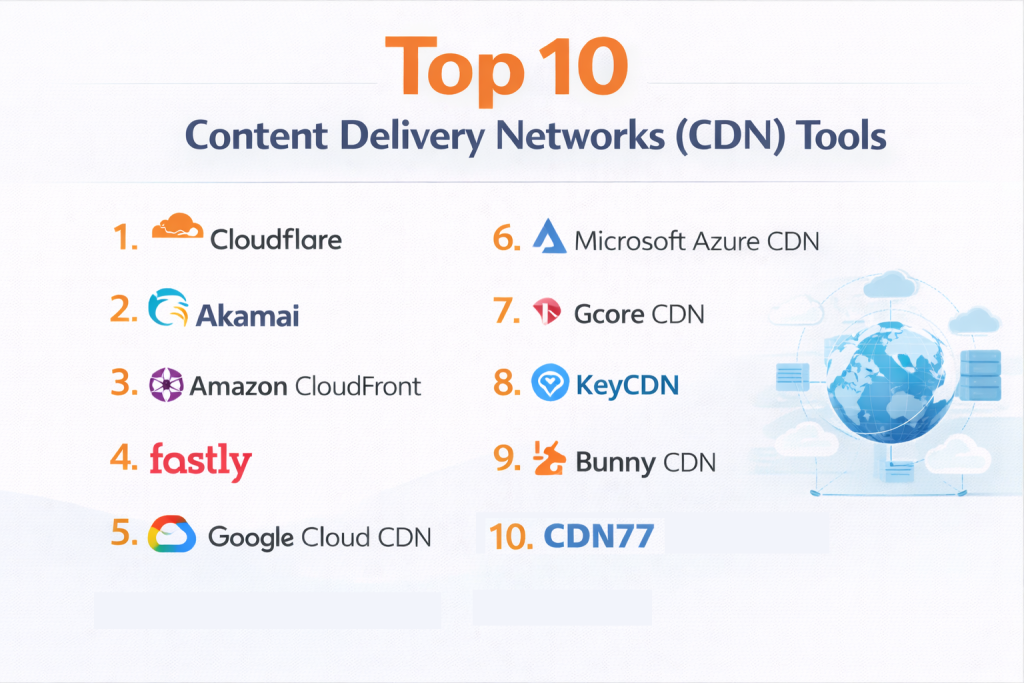
Top 10 Content Delivery Networks (CDN) Tools
1 — Cloudflare
Cloudflare is a comprehensive CDN platform that accelerates and secures websites, APIs, and applications with a massive global network. It caters to developers, enterprises, and e-commerce businesses seeking performance optimization, DDoS protection, and edge computing capabilities.
Cloudflare combines CDN services with security and developer tools, making it versatile for sites of all sizes, from blogs to high-traffic platforms requiring zero-trust security and real-time analytics.
Key features:
- Global network with over 330 locations for ultra-low latency.
- Built-in DDoS mitigation and web application firewall (WAF).
- Automatic image optimization and compression.
- Edge Workers for serverless code execution.
- Real-time analytics and performance monitoring.
- HTTP/3 support and Brotli compression.
- Free SSL/TLS encryption.
Pros:
- Free tier offers robust features for small sites.
- Excellent security integration reduces external needs.
- Scalable with seamless upgrades.
Cons:
- Advanced features locked in paid plans.
- Occasional complexity in configuration.
- Support response times vary by plan.
Security & compliance: SSO, encryption, audit logs; SOC 2, GDPR, ISO compliant.
Support & community: Comprehensive docs, forums, 24/7 enterprise support; large developer community.
2 — Akamai
Akamai is an established enterprise-grade CDN specializing in secure, high-performance content delivery for large-scale operations. It serves media companies, financial institutions, and e-commerce giants needing reliable global reach and advanced threat protection.
Akamai focuses on intelligent edge delivery with adaptive caching and real-time adjustments, ideal for handling massive traffic spikes and ensuring uptime in demanding environments.
Key features:
- Extensive network with thousands of servers worldwide.
- Intelligent caching and predictive prefetching.
- Bot management and API security.
- Media delivery optimization for video streaming.
- Real-time monitoring and threat intelligence.
- Edge DNS for faster resolution.
- Compliance-ready configurations.
Pros:
- Proven reliability for high-traffic sites.
- Strong focus on security and compliance.
- Excellent for video and dynamic content.
Cons:
- Premium pricing for enterprise features.
- Steeper learning curve.
- Less flexible for small users.
Security & compliance: SSO, encryption, audit logs; SOC 2, GDPR, HIPAA, ISO compliant.
Support & community: Dedicated enterprise support, docs; professional community.
3 — Amazon CloudFront
Amazon CloudFront is AWS’s fully managed CDN integrated with other AWS services for seamless content distribution. It’s designed for developers and enterprises building scalable applications with low latency and high transfer speeds.
CloudFront leverages AWS’s global infrastructure for caching and delivery, perfect for dynamic sites, APIs, and streaming needing tight integration with cloud storage and compute.
Key features:
- Deep integration with S3, EC2, Lambda@Edge.
- Customizable caching behaviors.
- Real-time metrics and logging.
- DDoS protection via AWS Shield.
- Field-level encryption.
- Origin failover.
- Geo-restriction controls.
Pros:
- Cost-effective pay-as-you-go model.
- Highly scalable with AWS ecosystem.
- Strong performance for global apps.
Cons:
- Complex setup for non-AWS users.
- Additional costs for advanced features.
- Limited free tier.
Security & compliance: SSO, encryption, audit logs; SOC 2, GDPR, HIPAA, ISO compliant.
Support & community: AWS docs, forums, enterprise support.
4 — Fastly
Fastly is a high-performance CDN emphasizing real-time edge computing and customization for dynamic content. It targets developers and media companies requiring instant purges and low-latency delivery.
Fastly’s Varnish-based platform allows custom VCL for logic at the edge, ideal for personalized experiences and API acceleration.
Key features:
- Instant cache purging.
- Varnish Configuration Language (VCL) for custom logic.
- Real-time logging and analytics.
- Image optimization on-the-fly.
- DDoS mitigation and WAF.
- Streaming support.
- API-first management.
Pros:
- Unmatched real-time control.
- Excellent for developers.
- Strong uptime and speed.
Cons:
- Higher learning curve.
- Pricing based on requests/bandwidth.
- Less PoPs than giants.
Security & compliance: Encryption, audit logs; SOC 2, GDPR compliant.
Support & community: Docs, community forums.
5 — Google Cloud CDN
Google Cloud CDN uses Google’s global infrastructure for caching and delivery, integrated with GCP services. It’s suited for cloud-native apps needing high availability and low costs.
Google CDN focuses on performance optimization with smart caching, ideal for GCP users handling media and dynamic content.
Key features:
- Integration with Compute Engine, Storage.
- HTTP/3 and QUIC support.
- Signed URLs/cookies for security.
- Real-time logs to BigQuery.
- Negative caching.
- Origin load balancing.
- Cache invalidation API.
Pros:
- Low latency via Google’s network.
- Cost-efficient for GCP.
- Reliable scalability.
Cons:
- Best within Google ecosystem.
- Setup requires GCP knowledge.
- Limited third-party integrations.
Security & compliance: Encryption; GDPR, HIPAA compliant.
Support & community: Google docs, enterprise.
6 — Microsoft Azure CDN
Microsoft Azure CDN delivers content through Azure’s network, integrated with Azure services for seamless app performance. It’s designed for Microsoft-centric enterprises needing hybrid cloud support.
Azure CDN offers multi-provider options (Akamai, Verizon) for flexibility, ideal for Azure users optimizing global delivery.
Key features:
- Multi-provider endpoints.
- Rules engine for customization.
- Real-time analytics.
- DDoS protection integration.
- Dynamic site acceleration.
- Storage/CDN bundling.
- Geo-filtering.
Pros:
- Flexible provider choice.
- Strong Azure integration.
- Good for hybrid setups.
Cons:
- Complex configuration.
- Costs add up with usage.
- Support varies by provider.
Security & compliance: SSO, encryption; SOC 2, GDPR, HIPAA.
Support & community: Azure portals, enterprise.
7 — Gcore CDN
Gcore CDN is a next-gen platform with AI optimization and video streaming focus. It serves gaming and media companies needing ultra-low latency.
Gcore combines CDN with cloud/edge services for comprehensive delivery, ideal for high-bandwidth applications.
Key features:
- AI traffic routing.
- Video platform integration.
- Global PoPs with low latency.
- Real-time monitoring.
- DDoS and bot protection.
- Streaming analytics.
- Custom rules.
Pros:
- Strong for video/gaming.
- Competitive pricing.
- Fast deployment.
Cons:
- Smaller brand recognition.
- Limited enterprise features.
- Support in select regions.
Security & compliance: Encryption; GDPR compliant.
Support & community: Chat, docs.
8 — KeyCDN
KeyCDN is a simple, pay-as-you-go CDN with global coverage and real-time analytics. It’s aimed at developers and SMBs seeking affordable performance.
KeyCDN offers straightforward caching and optimization, ideal for websites needing quick setup without complexity.
Key features:
- Global PoPs.
- HTTP/2 support.
- Real-time purging.
- Origin shield.
- Custom SSL.
- API management.
- Analytics dashboard.
Pros:
- Transparent pricing.
- Easy to use.
- Good value.
Cons:
- Fewer advanced security.
- Limited edge compute.
- Smaller network.
Security & compliance: Encryption; GDPR.
Support & community: Email, docs.
9 — Bunny CDN
Bunny CDN is an affordable, high-performance CDN with global optimization. It targets budget-conscious users with video and image focus.
Bunny provides fast delivery with smart caching, ideal for startups and media sites.
Key features:
- Global edge rules.
- Image optimizer.
- Video delivery.
- Real-time logs.
- DDoS protection.
- Perma-cache.
- API.
Pros:
- Low cost.
- Fast speeds.
- Easy integration.
Cons:
- Younger platform.
- Limited enterprise.
- Support basic.
Security & compliance: Encryption; GDPR.
Support & community: Ticket, docs.
10 — CDN77
CDN77 is a reliable CDN with real-time control and media optimization. It serves businesses needing transparent, high-performance delivery.
CDN77 offers custom configurations for video and websites, ideal for mid-sized operations.
Key features:
- 70+ PoPs.
- Real-time analytics.
- HTTP/2.
- DDoS mitigation.
- Video platform.
- API.
- Origin protection.
Pros:
- Transparent billing.
- Strong support.
- Good for media.
Cons:
- Fewer locations.
- Interface average.
- Scaling costs.
Security & compliance: Encryption; GDPR.
Support & community: 24/7 chat.
Comparison Table
| Tool Name | Best For | Platform(s) Supported | Standout Feature | Rating |
|---|---|---|---|---|
| Cloudflare | All-around performance/security | Cloud | Edge computing | 4.7/5 |
| Akamai | Enterprise media/dynamic | Cloud | Intelligent caching | 4.5/5 |
| Amazon CloudFront | AWS-integrated apps | Cloud | Lambda@Edge | 4.6/5 |
| Fastly | Real-time customization | Cloud | VCL logic | 4.6/5 |
| Google Cloud CDN | GCP-native optimization | Cloud | HTTP/3 support | 4.6/5 |
| Microsoft Azure CDN | Azure hybrid delivery | Cloud | Multi-provider | 4.6/5 |
| Gcore | Video/gaming low-latency | Cloud | AI routing | 4.5/5 |
| KeyCDN | Affordable website acceleration | Cloud | Pay-as-you-go | 4.5/5 |
| Bunny CDN | Budget video/image | Cloud | Smart optimization | 4.7/5 |
| CDN77 | Transparent media delivery | Cloud | Real-time control | 4.5/5 |
Evaluation & Scoring of Content Delivery Networks (CDN)
| Tool Name | Core Features (25%) | Ease of Use (15%) | Integrations & Ecosystem (15%) | Security & Compliance (10%) | Performance & Reliability (10%) | Support & Community (10%) | Price / Value (15%) | Total Score |
|---|---|---|---|---|---|---|---|---|
| Cloudflare | 9.5 (2.375) | 9 (1.35) | 9.5 (1.425) | 9.5 (0.95) | 9.5 (0.95) | 9 (0.9) | 9.5 (1.425) | 9.4 |
| Akamai | 10 (2.5) | 7.5 (1.125) | 9 (1.35) | 10 (1.0) | 10 (1.0) | 9 (0.9) | 8 (1.2) | 9.08 |
| Amazon CloudFront | 9 (2.25) | 8 (1.2) | 9.5 (1.425) | 9.5 (0.95) | 9.5 (0.95) | 8.5 (0.85) | 9 (1.35) | 8.95 |
| Fastly | 9 (2.25) | 8 (1.2) | 8.5 (1.275) | 9 (0.9) | 9.5 (0.95) | 8.5 (0.85) | 8.5 (1.275) | 8.75 |
| Google Cloud CDN | 8.5 (2.125) | 8 (1.2) | 9 (1.35) | 9 (0.9) | 9 (0.9) | 8.5 (0.85) | 9 (1.35) | 8.68 |
| Azure CDN | 8.5 (2.125) | 8 (1.2) | 9 (1.35) | 9 (0.9) | 9 (0.9) | 8 (0.8) | 8.5 (1.275) | 8.55 |
| Gcore | 8 (2.0) | 8.5 (1.275) | 8 (1.2) | 8 (0.8) | 8.5 (0.85) | 8 (0.8) | 9 (1.35) | 8.28 |
| KeyCDN | 8 (2.0) | 9 (1.35) | 7.5 (1.125) | 8 (0.8) | 8 (0.8) | 7.5 (0.75) | 9.5 (1.425) | 8.25 |
| Bunny CDN | 8 (2.0) | 9 (1.35) | 7.5 (1.125) | 8 (0.8) | 8.5 (0.85) | 8 (0.8) | 9.5 (1.425) | 8.35 |
| CDN77 | 8 (2.0) | 8.5 (1.275) | 8 (1.2) | 8 (0.8) | 8.5 (0.85) | 8 (0.8) | 9 (1.35) | 8.38 |
Which Content Delivery Networks (CDN) Tool Is Right for You?
CDN choice depends on your site’s needs, traffic, and tech stack.
Solo users: Cloudflare or KeyCDN for free/ease; Bunny CDN for budget.
SMBs: Fastly or Gcore for performance; CDN77 affordable media.
Mid-market: Amazon CloudFront or Azure CDN for cloud integration.
Enterprise: Akamai or Cloudflare for security/scale.
Budget-conscious: Bunny CDN or KeyCDN pay-as-you-go.
Premium solutions: Akamai for enterprise media; Fastly real-time.
Feature depth vs. ease of use: Akamai/Fastly depth; Cloudflare/Azure ease.
Integration and scalability: Amazon/Google cloud-native; Cloudflare broad.
Security and compliance: Akamai/Cloudflare strong WAF/DDoS.
Assess traffic patterns—media Akamai/Gcore; dynamic Fastly.
Frequently Asked Questions (FAQs)
What is a CDN? Distributed servers delivering content from nearest location for speed/security.
Why use a CDN? Reduces latency, handles spikes, saves bandwidth, improves SEO.
CDN cost? Free tiers (Cloudflare); pay-go $0.01-0.10/GB; enterprise custom.
Best for e-commerce? Shopify-integrated CDNs or Cloudflare for speed/security.
Implementation time? Hours for basic; days for custom caching.
Common mistake? Ignoring cache rules—slow sites. Best: Optimize images, monitor analytics.
Security benefits? DDoS/WAF in most; compliance for regulated.
Alternatives? Self-hosted caching; full for high traffic.
Edge computing? Cloudflare/Fastly for code at edge.
Measure CDN success? Load times, bandwidth savings, error rates.
Conclusion
The CDN market features versatile leaders like Cloudflare, enterprise stalwarts Akamai, cloud-native Amazon/Google, and value options like Bunny/KeyCDN. Key insights: AI routing, edge compute, integrated security drive adoption for faster, safer delivery.
What matters most is matching global coverage, security needs, integrations. The “best” depends on traffic type, budget, tech stack—no universal winner. Trial setups, analyze metrics, choose amplifying performance without complexity. Right CDN turns slow sites into seamless experiences, boosting engagement and revenue.