Introduction
A Consumer Loan Origination System (CLOS) is a centralized digital platform used by financial institutions—ranging from global banks and credit unions to fintech startups—to manage the end-to-end lifecycle of a loan application. From the moment a borrower submits an application for a personal loan, auto loan, or credit line, the CLOS orchestrates the entire workflow: capturing data, verifying identities, assessing creditworthiness via automated underwriting engines, and finally, facilitating the legal documentation and funding of the loan.
The importance of these systems has skyrocketed as consumer expectations shift toward “instant” gratification. In a market where digital-first lenders can offer loan decisions in seconds, traditional institutions must adopt robust CLOS technology to remain competitive. These systems are not just about speed; they are the primary defense against fraud and the core infrastructure for regulatory compliance. By automating complex calculations and audit trails, a CLOS minimizes human error, ensures consistent application of lending policies, and provides a scalable foundation for portfolio growth without a linear increase in headcount.
Key Real-World Use Cases
Consumer Loan Origination Systems are the backbone of modern retail lending, supporting:
- Instant Personal Loans: Powering “buy now, pay later” (BNPL) or small-dollar emergency loans with sub-minute approval times.
- Auto Finance: Integrating with dealership portals to provide real-time financing options for vehicle buyers.
- Home Equity Lines of Credit (HELOC): Managing the complex verification and appraisal workflows required for secured consumer debt.
- Digital Onboarding: Allowing new customers to open accounts and receive pre-approved credit offers entirely via mobile apps.
- Refinancing Operations: Automating the evaluation of existing debt to offer consumers lower-interest consolidation options.
What to Look For (Evaluation Criteria)
Selecting the right CLOS requires a balance between technological sophistication and operational fit:
- Automated Decisioning Engine: Look for a robust “Business Rules Engine” (BRE) that allows your risk team to adjust credit tiers and pricing instantly without needing a developer.
- API Ecosystem: The system must integrate seamlessly with third-party data providers for credit bureaus (Equifax, Experian), income verification (Plaid), and identity (IDology, Jumio).
- Borrower Portal UX: A frictionless, mobile-first interface is essential to reduce “application abandonment” rates.
- Compliance Automation: The tool should automatically handle state and federal disclosures (like TILA/RESPA in the US) and maintain a “read-only” audit trail for regulators.
Best for:
- Retail Banks and Credit Unions: Seeking to modernize legacy workflows and improve member/customer retention.
- Fintech Startups: Needing a “lending-in-a-box” solution to go to market rapidly with specialized loan products.
- Auto Dealership Networks: Requiring integrated finance portals to close sales on the lot.
- Non-Bank Lenders: Operating in niche markets like elective medical financing or student debt.
Not ideal for:
- Commercial/Corporate Lenders: Who require complex multi-party entity analysis and bespoke “high-touch” legal structures.
- Very Small Private Lenders: Managing fewer than 50 loans a month where manual processing via spreadsheets is still cost-effective.
- Stand-alone Mortgage Brokers: Who may be better served by a specialized “Mortgage Point of Sale” (POS) rather than a full consumer LOS.
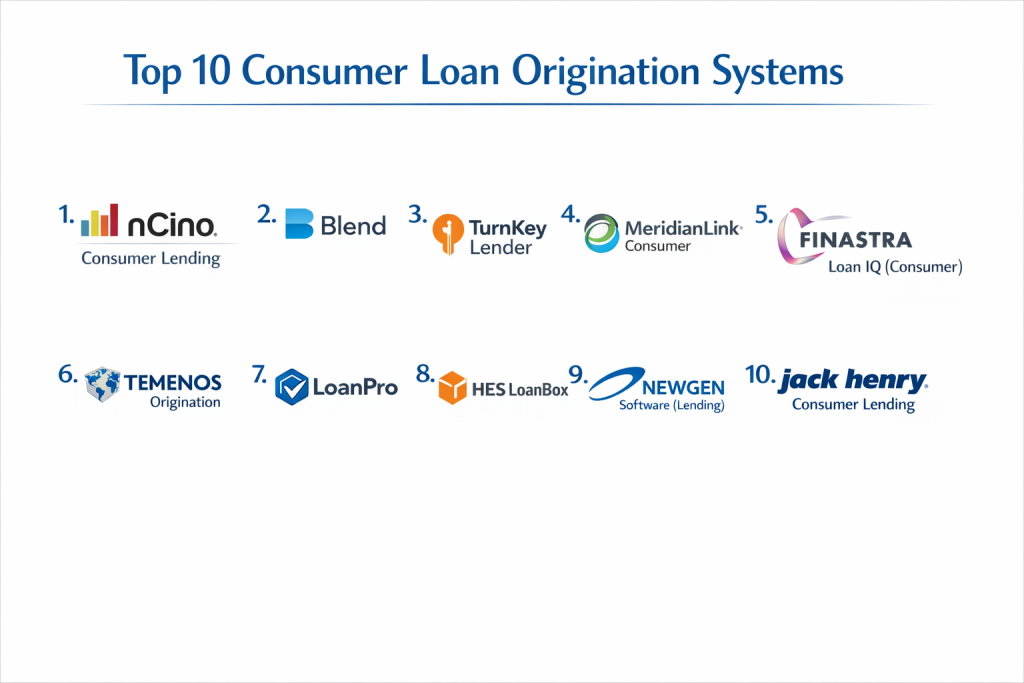
Top 10 Consumer Loan Origination Systems
1 — nCino Consumer Lending
Built on the Salesforce platform, nCino is a global leader in cloud-based banking. Its consumer lending module is designed to provide an omnichannel experience, allowing a loan to start on a mobile device and finish in a branch seamlessly.
Key features:
- Salesforce-Native Architecture: Leverages the world’s #1 CRM for a 360-degree view of the customer.
- Omnichannel Origination: Consistent experience across web, mobile, and in-person channels.
- Automated Credit Decisioning: Advanced AI-driven rules engine for instant pre-qualifications.
- Integrated Document Prep: Automatic generation of compliant loan closing packages.
- Configurable Workflows: Drag-and-drop tools to modify the lending process by product type.
Pros:
- Eliminates “data silos” by housing lending and CRM data in a single ecosystem.
- Highly scalable and frequently updated with new regulatory compliance features.
Cons:
- Implementation can be lengthy and expensive, often requiring specialized consultants.
- The system can feel “over-engineered” for smaller institutions with simple needs.
Security & compliance: SOC 2 Type II, ISO 27001, GDPR, and HIPAA compliant.
Support & community: Extensive “nCino University” training, global user conferences, and 24/7 enterprise support.
2 — Blend
Blend is famous for its “white-label” borrower portal that makes the loan application feel as easy as an e-commerce checkout. It focuses heavily on the front-end digital experience and data automation.
Key features:
- One-Tap Data Verification: Direct integrations with payroll providers and banks to pull data instantly.
- Mobile-First Design: Optimized for the highest conversion rates on smartphone applications.
- Agile Underwriting: Real-time feedback to borrowers as they upload documents or link accounts.
- Cross-Sell Engine: Intelligently suggests other products (like credit cards) based on application data.
- Unified Platform: Handles mortgages, consumer loans, and account opening in one interface.
Pros:
- Significantly reduces “Time to Close” by automating the collection of verified assets and income.
- Exceptionally high borrower satisfaction scores due to the intuitive interface.
Cons:
- Less focused on the “back-office” servicing than other end-to-end systems.
- Pricing models are typically geared toward high-volume lenders.
Security & compliance: SOC 2 Type II, PCI DSS, and GDPR compliant.
Support & community: Strong dedicated account management and a robust help center for technical staff.
3 — TurnKey Lender
TurnKey Lender is an award-winning, AI-powered platform that offers an “all-in-one” solution for the entire loan lifecycle, including origination, underwriting, and servicing.
Key features:
- AI-Powered Scoring: Uses machine learning to find creditworthy borrowers that traditional scores might miss.
- All-in-One Lifecycle: Covers origination, servicing, and collections in a single tool.
- Deep Customization: Supports complex interest types (Islamic finance, BNPL, payday).
- White-Label Portal: Fully brandable borrower and investor portals.
- Fast Deployment: Offers “pre-configured” templates to get lenders live in weeks, not months.
Pros:
- Excellent for non-traditional lenders who need flexibility in how they score and service loans.
- The AI component is remarkably effective at reducing default rates through predictive analytics.
Cons:
- The user interface for the back-office can be more complex than “point” solutions.
- Advanced AI features require a clean historical dataset to reach maximum efficiency.
Security & compliance: SOC 1/2, PCI DSS, ISO 27001, and GDPR compliant.
Support & community: Globally distributed support teams and extensive technical documentation.
4 — MeridianLink Consumer
A staple among North American credit unions and community banks, MeridianLink (formerly Lending360) is known for its deep integrations with core banking providers and its robust decisioning engine.
Key features:
- Multi-Channel Origination: Supports indirect lending (e.g., dealerships) and direct applications.
- Robust Decision Engine: Highly granular rule-setting for automated approvals.
- Core Banking Integration: Native connections to nearly every major core provider (Fiserv, Jack Henry, etc.).
- Advanced Analytics: Built-in reporting for portfolio trends and pull-through rates.
- Consolidated Credit Reports: Pulls from all three major bureaus with one-click analysis.
Pros:
- The “safe choice” for credit unions due to its long history and deep understanding of the sector.
- Exceptional at managing indirect auto lending workflows.
Cons:
- The software can feel a bit traditional compared to modern “fintech-first” rivals like Blend.
- Customizing workflows often requires more technical expertise than “no-code” competitors.
Security & compliance: SOC 2 Type II and GLBA compliant; rigorous audit trails.
Support & community: Very active user group community and regular regional training sessions.
5 — Finastra Loan IQ (Consumer)
Finastra is a global fintech giant, and its Loan IQ platform (with specific consumer modules) is built for high-performance enterprise banking and complex multi-product environments.
Key features:
- Global Scalability: Supports multi-currency, multi-language, and multi-country operations.
- FusionFabric.cloud: An open developer platform to build custom apps on top of the LOS.
- Total Lifecycle Management: From initial lead generation to the final payment.
- Risk Management Integration: Direct link to enterprise-level capital and liquidity tools.
- Automated Compliance: Localized regulatory updates for dozens of global jurisdictions.
Pros:
- Unrivaled for global banks that need a single platform to manage diverse consumer books worldwide.
- The “Open Banking” philosophy allows for incredible extensibility through APIs.
Cons:
- Extremely high total cost of ownership (TCO) suitable only for mid-to-large institutions.
- Requires a significant internal IT presence to manage and maintain.
Security & compliance: ISO 27001, SOC 2, and localized compliance (GDPR, CCPA).
Support & community: 24/7 global support and a massive ecosystem of third-party implementation partners.
6 — Temenos Origination
Temenos is a dominant player in the core banking space, and its origination module is designed to provide a “frictionless” journey for retail banking products using a cloud-native architecture.
Key features:
- Cloud-Native & Agnostic: Runs on Azure, AWS, or Google Cloud with high reliability.
- Low-Code Platform: Allows business analysts to change UI and workflows without deep coding.
- Explainable AI (XAI): AI decisioning that provides clear reasons for approval/denial to satisfy regulators.
- Omni-channel Journey: Start on an Apple Watch, continue on a laptop, finish with a banker.
- Pre-built Product Catalog: “Ready-to-wear” configurations for personal, auto, and student loans.
Pros:
- Leading-edge technology that is consistently ranked “Leader” by analysts like Gartner.
- Explainable AI is a massive plus for compliance-heavy environments.
Cons:
- Best performance is realized when used within the Temenos Core Banking ecosystem.
- The complexity of the system requires a high degree of training for administrators.
Security & compliance: SOC 2, ISO 27001, and GDPR compliant.
Support & community: Comprehensive “Temenos Learning Community” and global premium support tiers.
7 — LoanPro
LoanPro is a modern, API-first platform that focuses on the tech-forward lender who wants to build their own custom experience on top of a powerful, compliant engine.
Key features:
- API-First Design: Everything in the system is accessible via a robust API for custom builds.
- Automated Amortization: Highly accurate, real-time calculation engine for any loan structure.
- Unified Origination & Servicing: No “hand-off” issues between the new loan and the active one.
- Compliance-as-Code: Rules and audit trails are baked into every transaction.
- Real-time Ledgering: Instant visibility into the financial state of every loan in the portfolio.
Pros:
- The favorite of fintech “disruptors” who want to build a unique brand experience without building a ledger from scratch.
- Incredible flexibility in terms of loan logic and payment scheduling.
Cons:
- Requires developer resources to truly unlock the potential of the “API-first” approach.
- Documentation is excellent for developers but may be daunting for traditional bank staff.
Security & compliance: SOC 1/2 Type II, PCI DSS, and ISO 27001 compliant.
Support & community: High-quality developer support and an active Slack community for users.
8 — HES LoanBox
HES FinTech provides a modular platform that is particularly strong in the European and emerging markets, offering a “LoanBox” solution that is ready for digital-only lending.
Key features:
- Modular Architecture: Buy only the modules you need (e.g., just the Decision Engine).
- GiniMachine Integration: Native AI for advanced predictive credit scoring.
- KYC/AML Automation: Built-in integrations for European and global ID verification.
- Multi-Product Support: Handles BNPL, Microfinance, and Auto loans in one instance.
- Fast Market Entry: Designed to get a new digital lending brand live in under 3 months.
Pros:
- Very cost-effective for mid-market lenders looking for an enterprise-feel without the enterprise price.
- The predictive AI engine is one of the most accessible for smaller firms.
Cons:
- Less “out-of-the-box” connectivity to traditional North American core banking systems.
- Customer support is robust but may be in different time zones for US-based clients.
Security & compliance: ISO 27001 and GDPR compliant.
Support & community: Dedicated account managers and structured onboarding programs.
9 — Newgen Software (Lending)
Newgen offers a low-code digital transformation platform with a specific focus on “Configurable Lending,” allowing institutions to build highly bespoke workflows for complex consumer products.
Key features:
- Low-Code Development: High degree of UI/UX customizability without hard-coding.
- Omnichannel Capture: Extracts data from paper applications (via OCR) and digital portals.
- Intelligent Underwriting: Combines financial data with social/alternative data for better scoring.
- Dynamic Case Management: Handles “exceptions” and manual reviews with clear escalations.
- Robust Document DMS: Integrated Enterprise Content Management (ECM) for all loan files.
Pros:
- Exceptional for institutions that still have a significant amount of “manual” or paper-based processes to digitize.
- The most flexible system for building non-standard loan workflows.
Cons:
- The “blank canvas” nature of the software means implementation takes careful planning.
- User interface can feel a bit “industrial” compared to modern consumer-focused portals.
Security & compliance: ISO 27001, SOC 2, and GDPR compliant.
Support & community: Global presence with a strong emphasis on professional services and consulting.
10 — Jack Henry Consumer Lending
Jack Henry is a “Big Three” core provider in the US, and its lending suite is the backbone for thousands of community banks who value stability and deep integration.
Key features:
- Deep Core Integration: Seamless data flow between the LOS and the Jack Henry core.
- Automated Compliance: Automatic updates for federal lending regulations (TRID, etc.).
- Streamlined e-Signatures: Integrated digital signing to speed up the funding process.
- Credit Bureau Connectivity: Instant access to all three credit bureaus within the workflow.
- User-Friendly Admin: Designed for bank staff who are not IT specialists.
Pros:
- The “gold standard” for stability and reliability in the community banking space.
- Vendor consolidation—having your core and LOS with one provider simplifies support.
Cons:
- Innovation cycles can be slower than more agile “SaaS-only” providers.
- The ecosystem is relatively “closed,” making it harder to use third-party “fintech” apps.
Security & compliance: FFIEC regulated, SOC 2 Type II, and GLBA compliant.
Support & community: Massive user community (JHA User Group) and excellent regional support centers.
Comparison Table
| Tool Name | Best For | Platform(s) Supported | Standout Feature | Rating |
| nCino | Large Banks / SF Users | Cloud (SaaS) | Salesforce Ecosystem | N/A |
| Blend | Digital Borrower UX | Cloud (SaaS) | One-Tap Income Verify | N/A |
| TurnKey Lender | End-to-End Lifecycle | Cloud / On-Prem | All-in-One AI Scoring | N/A |
| MeridianLink | Credit Unions | Cloud (SaaS) | Deep Core Connectivity | N/A |
| Finastra Loan IQ | Global Enterprise | Cloud / Hybrid | FusionFabric API Openness | N/A |
| Temenos | Modern Retail Banks | Cloud-Native | Explainable AI (XAI) | N/A |
| LoanPro | Fintech Developers | Cloud (API-First) | Programmable Ledger | N/A |
| HES LoanBox | Modular / BNPL | Cloud (SaaS) | Fast-Track Deployment | N/A |
| Newgen Software | Bespoke Workflows | Cloud / On-Prem | Low-Code Flexibility | N/A |
| Jack Henry | Community Banks | Cloud / Hybrid | Core Stability | N/A |
Evaluation & Scoring of Consumer Loan Origination Systems
| Criterion | Weight | Description |
| Core Features | 25% | Decision engines, automated underwriting, and document prep. |
| Ease of Use | 15% | Borrower UI/UX and back-office administrator intuition. |
| Integrations | 15% | Depth of API ecosystem and native core banking connections. |
| Security & Compliance | 10% | Regulatory reporting, SOC 2 status, and audit trails. |
| Performance | 10% | Uptime, processing speed, and cloud scalability. |
| Support | 10% | Quality of documentation, community, and 24/7 support. |
| Price / Value | 15% | Total cost of ownership relative to productivity gains. |
Which Consumer Loan Origination System Is Right for You?
Solo Users vs SMB vs Mid-Market vs Enterprise
If you are a Solo Lender or a small boutique, TurnKey Lender or HES LoanBox offer “out-of-the-box” configurations that allow you to start lending quickly without a massive IT project. Mid-Market institutions (like credit unions) thrive with MeridianLink or Jack Henry, where the focus is on stability and core integration. Enterprise banks with global operations generally require the massive scale and regulatory modularity of Finastra or nCino.
Budget-Conscious vs Premium Solutions
For those with tight budgets, HES LoanBox or LoanPro (if you have internal tech talent) offer the best value-to-performance ratio. Premium solutions like nCino or Blend come with a high price tag but deliver measurable ROI through significantly higher borrower conversion rates and reduced manual document processing.
Feature Depth vs Ease of Use
If your priority is Ease of Use for the borrower, Blend is the undisputed leader. If your priority is Feature Depth and the ability to handle strange, complex loan products that don’t fit into a standard box, Newgen or LoanPro offer the most granular control over the lending logic.
Integration and Scalability Needs
For firms that want to build a “Fintech” experience with a custom mobile app, an API-first platform like LoanPro is essential. For traditional banks that want to scale while keeping their existing systems, nCino or Temenos provide the most comprehensive “bridge” between legacy data and modern cloud performance.
Security and Compliance Requirements
Every tool on this list meets basic bank-grade security. However, if you are in a highly litigious or strictly regulated region, Temenos (with Explainable AI) or nCino provide the best “defense” by showing exactly why a decision was made and maintaining an unalterable history of every disclosure sent to the borrower.
Frequently Asked Questions (FAQs)
What is the difference between an LOS and a Loan Management System (LMS)?
An LOS (Origination) focuses on the “Front End”—from application to the moment the money is sent. An LMS (Management/Servicing) handles the “Back End”—tracking payments, interest, and collections for the life of the loan.
How long does a typical implementation take?
For a mid-sized lender using a cloud-SaaS model, expect 3 to 6 months. For a large bank doing a core-integrated overhaul, it can take 12 to 18 months.
Can these systems handle BNPL (Buy Now Pay Later)?
Yes, tools like TurnKey Lender, LoanPro, and HES have specific modules for high-volume, low-dollar financing with sub-second approval needs.
Do I need a developer to change my credit rules?
In modern systems like nCino or Newgen, no. They use “No-Code” or “Low-Code” rules engines that allow risk officers to change logic via a visual interface.
Can these systems integrate with my existing Core Banking system?
Most can. Vendors like Jack Henry and MeridianLink have “native” integrations, while others like Blend and LoanPro use standard APIs to connect to your ledger.
Are these platforms secure for sensitive consumer data?
Yes. These are built to “Bank-Grade” standards, including SOC 2 Type II audits, end-to-end encryption, and multi-factor authentication.
What is “Explainable AI” in lending?
It is AI that can provide a specific, human-readable reason for why an application was rejected (e.g., “Debt-to-income ratio exceeds 45%”), which is a legal requirement in many jurisdictions.
Can a CLOS help reduce fraud?
Absolutely. By integrating with identity verification services (IDV) and checking data against known fraud databases in real-time, they catch discrepancies that manual underwriters might miss.
Is it better to have an on-premise or cloud-based LOS?
Almost all modern innovation is happening in the Cloud. It allows for faster updates, easier integrations, and better scalability during peak lending seasons.
What is the “Borrower Portal”?
It is the secure website or app where the consumer fills out their application, uploads documents, and signs their loan agreement. It is the “face” of your lending operation.
Conclusion
The transition from manual, paper-heavy lending to a fully automated Consumer Loan Origination System is no longer a luxury—it is a survival requirement. The market in 2026 is defined by speed, transparency, and a digital-first borrower experience. Whether you are a community bank looking to stay relevant with Jack Henry, or a high-growth fintech building a custom experience on LoanPro, the right choice depends on your technical maturity and your target borrower’s expectations.
Ultimately, the “best” tool is the one that removes the most friction from your specific workflow. As you evaluate these systems, prioritize the API ecosystem and the Decision Engine; these are the components that will allow you to pivot your strategy as market conditions change. By automating the routine, you empower your lending team to focus on what matters most: building relationships and managing the high-level risk that drives your institution’s success.