Introduction
Configure-Price-Quote (CPQ) Software is a sales tool designed to help companies accurately define the price of goods across a vast and ever-changing spectrum of variables. CPQ software aggregates these variables into a structured workflow that allows sales teams to generate complex quotes quickly, ensuring that every configuration is technically feasible and every price point is optimized for profitability. By automating the “Configure” (selecting product features), “Price” (applying discounts and localized currency), and “Quote” (generating a professional PDF or proposal) stages, these tools eliminate the human error associated with manual spreadsheets.
The implementation of CPQ is a strategic necessity for businesses with complex product catalogs or multi-layered pricing structures. In many B2B industries, sales reps spend an inordinate amount of time chasing approvals or fixing incorrect quotes; CPQ returns that time to active selling. Key real-world use cases include managing SaaS subscription bundles with varied “add-ons,” configuring industrial machinery with thousands of compatible parts, and handling tiered volume discounts for global distributors. When evaluating CPQ software, users should look for guided selling features, robust constraint logic engines, seamless CRM integration, and automated approval workflows.
Best for: Sales departments, revenue operations (RevOps) teams, and manufacturing engineers in mid-market to enterprise companies. It is particularly valuable in SaaS, manufacturing, telecommunications, and medical device industries where products are highly customizable.
Not ideal for: Small businesses with a simple, static price list (e.g., a boutique with five fixed-price services) or retail environments where pricing is handled entirely at a Point of Sale (POS) without the need for custom proposals.
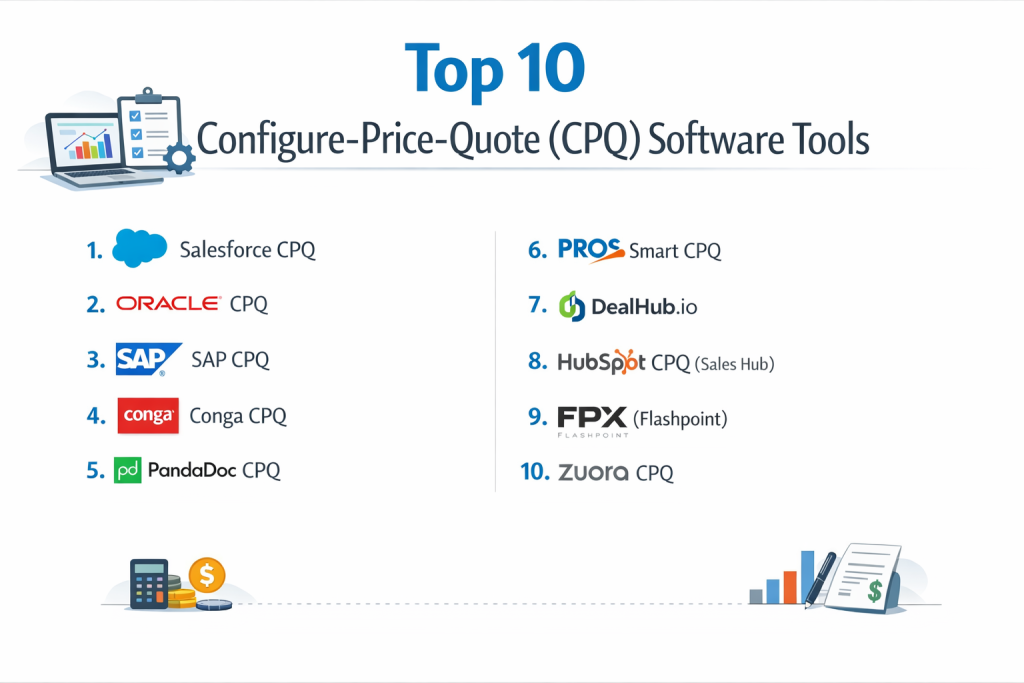
Top 10 Configure-Price-Quote (CPQ) Software Tools
1 — Salesforce CPQ
Formerly known as SteelBrick, Salesforce CPQ is the market leader, built natively on the Salesforce platform to provide a seamless transition from “Opportunity” to “Quote.”
- Key features:
- Guided Selling: Prompts reps with questions to steer them toward the right product mix.
- Product Bundling: Ensures that complementary parts are always included and incompatible ones are blocked.
- Advanced Approvals: Automates the internal review process for steep discounts.
- Subscription Management: Handles proration, co-termination, and renewals for recurring revenue.
- Document Generator: Creates branded, professional quotes and contracts with a single click.
- Pros:
- Native integration means no data sync issues between the CRM and the CPQ.
- Highly scalable and supported by a massive ecosystem of third-party consultants.
- Cons:
- Implementation is complex and almost always requires an expert partner.
- The cost can escalate quickly when adding multiple modules and user seats.
- Security & compliance: SOC 2 Type II, GDPR, HIPAA, ISO 27001, and Shield encryption.
- Support & community: Unbeatable community (Trailhead), extensive documentation, and tiered global support.
2 — Oracle CPQ
Oracle CPQ (formerly BigMachines) is an enterprise-grade solution known for its ability to handle extremely large and complex product configurations and massive datasets.
- Key features:
- Powerful Constraint Engine: Manages millions of product permutations without performance lag.
- Global Pricing: Supports multi-currency, multi-language, and localized tax logic.
- Deal Management: Provides reps with “price floor” and “target price” guidance based on historical data.
- Contract Lifecycle Management (CLM): Integrated tools for redlining and legal approvals.
- BOM Mapping: Directly translates sales quotes into Manufacturing Bills of Materials.
- Pros:
- Excellent for large-scale manufacturing and global conglomerates with legacy data.
- Strong integration with Oracle ERP and other third-party CRM systems like Microsoft Dynamics.
- Cons:
- The user interface can feel dated and less intuitive than modern SaaS-native tools.
- Administering the system requires specialized technical knowledge (often script-based).
- Security & compliance: HIPAA, GDPR, SOC 1/2, and FedRAMP authorized.
- Support & community: Enterprise-grade global support, Oracle University training, and active user groups.
3 — SAP CPQ
SAP CPQ (formerly CallidusCloud) is designed for organizations that need a high-performance pricing engine that bridges the gap between sales and the back-office ERP.
- Key features:
- Variant Configuration: Deep integration with SAP ERP to ensure manufacturing feasibility.
- Margin Health Indicators: Real-time alerts to reps if a discount will erode profitability too deeply.
- Omnichannel Selling: Provides a consistent pricing experience across direct sales and e-commerce.
- AI-Driven Cross-Sells: Suggests relevant additions based on customer purchase history.
- Automated Renewals: Tracks contract end-dates to trigger renewal quotes automatically.
- Pros:
- Perfect for existing SAP customers who want a “quote-to-cash” workflow.
- Very strong performance for high-volume quoting environments.
- Cons:
- Implementation is intensive and requires a deep understanding of SAP’s data structure.
- Can be overly rigid for fast-moving startups with frequently changing product lines.
- Security & compliance: ISO 27001, SOC 2, GDPR, and enterprise-standard encryption.
- Support & community: Global SAP support network and a vast library of technical documentation.
4 — Conga CPQ
Conga CPQ (integrated with the former Apttus) is a powerhouse for revenue lifecycle management, focusing heavily on the intersection of quoting and legal contracts.
- Key features:
- Contract Integration: Seamlessly moves from a quote to a legally binding contract with redlining.
- Attribute-Based Configuration: Allows for complex product selection without pre-defining every bundle.
- Pricing Promotions: Handles seasonal discounts, “buy-one-get-one,” and limited-time offers.
- E-Signature Native: Integrated document signing to close deals faster.
- Revenue Intelligence: Dashboards that track quote-to-close ratios and discount trends.
- Pros:
- Exceptional for industries where the “Quote” and the “Contract” are equally complex (e.g., Legal, Finance).
- Very flexible UI that can be tailored to specific sales roles.
- Cons:
- The merger of Apttus and Conga has occasionally led to a fragmented administrative experience.
- Higher learning curve for the “Admin” side of the platform.
- Security & compliance: SOC 2 Type II, HIPAA, GDPR, and ISO 27001.
- Support & community: Dedicated customer success managers and a robust online training portal.
5 — PandaDoc CPQ
PandaDoc offers a more streamlined, “lite” CPQ experience that focuses on document automation and ease of use for small to mid-market businesses.
- Key features:
- Smart Pricing Tables: Interactive tables that allow customers to select quantities and options.
- Drag-and-Drop Editor: The most intuitive proposal builder in the category.
- Native CRM Integrations: Works seamlessly with HubSpot, Pipedrive, and Zoho.
- Payment Collection: Collect payments immediately upon the signing of a quote.
- Audit Trails: See exactly when a customer opened, viewed, and signed a document.
- Pros:
- Low cost and rapid implementation—you can be live in a few days.
- Excellent for design-forward companies that want visually stunning proposals.
- Cons:
- Lacks the heavy “constraint logic” needed for complex manufacturing (e.g., if-then rules).
- Not suitable for managing thousands of multi-level product bundles.
- Security & compliance: SOC 2 Type II, HIPAA, GDPR, and eIDAS compliance for signatures.
- Support & community: 24/7 chat support, extensive video tutorials, and a friendly user community.
6 — PROS Smart CPQ
PROS is unique because it combines standard CPQ functionality with high-end AI and data science to provide “dynamic pricing.”
- Key features:
- AI Price Optimization: Analyzes market trends and competitor data to suggest the ideal price.
- Omnichannel Consistency: Ensures the same price is offered via a rep, a portal, or a partner.
- Massive Catalog Support: Can handle millions of SKUs with sub-second response times.
- Visualization: 2D/3D configuration tools for physical products.
- Agreement Management: Tracks long-term pricing agreements for recurring customers.
- Pros:
- Best-in-class for companies where pricing changes daily (e.g., Chemicals, Distribution, Travel).
- Powerful data science capabilities that help maximize gross margins.
- Cons:
- High technical barrier for setup and AI model training.
- Very expensive, making it inaccessible for the mid-market.
- Security & compliance: ISO 27001, SOC 2, and GDPR.
- Support & community: Professional services-heavy support and enterprise-grade SLAs.
7 — DealHub.io
DealHub offers a “Revenue Platform” approach that combines CPQ, CLM, and “DealRooms” to provide a collaborative buying experience.
- Key features:
- Zero-Code Configuration: Admins can set up complex rules without writing a single line of code.
- DealRooms: A private digital space for buyers and sellers to collaborate on documents.
- Real-Time Notifications: Alerts reps the second a buyer interacts with a proposal.
- Predictive Playbooks: Guides reps on which products to pitch based on the lead type.
- Subscription Billing: Handles complex SaaS billing cycles and renewals.
- Pros:
- Extremely fast time-to-value; much easier to maintain than Salesforce CPQ.
- The “DealRoom” feature significantly improves the buyer experience.
- Cons:
- Less established in the heavy industrial manufacturing space compared to Oracle or SAP.
- Reporting features are strong but not yet as deep as the Salesforce ecosystem.
- Security & compliance: SOC 2 Type II, GDPR, and ISO 27001.
- Support & community: High-touch onboarding and very responsive customer success teams.
8 — Hubspot CPQ (Sales Hub)
Hubspot has rapidly expanded its Sales Hub to include native CPQ features designed for companies that value simplicity and a unified “growth platform.”
- Key features:
- Product Library: Centralized repository for all SKUs and pricing tiers.
- Quote Templates: Customizable, branded templates that pull data directly from Hubspot CRM.
- E-Signatures: Built-in signing capabilities included in the Sales Professional tier.
- Stripe Integration: Easy payment processing linked to quotes.
- Reporting Dashboards: Track “Quote-to-Cash” metrics alongside marketing data.
- Pros:
- Unrivaled ease of use—if you can use Hubspot, you can use their CPQ.
- Perfectly integrated with the Hubspot Marketing and Service hubs.
- Cons:
- Lacks the deep “Configuration” logic needed for complex engineering (no dependency rules).
- Limited support for complex multi-currency or multi-entity business structures.
- Security & compliance: SOC 2, GDPR, and ISO 27001.
- Support & community: Massive community, Hubspot Academy, and 24/7 phone/chat support.
9 — FPX (Flashpoint)
FPX is a specialized CPQ designed for “Omnichannel Manufacturing,” helping companies sell complex equipment through dealer networks and direct channels.
- Key features:
- Dealer Portals: Allows external partners to generate their own quotes using your rules.
- Engineer-to-Order (ETO): Specialized workflows for products that require custom engineering.
- 3D Visual Configuration: Customers can see the machine they are building in real-time.
- BOM Generation: Automatically creates a bill of materials for the production line.
- Legacy Integration: Specifically designed to plug into old “Mainframe” ERP systems.
- Pros:
- The go-to choice for heavy machinery, pumps, and specialized industrial equipment.
- Excellent at managing the “Silo” between Sales and Engineering.
- Cons:
- Very niche focus; not suitable for SaaS or simple professional services.
- Implementation requires deep coordination with manufacturing engineering teams.
- Security & compliance: ISO 27001, SOC 2, and GDPR.
- Support & community: High-end professional services and industry-specific expertise.
10 — Zuora CPQ
Zuora is the leader in the “Subscription Economy,” and its CPQ is specifically built to manage the complexity of recurring revenue and usage-based billing.
- Key features:
- Usage-Based Pricing: Handles “Pay-as-you-go” models where the price changes monthly.
- Subscriber Lifecycle: Manages upgrades, downgrades, and “pauses” in service.
- Global Tax Engine: Built-in compliance for VAT and sales tax across 100+ countries.
- Revenue Recognition: Ensures that sales data perfectly matches accounting standards.
- Product Catalog: Designed for high-velocity SaaS releases.
- Pros:
- The absolute best for complex SaaS, Media, or IoT subscription models.
- Deeply connects the “Sales” process with the “Finance” and “Billing” processes.
- Cons:
- Not suitable for “One-time” physical product sales (like selling a single tractor).
- Can be very expensive for companies with low transaction volumes.
- Security & compliance: PCI Level 1, SOC 1/2, GDPR, and HIPAA.
- Support & community: Strong presence in the “Subscription Economy” thought leadership space.
Comparison Table
| Tool Name | Best For | Platform(s) Supported | Standout Feature | Rating (Gartner) |
| Salesforce CPQ | Salesforce Power Users | Cloud (Native) | Deep CRM Integration | 4.6 / 5 |
| Oracle CPQ | Global Enterprise Mfg | Cloud / On-Prem | High-Scale Logic Engine | 4.4 / 5 |
| SAP CPQ | SAP Ecosystem Users | Cloud (SaaS) | Variant Configuration | 4.3 / 5 |
| Conga CPQ | Contract-Heavy Sales | Cloud (SaaS) | Unified CLM/CPQ | 4.2 / 5 |
| PandaDoc CPQ | Small-Mid Market | Cloud (SaaS) | Interactive Proposal UI | 4.7 / 5 |
| PROS Smart CPQ | Dynamic AI Pricing | Cloud (SaaS) | Data Science Insights | 4.5 / 5 |
| DealHub.io | High-Growth Tech | Cloud (SaaS) | Collaborative DealRooms | 4.8 / 5 |
| Hubspot CPQ | Simple B2B Services | Cloud (SaaS) | Ease of Implementation | 4.5 / 5 |
| FPX | Industrial Dealers | Cloud / On-Prem | 3D Visual Configurator | N/A |
| Zuora CPQ | Complex Subscriptions | Cloud (SaaS) | Usage-Based Billing | 4.1 / 5 |
Evaluation & Scoring of Configure-Price-Quote (CPQ) Software
| Category | Weight | Evaluation Logic |
| Core Features | 25% | Logic engine strength, bundling, discounting, and document generation. |
| Ease of Use | 15% | Intuitiveness for reps and the “Admin” overhead for management. |
| Integrations | 15% | Quality of “Quote-to-Cash” sync with CRM and ERP systems. |
| Security & Compliance | 10% | Encryption, SOC 2 status, and support for regulated industries. |
| Performance | 10% | Calculation speed and reliability when handling large catalogs. |
| Support & Community | 10% | Training quality, forum activity, and vendor response times. |
| Price / Value | 15% | TCO (Total Cost of Ownership) vs. the reduction in “Quote Error.” |
Which Configure-Price-Quote (CPQ) Software Tool Is Right for You?
Solo Users vs SMB vs Mid-Market vs Enterprise
If you are a Solo user or a very small SMB, you likely don’t need a formal CPQ; a well-designed template in Hubspot or PandaDoc will suffice. Mid-market companies with 50-200 reps should prioritize “time-to-value.” DealHub.io or Conga are excellent here because they don’t require an army of developers to maintain. For Global Enterprises, the decision is usually dictated by your existing stack; if you are an SAP shop, use SAP CPQ. If you live in Salesforce, Salesforce CPQ is the default choice for its massive scalability and partner support.
Budget-conscious vs Premium Solutions
If you are Budget-conscious, PandaDoc and Hubspot provide the most “bang for your buck,” covering 80% of the needs for 20% of the price. If you require a Premium Solution, expect to pay for the AI and data science in PROS or the massive architectural depth of Oracle. These systems are expensive but pay for themselves by capturing 1-2% more margin on every single deal—which, for a billion-dollar company, is a massive return on investment.
Feature Depth vs Ease of Use
There is a direct correlation between how much a CPQ can do and how hard it is to use. Salesforce CPQ and Oracle have incredible Feature Depth (they can handle almost any rule you can imagine), but they are notoriously difficult to set up. On the flip side, DealHub and PandaDoc prioritize Ease of Use, ensuring that your sales reps actually want to use the software, which is often the biggest hurdle in CPQ adoption.
Integration and Scalability Needs
If your sales data needs to flow directly into a manufacturing floor (creating a “Bill of Materials”), you need a tool with heavy Engineering-to-Order capabilities like FPX or Oracle. If you are a SaaS company that expects to grow from 10 to 1,000 reps, the Scalability of Salesforce CPQ or Zuora is essential, as their underlying cloud infrastructure is designed to handle that trajectory without needing a system migration.
Security and Compliance Requirements
Companies in Finance and Healthcare must prioritize tools with HIPAA and SOC 2 Type II compliance. Conga and Salesforce are highly respected in these sectors. If you are a Government Contractor, check for FedRAMP authorization, which is a specific specialty of Oracle and Salesforce.
Frequently Asked Questions (FAQs)
1. What is the difference between a CRM and a CPQ?
A CRM manages your customer relationships and pipeline (leads, accounts, opportunities). A CPQ is an “add-on” that handles the actual creation of complex quotes within those opportunities.
2. Why shouldn’t I just use Excel for quoting?
Excel has no “guardrails.” A sales rep can accidentally offer an impossible product combination or a 90% discount without anyone knowing. CPQ enforces your business rules and ensures every quote is profitable and feasible.
3. How long does a CPQ implementation take?
Simple tools like PandaDoc take days. Mid-market tools like DealHub take 4-8 weeks. Enterprise tools like Salesforce CPQ or Oracle typically take 6-12 months.
4. What is “Guided Selling”?
It is a feature where the software asks the sales rep a series of questions (e.g., “How many users?” or “Does the customer need a battery backup?”) and then automatically recommends the correct products.
5. Does CPQ work for service-based businesses?
Yes. CPQ is excellent for professional services where you need to calculate “hours x rate” across different roles (Senior vs. Junior) and apply project-based discounts.
6. What is “Quote-to-Cash”?
It is the entire end-to-end process starting from when a quote is generated to when the payment is actually received and recorded in the accounting system.
7. Can CPQ help with product renewals?
Absolutely. Specialized tools like Zuora and Salesforce CPQ track when a customer’s contract is ending and can automatically generate a renewal quote 90 days in advance.
8. Do I need a full-time admin for CPQ?
For enterprise tools like Salesforce or Oracle, yes. For “no-code” tools like DealHub or PandaDoc, a Sales Ops manager can usually handle it as part of their regular duties.
9. Can CPQ handle 3D product visualizations?
Yes, tools like FPX and PROS offer visual configurators where customers can see a 3D model of their product change as they select different options.
10. Is CPQ software worth the investment?
For companies with complex pricing or high quote volumes, the “ROI” comes from faster deal cycles, fewer order errors, and better margin control. Most companies see a return within 12-18 months.
Conclusion
Selecting the right Configure-Price-Quote (CPQ) Software is a defining moment for a company’s revenue operations. It is the bridge between a “possible” sale and a “profitable” one. The “best” tool is not necessarily the one with the most features, but the one that your sales team will actually use and that your IT team can actually maintain. For companies deeply embedded in the Salesforce world, Salesforce CPQ is the logical powerhouse. For those looking for agility and modern buyer engagement, DealHub.io and PandaDoc represent the future of frictionless selling.
Ultimately, CPQ is about more than just numbers on a page; it is about providing your sales team with the confidence to quote accurately and your leadership with the data to price strategically. As business models continue to shift toward complex subscriptions and customized manufacturing, a robust CPQ becomes the essential foundation for any scalable sales organization.