Introduction
Compliance training platforms are specialized digital ecosystems designed to help organizations manage, deliver, and track mandatory employee education. Unlike a standard Learning Management System (LMS), these platforms are purpose-built to address legal and regulatory requirements. They focus on high-stakes topics such as anti-bribery, data privacy (GDPR/HIPAA), workplace harassment prevention, and cybersecurity. These systems do more than just host videos; they provide the “audit-ready” evidence companies need to prove to regulators that their workforce is properly trained and that the organization is acting in good faith.
The importance of these platforms cannot be overstated. In a regulatory landscape that changes almost daily, a single compliance failure can result in multimillion-dollar fines, permanent brand damage, or even criminal liability. By automating the assignment of courses based on an employee’s role or location, these tools remove the risk of human error in training administration. Furthermore, they utilize modern instructional design—such as microlearning and gamification—to ensure that employees actually retain the information rather than just clicking through to finish a task.
Key Real-World Use Cases
Compliance training platforms solve complex organizational challenges across several domains:
- Regulatory Onboarding: Automatically assigning required legal training (like OSHA safety or SEC regulations) to new hires based on their specific job function.
- Annual Recertification: Managing the “expiration” of certifications and automatically notifying employees when they need to retake mandatory courses.
- Audit Defense: Generating instant reports for government auditors to prove that 100% of the workforce has completed their ethical conduct training.
- Culture Building: Deploying organization-wide initiatives on Diversity, Equity, and Inclusion (DEI) to foster a safer and more professional workplace environment.
What to Look For (Evaluation Criteria)
When selecting a platform, consider these critical factors to ensure it meets your long-term needs:
- Content Accuracy & Updates: Does the provider have an in-house legal team that updates course content the moment a law changes?
- Automation Engine: Can the system automatically enroll users based on HRIS data (e.g., job title, state of residence)?
- Engagement Levels: Is the content boring “slideware,” or does it use high-quality video, interactive scenarios, and microlearning?
- Reporting Depth: Can you drill down into specific departments or regions to see who is non-compliant?
- Global Capabilities: Does the platform support multiple languages and local regulations (e.g., California’s specific harassment laws vs. New York’s)?
Best for:
- HR and Compliance Officers: Who need to ensure 100% completion rates for mandatory training.
- Legal Departments: Looking to mitigate corporate risk through documented “good faith” efforts.
- Regulated Industries: Such as Finance, Healthcare, Manufacturing, and Energy, where training is a legal mandate.
- Enterprises and Scaling SMBs: Organizations with 50+ employees where manual tracking in spreadsheets is no longer feasible.
Not ideal for:
- Small “Lifestyle” Businesses: A five-person shop can likely manage basic safety talks through simple checklists or free resources.
- Creative-Only Training: If you only need to teach soft skills or software coding, a general LMS like LinkedIn Learning or Udemy for Business is a better fit.
- Budget-Zero Organizations: While some platforms are affordable, true compliance “insurance” usually requires a paid subscription.
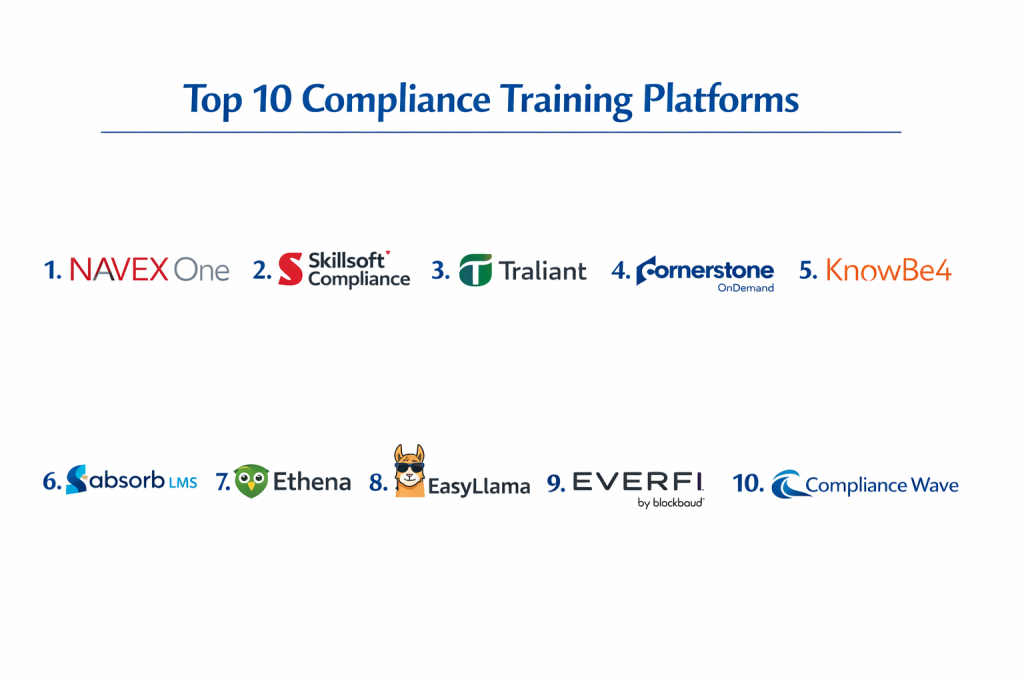
Top 10 Compliance Training Platforms
1 — NAVEX One
NAVEX is a global heavyweight in Governance, Risk, and Compliance (GRC). Their training platform is part of a larger ecosystem that includes whistleblower hotlines and policy management, making it a “one-stop shop” for corporate integrity.
Key features:
- Integrated GRC ecosystem that connects training data with incident reports.
- Adaptive learning paths that skip content employees already know.
- Extensive library covering global ethics, AML, and data privacy.
- Automated “burst” learning modules for quick knowledge reinforcement.
- Advanced judicial-grade reporting for regulatory defense.
Pros:
- Unrivaled for large, complex enterprises that need a holistic risk management view.
- Content is rigorously vetted by legal experts to ensure global compliance.
Cons:
- The system can be complex and intimidating for small HR teams.
- The user interface (UI) can feel “corporate” and less modern than newer startups.
Security & compliance: SOC 2 Type II, ISO 27001, GDPR, and HIPAA compliant.
Support & community: High-touch enterprise support with dedicated account managers and a vast library of best-practice webinars.
2 — Skillsoft Compliance
Skillsoft is one of the oldest and largest names in the industry. Their compliance arm focuses on “Culture of Compliance,” providing a massive library of high-quality video content and specialized legal expertise.
Key features:
- Over 500 risk-based training titles in 30+ languages.
- Percipio platform integration for a modern, Netflix-style user experience.
- “Legal Literacy” courses designed specifically for managers and executives.
- Automated recurring assignments and certification tracking.
- Customizable “Expert-Led” scenarios that mirror real-world workplace dilemmas.
Pros:
- One of the most extensive content libraries available in the world.
- Excellent mobile app that allows employees to complete training anywhere.
Cons:
- The sheer amount of content can lead to “choice paralysis” for admins.
- Pricing is often geared toward larger organizations with high user counts.
Security & compliance: FedRAMP, SOC 2, and ISO 27001 certified.
Support & community: 24/7 technical support and a massive global user community.
3 — Traliant
Traliant has gained rapid market share by focusing on “Hollywood-style” production values. Their courses look like modern television shows, designed to keep employees engaged rather than bored.
Key features:
- High-definition, story-based video content with professional actors.
- Industry-specific versions (e.g., Harassment Prevention for Construction vs. Healthcare).
- Mobile-first design optimized for “deskless” workers.
- Interactive “knowledge checks” that use gamification to reinforce learning.
- Easy customization to include your company’s specific policies and branding.
Pros:
- Very high employee engagement and completion rates due to the quality of the videos.
- Extremely fast implementation—you can be up and running in days.
Cons:
- Fewer “GRC” features (like whistleblowing) compared to NAVEX.
- May not have the deep “niche” regulatory content for highly technical manufacturing.
Security & compliance: SOC 2 Type II and GDPR compliant.
Support & community: Responsive customer success team and a streamlined onboarding process.
4 — Cornerstone OnDemand
Cornerstone is a comprehensive Talent Management suite. Its compliance module is built for organizations that want their mandatory training to live right alongside their performance reviews and career development.
Key features:
- Unified platform for learning, performance, and compliance.
- Powerful automation engine that triggers training based on internal promotions.
- Deep integration with HRIS systems like Workday and SAP.
- Auditor-specific dashboards for real-time compliance visibility.
- Support for external training (uploading third-party certifications).
Pros:
- Best for organizations that want a single “source of truth” for all employee data.
- Highly scalable—used by some of the largest workforces in the world.
Cons:
- High “admin burden”; requires a trained administrator to manage the platform effectively.
- The interface is incredibly feature-rich, which can be overwhelming for simple needs.
Security & compliance: FedRAMP, DoD IL4, ISO 27001, and SOC 2 Type II.
Support & community: Extensive partner network and a very active user group community.
5 — KnowBe4
While primarily known for cybersecurity, KnowBe4 has expanded into a full “Compliance Plus” library. It is the gold standard for organizations where the “human firewall” is the biggest risk.
Key features:
- World’s largest library of security awareness and compliance content.
- AI-recommended training based on an employee’s specific risk score.
- Integrated phishing simulations to test real-world behavior.
- “ModStore” for easy browsing and adding new training modules.
- Automated follow-up for users who fail “knowledge checks.”
Pros:
- Unbeatable for IT-heavy industries or companies worried about data breaches.
- Very affordable pricing tiers for small and medium businesses.
Cons:
- The library is very heavy on security, with fewer titles for HR-specific compliance.
- The “fun” style of content might not suit extremely conservative corporate cultures.
Security & compliance: SOC 2 Type II, GDPR, and HIPAA compliant.
Support & community: Highly rated “Customer Success” model and extensive documentation.
6 — Absorb LMS
Absorb is a modern, high-growth LMS that has won numerous awards for its user interface. It is particularly strong at “external” compliance (training your partners or vendors).
Key features:
- “Smart Administration” feature that uses AI to automate routine tasks.
- Absorb Analyze for deep, custom data visualization.
- Mercury Module for in-platform employee communications and announcements.
- E-commerce capabilities to sell your compliance courses to others.
- Multi-portal branding (different looks for different departments).
Pros:
- One of the best-looking and most intuitive interfaces on the market.
- Very strong at managing “external” learners who aren’t in your main HR system.
Cons:
- Building highly custom reports can be a bit “click-heavy” at first.
- Some advanced features (like Absorb Analyze) come at an extra cost.
Security & compliance: SOC 2 Type II, GDPR, and ISO 27001.
Support & community: Award-winning support team and a dedicated “Absorb Academy” for admins.
7 — Ethena
Ethena is the “disruptor” in the space, focusing on modern, inclusive, and bite-sized content delivered through tools like Slack and Microsoft Teams.
Key features:
- “Nudge” delivery system that sends training directly into an employee’s workflow.
- Modern, diverse content that addresses topics like “inclusive leadership” authentically.
- Pulse surveys to measure how employees actually feel about company culture.
- Real-time compliance tracking that updates the moment a “nudge” is completed.
- Seamless integration with modern HRIS platforms like Gusto and Rippling.
Pros:
- The highest “sentiment” ratings from employees who usually hate training.
- Minimal “time out of work” since training happens in 5-minute increments.
Cons:
- Not suitable for industries requiring 4-hour “heavy” safety certifications.
- The library is currently smaller than giants like Skillsoft.
Security & compliance: SOC 2 Type II and GDPR compliant.
Support & community: Extremely helpful for “Modern HR” teams; strong focus on Slack-based support.
8 — EasyLlama
EasyLlama is built for the “deskless” and mobile workforce. It focuses on being the easiest platform to use for both the admin who sets it up and the employee who takes the course on their phone.
Key features:
- Text-message delivery (employees can start training via an SMS link).
- State-specific compliance tracking (auto-detects if someone is in CA vs. TX).
- Anonymous reporting tool for employees to flag workplace issues.
- Library focused on “Workplace Culture” and HR legal mandates.
- Dashboard that highlights “at-risk” employees who haven’t finished training.
Pros:
- Incredible for retail, hospitality, and construction where employees don’t have laptops.
- Pricing is very transparent and “small-business friendly.”
Cons:
- Lacks the deep “Enterprise GRC” features for financial risk.
- The course library is specialized and not as broad as a general LMS.
Security & compliance: SOC 2 Type II and industry-standard encryption.
Support & community: Very fast email and chat support; highly rated on review sites.
9 — EVERFI (by Blackbaud)
EVERFI focuses on “Impact-Driven” training. They are widely used in both the corporate world and higher education, focusing on ethical behavior and social responsibility.
Key features:
- Data-driven insights into “risk areas” across your organization.
- Courses designed by social scientists to change actual behavior, not just check boxes.
- Robust focus on Financial Literacy, ESG, and Mental Health.
- Integrated dashboards for DEI (Diversity, Equity, and Inclusion) tracking.
- “Just-in-time” learning modules for high-stress situations.
Pros:
- Strongest choice for organizations that view compliance as a “Social Good.”
- Excellent reporting on “Pre-course” vs “Post-course” knowledge growth.
Cons:
- Can be more expensive than basic “box-ticking” software.
- Updates on the admin dashboard can sometimes lag behind real-time.
Security & compliance: SOC 2 Type II and GDPR compliant.
Support & community: Deep academic and legal expertise; strong customer success presence.
10 — Compliance Wave
Compliance Wave is unique because it offers a “Membership” model rather than a per-user license. They focus on “Micro-Learning” and constant communication rather than once-a-year training.
Key features:
- Unlimited access to a library of over 4,000 “Compliance Communications.”
- Multimedia focus: videos, cartoons, posters, and brief articles.
- “Behavior Change Science” baked into every piece of content.
- Flat-fee annual pricing (unlimited users for one price).
- Completely customizable content—you can edit their videos to fit your brand.
Pros:
- Best “value for money” for large organizations with massive headcounts.
- Great for keeping compliance “top of mind” year-round, not just once.
Cons:
- Requires more “creative work” from the admin to deploy the content effectively.
- Does not have the robust “LMS tracking” of a system like Cornerstone.
Security & compliance: Varies by deployment (usually integrates with your existing secure LMS).
Support & community: Dedicated “Engagement Manager” for every member.
Comparison Table
| Tool Name | Best For | Platform(s) Supported | Standout Feature | Rating |
| NAVEX One | Global Risk Mgmt | Web / Mobile | Integrated GRC Ecosystem | N/A |
| Skillsoft | Large Content Needs | Web / App | 500+ Global Legal Titles | N/A |
| Traliant | High Engagement | Web / Mobile | Hollywood Video Quality | N/A |
| Cornerstone | Unified HR/LMS | Web / App | HRIS-Triggered Automation | N/A |
| KnowBe4 | Cybersecurity Focus | Web / App | Phishing Simulations | N/A |
| Absorb LMS | External Partners | Web / Mobile | Multi-Portal Branding | N/A |
| Ethena | Modern/Slack Users | Slack / Teams | “Nudge” Delivery System | N/A |
| EasyLlama | Deskless Workers | SMS / Web | State-Specific Automation | N/A |
| EVERFI | ESG & Culture | Web | Behavior Change Analytics | N/A |
| Compliance Wave | Large Vol. Budget | Content Library | Flat-Fee Unlimited Use | N/A |
Evaluation & Scoring of Compliance Training Platforms
| Criterion | Weight | Evaluation Focus |
| Core Features | 25% | Automation, role-based assignment, and certification tracking. |
| Ease of Use | 15% | Learner interface quality and admin dashboard simplicity. |
| Integrations | 15% | Connection to HRIS (Workday, ADP) and Slack/Teams. |
| Security & Compliance | 10% | SOC 2, GDPR, HIPAA, and “Audit-Ready” reporting. |
| Performance | 10% | Video streaming speed and mobile responsiveness. |
| Support | 10% | Onboarding speed and customer success availability. |
| Price / Value | 15% | Content depth vs. total cost of ownership. |
Which Compliance Training Platform Is Right for You?
Solo Users vs SMB vs Mid-Market vs Enterprise
If you are a Small Business (SMB), look at EasyLlama or KnowBe4. They are “plug-and-play” and don’t require an IT degree to manage. Mid-Market firms will appreciate Traliant or Absorb LMS for their balance of high engagement and stronger reporting. Enterprises with 5,000+ employees almost always require NAVEX One, Skillsoft, or Cornerstone because these platforms can handle the extreme complexity of multiple legal jurisdictions and deep HRIS integrations.
Budget-Conscious vs Premium Solutions
If you have a massive workforce and a tight budget, Compliance Wave is the winner because their flat-fee model means you don’t pay “per head.” If you want the absolute best “brand protection” and money is no object, NAVEX and Skillsoft offer the most robust legal backing. For a “middle ground” that offers great ROI through employee time-savings, Ethena is a strong choice.
Feature Depth vs Ease of Use
If you want to customize every single button and workflow, Cornerstone has the most “Depth,” but it is very difficult to learn. If you want something that your employees can finish on their lunch break with zero training, EasyLlama and Ethena are the champions of “Ease of Use.”
Integration and Scalability Needs
For companies that use Slack or Microsoft Teams as their primary office, Ethena is the natural choice. If you are an SAP or Oracle shop, Cornerstone or NAVEX will integrate much more natively into your existing data architecture.
Security and Compliance Requirements
Highly regulated industries (Defense, Banking, Healthcare) should prioritize FedRAMP or ISO 27001 certifications. Skillsoft and Cornerstone are the leaders in government-grade security. If you are primarily focused on GDPR (Europe), ensure the provider has data centers in the EU, which is a strength for Absorb and NAVEX.
Frequently Asked Questions (FAQs)
What is the difference between an LMS and a Compliance Platform?
A general LMS hosts any content. A Compliance Platform includes legally-vetted content that is automatically updated when laws change.
How often should compliance training be updated?
Legally, most topics (like Harassment or AML) require annual or bi-annual updates. The best platforms update their content in real-time.
Can these platforms track in-person training?
Yes, most enterprise tools like Cornerstone allow you to log “Offline” training events to keep all records in one place.
Are these courses mobile-friendly?
Most are, but tools like EasyLlama and Traliant are “Mobile-First,” meaning they are specifically designed for small screens.
What is ‘Microlearning’?
It is breaking 1-hour courses into 5-minute “bursts.” This increases retention and reduces “training fatigue” for employees.
Do these platforms include a whistleblower hotline?
Usually no, but NAVEX is a rare exception that offers a fully integrated ethics hotline alongside their training.
Is the content available in multiple languages?
Yes, top-tier providers like Skillsoft and NAVEX offer content in 30+ languages with culturally adapted scenarios.
Can I upload my own company handbook?
Yes, almost all of these platforms allow you to upload PDFs or custom videos alongside their “off-the-shelf” content.
What happens during a regulatory audit?
You simply log into the platform and export a “Completion Report.” These are designed to be submitted directly to government agencies as proof of compliance.
How long does implementation take?
Simple tools (EasyLlama) take 24 hours. Enterprise suites (Cornerstone) can take 3 to 6 months to fully integrate with your HR data.
Conclusion
The “best” compliance training platform isn’t the one with the most features; it’s the one that your employees will actually use and your legal team will actually trust. If your workforce is primarily on the move, a mobile-first solution like EasyLlama is non-negotiable. If you are a global bank, the industrial-strength reliability of NAVEX One is the only way to sleep soundly at night.
As you evaluate these tools, remember that the cost of the software is always lower than the cost of a non-compliance fine. Look for a partner that doesn’t just “check the box” but actually helps build a culture of integrity. Start with a clear understanding of your specific regulatory risks, take advantage of free demos to see the content quality, and choose the platform that fits seamlessly into your employees’ daily work lives.