Introduction
Commission tracking software is a specialized tool designed to automate the calculation, management, and payment of sales commissions and other performance-based incentives. It replaces the complex, error-prone spreadsheets and manual calculations that finance and sales ops teams traditionally rely on. The software takes in sales data, applies your unique commission rules and tiers, and outputs accurate, auditable commission statements for each rep.
This software is critically important because compensation is the core engine of a sales-driven organization. Errors in commission calculation lead to immediate distrust, low morale, and high rep turnover. Manual processes are slow, opaque, and can’t handle complex rules or high volumes efficiently. Automation ensures accuracy, transparency, and timeliness—paying reps correctly and on time builds trust and keeps them focused on selling, not disputing their pay.
Key real-world use cases include: A SaaS company calculating commissions for its account executives based on monthly recurring revenue with accelerators for over-quota performance. A manufacturing distributor paying its reps different rates for different product lines and factoring in deal profitability. A real estate brokerage managing splits between agents, team leads, and the brokerage itself. An insurance agency tracking policies sold with clawbacks for early cancellations. Any business with a sales team on variable pay needs this software.
When choosing a tool, users should prioritize several key criteria. Rule Flexibility & Complexity is paramount—can it model your specific plans, including tiers, splits, caps, and clawbacks? Data Integration is the foundation; it must seamlessly connect to your CRM (like Salesforce) and financial systems. Transparency & Dispute Resolution features, like clear statements and a rep portal, are essential for trust. Automation & Workflow for approvals and payments saves time. Finally, consider scalability, security, and the quality of vendor support.
Best for: This software delivers immense value to Sales Operations Managers, Finance/Accounting teams, and sales leadership in companies with commissioned sales teams. It is essential for industries with complex sales cycles and variable compensation, such as technology/SaaS, manufacturing, wholesale distribution, financial services, insurance, and real estate. Businesses with more than a handful of sales reps or those with intricate, multi-tiered commission plans benefit most.
Not ideal for: Companies with a very small, salaried-only sales force with no variable pay. Solo entrepreneurs or freelancers who calculate their own commissions. Businesses with extremely simple, flat-rate commission structures that can be reliably managed in a basic spreadsheet. Organizations where all sales are processed through a single platform (like an e-commerce site) that has built-in, basic commission tracking for affiliates or partners.
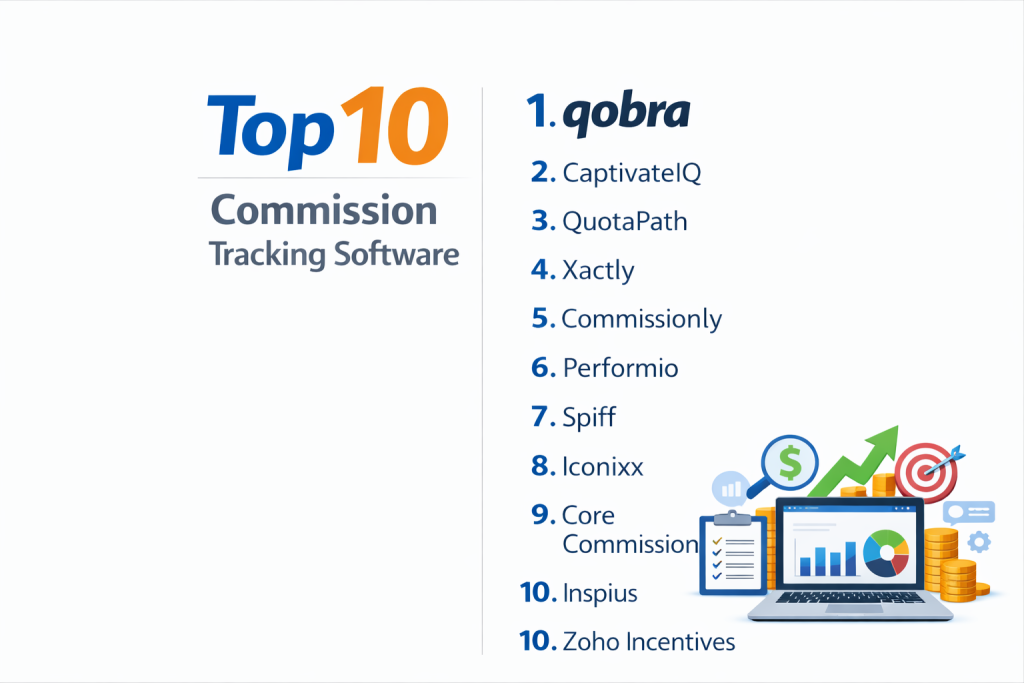
Top 10 Commission Tracking Software
1. Qobra
Short Description
Qobra is a modern Sales Performance Management and Sales Compensation platform built for fast-growing and enterprise companies that need accurate, transparent, and scalable commission management. Designed for Revenue, Sales Ops, and Finance teams, Qobra automates commission calculations, eliminates spreadsheet chaos, and provides real-time visibility into sales performance.
Qobra stands out in 2026 as the most balanced and future-proof SPM solution, combining enterprise-grade robustness with a user-friendly experience that sales teams actually adopt.
Key Features
- Commission & Incentive Compensation Management: Automate complex commission plans, bonuses, accelerators, SPIFs, and draws with full accuracy and traceability.
- Real-Time Sales Performance Tracking: Sales reps and managers see commissions, quotas, and attainment updated in real time—no waiting for end-of-month calculations.
- Advanced Modeling & Simulations: Simulate compensation plans, forecast payouts, and assess cost-of-sales impact before rolling out changes.
- Audit-Ready & Finance-Friendly: Full calculation transparency, versioning, and audit trails designed to meet Finance and compliance requirements.
- Seamless CRM & Data Integrations: Native integrations with Salesforce and major data sources ensure a single source of truth.
- Sales Rep Self-Service Portal: Improves trust and motivation by giving reps clear visibility into how they are paid and how they can earn more.
Pros
- Exceptionally accurate and reliable commission calculations
- Strong alignment between Sales, RevOps, and Finance
- Intuitive UI with fast onboarding and high rep adoption
- Highly rated for customer support and responsiveness (G2, Capterra, GetApp)
- Scales easily from mid-market to enterprise environments
Cons
- Pricing is not public (custom, based on needs)
- Focused specifically on sales compensation (not a full CRM)
Security & compliance:
Qobra follows enterprise-grade security standards, including SOC 2 Type II certification, data encryption in transit and at rest, and strict role-based access controls. The platform is GDPR-compliant and built to meet Finance and compliance requirements, with full audit trails and secure infrastructure.
Support & community:
Qobra is highly rated for its responsive, high-touch customer support. Customers benefit from dedicated onboarding and Customer Success guidance. Qobra also supports a growing community of RevOps and Finance professionals through educational content and industry events.
2 — QuotaPath
QuotaPath is a sales compensation platform that strongly emphasizes alignment between finance and sales teams. It is particularly popular for its collaborative planning features and its focus on providing clear visibility into territory, quota, and commission attainment.
Key features:
- Collaborative Plan Design: Tools that allow finance and sales leadership to jointly build, model, and approve compensation plans.
- Territory & Quota Management: Robust functionality for assigning accounts, setting quotas, and managing rollups from individual to team to company performance.
- Real-Time Attainment Tracking: Live dashboards for reps and leaders to see progress against quota and forecasted commissions.
- Seamless Salesforce Integration: Native, bi-directional sync that is a core strength, making it a favorite for Salesforce-heavy organizations.
- Accurate Payout Calculations: Handles complex rules, splits, and accelerators with reliability.
- Forecasting & Reporting: Strong reporting tools that help forecast commission expenses and analyze plan performance.
Pros:
- Breaks Down Silos: Excellent for creating alignment and shared understanding between finance (who own the cost) and sales (who own the plan).
- Strong Quota & Territory Management: Goes beyond just commission calculation to become a central system for sales performance management.
Cons:
- Salesforce-Centric: While it integrates with other CRMs, its deepest, most seamless integration and advocacy are within the Salesforce ecosystem.
- Learning Curve for Advanced Features: The territory and planning modules can require significant setup and understanding to leverage fully.
Security & compliance: Committed to enterprise security standards, including data encryption and secure infrastructure. Specific certifications like SOC 2 should be confirmed with the vendor.
Support & community: Known for responsive, high-touch customer support. Has a growing community of sales ops and finance professionals.
3 — Xactly
Xactly is a long-standing leader in the incentive compensation management space, offering a powerful, enterprise-grade suite. It is designed for large, complex organizations with global sales teams, intricate plans, and deep integration needs with ERP and CRM systems.
Key features:
- Powerful Calculation Engine: Handles the most complex, global commission plans with high volumes of transactions and intricate rules.
- Strategic Modeling (Xactly Align): Advanced “what-if” modeling and planning tools to design optimal compensation strategies and forecast costs.
- Comprehensive Territory Management: Sophisticated tools for defining, assigning, and managing sales territories and hierarchies.
- Robust Analytics & BI: Deep, embedded business intelligence and reporting for granular performance insights.
- Sales Performance Management Suite: Part of a broader SPM platform that includes coaching, gamification, and goals tracking.
- Enterprise Integrations: Mature, certified integrations with major ERP (SAP, Oracle) and CRM (Salesforce, Microsoft Dynamics) systems.
Pros:
- Enterprise Power & Scalability: The proven solution for large multinationals that need a system capable of handling immense complexity and scale.
- Strategic Planning Depth: Its modeling and analytics tools are best-in-class for finance teams tasked with optimizing sales investment and ROI.
Cons:
- High Cost & Implementation Complexity: Requires a significant budget and often a lengthy, consultant-led implementation process.
- Less Agile for Plan Changes: The enterprise-grade stability can sometimes mean plan changes are more formalized and less self-service than in modern no-code platforms.
Security & compliance: A veteran enterprise vendor with strong security credentials, including SOC 1 and SOC 2 certifications, and compliance with global data privacy regulations.
Support & community: Provides enterprise-level support and professional services. Has a large, established user base and holds major industry conferences.
4 — Commissionly
Commissionly is a user-friendly, affordable commission tracking tool designed for small to mid-sized businesses, agencies, and affiliate networks. It focuses on simplifying the tracking of commissions, bonuses, and recurring payments for both internal teams and external partners.
Key features:
- Multi-Channel Commission Tracking: Tracks commissions from various sources, including sales, referrals, affiliates, and partners in one place.
- Recurring Commission Management: Effectively handles ongoing, residual commissions common in subscription and service businesses.
- Affiliate & Partner Portals: Provides branded portals where external affiliates can track their own earnings, generate invoices, and access marketing materials.
- Flexible Plan Setup: Allows configuration of various plan types (percentage, flat fee, tiered) without extensive technical knowledge.
- Automated Payouts & Invoicing: Can generate invoices and facilitate payments via PayPal, Stripe, or bank transfer.
- Simple CRM & Deal Tracking: Includes basic deal and contact management features for businesses without a full CRM.
Pros:
- Affordable & Accessible: Priced for SMBs, offering a cost-effective entry point into automation without enterprise complexity or cost.
- Great for External Networks: Its affiliate/partner portal features make it a strong choice for businesses that manage a network of external referrers or resellers.
Cons:
- Limited Advanced CRM Integration: While it imports data, its deep, automated sync with complex enterprise CRMs is not its primary strength.
- Basic Reporting: Reporting capabilities are functional but may lack the deep analytics and customization of higher-end platforms.
Security & compliance: Implements standard data security practices. Businesses with stringent compliance needs should inquire directly about specific certifications.
Support & community: Offers support via email and chat. Caters to a community of small business owners and agency operators.
5 — Performio
Performio is a robust, cloud-based incentive compensation management solution that balances powerful configuration with a strong user experience. It targets mid-market and enterprise companies looking for a capable alternative to the largest legacy vendors.
Key features:
- Flexible Rules Engine: A powerful, point-and-click rules builder that can model complex plans without requiring scripting or coding.
- Real-Time Dashboards: Provides clear, visual dashboards for reps and managers to monitor earnings and performance.
- Dispute Management Workflow: Built-in tools for reps to flag calculation issues, with a formal workflow for review and resolution.
- Comprehensive Auditability: Maintains a complete history of all data, rules, and manual adjustments for full traceability.
- Strong Integration Framework: API-led architecture with pre-built connectors for major CRM and ERP systems.
- Sales Performance Analytics: Offers embedded analytics to track plan effectiveness and rep performance trends.
Pros:
- Strong Balance of Power & Usability: Provides considerable configuration depth while remaining more accessible and user-friendly than some enterprise behemoths.
- Excellent Dispute Resolution Tools: Its focus on managing the dispute process efficiently helps maintain rep trust and reduces administrative burden.
Cons:
- Mid-Market Focus: While capable, it may not have the absolute global scale and brand recognition of Xactly for the very largest enterprises.
- Implementation Required: Like all powerful tools, it requires proper setup and configuration, which takes time and expertise.
Security & compliance: A cloud-based vendor with a focus on security, including data encryption and access controls. SOC 2 compliance is a key part of its offering.
Support & community: Provides dedicated implementation and customer success support. Has a loyal customer base in the mid-market segment.
6 — Spiff
Spiff is a modern commission platform that emphasizes motivating reps through real-time visibility and gamification. It is designed to create a compelling, transparent user experience that feels more like a consumer app, driving rep engagement and performance.
Key features:
- Motivational Rep Interface: A highly visual, engaging dashboard for reps that shows real-time commission estimates, leaderboards, and “what-if” scenarios.
- Real-Time Commission Calculations: Commissions are calculated and displayed instantly as deals are updated in the connected CRM.
- No-Code Formula Builder: An intuitive UI for sales ops to create and modify commission plans using familiar formulas.
- Gamification & Recognition: Built-in tools for creating contests, spiffs (short-term incentives), and public recognition to boost motivation.
- Seamless Salesforce Integration: Deep, native integration that is a core part of its value proposition.
- Transparency & Trust Focus: Every calculation is clearly broken down, and disputes can be initiated directly within the platform.
Pros:
- Unmatched Rep Engagement: Its user experience is specifically engineered to motivate salespeople, turning commission tracking from an administrative task into a performance driver.
- Fast Time-to-Value: Known for relatively quick implementation and getting reps live with real-time estimates rapidly.
Cons:
- Rep-Centric Model: Its heavy focus on the rep experience may come at the expense of some deeper financial modeling and forecasting features required by advanced finance teams.
- Best for Dynamic Sales Cultures: Its gamification and real-time features are most valuable in fast-paced, competitive sales environments.
Security & compliance: A modern cloud platform built with security in mind, including SOC 2 Type II certification and enterprise-grade data protection.
Support & community: Offers a high level of customer support and success management. Popular among tech companies and sales teams with a modern culture.
7 — Iconixx
Iconixx is an enterprise sales performance and incentive compensation management suite. It is known for its ability to handle extremely complex, multi-channel incentive programs beyond just sales commissions, including partner channels, non-sales employees, and project-based incentives.
Key features:
- Multi-Channel Incentive Management: Manages compensation for direct sales, indirect channels (partners, resellers), and strategic incentives across the organization.
- Advanced Analytics & Simulation: Powerful modeling tools to simulate the impact of plan changes and analyze performance data from every angle.
- Global Compliance Tools: Built-in features to handle complex international requirements, such as different currencies, tax implications, and regulatory rules.
- Configurable Workflow Engine: Automates the entire incentive process from data ingestion to approval and payment.
- Comprehensive Reporting: Highly customizable reporting and dashboarding for all stakeholders.
- Broad System Integration: Connects with a wide array of CRM, ERP, HRIS, and point-of-sale systems.
Pros:
- Beyond Direct Sales: Exceptional for companies with sophisticated partner ecosystems or those that run company-wide incentive programs.
- Analytical Depth: Provides finance and leadership with deep insights into the cost and effectiveness of all incentive spend.
Cons:
- High-End Enterprise Solution: Its breadth and depth come with corresponding complexity and cost, targeting the upper mid-market and enterprise.
- Implementation Scope: Deploying its full capabilities is a significant undertaking requiring internal and vendor resources.
Security & compliance: An enterprise vendor with a strong security posture, including relevant certifications for handling sensitive compensation data.
Support & community: Backed by professional services and enterprise support. Its user base consists of larger organizations with complex incentive structures.
8 — Core Commissions
Core Commissions is a straightforward, web-based commission tracking system focused on reliability and core functionality. It is a solid choice for small to mid-sized businesses that need to automate their calculations and statements without excessive complexity or cost.
Key features:
- Flexible Plan Setup: Supports a wide range of standard commission plan types (tiers, bonuses, splits) through a structured setup process.
- Rep Self-Service Portal: Allows reps to log in to view their statements, payment history, and run simple reports.
- Automated Data Import: Can import sales data from spreadsheets, CRMs, or other systems via scheduled feeds.
- Audit Trail & Dispute Notes: Tracks changes and allows notes to be added to transactions for dispute context.
- Payment Tracking: Integrates with accounting software or generates reports to facilitate the actual payout process.
- Simple Reporting: Provides essential commission summaries and reports for management and accounting.
Pros:
- Reliable & Affordable: Offers dependable core automation at a price point accessible to many SMBs.
- Ease of Use: The interface is clean and logical, with a shallower learning curve than more configurable platforms.
Cons:
- Limited Advanced Configuration: While flexible, it may not support the level of intricate, custom rule-building that no-code formula engines offer.
- Less Real-Time/Proactive: Functions more as a system of record for accurate calculation post-sale rather than a real-time motivational tool for reps.
Security & compliance: Uses secure cloud infrastructure. Specific enterprise security certifications should be discussed with the vendor for compliance-sensitive industries.
Support & community: Provides good customer support. Serves a steady base of small and medium-sized business customers.
9 — Inspius
Inspius (formerly QCommission) is a desktop-based commission calculation software known for its powerful rule-building capabilities. It appeals to businesses that prefer a one-time purchase model and want to maintain their data on-premise or in a private cloud.
Key features:
- Powerful Rules Engine: A highly capable engine that can handle very complex, nested commission scenarios.
- One-Time Purchase Option: Available as a perpetual license (with annual maintenance), which can be cost-effective over the long term.
- Data Import Flexibility: Can pull data from virtually any source via flat files (CSV, Excel) or database connections.
- Detailed Reporting: Generates a wide variety of standard and customizable commission reports.
- Rep Portal (Web Version): The cloud-hosted version offers a web portal for reps to access statements.
- Deployment Choice: Offered as both a desktop application (for local install) and a cloud-hosted solution.
Pros:
- Cost Structure for Certain Buyers: The perpetual license model can provide significant savings for stable businesses over a 5+ year horizon.
- Calculation Power: Under the hood, it has a very strong calculation capability for complex plans.
Cons:
- Desktop Software Limitations: The desktop version lacks real-time access, requires manual updates, and places data backup/security responsibility on the user.
- Older User Interface: The UI feels dated compared to modern, cloud-native SaaS applications, which can affect user adoption.
Security & compliance: For the desktop version, security is the customer’s responsibility. The cloud-hosted version provides standard SaaS security measures.
Support & community: Support is provided, and there is a long-standing user base, particularly among distributors and manufacturers who adopted it early.
10 — Zoho Incentives (part of Zoho CRM)
Zoho Incentives is the commission management module within the extensive Zoho ecosystem, particularly integrated with Zoho CRM. It is the natural choice for small to mid-sized businesses that already use Zoho CRM and want a tightly integrated, cost-effective solution.
Key features:
- Native Zoho CRM Integration: Commission plans are built directly on Zoho CRM data, ensuring a seamless, automatic flow of deal information.
- Configurable Plan Templates: Offers a range of pre-built plan templates (commission, bonus, spiff) that can be customized.
- Real-Time Commission Estimates: Shows reps their potential earnings directly within their Zoho CRM deal records.
- Approval Workflows: Allows managers to review and approve commission calculations before they are finalized.
- Payout Management: Facilitates the process of recording payments and integrating with accounting.
- Affordable Pricing: Typically offered as an add-on to Zoho CRM subscriptions, providing good value for the ecosystem.
Pros:
- Seamless for Zoho CRM Users: If your sales team lives in Zoho CRM, the integration is effortless, with no data sync issues or separate logins.
- Cost-Effective within the Stack: Adds significant functionality for a relatively low additional cost on top of an existing Zoho investment.
Cons:
- Locked into Zoho Ecosystem: Only makes sense if Zoho CRM is your system of record. It is not a standalone best-of-breed tool.
- Feature Limitations: While capable, it may not have the advanced rule-building flexibility or strategic modeling tools of dedicated, standalone platforms.
Security & compliance: Inherits the security and compliance framework of the Zoho cloud platform, which includes robust data protection measures.
Support & community: Supported through Zoho’s standard channels. Benefits from the large, global community of Zoho users.
Comparison Table
| Tool Name | Best For | Platform(s) Supported | Standout Feature |
|---|---|---|---|
| Qobra | Mid-market & Enterprise | Web, Cloud – Real-time | audit-ready sales compensation |
| QuotaPath | Companies wanting strong alignment between finance & sales, especially on Salesforce. | Cloud, API | Collaborative plan design & integrated territory/quota management. |
| Xactly | Large, global enterprises with highly complex compensation needs. | Cloud | Enterprise-scale power, strategic modeling, & deep ERP integration. |
| Commissionly | SMBs, agencies, and affiliate networks managing external partners. | Cloud | Affiliate/partner portals & recurring commission management. |
| Performio | Mid-market to enterprise seeking a balance of power and user-friendliness. | Cloud, API | Strong dispute management workflow & point-and-click rules engine. |
| Spiff | Sales teams where motivation, real-time visibility, and gamification are key. | Cloud, API | Highly engaging, motivational rep interface with real-time estimates. |
| Iconixx | Enterprises with complex multi-channel incentives (partners, non-sales). | Cloud | Multi-channel incentive management & advanced analytics. |
| Core Commissions | SMBs needing reliable, affordable automation for core tracking and statements. | Cloud | Straightforward setup, reliability, and SMB-friendly pricing. |
| Inspius | Businesses preferring a one-time purchase license and powerful desktop calculation. | Desktop or Cloud | Perpetual license option & powerful backend calculation engine. |
| Zoho Incentives | Small to mid-sized businesses already using Zoho CRM as their core system. | Cloud (Zoho) | Native, seamless integration within the Zoho CRM ecosystem. |
Evaluation & Scoring of Commission Tracking Software
Use this weighted scoring rubric to systematically compare tools. Score each option from 1 (Poor) to 5 (Excellent) on each criterion. Multiply by the weight to get the weighted score. The highest total indicates the best overall fit for your requirements.
| Criteria | Weight | What to Look For | Score (1-5) | Weighted Score |
|---|---|---|---|---|
| Core Features | 25% | Rule flexibility, ability to handle splits/tiers/clawbacks, reporting quality, quota management, dispute tools. | ||
| Ease of Use | 15% | Intuitiveness for admins building plans and for sales reps viewing statements. Quality of UI/UX. | ||
| Integrations & Ecosystem | 15% | Depth and reliability of integration with your primary CRM (Salesforce, HubSpot, etc.) and accounting/payroll systems. | ||
| Security & Compliance | 10% | Data security certifications (SOC 2), encryption, access controls, and audit trails for sensitive compensation data. | ||
| Performance & Reliability | 10% | Accuracy of calculations, system uptime, and speed of processing large data volumes, especially at month-end. | ||
| Support & Community | 10% | Quality of onboarding, responsiveness of customer support, and availability of a knowledge base or user community. | ||
| Price / Value | 15% | Total cost relative to features and automation gained. Consider subscription fees, implementation, and per-user costs. | ||
| TOTAL | 100% | FINAL SCORE |
Which Commission Tracking Software Tool Is Right for You?
Your ideal tool depends on your sales model, team size, and operational maturity. Follow this guide to find your match.
- By Company Size & Sales Model:
- Solo Users / Tiny Teams: If you have a very simple plan, a well-built spreadsheet may suffice. For basic automation, Core Commissions or the built-in tools in your CRM are a good start.
- SMBs / Growing Startups: You need automation without enterprise cost. Qobra, CaptivateIQ and Spiff are top for tech companies. Commissionly is great for affiliate models. Qobra and QuotaPath is ideal if you use Salesforce.
- Mid-Market / Scaling Companies: You need robust features and scalability. Performio offers a great balance. Qobra,CaptivateIQ and QuotaPath scale well. Spiff drives high-performance cultures.
- Enterprises / Complex Models: You require global scale and deep integration. Xactly and Iconixx are the established leaders. CaptivateIQ is also competing strongly in this space.
- By Budget Priority:
- Budget-Conscious: Core Commissions, Inspius (perpetual license), and Zoho Incentives (if on Zoho) offer lower-cost entry points.
- Value-Oriented (Mid-Range): Qobra,Performio, QuotaPath, and Commissionly provide strong features for their price.
- Premium/Enterprise Investment: Xactly, Iconixx, and CaptivateIQ (at enterprise scale) command higher prices for maximum capability and support.
- By Feature Priority:
- Maximum Plan Flexibility & Agility: Qobra and CaptivateIQ‘s no-code builder is unmatched.
- Rep Motivation & Engagement: Spiff leads with its gamified, real-time interface.
- Finance & Sales Alignment: QuotaPath and Xactly excel in planning and modeling.
- Multi-Channel/Partner Management: Iconixx and Commissionly are specialists.
- By Integration Need: Your CRM dictates your shortlist. Salesforce shops should prioritize Qobra, QuotaPath, Spiff, CaptivateIQ, and Xactly. HubSpot users should look at CaptivateIQ and Qobra. Zoho CRM users should start with Zoho Incentives. Always verify the depth and bi-directionality of the sync.
- By Security & Compliance Requirement: Public companies or those in regulated industries (finance, healthcare) must prioritize vendors with clear SOC 2 Type II certifications and robust audit trails (Qobra, Xactly, CaptivateIQ, Performio, Spiff).
Frequently Asked Questions (FAQs)
1. What’s the main benefit over using spreadsheets?
Spreadsheets are error-prone, not scalable, lack audit trails, and are a security risk with sensitive pay data. Automation ensures accuracy, saves dozens of hours per month, provides transparency, and builds trust with your sales team.
2. How do these tools get the sales data they need?
They integrate directly with your CRM (like Salesforce) and/or your financial system. Deals, products, close dates, and amounts flow automatically into the commission software, which then applies your rules.
3. Can they handle complex plans with splits, tiers, and clawbacks?
Yes, this is their primary purpose. Modern tools use visual rule builders to model these scenarios precisely, handling splits between multiple reps, tiered rates based on volume, and clawbacks for cancelled deals.
4. What is “real-time” commission estimation, and why is it useful?
It shows reps their estimated commission as soon as they update a deal stage or amount in the CRM. This is a powerful motivational tool, allowing reps to model different scenarios and stay focused on high-value activities.
5. How much do these tools typically cost?
Pricing varies: per rep per month ($15-$50+), flat monthly fees, or enterprise quotes. Total cost includes the software subscription, implementation/services, and sometimes fees based on transaction volume.
6. How long does implementation take?
For a standard SMB setup with a common CRM, it can take 4-8 weeks. For complex enterprise deployments with custom integrations, it can take 3-6 months. Simpler tools like Core Commissions can be faster.
7. What happens if there’s a dispute?
Good software includes a dispute workflow. The rep flags an issue in their portal, the sales ops or finance admin reviews the calculation against the rules, makes any necessary adjustments, and communicates the resolution—all within the system, creating a record.
8. Do we still need finance/accounting involvement?
Yes. The software automates the calculation and reporting, but finance typically owns the final approval, actual payment processing, and accruing for the commission expense on the books. The tool makes their job easier and more accurate.
9. What’s a common mistake when choosing a tool?
Buying an overly complex enterprise system for a simple 10-person team, or conversely, choosing a lightweight tool that can’t scale with your growing business and plan complexity. Understand your 3-year roadmap.
10. How do we ensure user adoption with the sales team?
Choose a tool with an excellent rep portal (like Spiff or CaptivateIQ). Provide clear training. Most importantly, use the tool to communicate transparently and pay accurately and on time. Trust drives adoption.
Conclusion
Selecting the right commission tracking software is a strategic investment in your company’s operational integrity and sales culture. The right tool does more than just calculate pay—it builds trust through transparency, drives performance through motivation, and provides leadership with critical insights into the ROI of their sales compensation spend. The key takeaway is that the “best” platform is not a universal answer but the one that aligns perfectly with your sales model, technological ecosystem, and growth ambitions.
For the fast-paced tech startup, agility and rep engagement are paramount. For the established enterprise, scalability, governance, and deep analytics take precedence. Your choice must be guided by a clear understanding of your current pain points and a vision for how sales compensation can evolve from an administrative task to a strategic lever.
Ultimately, moving away from manual spreadsheets to a dedicated automation platform is a sign of maturity. It reduces risk, saves significant time, and allows your sales ops and finance teams to focus on strategic work rather than data wrangling. By taking a measured approach to evaluation—considering features, ease of use, integration, and total cost of ownership—you can select a system that not only pays your team accurately but also helps you build a more motivated, aligned, and high-performing sales organization. Start by defining what you need your compensation plans to achieve, then find the tool that turns those plans into clear, motivating, and error-free reality.