Introduction
A Clinical Trial Management System (CTMS) is a specialized software platform used by biotechnology, pharmaceutical, and medical device companies to manage the vast complexities of clinical research. In the world of drug development, a trial involves thousands of moving parts—from tracking patient enrollment and monitoring site visits to managing multi-million dollar budgets and ensuring every step follows strict legal regulations. A CTMS acts as the “command center” for these operations. It centralizes all study-related information, allowing research teams to move away from disconnected spreadsheets and paper files toward a single, unified digital truth.
The importance of a CTMS lies in its ability to reduce the time it takes to bring new medical treatments to market. By providing real-time visibility into how a study is progressing, these systems help identify delays before they become disasters. For instance, if a specific hospital is struggling to find patients for a study, the CTMS alerts the management team immediately so they can provide extra support. Furthermore, because clinical trials are governed by high-stakes safety and privacy laws, a CTMS provides the necessary audit trails to prove to government regulators that the trial was conducted ethically and accurately.
Key Real-World Use Cases
- Study Startup and Tracking: Managing the “milestones” of a trial, such as when a site is officially allowed to begin recruiting patients.
- Investigator Management: Keeping a database of doctors and clinics, tracking their qualifications, and managing the contracts signed with them.
- Patient Enrollment Monitoring: Tracking how many participants have signed up across different countries and comparing that to the original goals.
- Financial Tracking and Payments: Calculating how much to pay a clinic based on the number of patient visits they completed and automatically generating invoices.
- Monitoring Visit Reports: Providing a digital template for Clinical Research Associates (CRAs) to fill out when they visit a site to check on data quality.
What to Look For (Evaluation Criteria)
When choosing a CTMS, you should judge the platform based on these core pillars:
- System Integration: How well does it talk to other systems like Electronic Data Capture (EDC) or Electronic Trial Master Files (eTMF)?
- User Experience: Is the interface intuitive enough for busy monitors to use while traveling, or is it overly clunky?
- Reporting and Analytics: Can you create a “dashboard” that shows the health of your trial at a glance?
- Regulatory Compliance: Does the software meet the strict digital signature and data privacy requirements of global health authorities?
- Flexibility: Can the system be adapted for a small Phase 1 study as easily as a massive Phase 3 global trial?
Best for:
- Pharmaceutical and Biotech Companies: Organizations that own the drug “sponsor” and need to oversee the entire research lifecycle.
- Contract Research Organizations (CROs): Companies hired to run trials on behalf of sponsors who need to manage multiple projects for different clients simultaneously.
- Academic Medical Centers: Large universities conducting their own independent clinical research.
Not ideal for:
- Independent Doctors with Small Practices: If you are only participating in one or two trials as a “site,” you usually use the sponsor’s system rather than buying your own.
- General Project Management: If you are not dealing with patients or medical regulations, a standard tool like Trello or Asana is much cheaper and simpler.
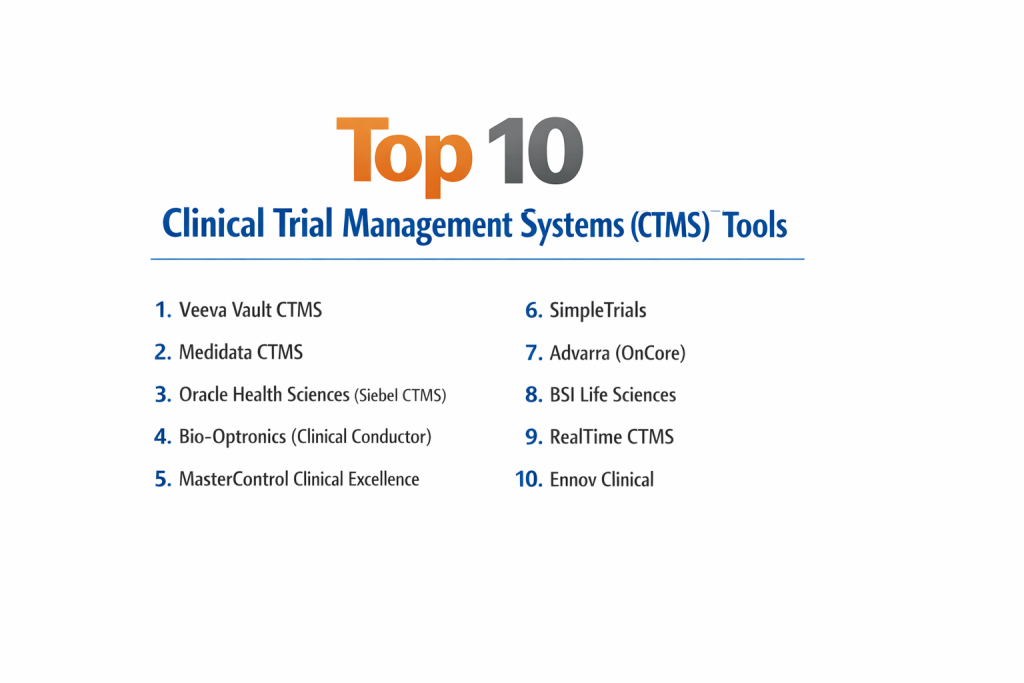
Top 10 Clinical Trial Management Systems (CTMS) Tools
1 — Veeva Vault CTMS
Veeva is currently the most prominent name in the life sciences software world. Their Vault CTMS is a modern, cloud-native platform that is part of a larger “Clinical Suite,” allowing for a totally seamless flow of information.
- Key features:
- Unified platform that connects CTMS, eTMF, and Study Startup.
- Automated trip report generation based on site data.
- Real-time integration with Veeva’s EDC system.
- Advanced “Study Training” tracking for site staff.
- Interactive dashboards for oversight and risk management.
- Highly configurable workflows for different study types.
- Pros:
- Eliminates “data silos” because it lives in the same ecosystem as other clinical tools.
- Very modern, “clean” user interface that feels like modern consumer software.
- Cons:
- Very expensive, often placing it out of reach for smaller startups.
- Requires a significant amount of time and expertise to set up initially.
- Security & compliance: Fully compliant with 21 CFR Part 11, GDPR, HIPAA, and SOC 2 Type 2 certified.
- Support & community: World-class enterprise support, a massive annual user summit, and deep documentation via “Veeva Help.”
2 — Medidata CTMS
Medidata (a Dassault Systèmes company) is a veteran in the clinical space. Their CTMS is known for its incredible data-crunching power and is a staple in high-volume, global pharmaceutical research.
- Key features:
- Deep integration with the Medidata Rave platform.
- Automated site payment systems that reduce financial errors.
- Advanced patient enrollment forecasting using historical data.
- Comprehensive monitoring visit management.
- Issue management tracking with automated escalations.
- Global oversight capabilities for multi-country trials.
- Pros:
- Unrivaled reliability for very large, complex trials involving thousands of patients.
- Excellent financial management tools that satisfy strict accounting audits.
- Cons:
- The interface can feel “dense” and slightly more dated than newer cloud competitors.
- Cost is a major factor; it is a premium-tier solution.
- Security & compliance: Meets all global standards including FISMA, ISO 27001, and HIPAA.
- Support & community: Large-scale global support infrastructure and a well-established professional services team.
3 — Oracle Health Sciences (Siebel CTMS)
Oracle’s Siebel CTMS is perhaps the most established “traditional” system in the industry. It is highly robust and offers deep customization for companies that have very specific, complex processes.
- Key features:
- High-level customization for large-scale enterprise workflows.
- Integration with Oracle’s extensive database and analytics tools.
- Robust site and investigator management modules.
- Detailed tracking of clinical supply and inventory.
- Sophisticated budgeting and contract management.
- Enterprise-wide reporting across hundreds of ongoing trials.
- Pros:
- Extremely powerful for the world’s largest pharmaceutical companies.
- Can be tailored to match almost any legacy business process.
- Cons:
- Known for being difficult to navigate; it often requires a “power user” to run.
- High cost of ownership due to the need for specialized IT maintenance.
- Security & compliance: Industry-standard 21 CFR Part 11 and GDPR compliance.
- Support & community: Massive global corporate support and a wide network of third-party consultants.
4 — Bio-Optronics (Clinical Conductor)
Clinical Conductor is a top-tier choice for both CROs and sites. It is praised for its versatility and its ability to handle both the “business” and “clinical” sides of a trial.
- Key features:
- Robust financial management and billing tools.
- Centralized recruitment and enrollment tracking.
- Multi-site management from a single dashboard.
- Compliance-ready document storage.
- Excellent scheduling tools for patient visits.
- Strong reporting for site performance metrics.
- Pros:
- More flexible than the “big three” (Veeva, Medidata, Oracle) for smaller organizations.
- Highly rated for its customer-centric approach and onboarding.
- Cons:
- Integration with external EDC systems isn’t always as “plug-and-play” as others.
- Reporting can be less visual than some of the newer web-only competitors.
- Security & compliance: HIPAA and Part 11 compliant.
- Support & community: Known for responsive support and active user training sessions.
5 — MasterControl Clinical Excellence
MasterControl is famous for its quality management software, and their clinical suite focuses heavily on “document control” and “audit readiness.”
- Key features:
- Automated management of Trial Master Files (TMF).
- Strong focus on Quality Management (QMS) integration.
- Digital signatures and automated approval workflows.
- Training management for all clinical staff.
- Audit management tools to prepare for inspections.
- Centralized document repository with version control.
- Pros:
- If your primary worry is passing a government audit, this is a top choice.
- Excellent at managing the “paperwork” side of clinical trials.
- Cons:
- Less focus on “site-level” daily activities like patient visit scheduling.
- The interface is built for compliance professionals, not necessarily doctors.
- Security & compliance: Exceptionally strong compliance history; SOC 2 and ISO 900x aligned.
- Support & community: Strong educational resources and a very professional support structure.
6 — SimpleTrials
SimpleTrials is a cloud-based CTMS that lives up to its name. It is designed to be affordable, easy to use, and quick to set up, making it perfect for small to mid-sized teams.
- Key features:
- Subscription-based pricing with no hidden fees.
- Core modules for site management, visits, and documents.
- Integrated eTMF (Trial Master File) capabilities.
- User-friendly dashboards for tracking milestones.
- Support for both Sponsors and CROs.
- Standardized templates for monitoring reports.
- Pros:
- One of the few systems with transparent pricing on their website.
- Can be set up in days rather than months.
- Cons:
- Does not have the “heavy-duty” AI or data forecasting of Medidata.
- Limited customization compared to enterprise tools like Oracle.
- Security & compliance: 21 CFR Part 11 and GDPR compliant.
- Support & community: Good online knowledge base and helpful email/phone support for small teams.
7 — Advarra (OnCore)
Advarra’s OnCore is the leading CTMS for academic medical centers and large health systems. It is built to handle the unique needs of research hospitals that run hundreds of trials across many departments.
- Key features:
- Strong focus on billing and financial compliance in a hospital setting.
- Centralized protocol management.
- Patient registry and recruitment tools.
- Regulatory and IRB (Institutional Review Board) integration.
- Staff effort and workload tracking.
- Reporting for NCI (National Cancer Institute) compliance.
- Pros:
- The “standard” for academic research; if you work in a university, you likely know OnCore.
- Superior at handling the “compliance maze” of hospital-based research.
- Cons:
- Too complex and “hospital-focused” for a small biotech company.
- Requires a dedicated internal team to manage the system.
- Security & compliance: Very high-level security; HIPAA and Part 11 compliant.
- Support & community: Massive community of academic users and strong regional user groups.
8 — BSI Life Sciences
BSI offers a “smart” CTMS that is highly flexible. It is unique because it allows companies to choose between an “out-of-the-box” setup or a highly customized one.
- Key features:
- Integrated CTMS and eTMF on one screen.
- Excellent “Trial Supply” management.
- Clean, modern interface with drag-and-drop features.
- Built-in CRM for managing site relationships.
- Support for “Decentralized” clinical trials (remote monitoring).
- Robust document management with digital signatures.
- Pros:
- The user interface is one of the best in the industry.
- A great “middle ground” between SimpleTrials and Veeva.
- Cons:
- A smaller brand name, which sometimes makes it harder to find “ready-trained” staff.
- European-focused, though they are expanding rapidly in the US.
- Security & compliance: ISO 27001 and GDPR compliant.
- Support & community: Highly personalized customer service and active onboarding.
9 — RealTime CTMS
RealTime is a specialized system that is built “by researchers, for researchers.” It is heavily focused on the efficiency of the clinical site itself.
- Key features:
- Excellent patient recruitment and database tools.
- Text messaging (SMS) integration for patient reminders.
- E-Regulatory document management.
- Study-level accounting and payment tracking.
- Integrated eSource (taking notes directly into a tablet).
- User-friendly calendar for site staff.
- Pros:
- The best choice for a clinical site that wants to be more profitable and organized.
- Very fast and responsive mobile applications.
- Cons:
- Less focused on “Global Sponsor” oversight for Phase 3 trials.
- Not as many integrations with enterprise-level accounting software.
- Security & compliance: HIPAA and Part 11 compliant.
- Support & community: Very active training “Bootcamps” and a friendly support team.
10 — Ennov Clinical
Ennov provides a unified platform that focuses on “End-to-End” clinical development, from the initial research to the final regulatory submission.
- Key features:
- Unified database for CTMS, EDC, and eTMF.
- Strong focus on Regulatory Affairs (RIM).
- Advanced pharmacovigilance (safety) modules.
- Visual reporting with customizable charts.
- Multi-language support for global teams.
- Document versioning and strict access controls.
- Pros:
- Great for companies that want to manage “Safety” and “Clinical” in one tool.
- Excellent price-to-feature ratio.
- Cons:
- The setup can be quite rigid if you don’t follow their specific workflows.
- Customer support is often cited as being more focused on the European market.
- Security & compliance: Fully compliant with EMA (Europe) and FDA (USA) standards.
- Support & community: Good documentation and structured training programs.
Comparison Table
| Tool Name | Best For | Platform(s) Supported | Standout Feature | Rating |
| Veeva Vault | Large Pharma / CROs | Cloud / Web / Mobile | Unified Vault Ecosystem | N/A |
| Medidata CTMS | Global Data Power | Cloud / Web | Advanced Site Payments | N/A |
| Oracle Siebel | Enterprise Customization | Web / On-Premise | High-Level Tailoring | N/A |
| Clinical Conductor | CROs & Sites | Web / Cloud | Business & Clinical Sync | N/A |
| SimpleTrials | Small Biotech Teams | Web-only | Transparent Subscriptions | N/A |
| Advarra OnCore | Research Hospitals | Web / Cloud | Academic Compliance | N/A |
| BSI Life Sciences | Mid-Market Flex | Web / Cloud | Integrated CTMS/eTMF | N/A |
| RealTime CTMS | Clinical Sites | Web / Tablet | SMS Patient Reminders | N/A |
| MasterControl | Compliance/Docs | Web / Cloud | Audit Readiness | N/A |
| Ennov Clinical | Regulated Safety | Web / Cloud | Safety/Reg/Clinical Sync | N/A |
Evaluation & Scoring of Clinical Trial Management Systems
| Criteria | Weight | Score (1-10) | Explanation |
| Core Features | 25% | 9 | Most systems cover the basics of site and patient tracking effectively. |
| Ease of Use | 15% | 7 | Clinical software is notoriously complex; newer tools score higher here. |
| Integrations | 15% | 8 | Ecosystems like Veeva and Medidata lead the way in connectivity. |
| Security | 10% | 10 | Security is non-negotiable and generally excellent across all top tools. |
| Performance | 10% | 9 | Cloud-based reliability is now the industry standard. |
| Support | 10% | 8 | Enterprise support is usually good, but can be slow for smaller users. |
| Price / Value | 15% | 6 | These tools are expensive, though SimpleTrials is changing the value game. |
Which Clinical Trial Management System Tool Is Right for You?
Solo Users vs SMB vs Mid-Market vs Enterprise
If you are a solo consultant or a tiny startup, you should avoid the “Big Three” (Oracle, Medidata, Veeva). They are too expensive and complex. Look at SimpleTrials or RealTime. Mid-market CROs will find the best balance in BSI or Clinical Conductor. Enterprises with multiple global trials almost always end up with Veeva or Medidata because of the massive data oversight those systems provide.
Budget-conscious vs Premium Solutions
Budget-conscious teams should prioritize SimpleTrials. It is the only one that lets you start small and pay as you go. If budget is not an issue and your goal is to have the absolute best-in-class integration with an eTMF and EDC, the premium investment in Veeva Vault is usually worth it in the long run.
Feature Depth vs Ease of Use
If you have a dedicated “Systems Administrator” on your team, you can handle the feature depth of Oracle Siebel. If your Clinical Research Associates (CRAs) are doing all the work themselves, you must pick something with high ease of use like Alma or BSI. A complex system that nobody knows how to use is a wasted investment.
Integration and Scalability Needs
Plan for the future. You may only have one trial now, but if it succeeds, you will have ten. Pick a system that can scale. Veeva and Medidata are the kings of scalability. Also, ensure the CTMS can talk to your “EDC” (where the medical data goes). If they don’t talk to each other, you will spend your life doing manual data entry.
Security and Compliance Requirements
All tools on this list meet the basic requirements of the FDA and EMA. However, if you are working in a specific niche—like cancer research at a university—the hospital-specific compliance of Advarra OnCore is a safer bet. If your main concern is passing a QA audit, MasterControl is the specialist.
Frequently Asked Questions (FAQs)
What is the difference between CTMS and EDC?
A CTMS manages the process of the trial (budgets, site visits, enrollment numbers). An EDC (Electronic Data Capture) stores the medical data of the patients (heart rate, blood test results). You need both.
How much does a CTMS cost?
It varies widely. Simple systems can cost $1,000 per month, while enterprise systems for large pharma companies can cost hundreds of thousands of dollars per year plus setup fees.
Is it hard to move from spreadsheets to a CTMS?
The biggest challenge is “data cleaning.” You have to make sure your old spreadsheets are accurate before you upload them into the new system. Most vendors offer “migration services” to help.
Can a CTMS help with patient recruitment?
Yes. Tools like RealTime and Clinical Conductor have databases where you can track potential participants and even send them text message reminders to keep them in the study.
Do these systems work on tablets?
Most modern cloud systems (Veeva, BSI, RealTime) work very well on tablets, which is essential for monitors who are traveling to different doctor’s offices.
What is 21 CFR Part 11?
This is a US law that says digital signatures and electronic records must be as reliable and trustworthy as paper records. Any CTMS you buy must be compliant with this.
How long does implementation take?
A simple tool can be ready in 2-4 weeks. An enterprise system like Oracle or Veeva often takes 4-9 months to fully configure for a large company.
Can a CTMS handle international trials?
Yes. The top-tier systems support multiple currencies for payments and multiple languages for site staff, which is critical for global Phase 3 trials.
What happens if the vendor goes out of business?
This is why “Data Portability” is important. Always ensure your contract states that you own the data and can export it into a standard format (like CSV or XML) at any time.
Do I need a CTMS for a Phase 1 study?
It’s not mandatory, but it’s a good habit. Starting with a simple CTMS like SimpleTrials during Phase 1 makes it much easier to scale up when you reach Phase 2 and 3.
Conclusion
Choosing a Clinical Trial Management System is a decision that affects every person in your research chain, from the CFO who signs the checks to the monitor who visits the clinic. There is no “perfect” system for everyone; the best tool is the one that fits your current size while allowing room for your future growth.
When evaluating these tools, look beyond the sales presentation. Focus on integration—because a system that doesn’t talk to your other tools will create more work than it saves. Also, prioritize compliance and security; in this industry, a data breach or a failed audit isn’t just a business problem—it can stop a life-saving drug from reaching the people who need it. By taking the time to match your specific study needs with the right platform, you can ensure that your research is faster, safer, and more successful.