Introduction
A Clinical Data Management System (CDMS) is a specialized software solution used in pharmaceutical research and medical device development to manage the vast quantities of data generated during clinical trials. At its core, a CDMS provides a structured environment for the collection, cleaning, and preparation of patient data for statistical analysis and regulatory submission. By replacing paper-based records with Electronic Data Capture (EDC) and automated validation checks, these systems ensure that clinical trial results are accurate, complete, and verifiable. In a highly regulated industry, a CDMS acts as the single source of truth, maintaining the integrity of data from the moment a patient visits a site to the final filing with health authorities.
The importance of a CDMS lies in its ability to reduce the time-to-market for life-saving therapies while maintaining strict adherence to safety standards. Key real-world use cases include managing global Phase III trials with thousands of participants, tracking adverse events in real-time, and integrating data from wearable sensors or electronic patient-reported outcomes (ePRO). When choosing a tool, users should evaluate Case Report Form (CRF) design flexibility, automated query management, CDISC standards support, and real-time data visibility.
Best for: Clinical Research Organizations (CROs), pharmaceutical companies, biotechnology firms, and medical device manufacturers. It is essential for clinical data managers, biostatisticians, and regulatory affairs professionals who must comply with GxP standards.
Not ideal for: General healthcare providers managing routine patient care (who need an EHR/EMR) or academic researchers conducting small-scale surveys without the intent of regulatory submission. For very basic observational studies, simpler data collection tools may be more cost-effective.
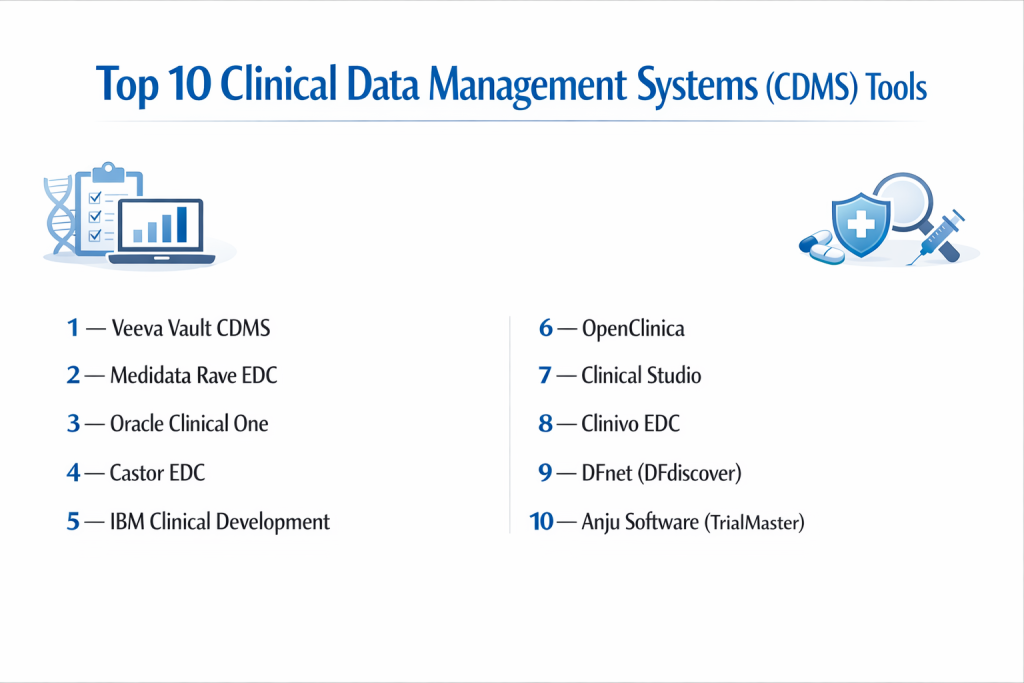
Top 10 Clinical Data Management Systems (CDMS) Tools
1 — Veeva Vault CDMS
Veeva Vault CDMS is a modern, cloud-native solution designed to simplify clinical data management for complex, global trials. It is part of the broader Veeva Development Cloud, allowing for seamless integration across the entire clinical lifecycle.
- Key features:
- Veeva Vault EDC: A high-performance interface for rapid data entry and site monitoring.
- Agile Design: Allows for mid-study changes without significant downtime or system migrations.
- Modern Architecture: Built on a multi-tenant cloud that handles massive data volumes effortlessly.
- Integrated Coder: Automated medical coding using MedDRA and WHODrug dictionaries.
- Reporting & Dashboards: Real-time visibility into study status and data trends.
- Pros:
- Exceptional speed for study build and deployment.
- User-friendly interface that reduces training time for site investigators.
- Cons:
- Premium pricing model often targets mid-to-enterprise organizations.
- Initial configuration requires a deep understanding of the Veeva ecosystem.
- Security & compliance: SOC 2 Type II, ISO 27001, HIPAA, GDPR, and full 21 CFR Part 11 compliance.
- Support & community: Extensive online training via Veeva Learn, 24/7 global support, and a very active user community through annual summits.
2 — Medidata Rave EDC
Medidata Rave is widely considered the industry standard for clinical trials. It is a robust, highly scalable platform that has been used in thousands of successful regulatory submissions.
- Key features:
- Unified Platform: Integrated eCOA, eConsent, and Randomization (RTSM) capabilities.
- Cloud Administration: Centralized management of users, sites, and studies.
- Intelligent Query Management: Automated rules that trigger queries during data entry.
- Global Library: Reuse validated CRF templates and edit checks across multiple studies.
- Medidata Detect: Real-time data surveillance to identify risks and anomalies early.
- Pros:
- Unmatched reliability and industry acceptance by regulatory bodies like the FDA.
- Deep integration with advanced analytics and AI-driven data insights.
- Cons:
- Complexity in study building can lead to longer setup times.
- The legacy user interface can feel dated compared to newer competitors.
- Security & compliance: ISO 27001, SOC 2, HIPAA, GDPR, and 21 CFR Part 11.
- Support & community: High-tier enterprise support and a massive global network of certified partners.
3 — Oracle Clinical One
Oracle Clinical One represents the next generation of CDMS, moving away from fragmented systems toward a unified platform that manages all aspects of a clinical trial.
- Key features:
- Unified Data Collection: One system for EDC, RTSM, and data from third-party sources.
- Single Source of Truth: Eliminates data redundancy by using a single platform for all clinical operations.
- Rapid Study Build: Drag-and-drop tools to create CRFs and edit checks in weeks rather than months.
- Real-time Insights: Integrated analytics provide immediate feedback on site performance.
- Scalable Architecture: Designed to handle everything from Phase I to massive Phase IV studies.
- Pros:
- Significantly reduces the need for complex integrations between different vendors.
- Excellent data consistency across the entire trial ecosystem.
- Cons:
- Steep learning curve for teams transitioning from older Oracle products.
- Requires a significant organizational commitment to the Oracle infrastructure.
- Security & compliance: FedRAMP, HIPAA, GDPR, SOC 1/2/3, and 21 CFR Part 11.
- Support & community: Extensive global reach with Oracle Support and a well-established user group (OHUG).
4 — Castor EDC
Castor is a modern, user-friendly EDC and CDMS platform that has gained popularity for its focus on decentralizing clinical trials and empowering researchers.
- Key features:
- DIY Study Build: Intuitive interface allows researchers to build their own studies without coding.
- Castor Connect: A mobile-friendly patient app for ePRO and eCOA.
- EHR Integration: Seamlessly pull data from Electronic Health Records via HL7 FHIR.
- Open API: High interoperability with other research tools and hardware.
- Automated Validations: Real-time data quality checks during entry.
- Pros:
- Very fast implementation; ideal for biotech startups and academic researchers.
- Modern, clean UI that improves the investigator experience.
- Cons:
- May lack some of the “deep” legacy features required for massive, complex global trials.
- Reporting tools are powerful but less customizable than enterprise giants.
- Security & compliance: ISO 27001, ISO 9001, GDPR, HIPAA, and 21 CFR Part 11.
- Support & community: Responsive customer success team and a growing library of self-service documentation.
5 — IBM Clinical Development
IBM Clinical Development is an all-in-one cloud platform that helps streamline the clinical trial process from startup through submission.
- Key features:
- Module-based Design: Choose only the features you need (EDC, IWRS, Medical Coding).
- Visual Data Mapping: Simple tools to map data to CDISC SDTM standards.
- Endpoint Management: Centralized tracking of clinical endpoints and adjudications.
- Automated Queries: Sophisticated logic to handle data discrepancies without manual intervention.
- Patient Engagement: Tools for capturing data directly from patients in the field.
- Pros:
- High flexibility for various study types and budget constraints.
- Backed by IBM’s robust security and data processing infrastructure.
- Cons:
- Pricing can be complex based on which modules are selected.
- Less frequent UI updates compared to some of the newer cloud-native competitors.
- Security & compliance: HIPAA, GDPR, ISO 27001, and 21 CFR Part 11.
- Support & community: Dedicated technical support and comprehensive onboarding services.
6 — OpenClinica
OpenClinica is a highly adaptable platform known for its open-source heritage and commitment to making clinical research more efficient and productive.
- Key features:
- Insight Analytics: Powerful visualization tools for monitoring data quality and site metrics.
- OpenClinica Participate: A seamless ePRO module that allows patients to enter data on any device.
- Case Report Form (CRF) Designer: Based on the ODK standard for high flexibility in form design.
- REST API: Easy integration with external systems and custom laboratory hardware.
- Automated Scheduling: Tracks patient visits and triggers alerts for data entry.
- Pros:
- Excellent balance of professional features and ease of use.
- Strong focus on data standards and interoperability.
- Cons:
- Customization requires some technical familiarity with the platform’s logic.
- Public community version lacks the advanced features of the enterprise edition.
- Security & compliance: SOC 2 Type II, GDPR, HIPAA, and 21 CFR Part 11.
- Support & community: Active community forums and professional support tiers for enterprise clients.
7 — Clinical Studio
Clinical Studio is a cloud-based EDC and CDMS platform that prioritizes mobile functionality and ease of use for small to mid-market CROs.
- Key features:
- Native Mobile App: Allows sites to enter data and manage queries on tablets and smartphones.
- Study Architect: A visual tool for building complex study designs without programming.
- Inventory Tracking: Built-in module for managing trial supplies and kits.
- Direct-to-Patient: Capture ePRO and eConsent directly within the mobile ecosystem.
- Medical Coding: Native support for MedDRA and WHODrug.
- Pros:
- One of the most mobile-friendly systems on the market.
- Affordable pricing for smaller organizations and specialized research firms.
- Cons:
- May not scale as easily as others for massive, multi-thousand site trials.
- Smaller user base compared to industry giants like Medidata.
- Security & compliance: HIPAA, GDPR, and 21 CFR Part 11 compliant.
- Support & community: Personalized support and comprehensive video training libraries.
8 — Clinivo EDC
Clinivo provides a streamlined, web-based CDMS designed specifically to accelerate the data management process for smaller biotechs and CROs.
- Key features:
- Rapid Deployment: Pre-validated modules allow for extremely fast study startups.
- Advanced Logic: Support for complex branch logic and multi-part CRFs.
- Real-time Monitoring: Remote monitoring tools for CRAs to verify data quickly.
- Query Management: Easy-to-use interface for resolving data discrepancies.
- Export Tools: Native exports to SAS, Excel, and PDF formats.
- Pros:
- Highly cost-effective for mid-market and smaller companies.
- Very intuitive; requires minimal training for new users.
- Cons:
- Limited ecosystem of native third-party integrations.
- Lacks some of the AI-driven predictive analytics found in enterprise platforms.
- Security & compliance: 21 CFR Part 11, HIPAA, and GDPR.
- Support & community: Direct access to technical experts and a simplified onboarding process.
9 — DFnet (DFdiscover)
DFdiscover by DFnet is a long-standing CDMS that offers unique flexibility by supporting both paper-based and electronic data capture in a single system.
- Key features:
- Hybrid Capture: Handles digital data entry, paper scanning, and mobile entry seamlessly.
- Offline Capability: Mobile data entry that syncs once an internet connection is found.
- Imaging Integration: Native support for including clinical images within the patient record.
- Data Validation: Powerful server-side logic to ensure data accuracy.
- Multi-language Support: Ideal for global trials requiring local language interfaces.
- Pros:
- Excellent for studies in remote areas with limited internet connectivity.
- Unique flexibility for trials that still require a paper backup or component.
- Cons:
- The user interface is more traditional and less “modern” than SaaS-only tools.
- Requires more technical setup for the hybrid scanning workflows.
- Security & compliance: 21 CFR Part 11, HIPAA, and GDPR compliant.
- Support & community: High-touch support from a team with deep clinical research experience.
10 — Anju Software (TrialMaster)
TrialMaster is a robust, enterprise-grade EDC and CDMS platform that excels in managing the complex data needs of large-scale Phase I-IV trials.
- Key features:
- TrialMaster EDC: Intuitive web-based capture with high-speed performance.
- Global Library: Accelerate study build by utilizing a repository of standard forms.
- eSource Integration: Directly pull data from lab systems and devices.
- Advanced Reporting: High-level dashboards for executive oversight.
- Medical Coding: Fully integrated MedDRA and WHODrug workflows.
- Pros:
- Strong track record of success in large, multi-center international trials.
- Very powerful customization options for unique study designs.
- Cons:
- Can be complex for small teams without a dedicated data management department.
- Implementation costs can be high for shorter, simpler studies.
- Security & compliance: SOC 1/2, ISO 27001, HIPAA, GDPR, and 21 CFR Part 11.
- Support & community: Enterprise-level support with a focus on long-term partnership.
Comparison Table
| Tool Name | Best For | Platform(s) Supported | Standout Feature | Rating (Gartner/TrueReview) |
| Veeva Vault CDMS | Global Enterprise | Cloud / Web | Agile mid-study changes | 4.7/5 |
| Medidata Rave EDC | High-Stakes Pharma | Cloud / Web | Industry-leading data surveillance | 4.8/5 |
| Oracle Clinical One | Unified Operations | Cloud / Web | Unified EDC & RTSM platform | 4.5/5 |
| Castor EDC | Decentralized Trials | Cloud / Web / Mobile | Direct EHR integration | 4.7/5 |
| IBM Clinical Dev. | Flexible Mid-Market | Cloud / Web | Module-based pricing/design | 4.3/5 |
| OpenClinica | Open-Science Teams | Cloud / Hybrid | ODK-based form flexibility | 4.6/5 |
| Clinical Studio | Mobile-First Sites | Cloud / Mobile | Native Tablet/Phone Data Entry | N/A |
| Clinivo EDC | Rapid Biotech Startups | Web-based | Speed of study deployment | N/A |
| DFnet (DFdiscover) | Remote/Hybrid Trials | Web / Mobile / Scan | Offline & Paper-Hybrid support | N/A |
| Anju TrialMaster | Complex Phase I-IV | Cloud / Web | Advanced enterprise scalability | 4.4/5 |
Evaluation & Scoring of Clinical Data Management Systems (CDMS)
Choosing the right CDMS involves weighing various factors that impact both the budget and the success of the trial.
| Category | Weight | Evaluation Criteria |
| Core Features | 25% | Presence of EDC, medical coding, query management, and reporting tools. |
| Ease of Use | 15% | Intuitiveness for site investigators and speed of study building for managers. |
| Integrations | 15% | Ability to connect with ePRO, eCOA, RTSM, labs, and wearables. |
| Security & Compliance | 10% | Adherence to 21 CFR Part 11, GDPR, HIPAA, and data encryption standards. |
| Performance | 10% | Uptime, system speed during high-volume data entry, and global availability. |
| Support & Community | 10% | Quality of technical documentation, training, and customer service response. |
| Price / Value | 15% | Total cost of ownership relative to the features provided and study size. |
Which Clinical Data Management Systems (CDMS) Tool Is Right for You?
Solo Users vs. SMB vs. Mid-Market vs. Enterprise
Solo researchers or academic PIs are often best served by Castor or the community edition of OpenClinica, as these provide high power without the enterprise price tag. SMBs and Biotech startups typically thrive with Clinivo or Clinical Studio, where rapid deployment is prioritized. Enterprise organizations and global pharmaceutical companies almost exclusively rely on Veeva, Medidata, or Oracle, as these platforms provide the global infrastructure and regulatory “weight” required for multi-site Phase III trials.
Budget-conscious vs. Premium Solutions
If budget is the primary driver, Castor and OpenClinica offer transparent, tiered pricing that scales with your study. However, for high-stakes trials where data loss or regulatory rejection would be catastrophic, Premium solutions like Medidata Rave or Veeva Vault are considered a worthwile investment. They offer advanced “risk-based monitoring” and “automated surveillance” features that can prevent million-dollar errors.
Feature Depth vs. Ease of Use
If you need Feature Depth—such as AI-driven anomaly detection or complex cross-study metadata management—Medidata and Oracle are the leaders. However, if your sites are less tech-savvy and you need high Ease of Use to ensure data entry compliance, Veeva and Castor have invested heavily in modern UX design that feels as familiar as a consumer application.
Integration and Scalability Needs
In the modern landscape, a CDMS must be able to “talk” to other systems. If you plan on using extensive wearable data or IoT sensors, look for a tool with a robust Open API like Castor or OpenClinica. For Scalability, ensure the vendor has a proven track record of handling “Data Volatility”—the ability to scale up for thousands of sites and scale down once the study moves into the analysis phase.
Security and Compliance Requirements
Every tool on this list meets the basic 21 CFR Part 11 requirements. However, if you are conducting trials in the European Union, your focus must be on GDPR-native features like “Data Residency” (where the data is physically stored). If you are working on US government-funded projects, look for FedRAMP authorization, which is a standout feature for Oracle.
Frequently Asked Questions (FAQs)
1. What is the difference between EDC and CDMS?
Electronic Data Capture (EDC) is the front-end tool used to enter trial data. A Clinical Data Management System (CDMS) is the broader system that includes EDC plus tools for data cleaning, medical coding, and reporting. Today, the terms are often used interchangeably.
2. Is a cloud-based CDMS safe for patient data?
Yes. Modern cloud-based systems use high-level encryption (AES-256), multi-factor authentication, and strict audit logs to ensure that patient data is more secure than it ever was in paper-based or local server environments.
3. How long does it take to build a study in a CDMS?
Depending on the complexity, a study build can take anywhere from 2 weeks in a DIY system like Castor to 12 weeks in a complex enterprise system like Medidata.
4. What are CDISC standards?
CDISC (Clinical Data Interchange Standards Consortium) provides the global framework for how clinical data should be structured (SDTM) and analyzed (ADaM) so that it is readable by regulatory agencies like the FDA.
5. Can I use these systems for decentralized clinical trials (DCTs)?
Yes. Many modern CDMS platforms (like Veeva, Castor, and OpenClinica) have specific modules for ePRO, eConsent, and telehealth integrations to support patients at home.
6. Do I need a programmer to set up a CDMS?
In many modern “No-Code” systems like Clinical Studio or Castor, a data manager can build the study. However, for complex logic and integrations in enterprise systems, a clinical programmer is usually required.
7. How much does a CDMS cost?
Pricing varies widely. Smaller studies might cost $10,000–$25,000 per year, while large, global trials can cost hundreds of thousands of dollars in licensing and setup fees.
8. What is an audit trail in clinical data?
An audit trail is a permanent, unalterable log that records who entered data, what they changed, and when they did it. This is a mandatory requirement for 21 CFR Part 11 compliance.
9. Can these systems handle medical imaging (X-rays, MRIs)?
Most EDC systems can handle small attachments, but for heavy medical imaging, you need a system with specialized imaging integration like DFnet or Anju TrialMaster.
10. What is medical coding in a CDMS?
Medical coding is the process of translating verbatim terms (like “headache”) into standardized medical terms using dictionaries like MedDRA to ensure consistent analysis across different sites.
Conclusion
The selection of a Clinical Data Management System is one of the most consequential decisions a research team will make. While the industry giants like Medidata and Veeva offer unparalleled security and enterprise features, the rise of “Agile” platforms like Castor and OpenClinica has made high-tier data management accessible to smaller biotechs and CROs.
Ultimately, the “best” CDMS is the one that aligns with your trial’s specific complexity, your sites’ technical capabilities, and your regulatory goals. By prioritizing data integrity, ease of use, and compliance, you ensure that your clinical trial results are not just data points, but a reliable foundation for the future of medicine.