Introduction
Chargeback Management Tools are specialized software platforms designed to help merchants prevent, detect, and resolve payment disputes initiated by cardholders. When a customer contacts their bank to reverse a transaction—whether due to fraud, a shipping error, or “friendly fraud” (where a legitimate purchase is falsely disputed)—the merchant is hit with a chargeback. These tools act as a defensive layer, automating the complex process of gathering evidence, filing representments, and monitoring dispute ratios. By integrating directly with payment gateways and card networks like Visa and Mastercard, they provide real-time alerts that allow businesses to refund a customer before a dispute becomes a formal chargeback, thereby protecting the merchant’s standing with their acquiring bank.
The importance of these tools has grown exponentially alongside the rise of e-commerce. Beyond the lost revenue of the sale and the physical cost of the goods, merchants face hefty administrative fees for every dispute. If a business’s chargeback ratio exceeds certain thresholds (typically 1%), they risk being placed in high-risk monitoring programs or losing their ability to process credit cards entirely. Chargeback management tools mitigate this risk by using machine learning to identify high-risk transactions before they happen and by providing a streamlined workflow to win back revenue that would otherwise be lost to illegitimate claims.
Key Real-World Use Cases
Chargeback management platforms are essential for various operational scenarios:
- Friendly Fraud Mitigation: Identifying cases where a customer claims they didn’t receive an item that was successfully delivered, using automated tracking data to win the dispute.
- Early Warning Alerts: Receiving notifications from networks like Ethoca or Verifi that a dispute is imminent, allowing the merchant to issue a refund and avoid a chargeback fee.
- Automated Evidence Gathering: Systematically pulling order history, IP addresses, and shipping confirmations into a formatted “rebuttal letter” for the bank.
- Risk Threshold Monitoring: Tracking real-time dispute ratios across different merchant accounts to ensure the business stays within card network compliance limits.
- True Fraud Prevention: Using historical dispute data to block specific users or device fingerprints from making future purchases.
What to Look For (Evaluation Criteria)
When choosing a chargeback management tool, organizations should consider the following:
- Alert Network Coverage: Does the tool have direct partnerships with both Ethoca (Mastercard) and Verifi (Visa)? Comprehensive coverage is vital for maximum prevention.
- Automation vs. Managed Services: Do you want a “do-it-yourself” software or a “managed service” where experts handle the disputes for you?
- Win Rate Performance: Does the vendor provide transparent data on their success rate in winning representments for your specific industry?
- Integration Depth: Can the tool pull data directly from your CRM (like Shopify or Salesforce) and your payment processor (like Stripe or Adyen)?
Best for:
- E-commerce Retailers: High-volume sellers who face frequent shipping disputes or “item not as described” claims.
- SaaS Companies: Businesses with recurring billing models that often face “unauthorized transaction” disputes from forgotten subscriptions.
- Digital Goods Providers: Platforms selling software or gaming credits where traditional shipping evidence doesn’t exist.
- Risk & Finance Managers: Professionals tasked with maintaining merchant account health and recovering lost revenue.
Not ideal for:
- Brick-and-Mortar Businesses: Physical shops with “card-present” transactions, which have significantly lower dispute rates.
- Low-Volume Startups: Very small businesses where the monthly software subscription might exceed the cost of the few chargebacks they receive.
- B2B Service Providers: Firms that rely on contracts and wire transfers rather than credit card payments for large invoices.
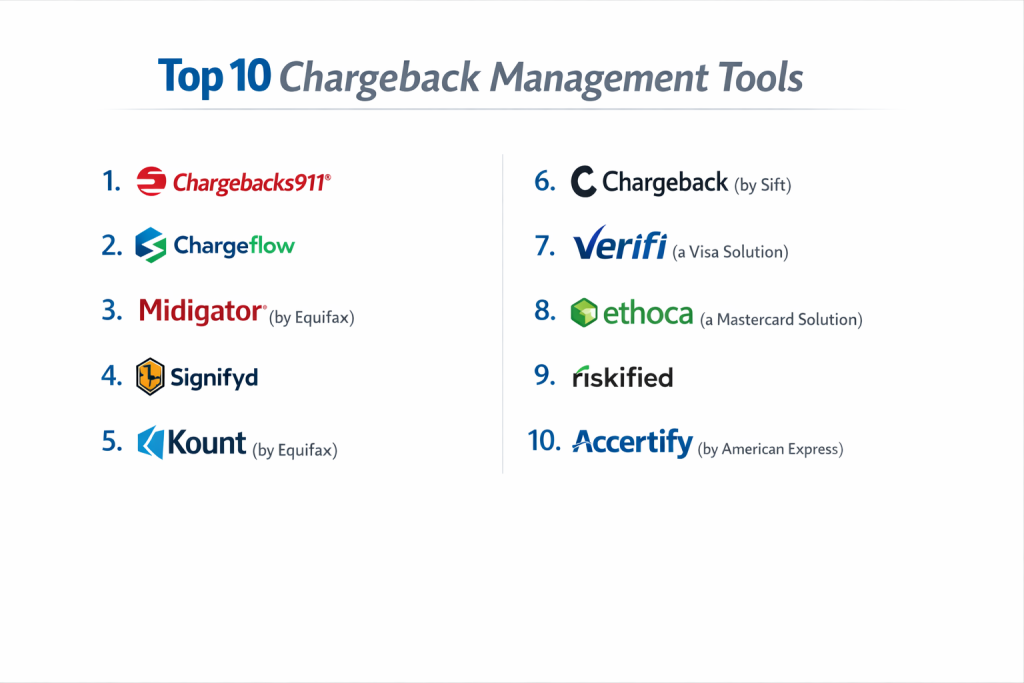
Top 10 Chargeback Management Tools
1 — Chargebacks911
Chargebacks911 is a global leader in the space, offering a comprehensive end-to-end platform that combines automated technology with human expertise. It is designed for large enterprises and high-risk merchants who need a robust, scalable defense.
Key features:
- Intelligent Source Detection: Uses proprietary algorithms to determine if a chargeback is true fraud, friendly fraud, or merchant error.
- LQD (Loss Qualified Data): Deep analytics that identify specific pain points in the merchant’s fulfillment process.
- Tactical Representment: Automated filing of dispute responses tailored to specific bank requirements.
- Affiliate Fraud Shield: Specialized monitoring for businesses that use third-party marketers.
- Real-Time Alerts: Integration with major card brand alert networks to prevent disputes.
Pros:
- Highly effective at recovering revenue through a combination of tech and manual review.
- One of the largest global databases of dispute data to help with predictive modeling.
Cons:
- The interface can be complex and may require a dedicated team member to manage.
- Pricing is generally higher than “software-only” competitors.
Security & compliance: PCI DSS Level 1, GDPR compliant, and uses advanced encryption for sensitive transaction data.
Support & community: High-end enterprise support, dedicated account managers, and an extensive library of white papers and webinars.
2 — Chargeflow
Chargeflow is a “fully automated” chargeback recovery platform that prides itself on a “set-it-and-forget-it” experience, making it a favorite for Shopify and e-commerce entrepreneurs.
Key features:
- ChargeScore: An AI-driven score that predicts the likelihood of winning a dispute before you even file.
- Automated Evidence Mining: Automatically pulls tracking, customer history, and delivery signatures from your tech stack.
- Success-Based Pricing: You only pay a percentage of the revenue they successfully recover.
- One-Click Integration: Seamless “native” apps for platforms like Shopify, BigCommerce, and WooCommerce.
- Chargeflow Insights: Real-time dashboard showing ROI and dispute health.
Pros:
- Zero upfront cost; you only pay when you win, making it very low risk.
- Extremely easy to set up for standard e-commerce platforms.
Cons:
- Less control over the specific evidence submitted compared to manual tools.
- Primarily focused on e-commerce; may not fit complex B2B or specialized service models.
Security & compliance: SOC 2 Type II compliant, GDPR, and uses enterprise-grade encryption.
Support & community: Excellent digital documentation and responsive chat-based support.
3 — Midigator (by Equifax)
Midigator is a data-driven platform that focuses on “dispute orchestration.” Now owned by Equifax, it leverages massive datasets to provide predictive insights and automated resolution.
Key features:
- Automated Prevention Alerts: Real-time notifications to refund customers before a chargeback occurs.
- MDR (Merchant Dispute Recovery): Automated representment engine that builds custom evidence packages.
- Multi-Account Management: Centralized dashboard for merchants running dozens of different merchant IDs (MIDs).
- Root-Cause Analysis: Identifies if specific products or regions are driving disproportionate disputes.
- Visa/Mastercard Direct Integration: High-speed data exchange with major card networks.
Pros:
- Exceptional reporting for multi-entity businesses.
- The backing of Equifax provides superior data security and reliability.
Cons:
- Can be “over-engineered” for small businesses with only one store.
- The transition to the Equifax ecosystem has made onboarding slightly more bureaucratic.
Security & compliance: SOC 2, PCI DSS Level 1, and rigorous Equifax-standard security protocols.
Support & community: Enterprise-grade support with dedicated implementation specialists.
4 — Signifyd
While primarily known for fraud prevention, Signifyd offers a “Commerce Protection” platform that includes a unique “100% Financial Guarantee” against fraudulent chargebacks.
Key features:
- Guaranteed Fraud Protection: They shift the liability from the merchant to themselves for approved orders.
- Abuse Manager: Identifies “friendly fraud” and policy abuse (like return fraud).
- Agent Console: A workspace for manual review teams to inspect high-value or high-risk orders.
- Decision Optimization: AI that approves more orders by accurately identifying legitimate customers.
- Chargeback Recovery: Automated handling of non-fraud disputes (like shipping claims).
Pros:
- Eliminates the financial risk of fraud chargebacks entirely through their guarantee model.
- Improves conversion rates by reducing “false declines.”
Cons:
- Only covers fraud-related chargebacks in the guarantee; you still manage “service” disputes.
- Success depends on the AI’s ability to approve orders; overly conservative settings can limit sales.
Security & compliance: PCI DSS Level 1, GDPR, and ISO 27001 compliant.
Support & community: Large user community and 24/7 global support availability.
5 — Kount (by Equifax)
Kount is an enterprise-grade AI platform that specializes in “Identity Trust.” It provides a comprehensive suite for preventing disputes before they happen through deep identity verification.
Key features:
- Identity Trust Global Network: Analyzes billions of signals from millions of devices to stop bad actors.
- Kount Control: Specifically targets Account Takeover (ATO) fraud, a major source of disputes.
- Near Real-Time Alerts: Prevents the escalation of disputes through the major card brand networks.
- Custom Policy Engine: Allows merchants to set specific rules for different markets or product lines.
- Case Management: Tools for human analysts to deep-dive into suspicious transaction patterns.
Pros:
- One of the most sophisticated “identity” engines in the industry.
- Excellent at stopping chargebacks at the source (the point of transaction).
Cons:
- Requires a fairly high level of technical expertise to configure the policy engine.
- More focused on prevention than the “recovery” of existing disputes.
Security & compliance: SOC 2 Type II, PCI DSS, and GDPR compliant.
Support & community: Extensive developer documentation and a dedicated “Kount University” for training.
6 — Chargeback (by Sift)
Chargeback (now part of the Sift ecosystem) offers a “Dispute Management” module that integrates with Sift’s Digital Trust & Safety Suite.
Key features:
- Dispute Response Automation: Generates data-backed responses based on the specific reason code.
- Sift Score Integration: Uses Sift’s machine learning scores to assess the validity of a dispute.
- Order Insight Integration: Provides real-time order details to the bank while the customer is on the phone.
- Global Dispute Coverage: Supports all major payment methods and reason codes.
- Workflow Automation: Replaces manual spreadsheet tracking with an automated queue.
Pros:
- Part of the broader Sift ecosystem, which is excellent for full-lifecycle fraud prevention.
- The “Order Insight” feature is highly effective at stopping disputes before they are filed.
Cons:
- Best used as part of the full Sift suite, which can be an expensive commitment.
- Can have a steeper learning curve for users unfamiliar with Sift’s interface.
Security & compliance: SOC 2 Type II, GDPR, and HIPAA compliant.
Support & community: Active community of fraud analysts and 24/7 technical support.
7 — Verifi (a Visa Solution)
Verifi is an industry-standard platform, now owned by Visa, that focuses on “post-transaction” dispute management through direct collaboration between issuers and merchants.
Key features:
- RDR (Rapid Dispute Resolution): An automated rules engine that resolves disputes based on merchant-set criteria.
- Order Insight: Sends merchant data (like digital receipts) to the cardholder’s banking app.
- CDRN (Cardholder Dispute Resolution Network): The legacy “gold standard” for dispute alerts.
- Unified API: Access all of Visa’s dispute management tools through a single connection.
- Pre-Arb Prevention: Stops disputes from moving into the costly “arbitration” phase.
Pros:
- Direct ownership by Visa ensures the most “official” and fastest routing for dispute data.
- The RDR feature is a game-changer for businesses wanting to automate refunds to save their MIDs.
Cons:
- Naturally very Visa-centric, though it does support other brands through various integrations.
- The interface is more “corporate” and less “user-friendly” than modern startups like Chargeflow.
Security & compliance: Bank-grade security, PCI DSS Level 1, and GDPR compliant.
Support & community: Massive global infrastructure and extensive institutional support.
8 — Ethoca (a Mastercard Solution)
Ethoca is the Mastercard counterpart to Verifi, providing a global network that allows merchants and issuers to share data in real-time to stop fraud and disputes.
Key features:
- Ethoca Alerts: The primary tool for receiving real-time dispute notifications for Mastercard transactions.
- Ethoca Eliminator: Provides issuers with real-time merchant data to clarify confusing transactions for customers.
- Consumer Clarity: Enhances digital banking apps with logos and detailed merchant info to reduce “I don’t recognize this” calls.
- Collaboration Network: Direct communication channel between 5,000+ issuers and thousands of merchants.
- Integrated Gateway Support: Available natively through many major gateways like Adyen and Cybersource.
Pros:
- The definitive network for Mastercard-related dispute prevention.
- Excellent at reducing “transaction confusion” disputes.
Cons:
- Most effective for preventing disputes rather than fighting and winning representments.
- Requires integration with an alert management tool to be fully utilized by smaller merchants.
Security & compliance: Mastercard-grade security, ISO 27001, and GDPR compliant.
Support & community: Huge global footprint with comprehensive enterprise documentation.
9 — Riskified
Riskified is an AI-powered platform that focuses on “frictionless” commerce and provides a “Chargeback Guarantee” for all orders it approves.
Key features:
- Chargeback Guarantee: Full reimbursement for any fraud-related chargebacks on orders they approve.
- Decisions API: Real-time “approve/decline” decisions for every order.
- Policy Protect: Stops shoppers from abusing promotions or returns.
- Account Guard: Prevents account takeover by monitoring login and behavioral patterns.
- Global Proxy Detection: Identifies sophisticated fraud techniques like “spoofing.”
Pros:
- Shifts the financial burden of fraud entirely away from the merchant.
- Optimized for high-growth e-commerce brands that want to maximize approval rates.
Cons:
- Like Signifyd, it only guarantees “fraud” disputes, not service-related ones.
- Can be more expensive than traditional software if your fraud rates are naturally low.
Security & compliance: SOC 2 Type II, PCI DSS Level 1, and GDPR compliant.
Support & community: High-touch account management and deep data-science support.
10 — Accertify (by American Express)
Accertify is an American Express company that provides a powerful, multi-layered defense against fraud and chargebacks for some of the world’s largest travel and retail brands.
Key features:
- Chargeback Management Suite: A full-service tool for tracking, responding to, and analyzing disputes.
- Device Intelligence: Tracks the reputation of specific devices across a global network.
- Machine Learning Models: Custom-built models tailored to the merchant’s specific industry risk.
- Strategic Consulting: Access to Accertify’s team of fraud and dispute experts.
- Unified Dashboard: Manages fraud, disputes, and compliance in one place.
Pros:
- Incredible depth of data, especially for travel, airlines, and large-scale retail.
- One of the most mature and “battle-tested” platforms in existence.
Cons:
- Implementation is a significant undertaking that requires internal technical resources.
- Not suited for small-to-mid-market businesses due to price and complexity.
Security & compliance: PCI DSS, SOC 1/2, and HIPAA compliant.
Support & community: Tier 1 enterprise support and a large community of “power users” in the Fortune 500.
Comparison Table
| Tool Name | Best For | Platform(s) Supported | Standout Feature | Rating |
| Chargebacks911 | Enterprise / High-Risk | Cloud / API | Source Detection Tech | 4.6 |
| Chargeflow | Shopify / SMBs | SaaS (Native App) | Success-Based Pricing | 4.8 |
| Midigator | Multi-MID Merchants | Cloud / API | Predictive Analytics | 4.4 |
| Signifyd | Fraud Liability Shift | Cloud / API | 100% Fraud Guarantee | 4.7 |
| Kount | Identity Verification | Cloud / SDK | Identity Trust Network | 4.5 |
| Chargeback (Sift) | Digital Trust | Cloud / API | Order Insight Integration | N/A |
| Verifi | Visa Prevention | Direct / API | Rapid Dispute Resolution | N/A |
| Ethoca | Mastercard Alerts | Direct / API | Global Issuer Network | N/A |
| Riskified | Growth E-commerce | Cloud / API | Chargeback Guarantee | 4.6 |
| Accertify | Large Retail / Travel | Cloud / Hybrid | Amex-Grade Analytics | N/A |
Evaluation & Scoring of Chargeback Management Tools
| Criterion | Weight | Evaluation Focus |
| Core Features | 25% | Alerts, automated representment, and fraud detection. |
| Ease of Use | 15% | Dashboard UI, setup speed, and workflow automation. |
| Integrations | 15% | Native e-commerce apps (Shopify) and gateway APIs. |
| Security & Compliance | 10% | SOC 2 status, GDPR compliance, and encryption. |
| Performance | 10% | Win rates, alert speed, and false decline rates. |
| Support | 10% | Managed services, technical docs, and responsiveness. |
| Price / Value | 15% | ROI, success-based fees vs. flat monthly costs. |
Which Chargeback Management Tool Is Right for You?
Solo Users vs SMB vs Mid-Market vs Enterprise
If you are a Shopify store owner (SMB), the automation and success-based pricing of Chargeflow or the native app of Signifyd are the best choices. They require almost no technical work. Mid-Market businesses with multiple stores or merchant accounts will find Midigator or Chargeback (by Sift) to be superior for managing complexity. Enterprises and high-risk industries (like gaming or travel) should look at Chargebacks911 or Accertify, as they offer the human-led expertise needed for high-stakes disputes.
Budget-Conscious vs Premium Solutions
The most Budget-Conscious path is a success-based model like Chargeflow, where you don’t pay anything unless they recover money for you. Premium solutions like Riskified or Signifyd charge a fee on every transaction in exchange for a full guarantee. While more expensive upfront, these “premium” models provide absolute financial predictability for your finance team.
Feature Depth vs Ease of Use
If you want Ease of Use, stick with the cloud-native, automated recovery tools. If you need Feature Depth—for example, if you are fighting complex “service not rendered” disputes in the B2B space—you need a tool like Chargebacks911 that allows you to customize the evidence for every single case.
Integration and Scalability Needs
For those with high scalability needs, particularly in the API space, Kount and Sift provide the most flexible developer tools. If your primary need is to integrate with major card brands to save your merchant account, the direct solutions from Verifi (Visa) and Ethoca (Mastercard) are essential components of your stack.
Security and Compliance Requirements
Merchants in healthcare or those with high sensitivity to data privacy should prioritize HIPAA-compliant tools like Sift/Chargeback or Accertify. All tools listed are PCI-compliant, but the “Big Tech” backed tools (Equifax, Visa, Mastercard) generally offer the most rigorous institutional security auditing.
Frequently Asked Questions (FAQs)
What is “Friendly Fraud”?
Friendly fraud occurs when a customer makes a legitimate purchase but then disputes the charge with their bank, claiming they didn’t receive it or didn’t authorize it.
How does an early warning alert work?
Alerts from Ethoca or Verifi notify you that a customer has contacted their bank. You usually have 24–72 hours to issue a refund and stop the formal chargeback from being filed.
Can I win a chargeback without a tool?
Yes, but it is a manual, labor-intensive process of logging into bank portals, uploading PDFs, and tracking deadlines that can take hours per case.
What is the “Chargeback Ratio”?
It is the number of chargebacks you receive divided by your total number of transactions. If it goes above 0.9% or 1%, you risk losing your ability to process credit cards.
Do these tools prevent all chargebacks?
No tool can prevent 100% of disputes, but they can significantly reduce them through alerts and better fraud detection at the point of sale.
Is success-based pricing better than a monthly fee?
For small stores, success-based is often better. For very high-volume stores, a flat monthly fee may be significantly cheaper than paying a percentage of every win.
What is a “Representment”?
It is the formal process where a merchant “represents” the transaction to the bank with evidence to prove the sale was legitimate.
What is “False Decline”?
A false decline is when a fraud tool is too aggressive and blocks a legitimate customer from buying, leading to lost revenue.
How long does it take to implement these tools?
Cloud-native apps (Chargeflow) take 10 minutes. Enterprise API integrations (Kount/Accertify) can take several weeks of development.
Can these tools help with “Order Insight”?
Yes, tools like Verifi send your receipts directly to the customer’s banking app, often stopping them from calling the bank in the first place.
Conclusion
Effective chargeback management is no longer just about “fighting” banks; it is about building a proactive ecosystem of data and prevention. In 2026, the rise of sophisticated friendly fraud and digital goods has made manual dispute resolution a losing game. Whether you choose the full automation of Chargeflow, the financial guarantee of Signifyd, or the deep analytics of Midigator, the goal is to protect your revenue and your merchant reputation.
The “best” tool is the one that fits your volume and your technical capacity. For most, a hybrid approach—using alerts for prevention and automated recovery for disputes—is the most effective strategy. Focus on integration depth and win-rate transparency, and you will turn a major liability into a manageable, and often recoverable, cost of doing business.