Introduction
A capitalization table (cap table) is a detailed spreadsheet or document that outlines the ownership structure of a company. It lists all securities a company has issued—common stock, preferred stock, options, warrants, and convertible notes—and who owns them. A Cap Table Management Tool is specialized software designed to replace error-prone manual spreadsheets by automating the modeling, tracking, and management of this equity ownership data from a company’s founding through exit.
This software is critically important because a cap table is the single source of truth for a company’s equity. Errors can have catastrophic consequences during fundraising, M&A, or an IPO, leading to legal disputes, deal delays, and massive financial loss. As companies grow, their equity structures become incredibly complex with multiple funding rounds, option pools, and investor rights. Manual tracking becomes impossible. These tools ensure accuracy, provide scenario modeling for fundraising, automate equity plan administration, and generate essential reports for investors, boards, and employees.
Key real-world use cases include: A startup founder modeling how much dilution they will experience in their next funding round. An HR manager granting stock options to a new hire and generating the legal documents. A CFO preparing a detailed 409A valuation report for the board. A venture capital firm tracking its portfolio company ownership. A company preparing for acquisition, needing to instantly calculate payout waterfalls for all shareholders.
When choosing a tool, users should prioritize several key criteria. Accuracy and Modeling Power is non-negotiable—can it accurately handle complex rounds, convertible notes, and waterfall calculations? Scenario Modeling is essential for fundraising and exit planning. Equity Plan Administration features for issuing options and managing vesting schedules streamline HR operations. Investor and Stakeholder Reporting should be clear and automated. Security and Compliance (especially with SEC and IRS regulations) is paramount. Finally, consider ease of use for non-finance users, integration with other systems, and the quality of customer support.
Best for: These tools deliver immense value to startup founders, CFOs, finance teams, HR/People Ops professionals, and lawyers at private companies. They are essential for venture-backed startups, fast-growing tech companies, and any business with an employee stock option plan (ESOP). Venture capital and private equity firms also use them to manage their portfolio company data.
Not ideal for: Very small sole proprietorships or partnerships with no external investors and no plans to issue equity to employees. A local services business with a single owner will not need this. Public companies use far more complex, specialized systems for shareholder management. For simple LLCs with a few members, a well-maintained spreadsheet may initially suffice, but the risk of error grows quickly.
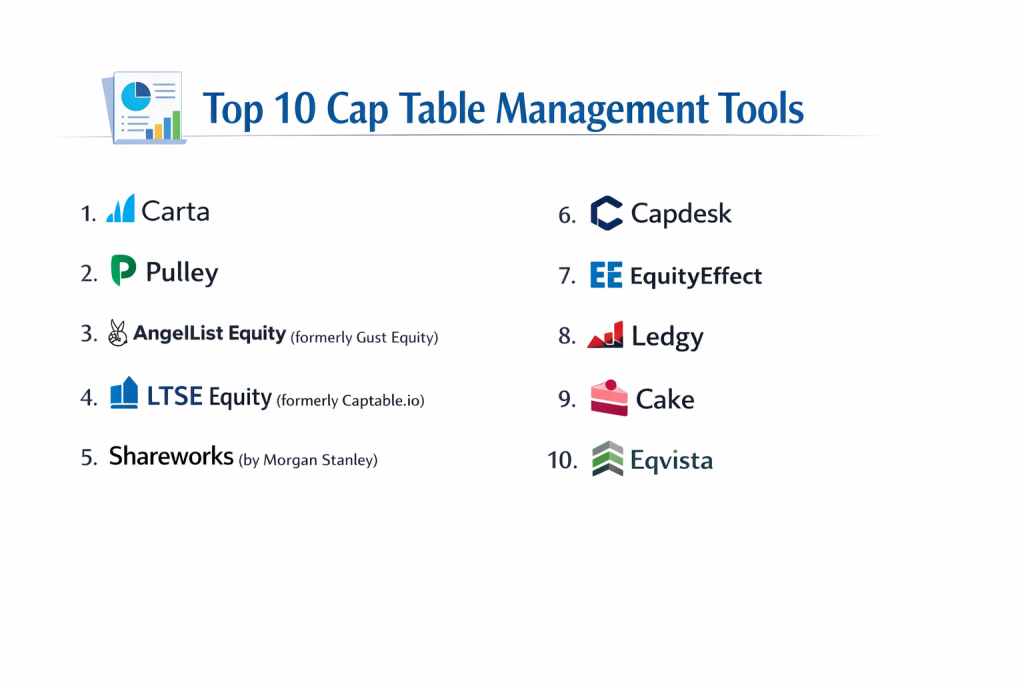
Top 10 Cap Table Management Tools
1 — Carta
Carta is the dominant, full-service platform in the cap table management space. It started with cap table software and expanded into a comprehensive equity management suite, including valuation services, liquidity solutions, and fund administration for investors.
Key features:
- End-to-End Equity Management: Manages cap tables, stock option plans (issuance, exercises, vesting), and convertible securities from founding to exit.
- Scenario Modeling & Waterfalls: Powerful tools to model fundraising rounds, exits (M&A, IPO), and visualize payout waterfalls for all shareholder classes.
- 409A Valuation Services: Integrated, audit-defensible 409A valuations to set fair market value for stock options, often at a bundled cost.
- Investor & Stakeholder Portals: Provides secure portals for investors to view their holdings and for employees to view their vested options and exercise them.
- Liquidity Solutions: Operates a secondary marketplace for private company stock and facilitates tender offers.
- Fund Administration: A separate suite for venture capital and private equity firms to manage their own funds and portfolio company data.
Pros:
- Market Leader & Ecosystem: The most comprehensive platform, creating a network effect. Its breadth of services (valuations, liquidity) makes it a one-stop shop.
- Investor & Employee Experience: The investor and employee portals are industry-standard, providing transparency and self-service that stakeholders expect.
Cons:
- Pricing & Cost Creep: Can become expensive, especially as you add services. Some users feel locked in due to the high cost of switching and data migration.
- Customer Support Challenges: Due to its massive scale, some users report slower or less personalized support compared to smaller competitors.
Security & compliance: Enterprise-grade security with SOC 1 and SOC 2 Type II certifications. Built to handle sensitive financial and shareholder data with strict access controls and audit trails.
Support & community: Offers standard support channels and a large help center. Its vast user base creates a de facto standard, but individualized support can vary.
2 — Pulley
Pulley is a modern, user-friendly cap table management platform designed specifically for fast-growing startups. It emphasizes simplicity, clear visualizations, and excellent customer support to make equity management accessible to founders.
Key features:
- Intuitive Founder-Focused Interface: Clean, simple dashboards and visualizations that make complex ownership data easy to understand.
- Fast, Accurate Modeling: Streamlined tools for modeling fundraising rounds (priced rounds, SAFEs, convertible notes) with real-time dilution impact.
- Integrated 409A Valuations: Partnership with leading valuation providers to offer fast, affordable 409A reports directly within the platform.
- Easy Equity Issuance: Guided workflows to issue stock options, create grant agreements, and manage employee equity plans with integrated e-signature.
- Investor Updates & Portals: Tools to share progress with investors and provide them with secure access to their cap table data.
- Strong Migration Support: Known for providing hands-on help to migrate from spreadsheets or other platforms like Carta.
Pros:
- Exceptional User Experience & Support: Renowned for its intuitive design and highly responsive, hands-on customer support team.
- Founder-Centric Design: Built with the startup founder’s needs and understanding as a priority, reducing complexity and anxiety around equity.
Cons:
- Smaller Ecosystem: Does not have the same breadth of adjacent services (like fund administration or a large liquidity network) as Carta.
- Scale for Later Stage: While it scales well, some ultra-complex, late-stage companies with intricate cap tables might eventually need deeper enterprise features.
Security & compliance: A modern cloud platform built with strong security foundations, including SOC 2 Type II compliance, data encryption, and granular permissions.
Support & community: A key differentiator. Offers white-glove onboarding and highly accessible support via chat, email, and call. Popular in the Y Combinator and tech startup community.
3 — AngelList Equity (formerly Gust Equity)
AngelList Equity leverages the massive AngelList ecosystem of startups and investors. It is a powerful, cost-effective solution for early-stage companies, especially those raising capital from or connected to the AngelList network.
Key features:
- Deep AngelList Ecosystem Integration: Seamlessly connects with AngelList Raise for fundraising and AngelList Talent for hiring, creating a unified startup operating system.
- Automated Cap Table from Fundraising: Automatically generates and updates your cap table based on completed SAFE or priced round documents from an AngelList raise.
- Free for Early-Stage: Offers a free tier for very early-stage companies with simple cap tables, with fees often tied to fundraising or optional services.
- Streamlined Option Management: Tools to issue equity to employees, advisors, and contractors with integrated e-signature.
- Investor Reporting: Provides updates and data access to investors who are also on the AngelList platform.
- Valuation Services: Access to 409A valuations through partners.
Pros:
- Powerful Ecosystem Play: Unbeatable for companies actively using AngelList for fundraising, recruiting, or back-office services. The automation from raise to cap table is a huge time-saver.
- Cost-Effective for Early Stage: The free and low-cost model is extremely attractive for bootstrapped and seed-stage startups.
Cons:
- Tied to AngelList: Its greatest strength is also a limitation; its full value is realized within the AngelList ecosystem.
- Less Customization & Advanced Modeling: May not offer the same depth of scenario modeling or customization for highly complex, non-standard cap table structures as some standalone platforms.
Security & compliance: Maintains strong security standards appropriate for financial data. Specific certifications should be verified, but it benefits from AngelList’s scale.
Support & community: Support is integrated with the AngelList platform. Has a massive built-in community of startups and investors.
4 — LTSE Equity (formerly Captable.io)
LTSE Equity, from the Long-Term Stock Exchange, is a robust cap table management tool known for its strong financial modeling engine and accuracy. It caters to startups and growth companies that prioritize precise, audit-ready calculations.
Key features:
- Financial Modeling Engine: A powerful, spreadsheet-like calculation engine under a polished interface, trusted for accuracy in complex scenarios.
- Detailed Scenario Modeling: Advanced tools for modeling waterfalls, option pool shuffles, and down-rounds with great precision.
- Fully Customizable Security Types: Ability to create and model virtually any type of equity or debt instrument, accommodating unique deal terms.
- Audit Trails & Version History: Maintains a complete history of every change to the cap table, which is crucial for audits and due diligence.
- Investor Data Room: Secure space to share sensitive company documents and cap table snapshots with investors.
- Integrations: Connects with HRIS platforms like Rippling and accounting software for data sync.
Pros:
- Modeling Power & Accuracy: Often praised by CFOs and finance professionals for its robust and trustworthy calculation capabilities.
- Flexibility for Complex Structures: Handles non-standard, complex securities and financing terms better than many user-friendly but simplified platforms.
Cons:
- Steeper Learning Curve: The powerful engine comes with a more complex interface that may be less immediately intuitive for non-finance founders.
- Less Emphasis on Employee Experience: While it manages options, its focus is more on the financial modeling side than on employee-facing portals.
Security & compliance: Employs bank-level security with features like SSO and detailed audit logs. SOC 2 compliance is a standard part of its offering.
Support & community: Provides knowledgeable support, particularly on complex modeling questions. Has a loyal user base among venture-backed companies.
5 — Shareworks (by Morgan Stanley)
Shareworks is an enterprise-grade equity management platform from Morgan Stanley. It is designed for later-stage private companies and public companies, offering global capabilities, extensive compliance features, and deep integration with financial services.
Key features:
- Global Equity Plan Administration: Sophisticated tools to manage equity compensation (stock options, RSUs, ESPPs) for a global workforce, handling multi-currency and cross-border tax compliance.
- Full Cap Table Management: Comprehensive cap table tracking and reporting for complex, multi-entity corporate structures.
- SEC & Global Regulatory Reporting: Built-in features to assist with filings and compliance for public companies or those preparing to go public.
- Employee Stock Plan Services: Full-service administration for employee stock purchase plans (ESPPs) and transaction processing.
- Financial Integration: Deep connectivity with Morgan Stanley’s brokerage and wealth management services for employee stock transactions.
- Robust Reporting & Analytics: Enterprise-level reporting for management, the board, and external auditors.
Pros:
- Enterprise & Global Scale: The leading solution for large, global companies with complex equity plans and stringent regulatory needs.
- Public Company Readiness: Unmatched for companies on the IPO path or already public, with tools designed for the strictures of public markets.
Cons:
- Overkill for Early Stage: Far too expensive and complex for startups and early-growth companies.
- Heavyweight Implementation: Requires significant resources, time, and often professional services to implement fully.
Security & compliance: As a Morgan Stanley company, it operates at the highest levels of financial services security, regulatory compliance, and data protection.
Support & community: Offers white-glove, enterprise-level support and strategic client management. Its user base consists of large, established corporations.
6 — Capdesk
Capdesk is a European-focused equity management platform that has gained significant traction globally. It is known for its strong visualization tools, focus on investor relations, and robust support for international cap table complexities.
Key features:
- Interactive Data Visualizations: Excellent charting and graphical representations of ownership, dilution, and waterfalls that are easy to share and understand.
- International Share Classes & Jurisdictions: Strong capabilities for managing multiple share classes across different countries and legal jurisdictions.
- Investor Relations Hub: Tools to communicate with investors, share updates, and manage data rooms, strengthening investor relations.
- Employee Equity Plans: Full management of option schemes, vesting, and exercises with a clean interface for employees.
- Scenario & Exit Modeling: Tools to model different financing and exit scenarios.
- API-First Platform: Strong API for integrating with other business systems like HR, finance, and CRM.
Pros:
- Strong International Focus: A top choice for companies with a European presence or global shareholder base, handling multi-currency and cross-border issues well.
- Excellent Data Visualization: Makes complex cap table data accessible and presentable to founders, boards, and investors.
Cons:
- U.S. Market Penetration: While growing, it has less brand recognition in the U.S. compared to Carta or Pulley, which can influence stakeholder familiarity.
- Feature Parity: May have slight differences in feature emphasis compared to U.S.-centric tools, though it covers all core cap table needs.
Security & compliance: Adheres to high security standards with ISO 27001 certification and GDPR compliance built-in, which is a major plus for European operations.
Support & community: Provides strong, responsive customer support. Has a growing community, particularly in the European startup ecosystem.
7 — EquityEffect
EquityEffect is a cap table and equity plan management tool known for its balance of power and user-friendliness. It serves startups and growth companies, with a particular strength in detailed equity compensation reporting and compliance.
Key features:
- Unified Cap Table & Compensation View: Integrates cap table data with detailed equity grant information for a holistic view of ownership and compensation.
- Advanced 409A & ASC 718 Reporting: Robust tools to assist with 409A valuation reports and ASC 718 (FAS 123R) expense reporting for financial statements.
- Granular Employee Grant Management: Detailed tracking of individual option grants, vesting schedules, exercises, and expirations.
- Scenario Modeling: Capabilities to model financing rounds and their impact.
- Secure Stakeholder Portals: Provides portals for investors, employees, and the board to access relevant information.
- Audit-Ready History: Maintains a complete audit trail of all transactions and changes.
Pros:
- Strong Financial Reporting Focus: Excellent for CFOs and accountants who need rigorous reporting for valuations (409A) and financial accounting (ASC 718).
- Balance of Power & Usability: Offers deeper financial features than some founder-friendly tools while remaining more accessible than heavy enterprise systems.
Cons:
- Brand Awareness: Operates with a lower profile than the largest players, which can sometimes be a factor in selection.
- Ecosystem: Has fewer adjacent services (like liquidity solutions) compared to the full-service market leader.
Security & compliance: A secure platform designed for sensitive data, with standard enterprise security practices and compliance features.
Support & community: Known for high-quality, personalized customer support and success management.
8 — Ledgy
Ledgy is a modern, European-origin cap table platform that emphasizes real-time collaboration, beautiful design, and making equity a strategic tool for hiring and retention. It’s popular with scale-ups and companies with a strong focus on employee ownership.
Key features:
- Real-Time Collaboration: Allows multiple stakeholders (founders, lawyers, investors) to view and collaborate on the cap table and scenarios simultaneously.
- Employee Engagement Focus: Intuitive, beautiful dashboards for employees to understand and visualize the value of their equity, increasing its impact as a retention tool.
- Dynamic Scenario Modeling: Easy-to-use modeling for fundraising, exits, and option pool expansions with instant visual feedback.
- International Compliance: Built to handle the complexities of equity across European countries and other international jurisdictions.
- API & Integrations: Connects with HR tools like Personio and accounting software to automate data entry.
- Investor Updates: Streamlined tools to keep investors informed.
Pros:
- Collaboration & Employee Experience: Stands out for its focus on making equity a transparent, collaborative, and engaging tool for all stakeholders, especially employees.
- Modern, Intuitive Design: The user interface is consistently praised for its clarity and ease of use.
Cons:
- Geographic Concentration: While expanding, its strongest adoption and feature nuances are in Europe.
- Market Share in the U.S.: Faces strong competition from established U.S. players in the North American market.
Security & compliance: Implements enterprise-grade security, is SOC 2 compliant, and is designed with European data privacy (GDPR) as a core principle.
Support & community: Provides excellent, responsive support. Has a passionate user base, particularly among technology scale-ups.
9 — Cake
Cake is a cap table management tool built for simplicity and speed, targeting early-stage startups and founders who want to get set up quickly without unnecessary complexity. It is often praised for its straightforward approach.
Key features:
- Extremely Fast Setup: Designed to get a startup’s cap table imported and functional in minutes, not days.
- Simple, Clean Interface: A no-frills, intuitive dashboard that focuses on the essential data points founders need to see.
- Core Modeling: Handles basic modeling for fundraising rounds (SAFEs, convertible notes, priced rounds) and dilution.
- Option Grant Management: Tools to issue stock options and manage a simple option pool.
- Investor Sharing: Easy ways to share a read-only view or PDF snapshot with investors.
- Affordable Pricing: Positioned as a cost-effective solution for early-stage companies.
Pros:
- Simplicity & Speed: Perfect for founders who want a no-nonsense tool to replace a spreadsheet immediately, with almost zero learning curve.
- Cost-Effective: One of the most affordable entry points into cap table software.
Cons:
- Limited Advanced Features: Lacks the depth of scenario modeling, waterfall analysis, and international capabilities of more robust platforms.
- Scalability: May not support a company through later, more complex financing stages and may require a migration to a more powerful tool later.
Security & compliance: Uses standard cloud security practices. Early-stage companies should confirm specific compliance certifications if required by investors.
Support & community: Offers lean support suitable for its simple product. Caters to the earliest-stage startup community.
10 — Eqvista
Eqvista is a comprehensive cap table and equity management platform that offers a wide array of features at a competitive price point. It aims to provide an all-in-one solution for cap table management, 409A valuations, and equity plan administration.
Key features:
- All-in-One Suite: Combines cap table management, 409A valuations, equity plan administration, and electronic cap table signing in one platform.
- Detailed Equity Tracking: Tracks all types of securities, including warrants, derivatives, and SAFEs.
- Built-in 409A Valuation Engine: Offers an automated, software-driven 409A valuation report as part of its service package.
- Document Generation & E-Signature: Creates stock option agreements, board consents, and other legal documents with integrated signing.
- Waterfall Analysis & Scenario Modeling: Tools for exit modeling and analyzing investor payouts.
- Multiple Company Management: Allows law firms, investors, or holding companies to manage multiple cap tables from a single dashboard.
Pros:
- Feature-Rich at a Competitive Price: Offers a very broad set of features for its price tier, making it attractive for bootstrapped or cost-conscious companies.
- Integrated 409A Valuations: The inclusion of a 409A valuation tool within the platform can simplify and reduce the cost of that mandatory process.
Cons:
- User Interface & Polish: The interface can feel cluttered or less polished compared to modern competitors like Pulley or Ledgy.
- Brand Perception: May not carry the same weight with sophisticated investors or in due diligence as the more established market leaders.
Security & compliance: Implements necessary security measures for financial data. Companies should inquire about specific compliance certifications for their needs.
Support & community: Provides customer support and resources. Its user base is diverse, from early startups to small public companies.
Comparison Table
| Tool Name | Best For | Platform(s) Supported | Standout Feature |
|---|---|---|---|
| Carta | Venture-backed startups to late-stage companies wanting a full-service equity ecosystem. | Cloud | Market-leading ecosystem (valuations, liquidity, fund admin). |
| Pulley | Fast-growing startups prioritizing an intuitive founder experience and great support. | Cloud | Exceptional user experience & white-glove customer support. |
| AngelList Equity | Early-stage startups deeply integrated into the AngelList fundraising & hiring ecosystem. | Cloud | Automated cap table from AngelList fundraising. |
| LTSE Equity | Startups & growth companies needing powerful, accurate financial modeling. | Cloud | Robust financial calculation engine for complex scenarios. |
| Shareworks | Late-stage pre-IPO and public companies with global, complex equity plans. | Cloud | Enterprise-scale global compliance & public company readiness. |
| Capdesk | Companies with an international footprint, especially in Europe. | Cloud | Strong international features & excellent data visualization. |
| EquityEffect | Companies needing strong financial reporting for 409A valuations & ASC 718. | Cloud | Depth in valuation and expense accounting compliance. |
| Ledgy | Scale-ups focusing on employee engagement and real-time stakeholder collaboration. | Cloud | Real-time collaboration & beautiful employee equity dashboards. |
| Cake | Very early-stage startups wanting the simplest, fastest replacement for a spreadsheet. | Cloud | Ultra-fast setup & extreme simplicity. |
| Eqvista | Cost-conscious companies wanting a broad feature set in one affordable platform. | Cloud | All-in-one suite with integrated 409A valuations. |
Evaluation & Scoring of Cap Table Management Tools
To make a data-driven decision, use this weighted scoring rubric. Score each tool from 1 (Poor) to 5 (Excellent) for each criterion. Multiply the score by the weight to calculate the weighted score. The tool with the highest total represents the best fit for your company’s stage and needs.
| Criteria | Weight | What to Look For | Score (1-5) | Weighted Score |
|---|---|---|---|---|
| Core Features | 25% | Accuracy, scenario/waterfall modeling, equity plan administration, security type support, reporting. | ||
| Ease of Use | 15% | Intuitiveness for founders, employees, and administrators. Quality of visualizations and dashboards. | ||
| Integrations & Ecosystem | 15% | Connections to fundraising platforms, HRIS, accounting software, valuation providers, and investor networks. | ||
| Security & Compliance | 10% | Data security (SOC 2), audit trails, and features supporting 409A, ASC 718, and other regulatory needs. | ||
| Performance & Reliability | 10% | Platform uptime, calculation speed, and ability to handle complex cap tables at scale. | ||
| Support & Community | 10% | Quality of onboarding, responsiveness of support, and existence of a user community or network. | ||
| Price / Value | 15% | Total cost relative to features, stage appropriateness, and the potential cost of errors without the tool. | ||
| TOTAL | 100% | FINAL SCORE |
Which Cap Table Management Tool Is Right for You?
The right tool depends overwhelmingly on your company’s stage, complexity, and stakeholder expectations. Use this guide to find your match.
- By Company Stage & Complexity:
- Pre-Seed / Idea Stage: A well-structured spreadsheet can work. For software, Cake offers the simplest start. AngelList Equity is free if you’re in that ecosystem.
- Seed / Series A (Venture-Backed): You need robustness and investor credibility. Pulley and Carta are top choices for balance and support. LTSE Equity is great for modeling precision.
- Growth / Series B+: Complexity increases. Carta‘s ecosystem is compelling. Capdesk and Ledgy are strong for international teams. EquityEffect excels in financial reporting.
- Late-Stage / Pre-IPO: You need audit trails, global compliance, and IPO prep. Shareworks is the enterprise leader. Carta also serves this segment.
- Public Company: Shareworks and other specialized public company stock administration platforms are required.
- By Primary Need:
- Founder Simplicity & Support: Choose Pulley or Cake.
- Ecosystem & Network: Choose Carta (broad ecosystem) or AngelList Equity (if within AngelList).
- Financial Modeling Power: Choose LTSE Equity or EquityEffect.
- Employee Engagement & Collaboration: Choose Ledgy or Pulley.
- International Operations: Choose Capdesk or Ledgy.
- Cost-Conscious Feature Depth: Choose Eqvista.
- By Budget Priority:
- Low Cost / Free: AngelList Equity (free tier), Cake, and Eqvista offer low-cost entry points.
- Value-Oriented (Mid-Range): Pulley, LTSE Equity, Capdesk, and Ledgy offer strong features for their price.
- Premium/Full-Service: Carta and Shareworks command higher prices for their comprehensive suites and scale.
- By Stakeholder Expectations: If your lead investors or board members expect you to be on Carta, that can be a deciding factor due to its status as the market standard. For European investors, Capdesk or Ledgy may be more familiar.
- By Security & Compliance Need: All serious tools offer good security. For specific needs like GDPR (Europe) or rigorous audit trails for SOX readiness (pre-IPO), prioritize platforms like Capdesk, Ledgy, Shareworks, or Carta.
Frequently Asked Questions (FAQs)
1. Can’t I just use a spreadsheet?
For a very simple, early-stage company with one founder, maybe. But spreadsheets are prone to catastrophic errors (wrong formulas, manual entry mistakes), lack audit trails, can’t handle complex modeling, and are a major red flag for investors during due diligence.
2. When should a startup get a cap table tool?
Ideally, before your first formal fundraising round (SAFE, convertible note, or priced seed round) or before you grant your first stock options to employees. Starting clean is much easier than fixing a messy spreadsheet later.
3. What is a 409A valuation, and do I need one?
A 409A valuation is an independent assessment of the fair market value (FMV) of your company’s common stock. You legally need one to issue stock options to employees and advisors at a strike price that avoids tax penalties for them. Most cap table platforms offer integrated 409A services.
4. How much do these tools cost?
Pricing varies: monthly/annual subscriptions per stakeholder, pricing based on the number of security holders, or a flat platform fee. Costs can range from ~$50/month for early-stage tools to tens of thousands per year for enterprise platforms. 409A valuations are usually an additional cost.
5. What’s involved in migrating from a spreadsheet or another tool?
A good provider will offer migration support. You’ll provide your existing cap table data, legal documents (certificate of incorporation, option plans, etc.), and the provider’s team will help reconstruct it in their system, verifying accuracy. This is a critical service to evaluate.
6. Who should have access to the cap table?
Founders, the head of finance/CFO, and your corporate lawyer need full access. Investors get view-only access to their specific holdings. Employees see only their own equity grants. Granular permissioning is a key feature.
7. Can these tools help with fundraising?
Absolutely. Scenario modeling lets you see exactly how much dilution you’ll experience at different valuations. A clean, professional cap table is a required document in investor due diligence and builds immediate credibility.
8. What happens at an exit (acquisition)?
The tool can run a final “waterfall analysis” to model exactly how the sale proceeds will be distributed among all shareholders (common, preferred, option holders) based on their liquidation preferences. This is vital for setting expectations and closing the deal.
9. What’s the biggest mistake companies make?
Waiting too long. Letting the cap table become a disorganized mess in a spreadsheet, then trying to clean it up during a time-sensitive fundraising round or due diligence process. This causes delays, erodes trust, and can kill deals.
10. Do I still need a lawyer?
YES. Cap table software is a tool for managing data and calculations. It does not replace legal advice on structuring financing rounds, drafting option plans, or navigating securities laws. Your lawyer and your software should work together.
Conclusion
Selecting the right cap table management tool is a foundational business decision with long-term implications for governance, fundraising, and culture. The right platform moves equity from a source of anxiety and potential error to a strategic asset that aligns stakeholders, attracts talent, and enables growth. The core lesson is that the “best” tool is a function of your company’s maturity, geographic footprint, and the specific needs of your stakeholders.
For the scrappy early-stage founder, simplicity and cost are key. For the venture-backed scale-up, accuracy, modeling, and investor relations take precedence. For the global pre-IPO company, compliance, scalability, and auditability are non-negotiable. Your choice must be guided by an honest assessment of where you are today and a clear vision of where you need the tool to take you.
Ultimately, a professional cap table management system is a sign of operational maturity. It is an investment that pays for itself many times over by preventing costly mistakes, saving countless hours during fundraising and due diligence, and turning equity into a transparent, motivating force for your entire team. By carefully evaluating options against your stage-specific criteria, you can choose a platform that not only tracks your ownership today but also provides the clarity and confidence to navigate your company’s journey from startup to success.