Introduction
Candidate Assessment Tools are specialized software platforms used to evaluate the skills, personality, and cognitive abilities of job applicants. Unlike a standard background check, these tools provide an interactive environment where candidates demonstrate their proficiency through work samples, situational judgment tests, or technical exams. By shifting the evaluation to the beginning of the funnel, companies can filter out unqualified leads before spending dozens of hours on manual interviews.
The importance of these tools lies in their ability to reduce unconscious bias and improve quality of hire. Real-world use cases include a software firm using automated coding “sandboxes” to vet thousands of developers, or a customer service center using voice-recognition assessments to test language proficiency and empathy. When evaluating these tools, users should look for scientific validity, proctoring capabilities (to prevent cheating), candidate experience (UX), and ATS integration to ensure a seamless workflow.
Best for: Talent acquisition teams, technical hiring managers, and HR departments in mid-to-large enterprises. They are particularly essential for high-volume hiring (retail/hospitality) and high-stakes technical hiring (software engineering/finance) where the cost of a “bad hire” is catastrophic.
Not ideal for: Very small businesses hiring for creative or executive roles where a portfolio review and deep personal networking are more effective than standardized testing. It may also be overkill for internships where potential is prioritized over current hard skills.
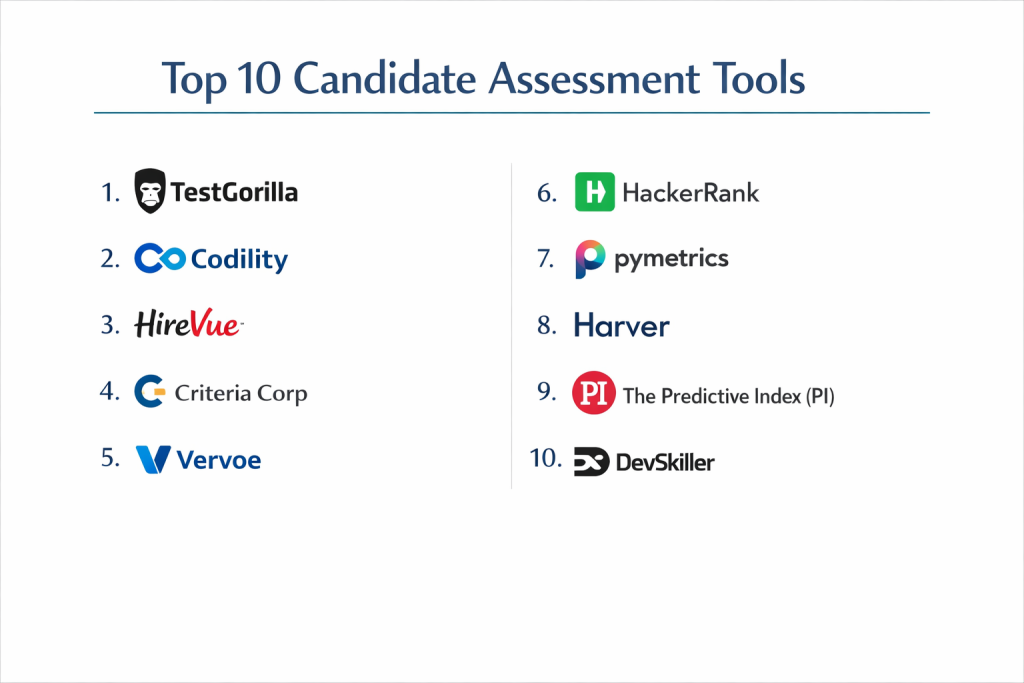
Top 10 Candidate Assessment Tools
1 — TestGorilla
TestGorilla has rapidly become the market leader for SMBs and mid-market firms by offering a massive library of pre-built tests ranging from “Critical Thinking” to “Advanced Google Ads.”
- Key features:
- Extensive Test Library: Over 300+ scientifically validated tests covering soft and hard skills.
- Custom Coding Challenges: Ability to create proprietary technical tests for niche roles.
- One-Way Video Interviews: Candidates record responses to prompts directly in the assessment.
- Anti-Cheating Measures: Snapshot monitoring, full-screen detection, and IP tracking.
- Multi-Measure Assessments: Combine up to five different tests into a single candidate experience.
- Detailed Benchmarking: Compare candidate scores against global averages for the same role.
- Pros:
- Exceptionally easy for non-technical HR managers to set up complex assessments.
- The candidate interface is modern, mobile-friendly, and very professional.
- Cons:
- The pricing model can get expensive if you need a high volume of assessments.
- Customization of individual test questions is limited on lower-tier plans.
- Security & compliance: SOC 2 Type II, GDPR compliant, SSO support, and data encryption at rest and in transit.
- Support & community: High-quality help center, responsive chat support, and a growing community of HR professionals using their “Hire Power” blog resources.
2 — HackerRank
HackerRank is the gold standard for technical and developer hiring. It provides an “Integrated Development Environment” (IDE) where candidates write code that is automatically graded in real-time.
- Key features:
- Real-World Coding Environments: Supports over 40 programming languages.
- CodePair: A live, collaborative coding environment for technical interviews.
- Project-Based Assessments: Evaluate how developers handle complex, multi-file software architectures.
- Plagiarism Detection: Uses an MOSS-like algorithm to detect code copied from the internet.
- Standardized Tech Sprints: Pre-made tests for roles like Data Scientist, DevOps, or Full Stack.
- Developer Branding: Custom-branded coding challenges to attract top-tier tech talent.
- Pros:
- The most trusted platform by developers; the IDE feels like their actual work environment.
- Automated grading significantly reduces the burden on engineering managers.
- Cons:
- Not suitable for non-technical roles (Sales, Marketing, HR).
- Some candidates find the timed coding challenges to be high-pressure or “stress-inducing.”
- Security & compliance: ISO 27001, SOC 2, GDPR, and HIPAA compliant.
- Support & community: Extensive enterprise support, a massive developer community (HackerRank for Developers), and dedicated account management.
3 — Pymetrics
Pymetrics takes a unique, “neuroscience-based” approach. Instead of traditional questions, candidates play simple games that measure cognitive and emotional traits like risk-taking and focus.
- Key features:
- Gamified Assessments: Behavioral games that are engaging for the candidate.
- Custom Success Profiles: AI models your top current performers to find “lookalikes” in the applicant pool.
- Bias-Free Algorithms: The platform audited its own AI to ensure no demographic bias.
- Soft Skill Mapping: Deep insights into teamwork, attention, and effort.
- Internal Mobility: Use the same data to see which current employees are a fit for a promotion.
- LinkedIn Integration: Candidates can share their Pymetrics badges on their professional profiles.
- Pros:
- One of the best candidate experiences in the market; it feels like playing a mobile game.
- Excellent for identifying “potential” in candidates who might lack a traditional resume background.
- Cons:
- Some stakeholders find the “game” approach too unconventional for corporate roles.
- Requires a large data set of current employees to build the most effective predictive models.
- Security & compliance: GDPR, SOC 2, and high-level encryption. Built with a focus on ethical AI.
- Support & community: Premium enterprise support and consultation for building custom AI models.
4 — HireVue
HireVue is the pioneer of video-based assessments. It combines asynchronous video interviews with game-based challenges and technical exams in a single enterprise-scale platform.
- Key features:
- Asynchronous Video: Candidates record interviews at their convenience.
- AI Evaluation (Optional): AI analyzes language patterns and responses for fit (subject to local regulations).
- Live Video Interviewing: Built-in tool that replaces Zoom/Teams with recruitment-specific features.
- Game-Based Assessments: Short challenges to measure cognitive ability.
- Automated Scheduling: Syncs with calendars to book live follow-up interviews.
- Enterprise Scalability: Designed to handle hundreds of thousands of applicants per year.
- Pros:
- Unrivaled for high-volume hiring where personal resume review is impossible.
- The integrated scheduling and video tools keep the entire process in one place.
- Cons:
- AI video analysis has faced some public pushback and regulatory scrutiny in certain regions.
- The platform can feel “corporate” and less agile for small startups.
- Security & compliance: SOC 2 Type II, ISO 27001, FedRAMP (for government), and GDPR.
- Support & community: 24/7 global support, dedicated implementation specialists, and annual user conferences.
5 — Criteria Corp
Criteria provides a well-rounded suite focusing on cognitive aptitude, personality, and emotional intelligence. They are known for their “CCAT” (Criteria Cognitive Aptitude Test), which is one of the most popular hiring exams in the world.
- Key features:
- The CCAT: A highly predictive 15-minute test of critical thinking and problem-solving.
- Emotify: An ability-based measure of emotional intelligence.
- Video Interviewing: Integrated one-way video responses.
- Job Benchmarking: Tools to determine which traits are actually necessary for a specific role.
- Unlimited Testing Model: Pricing is based on headcount, not per-test, encouraging high usage.
- Skill-Specific Tests: Literacy, numeracy, and software skills (Excel, Word).
- Pros:
- The subscription model is very cost-effective for companies with high turnover or frequent hiring.
- The reports are easy for non-experts to read, providing clear “Hire/Don’t Hire” recommendations.
- Cons:
- The interface for candidates is functional but looks slightly more “traditional” than Pymetrics or Teamtailor.
- Some of the cognitive tests are quite difficult and can discourage lower-level applicants.
- Security & compliance: GDPR, SOC 2, and rigorous adherence to EEOC (Equal Employment Opportunity) guidelines.
- Support & community: Outstanding customer success teams and a deep library of whitepapers on psychometric science.
6 — Codility
Codility is the primary competitor to HackerRank, specifically focusing on helping engineering teams build better “hiring pipelines” through automated code screening.
- Key features:
- CodeCheck: Automated screening tests for specific engineering roles.
- CodeLive: Online whiteboarding for technical interviews.
- Custom Tasks: Create coding challenges that mirror your actual codebase.
- Comprehensive Anti-Plagiarism: Monitors for leaked solutions across the web.
- Detailed Performance Insights: Shows not just if the code worked, but how efficient the solution was.
- Mobile Coding: Candidates can even complete smaller tasks on mobile devices.
- Pros:
- The reporting provides a “Time-to-Solve” and “Correctness” score that is very detailed.
- The platform is highly stable and can handle large-scale “Coding Challenges” or hackathons.
- Cons:
- Like HackerRank, it is useless for any role outside of technical/engineering.
- The pricing is firmly in the “enterprise” bracket.
- Security & compliance: ISO 27001, SOC 2 Type II, and GDPR compliant.
- Support & community: High-tier support with technical account managers for enterprise clients.
7 — Vervoe
Vervoe’s philosophy is “Skills-First.” They allow you to create “Work Samples” where candidates do the actual tasks they would do on the job—like writing a marketing email or editing a spreadsheet.
- Key features:
- Immersive Work Samples: Candidates answer via text, video, code, or file upload.
- AI Grading: The system learns how you grade and eventually automates it.
- Ready-made Library: Access to hundreds of assessments for various job titles.
- Tailored Branding: Create a highly customized, branded candidate portal.
- Anti-Cheating Tools: Randomization of questions and tab-tracking.
- Predictive Scoring: Ranks candidates based on their performance across multiple dimensions.
- Pros:
- Fantastic for non-technical “Skills” testing (e.g., “Can this person actually use Excel?”).
- Highly customizable; you can build an assessment that feels exactly like a day at your office.
- Cons:
- Creating custom assessments from scratch takes more time than using pre-made tests.
- The AI grading requires a “calibration” period where a human must grade the first few dozen candidates.
- Security & compliance: GDPR compliant and uses standard SSL encryption.
- Support & community: Excellent documentation and a very helpful “Recruitment Resources” blog.
8 — Harver
Harver is built specifically for volume hiring. If you need to hire 5,000 retail associates or call center reps, Harver’s automated flow is designed to do it without human recruiters.
- Key features:
- Situational Judgment Tests (SJT): Puts candidates in virtual customer scenarios.
- Automated Decisioning: Automatically moves candidates to the next stage or rejects them.
- Cultural Fit Assessments: Measures alignment with company values.
- Language Testing: Automated oral and written language proficiency exams.
- Virtual Job Tryouts: Realistic previews of the job to reduce early turnover.
- Mobile-First Design: Optimized for candidates applying from their smartphones.
- Pros:
- Dramatically reduces “Time-to-Hire” in industries like retail and BPO (Business Process Outsourcing).
- Helps set candidate expectations, which lowers 90-day turnover rates.
- Cons:
- Not suitable for specialized “Headhunting” or executive search.
- Implementation is heavy and requires a deep dive into your existing hiring data.
- Security & compliance: ISO 27001, SOC 2, and GDPR compliant.
- Support & community: Dedicated solution consultants and enterprise-grade support.
9 — Wonderlic
One of the oldest names in testing, Wonderlic has modernized its platform to offer the “Select” suite—a multi-dimensional assessment of personality, motivation, and cognitive ability.
- Key features:
- The Wonderlic Contemporary: A modern version of the classic 12-minute cognitive test.
- Motivation Assessment: Measures what drives a person to stay engaged at work.
- Personality Measure: Focuses on traits that predict workplace behavior (The Big Five).
- Single Score Results: Combines all three metrics into one “Fit Score” for a specific role.
- Proctored and Unproctored Options: Flexibility for high-stakes or low-stakes testing.
- Guided Interview Questions: Generates specific questions based on the candidate’s test results.
- Pros:
- Backed by decades of psychometric research and data.
- Very fast for candidates to complete (usually under 30 minutes for the full suite).
- Cons:
- Lacks modern “gamified” or “video-based” features.
- The results can feel a bit “academic” to some hiring managers.
- Security & compliance: GDPR compliant and adheres strictly to EEOC/Professional testing standards.
- Support & community: Strong academic support and professional onboarding for HR teams.
10 — CodinGame (by CoderPad)
CodinGame turns technical assessment into a competitive game. Developers solve puzzles and “save the world” using their code, making it highly engaging.
- Key features:
- Gamified Technical Challenges: More fun than a standard whiteboard test.
- Language-Agnostic Tasks: Tests logic and algorithm skills regardless of language.
- Anti-Plagiarism: Sophisticated code comparison tools.
- Global Developer Community: Access to a pool of developers who already play on the site.
- Detailed Replay: Recruiters can watch a “playback” of the candidate writing the code.
- Team-Based Challenges: Use it for internal hackathons or team building.
- Pros:
- Has a very high “Candidate Completion Rate” because it is genuinely fun.
- The “Playback” feature is invaluable for seeing how a candidate thinks, not just the result.
- Cons:
- Might feel a bit too “informal” for very traditional corporate environments.
- Smaller test library compared to giants like HackerRank.
- Security & compliance: GDPR compliant and SOC 2.
- Support & community: Highly engaged developer community and responsive tech support.
Comparison Table
| Tool Name | Best For | Platform(s) Supported | Standout Feature | Rating (Gartner) |
| TestGorilla | SMBs / General Skills | Web, Mobile | 300+ Test Library | 4.6 / 5 |
| HackerRank | Software Engineering | Web | IDE-Native Coding | 4.7 / 5 |
| Pymetrics | Soft Skills / Potential | Web, Mobile | Gamified Neuroscience | 4.5 / 5 |
| HireVue | Volume / Video | Web, Mobile | AI Video Analysis | 4.4 / 5 |
| Criteria Corp | Cognitive Aptitude | Web, Mobile | CCAT (Cognitive Test) | 4.7 / 5 |
| Codility | Technical Pipelines | Web | Technical Work Samples | 4.3 / 5 |
| Vervoe | “Work Sample” Testing | Web | AI Grading of Tasks | 4.5 / 5 |
| Harver | Retail / High-Volume | Web, Mobile | Automated Decisioning | 4.2 / 5 |
| Wonderlic | Classic Psychometrics | Web | Predictive “Fit Score” | 4.4 / 5 |
| CodinGame | Developer Engagement | Web | Gamified Code Playback | 4.8 / 5 |
Evaluation & Scoring of Candidate Assessment Tools
To rank these tools, we utilize a weighted scoring system that reflects the diverse needs of modern HR departments.
| Category | Weight | Evaluation Criteria |
| Core Features | 25% | Variety of tests, proctoring, anti-cheating, and customizability. |
| Ease of Use | 15% | Candidate experience (UX) and hiring manager dashboard simplicity. |
| Integrations | 15% | Native connectivity with major ATS (Greenhouse, Lever, etc.). |
| Security & Compliance | 10% | GDPR, SOC 2, and scientific validation (EEOC). |
| Performance | 10% | System stability and proctoring reliability. |
| Support & Community | 10% | Onboarding, customer success, and documentation quality. |
| Price / Value | 15% | Transparency and ROI (Time-to-hire reduction). |
Which Candidate Assessment Tool Is Right for You?
Solo Users vs. SMB vs. Mid-market vs. Enterprise
Solo users (e.g., fractional recruiters) should stick to TestGorilla‘s pay-as-you-go or free tiers. SMBs benefit from the all-in-one nature of Criteria Corp. Mid-market companies scaling technical teams should look at HackerRank or CodinGame. Enterprises with complex compliance needs and massive applicant volume require HireVue or Harver.
Budget-conscious vs. Premium Solutions
If budget is your main concern, Criteria Corp offers an unlimited testing model that is hard to beat for cost-per-candidate. Breezy HR (an ATS) also has built-in light assessments. If you are a premium buyer who wants the absolute best in predictive AI and neuroscience, Pymetrics and HireVue are the high-end investments.
Feature Depth vs. Ease of Use
For Ease of Use, TestGorilla and Vervoe allow you to set up an assessment in minutes. For Feature Depth, where you need to customize every logic gate of a coding challenge or psychological profile, HackerRank and Pymetrics offer the most granular control.
Integration and Scalability Needs
If you use Greenhouse or Lever, almost all these tools integrate, but HackerRank and Criteria have the deepest, most “invisible” integrations. For scalability, ensure the tool offers automated proctoring; you cannot manually watch thousands of candidates take tests.
Frequently Asked Questions (FAQs)
1. Do these tools really prevent cheating?
Most use “proctoring” features like taking snapshots of the candidate via webcam, locking the browser so they can’t search Google, and using AI to detect if the code or text was copied from elsewhere. While not 100% foolproof, they catch the vast majority of attempts.
2. Is it legal to use AI to grade candidates?
Yes, but it is regulated. In the US, the EEOC provides guidelines, and New York City has specific laws regarding “Automated Employment Decision Tools.” Most vendors (like Pymetrics and HireVue) have legal teams ensuring their AI is compliant.
3. Do assessments discourage candidates from applying?
They can. A 2-hour test for an entry-level job will cause “drop-off.” The best practice is to keep initial assessments under 20 minutes and only use longer, specialized tests for finalists.
4. What is the difference between an ATS and an Assessment Tool?
An ATS (Applicant Tracking System) is a database to manage resumes and stages. An Assessment Tool is a “plug-in” that actually tests the candidate’s skills. Most assessment tools live inside your ATS.
5. Can these tools test “Soft Skills”?
Yes. Through situational judgment tests (SJTs) and behavioral games, platforms like Pymetrics and Criteria can measure empathy, grit, risk tolerance, and communication style.
6. How much do these tools cost?
Pricing varies wildly. Some charge $1 per test, others charge $200 per month for unlimited tests, and enterprise tools can cost $50,000+ per year. Always ask about “hidden” implementation fees.
7. Should I test every applicant or only finalists?
For high-volume roles (Retail), test everyone early to save time. For specialized roles (Executive), only test the top 3-5 candidates to provide deeper data before a final decision.
8. What is “Scientific Validity”?
It means the test has been proven to actually measure what it claims to measure. Professional tools like Wonderlic and Criteria have decades of peer-reviewed research backing their methods.
9. Can I use these for internal promotions?
Highly recommended. Assessment tools help identify “hidden gems” in your own company who have the skills for a new role but might not have the “obvious” resume for it.
10. Do candidates like taking these tests?
If the test is relevant and fun (like CodinGame or Pymetrics), they do. If it’s a boring, 1990s-style multiple-choice exam, it can hurt your employer brand.
Conclusion
The “best” Candidate Assessment Tool depends entirely on what you are trying to measure. If you are hiring developers, HackerRank is the gold standard. If you are a small business needing to verify general skills, TestGorilla is unbeatable. For global giants managing thousands of hires, HireVue or Harver provide the necessary automation.
By moving from resume-based hiring to skills-based hiring, you aren’t just making the process faster—you’re making it fairer. Assessment tools allow the quiet, talented worker to outshine the loud, polished interviewee, which is exactly how you build a high-performing company.