Introduction
Call Recording & QA (Quality Assurance) Tools are specialized software solutions designed to capture, store, and analyze audio interactions between organization representatives and their customers. Beyond mere recording, modern platforms leverage Artificial Intelligence (AI) and Natural Language Processing (NLP) to transcribe calls, score agent performance, and detect customer sentiment. These tools act as a “black box” for business communications, transforming raw audio data into actionable insights that can be used to improve service quality, ensure regulatory compliance, and refine sales scripts.
The importance of these tools cannot be overstated in a data-driven business environment. They provide an objective record for dispute resolution, a goldmine for training new hires, and a vital shield for compliance in regulated industries like finance and healthcare. Key real-world use cases include identifying high-performing sales patterns, monitoring support agents for script adherence, and performing automated “keyword spotting” to track competitor mentions. When choosing a tool, users should evaluate transcription accuracy, automated scoring capabilities, security protocols (like PCI redaction), and how well the software integrates with their existing CRM or telephony stack.
Best for: Call center managers, sales leaders, compliance officers, and customer success teams at mid-market to enterprise companies. They are essential for industries like insurance, banking, legal services, and high-volume e-commerce.
Not ideal for: Solo freelancers or micro-businesses with very low call volumes where manual note-taking is sufficient, or companies that operate exclusively via text-based communication channels.
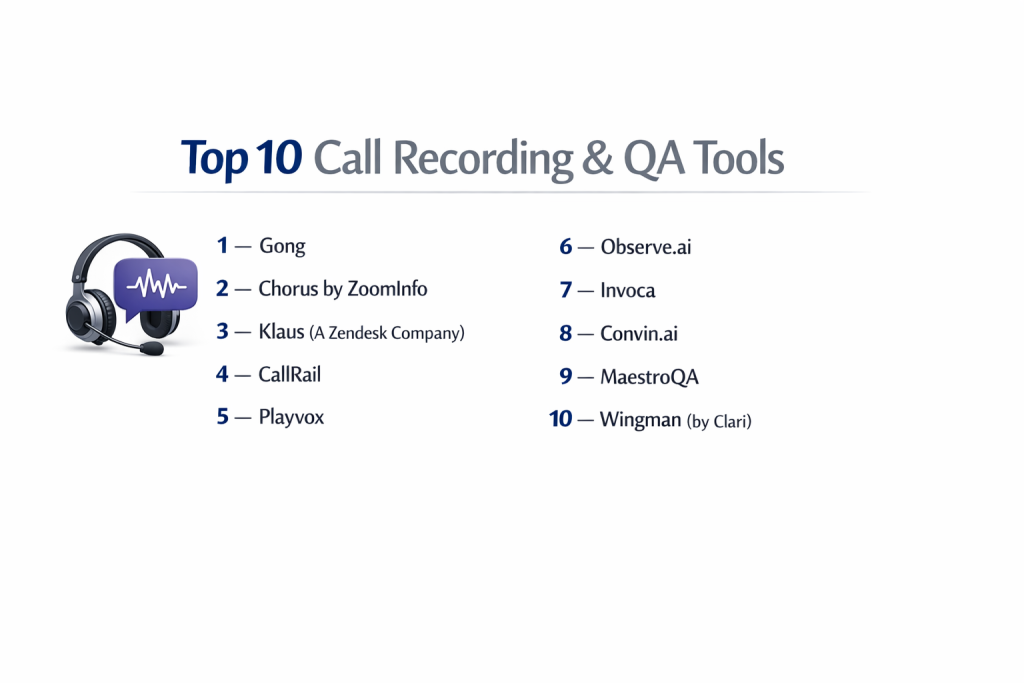
Top 10 Call Recording & QA Tools
1 — Gong
Gong is a market leader in the “Revenue Intelligence” space. It captures and analyzes every customer interaction across phone, email, and web conferencing to provide a complete picture of the sales pipeline.
- Key features:
- Reality Platform: Captures calls and meetings automatically with high-fidelity recording.
- Deal Intelligence: Alerts sales leaders to “at-risk” deals based on conversation patterns.
- Automated Coaching: Identifies winning behaviors and suggests improvements for underperforming agents.
- Keyword & Topic Tracking: Monitors specific themes, such as pricing objections or competitor names.
- CRM Auto-Sync: Automatically updates Salesforce or HubSpot with call summaries.
- Strategic Initiatives: Tracks how well a new marketing message is being adopted by the team.
- Pros:
- Exceptional Insights: Provides deep visibility into why deals are won or lost.
- User Interface: Highly intuitive and visually engaging for sales teams.
- Cons:
- Premium Pricing: One of the most expensive options on the market.
- Sales Focus: Less optimized for pure customer support/ticketing environments.
- Security & compliance: SOC 2 Type II, ISO 27001, GDPR, and HIPAA compliant. Features data encryption and SSO.
- Support & community: Extensive “Gong Academy,” highly responsive customer success managers, and a large professional user community.
2 — Chorus by ZoomInfo
Chorus (acquired by ZoomInfo) focuses on conversation intelligence for high-growth sales teams. It leverages the vast ZoomInfo database to provide context about who is on the other end of the call.
- Key features:
- Moment-by-Moment Analysis: Breaks down calls into segments like “Discovery,” “Pitch,” and “Next Steps.”
- Competitor Intelligence: Automatically flags when competitors are mentioned and analyzes the context.
- Call Snippets: Allows managers to easily clip and share “teachable moments” with the team.
- Market Insights: Aggregates data from thousands of calls to show market trends.
- Salesforce Integration: Bi-directional sync to keep deal records accurate.
- Pros:
- ZoomInfo Integration: Unique ability to see deep company data alongside call recordings.
- Transcription Speed: Very fast processing times from call end to transcript availability.
- Cons:
- Platform Tethering: Most effective when used within the broader ZoomInfo ecosystem.
- UI Density: Some users find the dashboard a bit cluttered compared to Gong.
- Security & compliance: SOC 2 Type II, GDPR, and CCPA compliant. Offers robust audit logs.
- Support & community: Strong documentation and dedicated account management for enterprise clients.
3 — Klaus (A Zendesk Company)
Klaus is specifically designed for customer support teams. It focuses heavily on the “Quality Assurance” aspect, providing a structured way for managers to score and review support interactions.
- Key features:
- AI-Powered Sampling: Automatically identifies “interesting” calls (e.g., very long calls or low sentiment) for review.
- Custom Scorecards: Allows managers to build specific grading criteria for different teams.
- Internal Feedback Loops: Enables agents to see their scores and comments in real-time.
- Root Cause Analysis: Helps identify systemic issues in support workflows.
- Seamless Helpdesk Integration: Works natively inside Zendesk, Salesforce Service Cloud, and Intercom.
- Pros:
- Support Optimized: Built by and for support professionals, not sales reps.
- Ease of Implementation: Can be set up and integrated with a helpdesk in minutes.
- Cons:
- Limited Sales Features: Lacks the “deal intelligence” and pipeline forecasting of Gong.
- Transcription Quality: While good, it may not be as specialized as some AI-first platforms.
- Security & compliance: SOC 2 Type II and GDPR compliant. Data is encrypted at rest and in transit.
- Support & community: Known for high-quality customer support and a helpful blog on QA best practices.
4 — CallRail
CallRail is a favorite among marketers and small-to-mid-sized businesses. It combines call recording with powerful “Call Tracking” to show which marketing campaigns are driving the most valuable calls.
- Key features:
- Conversation Intelligence: AI that summarizes calls and tags them with specific keywords automatically.
- Keyword Spotting: Identifies when callers use specific terms like “appointment” or “quote.”
- Dynamic Number Insertion: Tracks which online source led to a phone call.
- Lead Center: A unified inbox for calls, texts, and chats.
- Form Tracking: Connects form submissions on your site to subsequent phone calls.
- Pros:
- Marketing Insights: Best-in-class for attributing phone calls to specific ad spend.
- Affordability: More accessible pricing for SMBs compared to enterprise conversation intelligence tools.
- Cons:
- Basic QA: The quality assurance and coaching features are not as deep as Klaus or Gong.
- Mobile App: The mobile experience can be a bit limited for advanced admin tasks.
- Security & compliance: HIPAA, SOC 2, and GDPR compliant. Offers PCI redaction for credit card security.
- Support & community: Extensive self-service documentation and a very helpful support team.
5 — Playvox
Playvox is a comprehensive workforce engagement management (WEM) platform. It is designed for large contact centers that need to balance QA with agent scheduling and motivation.
- Key features:
- Omnichannel QA: Review calls, chats, emails, and social media interactions in one place.
- Learning Management System (LMS): Push training modules to agents based on their QA scores.
- Gamification: Reward agents with badges and points for high-quality interactions.
- Coaching Workflows: Standardized templates for 1-on-1 coaching sessions.
- Motivation Tools: Built-in recognition and community features for agent engagement.
- Pros:
- Holistic Approach: Connects QA scores directly to agent training and motivation.
- Enterprise Scalability: Built to handle thousands of agents across multiple locations.
- Cons:
- Complexity: Can be “too much software” for small teams just looking for simple recording.
- Implementation Time: Requires significant time to configure the LMS and gamification layers.
- Security & compliance: SOC 2 Type II, GDPR, and HIPAA compliant. High-level data encryption.
- Support & community: Global support footprint and a dedicated customer success department.
6 — Observe.ai
Observe.ai focuses on 100% call coverage. While human managers can only review a fraction of calls, this AI-first platform analyzes every single second of audio to ensure total compliance.
- Key features:
- Auto-QA: Automatically scores 100% of your interactions based on custom rubrics.
- Real-time Agent Assist: Provides “pop-up” suggestions to agents during live calls.
- Compliance Redaction: Automatically removes sensitive PII and credit card numbers from audio and text.
- Sentiment Analysis: Maps the emotional journey of the customer throughout the call.
- Dead Air Detection: Identifies long periods of silence that indicate agent struggle or technical issues.
- Pros:
- Total Visibility: Eliminates the “blind spots” inherent in manual QA sampling.
- Compliance Focus: Ideal for highly regulated environments like debt collection or healthcare.
- Cons:
- Technical Setup: Requires a clean telephony integration to get the most out of the AI.
- Initial Calibration: The AI needs time and feedback to perfect its automated scoring.
- Security & compliance: PCI DSS Level 1, SOC 2 Type II, GDPR, and HIPAA compliant.
- Support & community: Strong professional services for enterprise implementation.
7 — Invoca
Invoca is an “Active Conversation Intelligence” platform primarily used by large consumer brands (Telco, Auto, Home Services) to link marketing to sales outcomes.
- Key features:
- Signal Discovery: Uses AI to find recurring patterns in conversations without manual keyword entry.
- Pre-call Data: Shows the agent what the customer was looking at on the website before they called.
- Automated Call Distribution: Routes calls based on the digital intent of the caller.
- Lost Opportunity Recovery: Identifies high-value calls that didn’t convert for immediate follow-up.
- Multi-location Management: Excellent for brands with hundreds of local dealerships or branches.
- Pros:
- Customer Journey Mapping: Truly connects the digital click to the physical call.
- Enterprise Breadth: Built for the complex needs of massive, multi-unit brands.
- Cons:
- Price Point: Generally targeted at large enterprise budgets.
- Learning Curve: A powerful but complex tool that requires dedicated ownership.
- Security & compliance: SOC 2 Type II, HIPAA, and GDPR compliant. PCI DSS certified.
- Support & community: High-touch support model and annual user conferences.
8 — Convin.ai
Convin.ai is a versatile conversation intelligence platform that offers high-end features like automated QA and sales coaching at a more accessible mid-market price point.
- Key features:
- Automated Coaching: Generates personalized coaching plans for agents based on their performance metrics.
- Call Summarization: Uses Generative AI to create short, accurate summaries of long calls.
- Topic Analysis: Categorizes calls into themes like “Billing,” “Technical Support,” or “Pricing.”
- Agent Dashboard: Individualized portals for agents to track their own growth and scores.
- Ease of Integration: Connects with most modern VoIP and CRM systems.
- Pros:
- Generative AI Features: Excellent use of modern AI for summarization and insights.
- Good Balance: Offers many “Gong-like” features at a lower total cost of ownership.
- Cons:
- Brand Maturity: Newer to the market compared to incumbents like Gong or Chorus.
- Community Size: Smaller user base means fewer third-party resources and community forums.
- Security & compliance: GDPR compliant and SOC 2 certified. Data hosted on secure servers.
- Support & community: Responsive customer support and personalized onboarding.
9 — MaestroQA
MaestroQA is a specialized quality assurance tool that prioritizes the relationship between the manager and the agent. It is designed to turn QA from a “policing” activity into a coaching activity.
- Key features:
- Screen Capture: Records the agent’s desktop alongside the audio to see exactly what they were doing.
- Grader Calibration: Tools to ensure that different managers are scoring calls consistently.
- Custom Reporting: Build deep data visualizations to show QA impact on CSAT or NPS.
- Agent Wellness Tracking: Monitors for signs of burnout or high stress in call patterns.
- Workflow Automation: Automatically assigns calls for review based on agent experience levels.
- Pros:
- Human-Centric: Focuses on the “why” behind agent performance, not just the “what.”
- Calibration Tools: Best-in-class for ensuring QA fairness across large management teams.
- Cons:
- Analytics Depth: Not as heavy on the “market intelligence” side as some sales-focused tools.
- Interface: The UI is functional but can feel a bit traditional compared to modern SaaS startups.
- Security & compliance: SOC 2 Type II, HIPAA, and GDPR compliant.
- Support & community: Excellent “MaestroQA University” and a very active support community.
10 — Wingman (by Clari)
Wingman (now part of Clari) is a real-time conversation intelligence tool that focuses on “winning the deal” while the call is still happening.
- Key features:
- Real-time Cue Cards: Shows agents talk track suggestions live on screen based on the caller’s questions.
- Monologue Alerts: Gently pings the agent if they have been talking for too long without customer engagement.
- Pipeline Inspection: Uses call data to validate if a deal is actually as healthy as the CRM says.
- Meeting Recording: Seamlessly joins Zoom, Google Meet, and Microsoft Teams.
- Sales Playlist: Curate collections of great calls for new hire onboarding.
- Pros:
- Real-time Assistance: One of the few tools that helps during the call, not just after.
- Clari Integration: Powerful for revenue leaders who use Clari for forecasting.
- Cons:
- Distraction Risk: Some agents may find live cue cards distracting during sensitive calls.
- Niche Focus: Heavily skewed toward sales teams; less useful for general customer support.
- Security & compliance: SOC 2 Type II, GDPR, and HIPAA compliant.
- Support & community: Backed by Clari’s robust enterprise support infrastructure.
Comparison Table
| Tool Name | Best For | Platform(s) Supported | Standout Feature | Rating |
| Gong | Sales Intelligence | Web, Mobile, CRM | Revenue Intelligence AI | 4.8/5 |
| Chorus | Sales Coaching | Web, ZoomInfo | Moment-by-moment Analysis | 4.6/5 |
| Klaus | Support QA | Web, Helpdesks | AI-powered Ticket Sampling | 4.7/5 |
| CallRail | Marketing Attribution | Web, Mobile | Dynamic Number Insertion | 4.5/5 |
| Playvox | Workforce Management | Web, Omnichannel | LMS & Gamification | 4.4/5 |
| Observe.ai | 100% Compliance | Web, Telephony | Auto-QA for all calls | 4.6/5 |
| Invoca | Enterprise Marketing | Web, Telephony | Signal Discovery AI | 4.3/5 |
| Convin.ai | Mid-market Coaching | Web, CRM | Gen-AI Call Summaries | 4.5/5 |
| MaestroQA | Manager Calibration | Web, CRM | Desktop Screen Capture | 4.4/5 |
| Wingman | Real-time Sales | Web, Teams/Zoom | Real-time Cue Cards | 4.6/5 |
Evaluation & Scoring of Call Recording & QA Tools
| Category | Weight | Evaluation Criteria |
| Core Features | 25% | Recording quality, transcription accuracy, and automated scoring. |
| Ease of Use | 15% | Intuitive interface for both admins and agents. |
| Integrations | 15% | Connectivity with CRMs (Salesforce), Helpdesks, and Telephony. |
| Security & Compliance | 10% | SOC 2, HIPAA, PCI redaction, and data residency. |
| Performance | 10% | Processing speed and platform uptime reliability. |
| Support & Community | 10% | Documentation, onboarding, and customer success quality. |
| Price / Value | 15% | Transparent pricing and clear return on investment. |
Which Call Recording & QA Tool Is Right for You?
Solo Users vs. SMB vs. Mid-Market vs. Enterprise
For SMBs and solo users looking to optimize marketing spend, CallRail is the clear winner due to its attribution focus and accessibility. Mid-Market teams looking for “Gong-lite” features without the enterprise price tag should investigate Convin.ai or Wingman. For Large Enterprises with thousands of seats and complex compliance needs, Gong (Sales), Klaus (Support), or Playvox (Workforce Management) provide the necessary scale and governance.
Budget-Conscious vs. Premium Solutions
If budget is the primary driver, CallRail and Tidio (for chat) are strong starting points. However, if you are looking for a Premium Solution that can transform your entire revenue operation, the high cost of Gong or Observe.ai is often justified by the massive increase in agent productivity and deal win rates.
Feature Depth vs. Ease of Use
If you want a tool that you can set up in an afternoon and start using immediately, Klaus and CallRail are highly intuitive. If you require Feature Depth—such as the ability to record agent screens, push training modules to an LMS, or perform complex sentiment mapping—Playvox and MaestroQA offer the granular controls you need.
Integration and Scalability Needs
For companies living in Salesforce, tools like Gong, Chorus, and Invoca offer the deepest, most stable integrations. If you are building a modern, composable stack, ensure the tool you choose has a robust API. In terms of Scalability, look for platforms that offer “Auto-QA,” as manual review becomes impossible once you pass the 100-agent threshold.
Security and Compliance Requirements
This is a non-negotiable for Healthcare (HIPAA) and Finance/Retail (PCI). Ensure the tool doesn’t just record, but also redacts. Observe.ai and CallRail are particularly strong in automated redaction, ensuring that credit card numbers and social security numbers are never stored in your transcripts or audio files.
Frequently Asked Questions (FAQs)
1. Is call recording legal in my jurisdiction?
Laws vary by country and state. Generally, “One-Party Consent” states require only one person on the call to know they are being recorded, while “Two-Party Consent” states require everyone to be notified. Most tools include an automated “This call is being recorded” greeting to ensure compliance.
2. What is PCI Redaction?
PCI (Payment Card Industry) redaction is a feature that automatically detects and “mutes” or removes the audio and text when a customer recites a credit card number. This is vital for maintaining security standards.
3. Does call recording slow down my internet or phone system?
Most modern tools record in the cloud or via a “SIP invite,” meaning there is zero impact on the audio quality or the latency of your actual phone conversation.
4. How accurate are the AI transcripts?
Current AI technology typically achieves 85% to 95% accuracy. It may struggle with heavy accents or very technical jargon, but most platforms allow you to “train” the AI on your specific company vocabulary.
5. Can these tools record video calls like Zoom and Teams?
Yes, most enterprise tools like Gong, Chorus, and Wingman act as a “virtual attendee” that joins the video meeting and records both the audio and the shared screen.
6. What is the difference between Recording and QA?
Recording is just the storage of the audio. QA (Quality Assurance) is the process of evaluating that audio against specific standards (e.g., “Did the agent greet the customer by name?”).
7. How many calls should a manager review per week?
Manually, most managers can only review 1-2% of calls. AI-driven “Auto-QA” tools allow you to “review” 100% of calls, with managers only stepping in for the ones flagged as problematic.
8. Do these tools integrate with my CRM?
Almost all top-tier tools integrate with Salesforce, HubSpot, and Microsoft Dynamics. This allows the call recording to live directly inside the Lead or Opportunity record.
9. Can I use these for remote teams?
Absolutely. Since these are cloud-based SaaS platforms, they work regardless of where the agent is located, as long as they are using a supported VoIP or softphone system.
10. What is “Sentiment Analysis”?
It is an AI feature that analyzes tone of voice and word choice to determine if a customer is “Happy,” “Frustrated,” or “Neutral.” It helps managers quickly find the calls that need immediate attention.
Conclusion
Selecting the right Call Recording & QA Tool is no longer just about compliance; it is about unlocking the “voice of the customer” to drive business growth. Whether you are a sales leader looking to replicate your top rep’s success with Gong, or a support manager aiming for perfect CSAT scores with Klaus, the data contained in your voice interactions is your most valuable asset.
The “best” tool is the one that aligns with your specific operational focus—be it marketing attribution, agent coaching, or total compliance. Start by identifying your “blind spots.” If you don’t know why your customers are churned or why your deals are stalling, an AI-powered conversation intelligence platform is the key to finding those answers.