Introduction
Calendar Software is a digital application designed to help individuals and organizations manage time, schedule appointments, and coordinate events. Gone are the days of paper planners; modern calendar tools act as sophisticated time-management engines that sync across multiple devices, integrate with video conferencing platforms, and automate the tedious back-and-forth of finding a meeting time. These tools serve as the central nervous system for productivity, allowing users to visualize their commitments and protect their most valuable resource: time.
The importance of choosing the right calendar software lies in its ability to reduce “cognitive load.” A high-quality tool doesn’t just store dates; it sends reminders, manages time zones, and balances personal life with professional obligations. By centralizing schedules, teams can avoid double-booking and ensure that project deadlines are visible to everyone involved. When evaluating these tools, users should prioritize cross-platform synchronization, ease of invitation, integration with third-party apps (like Zoom or Slack), and intuitive user interface design.
Key Real-World Use Cases
- Team Coordination: Managers use shared calendars to view team availability instantly, making it easy to schedule recurring stand-ups without checking with every individual.
- External Client Booking: Consultants use “booking links” to allow clients to choose available slots, eliminating dozens of emails to settle on a time.
- Resource Management: Educational institutions and offices use calendar tools to manage the booking of physical spaces like conference rooms or labs.
- Personal Habit Tracking: Individuals use time-blocking techniques to dedicate specific hours to deep work, exercise, or family time.
Best for:
- Corporate Professionals and Executives: Who manage complex schedules and need to balance internal meetings with external networking.
- Small Business Owners and Freelancers: Who need to present a professional booking experience to clients while maintaining a lean operation.
- Project Managers: Who must align team schedules with project milestones and deadlines across different time zones.
Not ideal for:
- Ultra-Casual Users: Those who only have one or two appointments a month may find a dedicated app unnecessary compared to the default calendar on their smartphone.
- Purely Offline Workers: In environments where internet access is restricted or non-existent, traditional physical planners may still be more reliable.
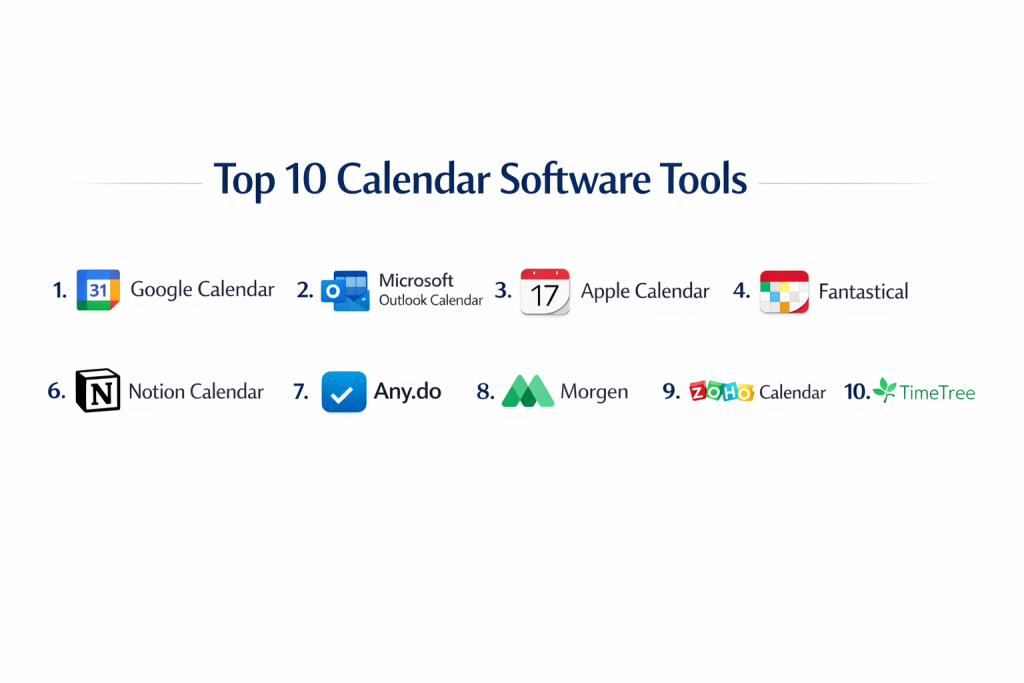
Top 10 Calendar Software Tools
1 — Google Calendar
Google Calendar is the industry titan, providing a clean, accessible, and deeply integrated experience for both personal users and Google Workspace enterprises.
- Key features:
- “Find a Time” feature to automatically identify gaps in multiple team members’ schedules.
- Multiple calendar views (day, week, month, year, and schedule).
- Integrated “Tasks” and “Reminders” that appear alongside time-based events.
- Automatic event creation from Gmail (flights, hotel bookings, reservations).
- Robust sharing permissions for public, private, or team-only calendars.
- Appointment Slots feature for creating bookable windows of time.
- Pros:
- Completely free for personal use and standard for most businesses.
- The most extensive integration ecosystem in the world; nearly every app connects to it.
- Cons:
- Privacy concerns for some users regarding Google’s data collection.
- The interface, while functional, can feel a bit utilitarian and plain.
- Security & compliance: SOC 2, HIPAA (with BAA), GDPR, ISO 27001.
- Support & community: Massive community forums, extensive help documentation, and enterprise support for Workspace users.
2 — Microsoft Outlook Calendar
The backbone of the corporate world, Outlook Calendar is designed for deep productivity and seamless integration with the Microsoft 365 suite.
- Key features:
- Deep integration with Microsoft Teams for one-click video meeting creation.
- Side-by-side calendar views to compare schedules across the team.
- “Scheduling Assistant” for complex enterprise meeting coordination.
- Ability to share “Free/Busy” status while hiding private event details.
- Weather integration and “Up Next” notifications on the desktop.
- Sophisticated delegate access for executive assistants to manage lead schedules.
- Pros:
- Unmatched security and administrative controls for large organizations.
- Exceptional offline capabilities via the desktop application.
- Cons:
- Can be overly complex for solo users or small teams.
- The mobile experience is slightly less intuitive than the desktop version.
- Security & compliance: SOC 2, HIPAA, GDPR, ISO 27001, FedRAMP.
- Support & community: Professional 24/7 global support and an massive library of certified training resources.
3 — Apple Calendar
Apple Calendar (formerly iCal) is the default choice for users within the macOS and iOS ecosystem, focusing on elegance and simplicity.
- Key features:
- iCloud synchronization that works flawlessly across iPhone, iPad, Mac, and Apple Watch.
- “Time to Leave” alerts based on current traffic and location data.
- Natural language input (e.g., typing “Lunch with Mom at 1pm”).
- Integration with Apple Maps for easy navigation to event locations.
- Clean, minimalist interface that avoids visual clutter.
- Family Sharing features for managing household schedules.
- Pros:
- No additional cost for Apple device owners.
- Respects user privacy more than most advertising-driven competitors.
- Cons:
- Limited collaboration features for users outside the Apple ecosystem.
- No native web or desktop app for Windows or Android users.
- Security & compliance: End-to-end encryption for iCloud data; GDPR compliant.
- Support & community: Available via Apple Support, retail Genius Bars, and extensive online guides.
4 — Fantastical
Fantastical is a premium calendar app for Mac and iOS known for its beautiful design and industry-leading natural language processing.
- Key features:
- Advanced natural language parsing for quick event creation.
- “Calendar Sets” to quickly toggle between work and personal views.
- Built-in weather forecasts and “Interesting Calendars” (sports, TV shows).
- Meeting proposals that allow invitees to vote on multiple time options.
- Integrated task management that syncs with Todoist and Google Tasks.
- Beautifully designed widgets for the macOS and iOS home screens.
- Pros:
- The best user experience (UX) for power users on Apple devices.
- Combines calendar and tasks into a single, cohesive interface.
- Cons:
- Requires a monthly subscription, which may be a hurdle for casual users.
- Only available for Apple platforms.
- Security & compliance: GDPR compliant; uses standard Apple-based security protocols.
- Support & community: Responsive developer support and a highly engaged Apple power-user community.
5 — Calendly
While often categorized as a scheduling tool, Calendly has evolved into a full calendar management platform for people whose lives revolve around external meetings.
- Key features:
- Customizable booking links with specific availability “rules.”
- Automated workflows for meeting reminders, follow-ups, and thank-yous.
- Group scheduling for webinars or multi-person training sessions.
- Integration with payment processors (Stripe/PayPal) for paid consultations.
- Round-robin scheduling to distribute meetings across a sales team.
- Metrics and reporting to track meeting volume and cancellations.
- Pros:
- Dramatically reduces the time spent on “email tag.”
- Professional presentation for clients and external partners.
- Cons:
- Not designed to be a “primary” calendar for viewing your whole day.
- The free version is limited to only one “event type.”
- Security & compliance: SOC 2 Type II, GDPR, HIPAA (Enterprise only).
- Support & community: Extensive help center, live chat for higher tiers, and a robust blog on productivity.
6 — Notion Calendar (formerly Cron)
Notion Calendar is a modern, fast, and sleek calendar tool designed for professionals who want a high-performance experience that integrates with their documentation.
- Key features:
- Deep integration with Notion, allowing users to link calendar events to Notion pages.
- Built-in “Availability Sharing” to quickly send slots to others.
- Global time zone support with easy-to-use time zone sliders.
- Command menu (Cmd+K) for lightning-fast keyboard-driven navigation.
- Clean, dark-mode-first aesthetic with minimal borders.
- Native app for Mac, Windows, and iOS.
- Pros:
- Extremely fast performance with zero “lag” when switching views.
- Perfect for Notion users who want their tasks and time in one place.
- Cons:
- Still relatively new, with fewer legacy features than Outlook or Google.
- Requires a Google account for initial setup.
- Security & compliance: SOC 2 compliant; GDPR compliant.
- Support & community: Active Discord community and fast email support from the Notion team.
7 — Any.do
Any.do is primarily a task manager that features a powerful integrated calendar, making it the choice for those who view “time” and “to-dos” as the same thing.
- Key features:
- “My Day” view that combines your calendar events and daily tasks.
- WhatsApp integration for creating reminders and events via chat.
- Smart grocery lists and recurring event support.
- Visual color-coding for different life areas (Work, Personal, Health).
- Homescreen widgets for quick entry on mobile devices.
- Cross-platform sync between web, mobile, and wearable devices.
- Pros:
- Excellent for individuals who want to consolidate multiple apps into one.
- The WhatsApp integration is a unique, highly convenient feature.
- Cons:
- The calendar view can feel slightly secondary to the task list.
- Most of the best features are locked behind a “Premium” subscription.
- Security & compliance: GDPR compliant; standard data encryption.
- Support & community: Helpful knowledge base and ticket-based customer support.
8 — Morgen
Morgen is a unified calendar, task manager, and scheduler that aggregates all your different calendars (Google, Outlook, iCloud) into one desktop hub.
- Key features:
- Multi-account aggregation (view work and personal calendars together).
- Built-in “Time Blocking” to drag tasks directly onto the calendar.
- Integrated scheduling links similar to Calendly.
- Native desktop apps for Windows, Mac, and Linux.
- Privacy-focused: Morgen does not store your calendar data on its servers.
- Advanced search and filtering across all connected accounts.
- Pros:
- One of the few high-quality calendar apps with a native Linux version.
- The privacy model is superior for users wary of third-party cloud storage.
- Cons:
- The mobile app is currently less powerful than the desktop version.
- The free tier has significant limitations on the number of accounts.
- Security & compliance: GDPR compliant; locally stored data options for privacy.
- Support & community: Active user community and direct developer support via email.
9 — Zoho Calendar
Zoho Calendar is a robust business-grade calendar that works seamlessly within the Zoho ecosystem, ideal for companies looking for an alternative to Google and Microsoft.
- Key features:
- “Group Calendars” for departmental tracking and event planning.
- Smart “Embed” options for putting a calendar on a public website.
- Integration with Zoho CRM to track client meetings and sales calls.
- Two-way sync with other major calendar providers.
- Appointment booking features built-in.
- Extensive notification customization (email, pop-up, SMS).
- Pros:
- Great value for money, especially for businesses already using Zoho apps.
- Excellent at handling public-facing calendars for events.
- Cons:
- The UI can feel a bit dated and “clunky” compared to Notion or Morgen.
- Mobile app performance is occasionally inconsistent.
- Security & compliance: SOC 2, HIPAA, GDPR, ISO 27001.
- Support & community: Global 24/5 support, localized partners, and detailed documentation.
10 — TimeTree
TimeTree is specifically designed for shared use cases, such as families, couples, or small interest groups who need to stay in sync.
- Key features:
- Dedicated “Chat” for every individual event on the calendar.
- “Memo” feature for keeping notes or shopping lists that aren’t tied to a date.
- Public calendars for organizations to share events with their community.
- Easy “Join” feature via a simple link or QR code.
- Multiple separate calendars (e.g., “Home,” “Soccer Team,” “Work”).
- Feed-style updates to see who changed what on the schedule.
- Pros:
- The absolute best tool for family and social coordination.
- The event-specific chat keeps discussions organized and in context.
- Cons:
- Lacks the deep professional features (like eDiscovery) required by enterprises.
- Includes advertisements in the free version.
- Security & compliance: Varies / N/A.
- Support & community: Strong presence on social media and a helpful user-centric blog.
Comparison Table
| Tool Name | Best For | Platform(s) Supported | Standout Feature | Rating |
| Google Calendar | General Ecosystem | Web, iOS, Android | Gmail Auto-Integration | 4.8/5 |
| Outlook | Enterprise Users | Win, Mac, Web, Mobile | Teams/Office Sync | 4.7/5 |
| Apple Calendar | Apple Purists | macOS, iOS, WatchOS | Time to Leave Alerts | 4.4/5 |
| Fantastical | UX & Power Users | macOS, iOS | Natural Language Input | 4.6/5 |
| Calendly | Client Booking | Web, iOS, Android | Scheduling Automation | 4.8/5 |
| Notion Calendar | Notion Power Users | Win, Mac, iOS | Notion Page Linking | 4.5/5 |
| Any.do | Task Consolidation | All Platforms | WhatsApp Reminders | 4.3/5 |
| Morgen | Privacy & Linux | Win, Mac, Linux, Mobile | Unified Hub (No Storage) | 4.5/5 |
| Zoho Calendar | SMB Productivity | Web, Mobile | Embeddable Calendars | 4.2/5 |
| TimeTree | Families & Groups | iOS, Android, Web | Event-Specific Chat | 4.4/5 |
Evaluation & Scoring of Calendar Software
| Criteria | Weight | Average Score (out of 10) | Notes |
| Core Features | 25% | 9.0 | Basic scheduling is excellent across the board. |
| Ease of Use | 15% | 8.5 | Apple and Notion lead here; Outlook can be dense. |
| Integrations | 15% | 9.0 | Google and Outlook have the widest ecosystems. |
| Security & Compliance | 10% | 8.0 | Enterprise tools win; social tools like TimeTree are lower. |
| Performance | 10% | 8.5 | Notion Calendar is exceptionally fast. |
| Support & Community | 10% | 8.0 | Google and Microsoft have the largest communities. |
| Price / Value | 15% | 8.5 | Google and Apple offer the best free options. |
Which Calendar Software Tool Is Right for You?
Solo Users vs SMB vs Mid-Market vs Enterprise
If you are a Solo User, your choice should be dictated by your hardware. iPhone users will find Apple Calendar or Fantastical the most natural, while Android users should stick with Google Calendar. For SMBs, Calendly combined with Google Calendar offers the best balance of internal and external scheduling. Mid-Market and Enterprise organizations should almost exclusively look at Microsoft Outlook or Google Workspace, as these tools provide the administrative oversight, security, and global address lists required to manage thousands of employees.
Budget-Conscious vs Premium Solutions
If you are Budget-Conscious, the default tools (Google, Apple, Microsoft) are free or included with suites you already pay for. However, if you are a “time-management athlete,” a Premium Solution like Fantastical or Morgen is worth the investment. These tools offer productivity features like “Calendar Sets” and “Time Blocking” that can save you several hours a month, easily paying for the subscription cost.
Feature Depth vs Ease of Use
If you prioritize Ease of Use, Notion Calendar and Apple Calendar are the winners. They have clean interfaces with no unnecessary buttons. If you require Feature Depth—meaning you need to manage room bookings, delegate access, and complex time zone math—Outlook and Zoho provide the technical horsepower necessary for those tasks.
Integration and Scalability Needs
For those whose workflow is scattered across many apps, Google Calendar is the best because it acts as the “default” for all third-party integrations. For those building a documentation-heavy business, Notion Calendar is the most scalable choice as it links your schedule directly to your project notes and wikis.
Security and Compliance Requirements
If you work in a regulated industry like healthcare (HIPAA) or finance (FINRA), you must stick with the enterprise tiers of Microsoft 365 or Google Workspace. These are the only platforms that offer the necessary Business Associate Agreements (BAAs) and audit logs to remain compliant with federal laws.
Frequently Asked Questions (FAQs)
1. Can I sync different calendars (e.g., Work and Personal) in one app?
Yes. Tools like Morgen, Fantastical, and Notion Calendar are designed specifically to pull in “feeds” from different sources (Google, Outlook, iCloud) so you can see your entire life in one view without merging the actual data.
2. How do I prevent people from seeing my private appointments on a shared calendar?
Most professional tools have a “Private” setting. When you mark an event as private, others will only see that you are “Busy” during that time, but they won’t see the title, location, or notes of the event.
3. What is “Natural Language Input”?
This is a feature found in apps like Fantastical and Apple Calendar. Instead of clicking boxes for time and date, you simply type “Coffee with Sarah at Starbucks on Friday at 9am,” and the app automatically parses that into an event.
4. Is my calendar data private?
This depends on the tool. Google uses data for various services, whereas Apple and Morgen prioritize on-device processing or encryption. Always check the privacy policy if you are handling sensitive information.
5. Can I use these tools offline?
Native desktop applications like Microsoft Outlook and Morgen offer robust offline support. Web-based calendars like Google Calendar have limited offline modes that must be enabled in settings.
6. Does Calendly replace my Google Calendar?
No. Calendly is a scheduling layer that “sits on top” of your Google or Outlook calendar. It checks your existing calendar for conflicts and then adds new meetings to it.
7. How do I handle different time zones for international meetings?
Modern tools like Notion Calendar and Google Calendar allow you to add a secondary time zone to your sidebar. When you invite someone, the tool automatically adjusts the time to their local zone.
8. What are “Calendar Sets”?
Found in power-user apps like Fantastical, these allow you to group calendars together. You can have a “Work Set” and a “Home Set” and switch between them with one click or based on your location.
9. Can I recover a deleted calendar event?
In Google Calendar and Outlook, there is usually a “Trash” or “Deleted Items” folder that stores removed events for 30 days. After that, they are typically gone forever unless you have a backup.
10. What is Time Blocking?
Time blocking is a productivity method where you schedule every minute of your day. Tools like Morgen and Any.do make this easier by allowing you to drag tasks directly onto your calendar as time slots.
Conclusion
The “best” Calendar Software is the one that removes the most friction from your day. For the vast majority of people, the power and familiarity of Google Calendar or Microsoft Outlook are more than enough. These platforms have defined the digital schedule for decades and continue to innovate with AI features and deep ecosystem integrations.
However, as our work lives become more complex, specialized tools are carving out important niches. If you find yourself drowning in “booking emails,” Calendly is an essential addition. If you want a more aesthetic, high-performance experience, Notion Calendar or Fantastical can transform how you feel about your daily schedule. Ultimately, your calendar should be a tool that serves you, not a list of demands that overwhelms you. By choosing a tool that aligns with your hardware, your privacy needs, and your professional goals, you can turn a chaotic schedule into a well-oiled machine for success.