Introduction
A Building Energy Management System (BEMS) is a sophisticated computer-based control system installed in buildings to monitor and manage energy-related services. Unlike a traditional Building Management System (BMS) that focuses on general automation, a BEMS is specifically engineered to optimize energy consumption. It integrates hardware—such as sensors, meters, and controllers—with advanced software that analyzes data to control heating, ventilation, air conditioning (HVAC), lighting, and power systems. By using real-time data, a BEMS ensures that energy is used only when and where it is needed.
The importance of BEMS has grown exponentially as organizations face rising utility costs and stricter environmental regulations. These systems are the backbone of sustainable architecture, enabling “Smart Buildings” to reduce their carbon footprint while maintaining occupant comfort. Beyond simple cost savings, a BEMS provides the transparency required for ESG reporting and certifications like LEED or BREEAM. It transforms a passive structure into an intelligent asset that can respond to grid demands and identify equipment inefficiencies before they lead to costly breakdowns.
Key Real-World Use Cases
- Occupancy-Based Control: Automatically dimming lights and adjusting HVAC setpoints in office zones when sensors detect no movement.
- Peak Shaving: Reducing a building’s energy load during high-tariff periods to avoid expensive “demand charges” from utility providers.
- Predictive Maintenance: Analyzing energy spikes in an air handling unit that suggest a motor is about to fail, allowing for repair before a total outage.
- Multi-Site Benchmarking: Comparing the energy intensity of dozens of retail locations to identify which stores are underperforming.
What to Look For (Evaluation Criteria)
When choosing a BEMS, prioritize Interoperability. The system must speak common protocols like BACnet, Modbus, or LonWorks to interact with existing hardware. Look for Data Granularity—the ability to see energy use down to the individual circuit or room level—and Cloud-Native Analytics, which allow you to manage your building portfolio from anywhere.
Best for: Facility managers, sustainability officers, and real estate developers in commercial, industrial, and institutional sectors (hospitals, universities, data centers). It is essential for companies with high energy overheads looking to automate sustainability.
Not ideal for: Residential homeowners or micro-businesses with basic utility needs. For these users, a simple smart thermostat or “plug-and-play” energy monitor is often more cost-effective than a full enterprise BEMS.
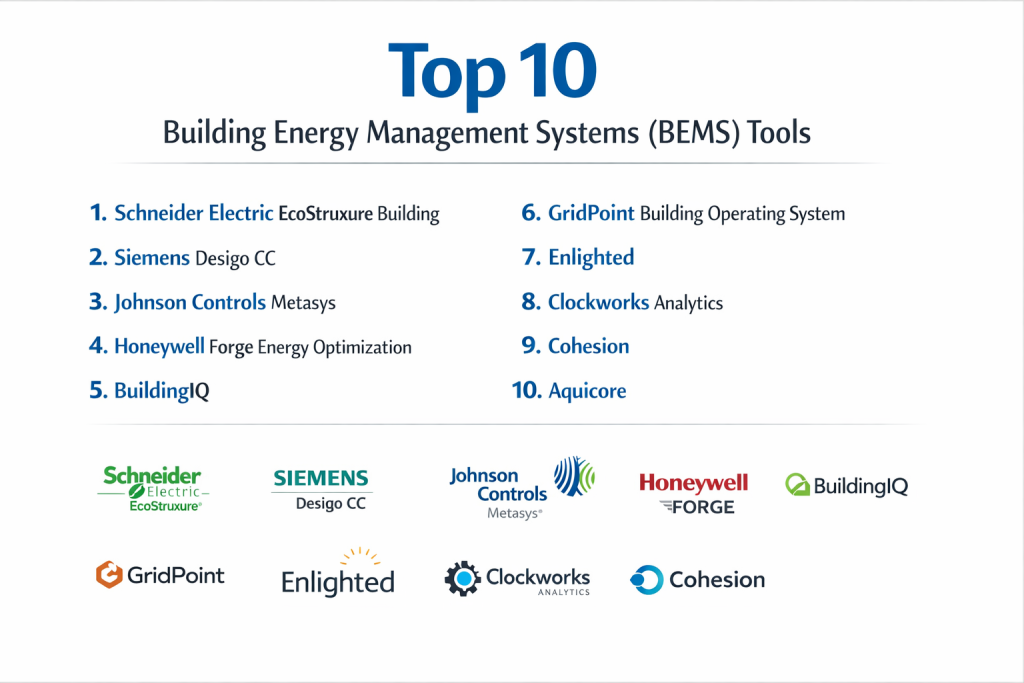
Top 10 Building Energy Management Systems (BEMS) Tools
1 — Schneider Electric (EcoStruxure Building)
Schneider Electric is a global leader in energy management. Their EcoStruxure platform is a comprehensive IoT-enabled solution that connects hardware, software, and services into a unified architecture.
- Key features
- IoT-connected hardware for power monitoring and HVAC control.
- Advanced edge control for localized, real-time decision-making.
- Predictive analytics to optimize energy and asset performance.
- Native integration with renewable energy sources and EV charging.
- Detailed sustainability and regulatory reporting dashboards.
- Cybersecure-by-design architecture.
- Mobile app for remote facility monitoring and overrides.
- Pros
- Unmatched scalability, capable of managing global portfolios or single high-tech campuses.
- Strongest hardware-software synergy in the market; their meters and controllers are industry standards.
- Cons
- The system is highly complex and usually requires certified partners for installation and maintenance.
- Higher upfront capital expenditure compared to software-only overlays.
- Security & compliance: SOC 2, ISO 27001, GDPR, and IEC 62443 (Cybersecurity for Industrial Automation).
- Support & community: Extensive global partner network, 24/7 technical support, and a massive community forum for system integrators.
2 — Honeywell (Forge for Buildings)
Honeywell Forge is a “Workplace Performance” suite that uses a SaaS model to provide high-level energy optimization and air quality monitoring.
- Key features
- AI-driven autonomous control for HVAC systems.
- Real-time monitoring of CO2, humidity, and volatile organic compounds (VOCs).
- Integrated energy dashboards for multi-site benchmarking.
- Condition-based maintenance alerts based on energy anomalies.
- Cloud-based analytics that sit on top of legacy BMS hardware.
- Sustainability reporting for LEED and WELL certifications.
- Pros
- Excellent at retrofitting older buildings because it can overlay existing, disparate control systems.
- Strong focus on occupant wellness (air quality) alongside energy efficiency.
- Cons
- Subscription-based costs can add up for large-scale deployments.
- Requires a reliable internet connection for full cloud-based AI functionality.
- Security & compliance: SOC 2 Type II, ISO 27001, GDPR, and SSO support.
- Support & community: Global enterprise support, dedicated account managers, and specialized training programs.
3 — Siemens (Desigo CC)
Desigo CC is a total building management station that excels in integrating fire safety and security alongside specialized energy management.
- Key features
- Unified management of HVAC, lighting, fire, and physical security.
- Advanced energy analytics and trend logging.
- Support for open standards (BACnet, Modbus, OPC, ONVIF).
- Modular architecture allowing users to add energy modules as needed.
- Sophisticated shading and lighting control based on solar position.
- Energy demand-response capabilities.
- Pros
- Best-in-class for high-security environments like hospitals or data centers where fire and energy must be integrated.
- Highly reliable hardware with a very long lifecycle.
- Cons
- The user interface is powerful but can feel traditional and less “modern” than SaaS-first competitors.
- Configuration requires specialized training or Siemens-certified technicians.
- Security & compliance: ISO 27001, SOC 2, GDPR, and various international fire/safety certifications.
- Support & community: Professional implementation services, global field support, and Siemens Xcelerator ecosystem.
4 — Johnson Controls (Metasys)
Metasys is one of the most widely deployed building automation systems, known for its ability to unify thousands of devices into a single, navigable interface.
- Key features
- Advanced “Energy Dashboard” for real-time utility tracking.
- Mobile-optimized interface with “Space Tree” navigation.
- Cyber-resilient hardware with built-in encryption.
- Deep integration with chillers and air handling units.
- Detailed audit logs for tracking user changes and energy overrides.
- Fault detection and diagnostics for energy-hungry equipment.
- Pros
- Exceptionally easy to navigate for facility managers thanks to its visual “Space-first” design.
- Strong hardware legacy, particularly in heavy HVAC equipment.
- Cons
- Upgrading from legacy versions of Metasys can be a complex and expensive process.
- Can feel “locked-in” to the Johnson Controls ecosystem for certain high-end features.
- Security & compliance: FIPS 140-2 (for government sites), SOC 2, and GDPR.
- Support & community: Large network of branches, extensive documentation, and the Johnson Controls training institute.
5 — Facilio
Facilio is a modern, cloud-native O&M (Operations & Maintenance) platform that uses IoT to centralize energy data and building operations.
- Key features
- Real-time IoT data ingestion from existing BMS/BEMS.
- AI-based fault detection and diagnostics (FDD).
- Automated energy-saving workflows based on occupancy data.
- Tenant billing and energy cost-allocation modules.
- Unified dashboard for sustainability tracking across portfolios.
- API-first approach for easy integration with third-party software.
- Pros
- Much faster to deploy than traditional hardware-heavy BEMS.
- The user interface is modern, clean, and requires very little training.
- Cons
- Primarily a software layer; you still need existing hardware/controllers to execute commands.
- May not have the same level of “deep” industrial hardware control as Schneider or Siemens.
- Security & compliance: SOC 2 Type II, ISO 27001, GDPR, and SSO support.
- Support & community: 24/7 global support, agile product updates, and personalized onboarding.
6 — Dexma (by Spacewell)
Dexma is a powerful energy analytics software that focuses on the data-crunching side of BEMS, helping users identify where every watt is spent.
- Key features
- “Dexma Detect” for automated energy auditing via AI.
- “Dexma Analyse” for deep sub-metering and regression analysis.
- “Dexma Control” for automated demand-response.
- Hardware-agnostic (works with over 500 different meter types).
- Measurement and Verification (M&V) following IPMVP standards.
- Customized reporting for different stakeholders (CFO vs. Engineer).
- Pros
- The most powerful tool for energy “detective work”—identifying hidden waste without site visits.
- Excellent flexibility for buildings that already have a mix of different meter brands.
- Cons
- Focuses more on monitoring and analysis than on the direct hardware control of a BMS.
- Requires good quality data input; “garbage in, garbage out” applies here.
- Security & compliance: GDPR, ISO 27001, and secure data encryption.
- Support & community: Strong European presence, extensive webinars, and a dedicated partner portal.
7 — ABB (Ability Building Analyzer)
ABB Ability provides a cloud-based solution focused on multi-site energy management and operational efficiency.
- Key features
- Data collection from power circuits, gas, water, and steam.
- Benchmarking tools to compare buildings across different climates.
- Automated alerts for energy deviations.
- Integration with ABB’s low-voltage and medium-voltage power hardware.
- Scalable from small commercial buildings to large industrial plants.
- Intuitive web-based dashboards.
- Pros
- Ideal for industrial facilities that are already using ABB power equipment.
- Very strong at tracking “process energy” in addition to “building energy.”
- Cons
- Less focus on the “occupant experience” compared to tools like Honeywell or Facilio.
- Analytics are robust but less “predictive” than some AI-first competitors.
- Security & compliance: ISO 27001, GDPR, and standard industrial cybersecurity protocols.
- Support & community: Global industrial support network and comprehensive engineering documentation.
8 — BrainBox AI
BrainBox AI is a unique “overlay” system that uses autonomous AI to control existing HVAC systems and reduce energy spend without manual intervention.
- Key features
- Autonomous HVAC optimization (no human in the loop).
- Integration with existing BMS via BACnet.
- Predictive weather modeling to adjust building temperatures in advance.
- Deep learning that “learns” a building’s thermal profile.
- Dashboard for tracking carbon footprint reduction.
- Rapid deployment (often under 3 hours for the initial link).
- Pros
- The highest “set and forget” value; it does the energy saving for you.
- Can achieve 20-30% energy savings with zero hardware changes.
- Cons
- Restricted mainly to HVAC; does not manage lighting or other energy loads.
- Some facility managers may be hesitant to give an AI full control over building setpoints.
- Security & compliance: SOC 2, GDPR, and secure VPN/Gateway connections.
- Support & community: High-touch implementation and 24/7 monitoring of the AI’s performance.
9 — Entic (by Aquicore)
Entic (now a part of Aquicore) specializes in the optimization of central plants—chillers, boilers, and cooling towers—which are the biggest energy users in a building.
- Key features
- Real-time central plant optimization.
- Deep sub-metering of major equipment.
- Financial modeling of energy savings for REITs and owners.
- Fault detection specifically for high-load mechanical systems.
- Integration with major BMS platforms.
- Automated ESG data collection.
- Pros
- Targets the “biggest levers” in energy spend; perfect for high-rise buildings.
- Provides the financial transparency that real estate investors need.
- Cons
- Not a general-purpose BEMS; focuses mostly on heavy mechanical systems.
- More applicable to large-scale buildings than small commercial retail.
- Security & compliance: SOC 2 Type II, GDPR, and SSO.
- Support & community: Strong focus on the North American commercial real estate market.
10 — Wattics (by EnergyElephant)
Wattics is an energy management platform that excels in providing data for sustainability professionals and energy consultants.
- Key features
- Machine learning for identifying energy patterns and “waste.”
- Formula-based virtual meters for calculating untracked loads.
- White-label options for energy consultants to use with their clients.
- Tariff analysis and utility bill verification.
- Project tracking to see the ROI of energy-saving initiatives.
- Global multi-currency and multi-unit support.
- Pros
- The best tool for energy consultants who manage portfolios for third parties.
- Exceptional utility bill audit features to find provider errors.
- Cons
- Limited direct hardware control; primarily a monitoring and reporting tool.
- The interface, while clean, is data-heavy and may overwhelm casual users.
- Security & compliance: GDPR, ISO 27001, and standard encryption.
- Support & community: Excellent onboarding for consultants and proactive technical support.
Comparison Table
| Tool Name | Best For | Platform(s) Supported | Standout Feature | Rating |
| Schneider Electric | Global Enterprises | On-prem/Cloud | Hardware-Software Unity | 4.8 / 5 |
| Honeywell Forge | Occupant Wellness | Cloud (SaaS) | Air Quality + Energy | 4.6 / 5 |
| Siemens Desigo | High-Security Sites | On-prem/Cloud | Integrated Fire/Security | 4.7 / 5 |
| Johnson Controls | Facility Managers | On-prem/Cloud | Space-Tree Navigation | 4.5 / 5 |
| Facilio | Portfolio O&M | Cloud (SaaS) | Modern IoT Operations | 4.7 / 5 |
| Dexma | Data Enthusiasts | Cloud (SaaS) | Hardware-Agnostic | 4.4 / 5 |
| ABB Ability | Industrial Plants | Cloud/Edge | Process Energy Tracking | 4.3 / 5 |
| BrainBox AI | Hands-off Savings | Cloud/Edge | Autonomous AI Control | 4.8 / 5 |
| Entic | Commercial REITs | Cloud (SaaS) | Central Plant Focus | 4.5 / 5 |
| Wattics | Energy Consultants | Cloud (SaaS) | White-label Reporting | 4.4 / 5 |
Evaluation & Scoring of Building Energy Management Systems (BEMS)
| Category | Weight | Evaluation Logic |
| Core Features | 25% | Presence of FDD, real-time control, and demand-response. |
| Ease of Use | 15% | Intuitiveness of the UI and accessibility for non-engineers. |
| Integrations | 15% | Support for open protocols (BACnet) and third-party APIs. |
| Security & Compliance | 10% | Cybersecurity certifications and data privacy standards. |
| Performance | 10% | Latency in control loops and system uptime. |
| Support & Community | 10% | Global availability of technicians and documentation. |
| Price / Value | 15% | ROI speed and transparency of licensing/subscription. |
Which Building Energy Management Systems (BEMS) Tool Is Right for You?
Solo Users vs SMB vs Mid-Market vs Enterprise
If you are an SMB or managing a single site, a cloud-native solution like Facilio or BrainBox AI is often best because it avoids the need for massive on-site servers and specialized IT staff. Enterprise users with global portfolios need the infrastructure of Schneider Electric or Siemens, which can provide localized field support in every major city and handle the security requirements of thousands of nodes.
Budget-Conscious vs Premium Solutions
If you are budget-conscious, look for “software-only” overlays like Dexma or Wattics. These allow you to get 80% of the value of a BEMS by using your existing meters, avoiding the cost of new hardware. If you have a premium budget and are building from scratch, investing in a full EcoStruxure or Metasys deployment ensures that your hardware and software are perfectly tuned for the next 20 years.
Feature Depth vs Ease of Use
Do you need an engineer to be able to reprogram a logic controller? Choose Siemens. Do you want a sustainability manager to be able to download a carbon report in three clicks? Choose Honeywell or Facilio. Never buy more complexity than your team is trained to handle.
Integration and Scalability Needs
If your building is a “Frankenstein” of different brands, you must prioritize a hardware-agnostic tool like Dexma. However, if you are scaling a data center or hospital, the scalability and reliability of ABB or Schneider‘s integrated power systems are superior.
Security and Compliance Requirements
For government or defense-related sites, FIPS 140-2 or IEC 62443 compliance is non-negotiable. Johnson Controls and Siemens have long-standing experience in these high-security environments. For corporate offices, ensure the tool is SOC 2 Type II certified to protect your occupancy and operational data from breaches.
Frequently Asked Questions (FAQs)
1. What is the difference between a BMS and a BEMS?
A BMS (Building Management System) controls general building functions like security, fire, and basic HVAC. A BEMS (Building Energy Management System) is a specialized subset that focuses exclusively on measuring and optimizing energy usage through advanced analytics.
2. Can a BEMS work with my existing, older equipment?
Yes. Most modern BEMS are “hardware-agnostic” or use gateways to translate older protocols (like LonWorks) into modern ones (like BACnet or MQTT), allowing them to control legacy systems.
3. How much energy can I realistically save?
On average, a well-implemented BEMS can reduce energy consumption by 15% to 30%. Autonomous AI solutions like BrainBox AI often achieve the higher end of that range specifically for HVAC.
4. Does it require a cloud connection?
While many modern systems are cloud-based for better analytics, most industrial-grade systems (like Siemens or Schneider) have on-premise components that continue to function if the internet goes down.
5. How long is the ROI (Return on Investment)?
Typical ROI for a BEMS is between 1 and 3 years, depending on the building size, energy costs in your region, and the depth of the implementation.
6. Is a BEMS necessary for LEED certification?
While not strictly mandatory, a BEMS makes obtaining LEED points for “Optimize Energy Performance” and “Advanced Energy Metering” significantly easier by providing the required data.
7. Can I manage my building from a mobile phone?
Yes. Most top-tier systems like Johnson Controls Metasys and Facilio offer mobile-optimized apps that allow facility managers to adjust setpoints and receive alarms on the go.
8. What is “Demand Response”?
Demand Response is when the BEMS automatically reduces the building’s energy load in response to a signal from the utility provider, often in exchange for financial incentives or lower rates.
9. Will the system interfere with occupant comfort?
No. A high-quality BEMS is designed to optimize energy within comfortable parameters. In fact, by identifying faults like “short-cycling,” it often leads to more stable temperatures and better air quality.
10. What is the biggest mistake when buying a BEMS?
Underestimating the importance of data quality. If your building’s meters are poorly calibrated or your sensors are misplaced, the BEMS will provide inaccurate “garbage” data that won’t lead to real savings.
Conclusion
The selection of a Building Energy Management System (BEMS) is no longer a luxury for modern facility management—it is a strategic necessity. Whether you choose the massive enterprise power of Schneider Electric, the autonomous AI efficiency of BrainBox AI, or the modern software-led approach of Facilio, the goal is the same: to turn your building from a source of waste into a model of efficiency.
Ultimately, the best tool is the one that aligns with your specific technical capabilities and business goals. If you have a small internal team, prioritize ease of use and automation. If you have a global portfolio of mission-critical sites, prioritize hardware reliability and security. By investing in the right BEMS today, you aren’t just saving on next month’s utility bill; you are future-proofing your assets for a decarbonized world.