Introduction
Board management portals are highly secure, centralized digital platforms designed to streamline the administrative processes and communication needs of a company’s board of directors and executive leadership. Unlike generic file-sharing services or email, these portals provide a purpose-built environment for managing sensitive board materials, scheduling meetings, and facilitating decision-making. By moving away from physical “board books”—which are costly to print and risky to transport—organizations use these portals to distribute digital agendas, conduct secure votes, and maintain an immutable record of board activity. This ensures that directors have 24/7 access to the latest information, regardless of their location.
The importance of board management portals has escalated as corporate governance requirements become more stringent. In an era of high-stakes cyber threats and regulatory oversight, boards cannot afford to have confidential strategies or financial reports sitting in unencrypted personal email inboxes. Key real-world use cases include the secure distribution of quarterly financial reports, the digital signing of resolutions, and the management of committee-specific documents. When evaluating tools in this category, users should prioritize military-grade security, an intuitive interface for non-technical users, robust offline access, and the ability to archive minutes and votes for legal compliance.
Key Real-World Use Cases
- Digital Board Book Creation: Administrative assistants can compile hundreds of pages of reports into a single, navigable digital book that directors can annotate on their iPads.
- Secure Voting and Consents: Board members can cast legally binding votes on resolutions or approve meeting minutes remotely, accelerating the decision-making process between quarterly sessions.
- Committee Collaboration: Audit, compensation, or nominating committees can have their own private workspaces within the portal to discuss sensitive matters before presenting them to the full board.
- Conflict of Interest Disclosures: Boards can distribute and collect annual disclosure forms and compliance questionnaires, maintaining a clear audit trail for regulators.
- Emergency Communication: During a crisis, the portal serves as a secure “war room” where executives and directors can exchange encrypted messages and access contingency plans.
What to Look For (Evaluation Criteria)
- Security & Encryption: Look for AES 256-bit encryption, multi-factor authentication (MFA), and remote wipe capabilities in case a director loses their device.
- User Experience (UX): Many board members are senior executives who require a simple, “low-friction” interface. If the app is too complex, they won’t use it.
- Annotation Tools: The ability to highlight, draw, and leave “sticky notes” on documents—privately or shared—is a core requirement for effective review.
- Offline Functionality: Directors often review materials on airplanes; the portal must allow for offline reading and syncing once a connection is restored.
- Granular Permissions: Administrators must be able to control exactly who sees which document, down to the individual page or committee level.
Best for: Boards of directors, Corporate Secretaries, CEOs, and legal counsel in mid-sized to enterprise-level organizations, non-profits, healthcare systems, and government agencies. It is essential for any group requiring high-security collaboration and strict governance.
Not ideal for: Very small startups or small family businesses where board activity is informal and infrequent. For these groups, standard secure cloud storage and encrypted email may suffice until they reach a certain level of complexity or regulatory oversight.
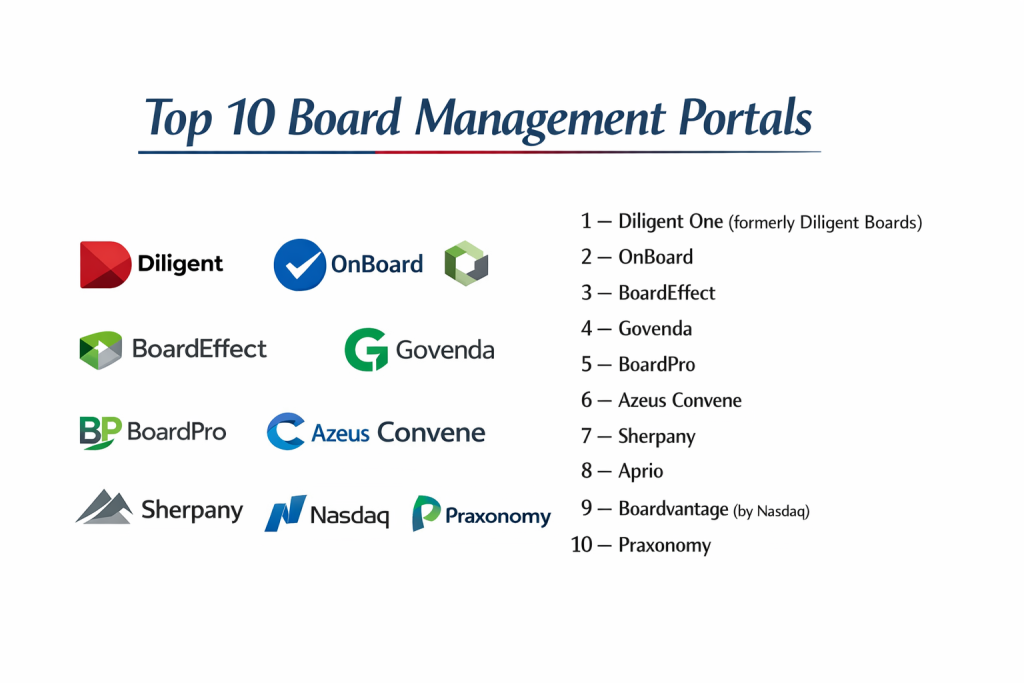
Top 10 Board Management Portals
1 — Diligent One (formerly Diligent Boards)
Diligent is the most widely used board portal globally, known for its extensive feature set and deep focus on modern governance and ESG (Environmental, Social, and Governance) tracking.
- Key features:
- Unified dashboard for board meetings, entity management, and risk data.
- Intuitive “Digital Board Book” builder with drag-and-drop functionality.
- Secure messaging via Diligent Messenger to keep board chats off SMS/email.
- Integrated voting, signatures, and evaluations.
- Granular permission controls for specific committees and sub-groups.
- ESG and climate reporting integration.
- Pros:
- Unmatched global scale and a massive user community of directors.
- Very high security standards often preferred by financial and government sectors.
- Cons:
- Considered one of the most expensive options on the market.
- The interface can feel heavy due to the sheer number of integrated modules.
- Security & compliance: SOC 2 Type II, ISO 27001, HIPAA, GDPR, and FedRAMP (in specific versions).
- Support & community: 24/7/365 global support, dedicated customer success managers, and the “Diligent Institute” for governance research.
2 — OnBoard
OnBoard is a modern, high-growth portal known for its exceptional user interface and “intelligent” features that make meeting preparation faster for both admins and directors.
- Key features:
- Zoom and Microsoft Teams integration directly within the portal.
- Dues and compliance tracking for non-profit and healthcare boards.
- AI-driven “Meeting Intelligence” for better agenda planning.
- Real-time multi-device syncing for annotations and notes.
- Built-in e-signature and survey tools.
- Offline access with automatic data synchronization.
- Pros:
- Highly intuitive and requires almost zero training for directors.
- Excellent mobile app performance across iOS and Android.
- Cons:
- Advanced analytics features are locked behind higher-tier pricing.
- Smaller “ecosystem” of non-board governance tools compared to Diligent.
- Security & compliance: SOC 2 Type II, ISO 27001, HIPAA, and GDPR compliant.
- Support & community: 24/7 support, comprehensive onboarding, and an active user community forum.
3 — BoardEffect
BoardEffect is specifically tailored for the unique needs of non-profits, higher education, and healthcare organizations, focusing on the full “cycle” of board activity.
- Key features:
- Specialized modules for volunteer board member onboarding.
- Archive for historical documents and “institutional memory.”
- Workroom collaboration spaces for committees and task forces.
- Automated scheduling and RSVP tracking.
- Support for complex organizational hierarchies with multiple sub-boards.
- Conflict of interest tracking and policy management.
- Pros:
- Perfectly aligned with the workflow of non-profit governance.
- Cost-effective compared to enterprise-heavy tools like Diligent.
- Cons:
- Lacks some of the high-end financial risk modeling found in corporate portals.
- The user interface is functional but less “slick” than OnBoard.
- Security & compliance: SOC 2 Type II, HIPAA, and GDPR.
- Support & community: Dedicated client success teams and a strong focus on mission-driven organizations.
4 — Govenda
Govenda (formerly BoardBookit) is a female-founded company that provides a streamlined, relationship-driven approach to board management with transparent pricing.
- Key features:
- “Relationship Mapping” to identify potential conflicts of interest.
- Corporate entity management integrated with board activities.
- E-signatures and automated voting tallies.
- Unlimited users and committees on most plans.
- Easy-to-use agenda builder that converts to a PDF board book.
- Granular document access and audit trails.
- Pros:
- Very transparent pricing model compared to industry competitors.
- High degree of flexibility for smaller or growing organizations.
- Cons:
- Fewer integrations with third-party enterprise risk software.
- Reporting features are less robust than enterprise-grade competitors.
- Security & compliance: SOC 2 Type II and GDPR compliant.
- Support & community: High-touch customer support and a personalized onboarding experience.
5 — BoardPro
BoardPro is an ideal choice for small-to-medium enterprises (SMEs) and charities that need a simplified tool to professionalize their board meetings without the enterprise price tag.
- Key features:
- Automated minute-taking assistant to speed up post-meeting work.
- Smart agenda templates and “action item” tracking.
- Centralized document repository for board papers.
- Simplified voting and interest register.
- Integration with Xero for financial oversight (popular in SMEs).
- Mobile-friendly web interface for quick reviews.
- Pros:
- Extremely affordable and provides high ROI for smaller organizations.
- Focused strictly on essential features, reducing the “clutter” for users.
- Cons:
- Does not have the deep security certifications required by major banks or government.
- Lacks a dedicated offline-first mobile app compared to higher-end rivals.
- Security & compliance: Data encryption and standard secure hosting; SOC 2 (Varies/Check current status).
- Support & community: Excellent self-service knowledge base and responsive email/chat support.
6 — Azeus Convene
Convene is a multi-award-winning board portal that is particularly strong in the UK, Europe, and Asia, offering deep multi-device compatibility and high-end security.
- Key features:
- Live meeting mode that allows the presenter to control everyone’s screen.
- Extensive annotation tools including pen, highlighter, and sticky notes.
- Automated audit trails for every document view and edit.
- Advanced “Review Room” for pre-meeting discussions.
- Dual-factor authentication and remote data wipe.
- Native apps for Windows, Mac, iOS, and Android.
- Pros:
- One of the best “Live Meeting” experiences in the category.
- Very strong international presence with localized support.
- Cons:
- The setup process can be more complex than “plug-and-play” rivals like OnBoard.
- Interface can feel slightly technical for very senior board members.
- Security & compliance: ISO 27001, SOC 2, HIPAA, and GDPR.
- Support & community: 24/7 global support and on-site training availability for enterprise clients.
7 — Sherpany
Sherpany is a premium European board portal that focuses on “Meeting Management” as a discipline, aiming to make leadership teams more productive by reducing meeting time.
- Key features:
- “Meeting Design” templates to ensure every session has a clear goal.
- Preparation tracking: Admins can see who has read the materials.
- Encrypted messaging and secure document distribution.
- Digital voting and resolution tracking.
- High-end offline mode for mobile devices.
- Focus on executive committees (ExCo) in addition to boards.
- Pros:
- Exceptional focus on “Strategic” meeting outcomes rather than just document storage.
- Adheres to the strictest European data privacy standards.
- Cons:
- Pricing is at the top of the market.
- Not as widely adopted in North America as Diligent or OnBoard.
- Security & compliance: ISO 27001, ISAE 3000, and GDPR compliant.
- Support & community: Dedicated “Meeting Scientists” to help improve board culture and support.
8 — Aprio
Aprio is known for providing “enterprise-level features with a boutique service feel.” It is highly regarded for its balance of security and affordability for mid-market firms.
- Key features:
- Single-click board book generation.
- Secure voting, surveys, and polls.
- Calendar sync with Outlook and Google.
- Archive for past board meetings and historical data.
- Dedicated “Legal and Compliance” section for corporate records.
- Granular user permissions for various stakeholders.
- Pros:
- Exceptional customer service and personalized training.
- Includes “Unlimited Training” for new directors as they join the board.
- Cons:
- Mobile app is good but lacks some of the advanced features found in Convene or OnBoard.
- Integrations with external GRC (Governance, Risk, Compliance) suites are limited.
- Security & compliance: SOC 2 Type II and GDPR compliant.
- Support & community: 24/7 support with a “no-wait” policy and dedicated success managers.
9 — Boardvantage (by Nasdaq)
Owned by Nasdaq, this portal is built for the high-pressure environment of public companies and highly regulated financial institutions.
- Key features:
- Deep integration with Nasdaq’s corporate services.
- “TeamSpaces” for secure collaboration outside of board meetings.
- Advanced multi-factor authentication and biometric login.
- Signature workflows for regulatory filings.
- Conflict of interest and D&O (Directors and Officers) questionnaires.
- Real-time notifications for document updates.
- Pros:
- The “Nasdaq” brand provides significant peace of mind for public companies.
- Designed specifically to handle high-volume document workflows.
- Cons:
- Can feel overly “corporate” and rigid for non-profits or smaller SMEs.
- The pricing can be complex due to Nasdaq’s modular service structure.
- Security & compliance: SOC 2, ISO 27001, and GDPR.
- Support & community: Global enterprise support and access to Nasdaq’s governance insights.
10 — Praxonomy
Praxonomy is a streamlined, cloud-native board portal designed to be “fast, simple, and secure.” It is an excellent choice for organizations that want modern security without the legacy complexity.
- Key features:
- Centralized document repository with smart search.
- Agenda builder with automatic PDF conversion.
- Secure voting and resolution tracking.
- Audit logs for transparency and compliance.
- Task management for board-level actions.
- Collaborative private notes for directors.
- Pros:
- Very modern, clean interface that feels like a 2026 SaaS app.
- Highly competitive pricing for the mid-market.
- Cons:
- Fewer specialized features for healthcare or government-specific boards.
- Lacks the massive global “Community” and research arms of Diligent or Sherpany.
- Security & compliance: ISO 27001 and GDPR compliant.
- Support & community: Reliable customer support and straightforward onboarding documentation.
Comparison Table
| Tool Name | Best For | Platform(s) Supported | Standout Feature | Rating |
| Diligent One | Global Enterprise | Web, iOS, Android, Win | ESG/Risk Integration | 4.3 / 5 |
| OnBoard | Mid-Market / SMEs | Web, iOS, Android, Win | Zoom/Teams Integration | 4.8 / 5 |
| BoardEffect | Non-Profits / Higher Ed | Web, iOS, Android | Mission-Cycle Focus | 4.4 / 5 |
| Govenda | Relationship Mgmt | Web, iOS, Android | Relationship Mapping | 4.7 / 5 |
| BoardPro | Small Charity / SME | Web (Mobile Responsive) | Minute-Taking Assist | 4.5 / 5 |
| Convene | Live Meeting Focus | Web, iOS, Android, Mac | Live Presenter Mode | 4.6 / 5 |
| Sherpany | Strategic Productivity | Web, iOS, Android | Meeting Design Templates | 4.7 / 5 |
| Aprio | Boutique Service | Web, iOS, Android | Unlimited User Training | 4.8 / 5 |
| Boardvantage | Public Companies | Web, iOS, Android | Nasdaq Ecosystem | 4.1 / 5 |
| Praxonomy | Simple Mid-Market | Web, iOS | Clean SaaS Interface | 4.5 / 5 |
Evaluation & Scoring of Board Management Portals
| Criteria | Weight | Evaluation Focus |
| Core Features | 25% | Board book builder, voting, minutes, and annotations. |
| Ease of Use | 15% | Director adoption rate and administrative efficiency. |
| Integrations | 15% | Sync with Teams/Zoom, Outlook/Google, and GRC tools. |
| Security & Compliance | 10% | Encryption, MFA, SOC 2, and remote wipe capabilities. |
| Performance | 10% | App speed, offline reliability, and syncing speed. |
| Support & Community | 10% | 24/7 availability and board-specific training. |
| Price / Value | 15% | Total cost vs. governance risk reduction. |
Which Board Management Portal Is Right for You?
Small to Mid-Market vs. Enterprise
For SMEs and small charities, the priority is cost-efficiency and ease of setup. BoardPro or Praxonomy are excellent starting points. Mid-Market organizations with 50-500 employees usually find the best balance with OnBoard or Aprio. Enterprise organizations—especially those that are global or public—require the deep risk integration and global footprint of Diligent One or Nasdaq Boardvantage.
Budget and Value
If you are budget-conscious, BoardPro offers a transparent entry-level price that covers the essentials. For organizations where the “cost of a breach” or a governance failure is catastrophic, the premium price of Diligent or Sherpany is seen as an insurance policy. Always look at the total cost of ownership, including fees for additional users or committees.
Technical Depth vs. Simplicity
If your board members are not tech-savvy, OnBoard and Aprio win on simplicity. They are designed to feel like common consumer apps. If your board requires technical depth—such as integrated ESG data, real-time risk feeds, or complex multi-entity management—you must sacrifice some simplicity for the power of Diligent.
Security and Compliance Requirements
Banking, Healthcare, and Government sectors have non-negotiable Security and Compliance needs. Ensure your choice has at least SOC 2 Type II and ISO 27001 certification. If you are a US federal contractor, Diligent is one of the few with a FedRAMP authorized version. For European companies, Sherpany or Convene offer superior alignment with regional privacy laws.
Frequently Asked Questions (FAQs)
What is a board portal?
A board portal is a secure digital platform where directors access board books, vote on resolutions, and collaborate. It replaces paper board books and insecure email communication.
Are board portals safer than email?
Yes. Portals use AES 256-bit encryption and allow for “remote wipe” of data. Emails are often unencrypted and can be intercepted or forwarded to unauthorized parties.
How much does a board portal cost?
Pricing varies widely. Small organizations might pay $2,000–$5,000 annually, while large enterprise solutions can exceed $50,000 depending on the number of users and features.
Can I use these tools on an iPad?
Absolutely. Most board members prefer iPads for reading board books. Tools like OnBoard, Diligent, and Convene have dedicated iOS apps optimized for tablet use.
Do these portals work offline?
Yes, most top-tier portals allow you to download board books for offline reading. Annotations made while offline will sync the next time you connect to the internet.
What is a “Digital Board Book”?
It is a single, hyperlinked PDF or interactive document containing the agenda and all supporting reports for a meeting, designed for easy navigation on a screen.
How long does it take to set up a board portal?
Implementation can take anywhere from a few days for a small non-profit to several weeks for a large corporation requiring data migration and extensive training.
Can we vote on resolutions in the portal?
Yes. Board portals include “Consent” or “Voting” modules that provide a legal audit trail of director approvals between formal meetings.
What happens if a director loses their device?
Administrators can remotely wipe the board data from that specific device through the portal’s management console, ensuring no confidential data is exposed.
Is training included?
Most premium providers (like Aprio and OnBoard) include unlimited training for new directors as part of their subscription, recognizing that board turnover is common.
Conclusion
Selecting a board management portal is a critical step in modernizing your organization’s governance. The “best” tool isn’t necessarily the one with the most features, but the one that your board members will actually use. If the technology is too cumbersome, directors will revert to insecure methods like printing documents or using personal email, which defeats the purpose of the investment.
For those prioritizing user experience and modern design, OnBoard and Sherpany are leading the way. For organizations that need a massive ecosystem of governance and risk tools, Diligent remains the industry standard. Meanwhile, non-profits and SMEs have high-quality, affordable options in BoardEffect and BoardPro. By centralizing your board’s activity in a secure portal, you not only protect your organization’s most sensitive data but also empower your leadership to make better, faster, and more informed decisions.