Introduction
Attack Surface Management (ASM) is the continuous process of discovering, analyzing, remediating, and monitoring the cybersecurity vulnerabilities and potential attack vectors that make up an organization’s digital footprint. Unlike traditional vulnerability scanning, which often focuses on known assets within a network, ASM takes an “outside-in” perspective. It mimics the vantage point of an adversary, looking for everything from forgotten subdomains and exposed database ports to misconfigured cloud buckets and “Shadow IT” instances that the security team might not even know exist.
ASM is critical because the digital perimeter has effectively dissolved. With the rise of remote work, multi-cloud environments, and third-party SaaS integrations, an organization’s attack surface expands daily. Key real-world use cases include identifying abandoned marketing websites that are susceptible to takeover, detecting leaked API keys on public repositories, and uncovering subsidiary networks that lack enterprise-grade security controls. When evaluating ASM tools, users should prioritize discovery accuracy, asset attribution (ensuring the found asset actually belongs to you), and risk-based prioritization to avoid being overwhelmed by data.
Best for: ASM tools are indispensable for CISOs, IT Security Managers, and SOC analysts at mid-to-large enterprises. They are particularly vital for organizations undergoing rapid digital transformation, M&A activity, or those operating in highly regulated sectors like finance, healthcare, and technology.
Not ideal for: Small businesses with a static, localized footprint (e.g., a single brick-and-mortar shop with one website). For these users, a standard website firewall and basic automated vulnerability scanner are usually sufficient. ASM may also be redundant for teams that have already achieved 100% centralized control through strict Managed Service Provider (MSP) constraints.
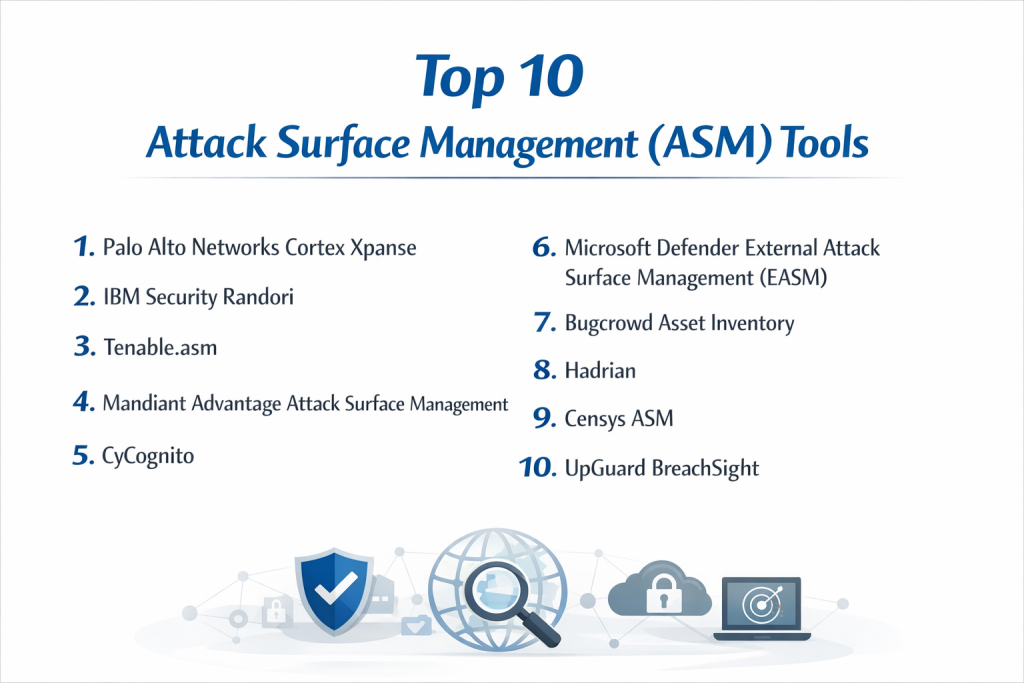
Top 10 Attack Surface Management (ASM) Tools
1 — Palo Alto Networks Cortex Xpanse
Cortex Xpanse is arguably the most powerful ASM platform on the market, providing an automated, “outside-in” view of the entire global internet to find an organization’s exposed assets.
- Key Features:
- Internet-Scale Sensing: Scans the entire IPv4 space multiple times a day to find your assets.
- Automated Attribution: Uses advanced algorithms to map discovered IPs and domains to your specific brand.
- Shadow IT Discovery: Finds cloud instances and servers created outside of official IT channels.
- RDP & Database Exposure Tracking: Specifically flags high-risk ports exposed to the public web.
- Cloud Governance: Monitors AWS, Azure, and GCP for misconfigurations and rogue buckets.
- Pros:
- Unrivaled data depth; it finds assets that other scanners miss.
- Integrates seamlessly with the broader Cortex XDR and XSOAR ecosystem for rapid response.
- Cons:
- High price point makes it primarily an enterprise-only solution.
- The volume of data can be intimidating for smaller security teams to parse.
- Security & Compliance: SOC 2 Type II, ISO 27001, FedRAMP authorized, and GDPR compliant.
- Support & Community: Comprehensive enterprise support, dedicated account managers, and a vast library of technical training via Palo Alto’s Beacon portal.
2 — IBM Security Randori
IBM’s acquisition of Randori brought a “Hacker-Led” philosophy to ASM, focusing on which assets an attacker would actually target first based on “temptation.”
- Key Features:
- Target Temptation Score: Prioritizes assets based on how attractive they are to real-world hackers.
- Black-Box Discovery: Requires only an email domain to begin mapping the entire attack surface.
- Randori Attack: An integrated automated pentesting module to validate if a hole can be exploited.
- Continuous Monitoring: Alerts in real-time when a new high-value asset appears.
- Bi-Directional API: Easily pushes data to SIEM and SOAR platforms for remediation.
- Pros:
- Provides a very clear, prioritized “to-do” list for security teams.
- The “temptation” logic helps reduce alert fatigue significantly.
- Cons:
- Focuses more on perimeter attack vectors than internal cloud misconfigurations.
- Some users find the reporting interface less granular than competitors.
- Security & Compliance: ISO 27001, SOC 2, and GDPR compliant.
- Support & Community: Benefit from IBM’s global support infrastructure and the X-Force threat intelligence community.
3 — Tenable.asm
Tenable.asm (formerly Bit Discovery) provides a comprehensive map of the digital environment, leveraging Tenable’s long history in vulnerability management.
- Key Features:
- Asset Inventory: Maintains a living record of every domain, certificate, and service.
- 500+ Metadata Filters: Allows users to slice and dice data to find specific risks (e.g., expired SSL).
- Subsidiary Monitoring: Easily tracks the security posture of different business units or acquired companies.
- Tenable.one Integration: Part of the broader “Exposure Management” platform.
- Change Detection: Notifies the team when a service changes or a new port opens.
- Pros:
- Exceptional at identifying “dangling DNS” and forgotten subdomains.
- Very intuitive user interface that is easy for junior analysts to navigate.
- Cons:
- Best utilized as part of the Tenable ecosystem; standalone value is slightly lower.
- Discovery speed for very large, complex networks can vary.
- Security & Compliance: SOC 2, HIPAA, and GDPR compliant.
- Support & Community: Strong community forums and a robust “Tenable University” for certification.
4 — Mandiant Advantage Attack Surface Management
Now part of Google Cloud, Mandiant provides ASM fueled by some of the world’s most advanced threat intelligence and incident response data.
- Key Features:
- Intelligence-Led Discovery: Maps assets based on known tactics used by sophisticated threat actors.
- Operationalized Insights: Provides clear instructions on how to remediate found issues.
- Global Footprint Mapping: Visualizes where in the world your digital assets are physically hosted.
- Third-Party Risk: Ability to monitor the external attack surface of critical vendors.
- Google Cloud Integration: Deep visibility into GCP environments.
- Pros:
- Backed by world-class threat intelligence from Mandiant’s frontline responders.
- Excellent at identifying nation-state level vulnerabilities and exposures.
- Cons:
- Can be technically complex to set up for smaller organizations.
- Integration with non-Google/non-Mandiant tools is still maturing.
- Security & Compliance: FedRAMP, SOC 2, and ISO 27001 compliant.
- Support & Community: High-tier professional services and 24/7 enterprise-grade support.
5 — CyCognito
CyCognito takes a unique approach by attempting to discover “paths of least resistance” across the entire ecosystem, including third parties and subsidiaries.
- Key Features:
- Full Path Discovery: Maps the relationship between assets to see how an attacker might pivot.
- Automated Security Testing: Regularly tests discovered assets for common vulnerabilities.
- Business Context Attribution: Assigns assets to specific business owners or departments.
- Risk Benchmarking: Compares your attack surface risk against industry peers.
- Exposed Data Detection: Finds leaked credentials and sensitive files in the public domain.
- Pros:
- Superior asset attribution; it rarely misses a subsidiary or “unowned” asset.
- Very strong at uncovering risks in third-party supply chains.
- Cons:
- The “automated testing” can occasionally trigger security alerts on your own network.
- Pricing is based on the scale of the attack surface, which can scale quickly.
- Security & Compliance: SOC 2 Type II and GDPR compliant.
- Support & Community: Proactive customer success teams and detailed onboarding documentation.
6 — Microsoft Defender External Attack Surface Management (EASM)
Based on the acquisition of RiskIQ, Microsoft EASM is a built-in solution for Azure users that maps the “known and unknown” internet.
- Key Features:
- RiskIQ Data Integration: Leverages one of the world’s largest internet datasets.
- Automated Discovery: Finds assets related to your brand via seeds like domains and IPs.
- Dashboard Integration: Displays EASM data directly within the Microsoft 365 Defender portal.
- Vulnerability Tracking: Identifies CVEs on external-facing software versions.
- Bill-thru-Azure: Convenient procurement for existing Microsoft enterprise customers.
- Pros:
- Incredibly easy to “turn on” for organizations already in the Microsoft ecosystem.
- Large historical dataset allows for “time-travel” to see past exposures.
- Cons:
- Reporting and customization are less flexible than boutique ASM tools.
- Can be difficult to manage for companies with massive non-Azure footprints.
- Security & Compliance: ISO 27001, SOC 2, FedRAMP High, and GDPR compliant.
- Support & Community: Vast Microsoft community and global technical support.
7 — Bugcrowd Asset Inventory
Bugcrowd leverages its massive “crowd” of ethical hackers to provide an ASM solution that combines automated discovery with human intelligence.
- Key Features:
- Continuous Discovery: Constantly monitors for new assets in the background.
- Crowdsourced Validation: Uses humans to verify if a discovered asset is actually a risk.
- Vulnerability Disclosure Integration: Links ASM directly to your bug bounty program.
- Shadow IT Attribution: Finds rogue web apps and APIs created by developers.
- Prioritized Remediation: Focuses on the “P1” issues that lead to breaches.
- Pros:
- Very low false-positive rate because of the human-in-the-loop validation.
- Excellent for organizations that also run Bug Bounty or VDP programs.
- Cons:
- Not a pure “software” solution; requires more interaction with the platform.
- Discovery depth on non-web assets (like legacy VOIP) can be lower than Xpanse.
- Security & Compliance: SOC 2 Type II, ISO 27001, and HIPAA compliant.
- Support & Community: Access to a massive community of world-class security researchers.
8 — Hadrian
Hadrian is a newer, European-based entry that focuses on “AI-driven” offensive security, providing continuous, high-speed testing of the attack surface.
- Key Features:
- Event-Based Scanning: Triggers a scan the moment a DNS record or IP changes.
- Autonomous Hacking: Uses AI to simulate the steps an attacker would take to exploit a bug.
- Real-Time Dashboards: Displays a live “Hacker’s View” of your organization.
- Cloud-Native Sensors: Specifically tuned for modern, ephemeral cloud environments.
- API-First Design: Built to integrate with modern DevOps pipelines.
- Pros:
- Extremely fast; it often discovers and tests new assets within minutes.
- Very modern UI/UX that appeals to technical security engineers.
- Cons:
- Smaller brand presence in the US market compared to Palo Alto or IBM.
- Automated exploitation features require careful monitoring to avoid disruption.
- Security & Compliance: GDPR compliant and SOC 2 ready.
- Support & Community: High-touch startup support with direct access to engineering teams.
9 — Censys ASM
Censys is a pioneer in internet-wide scanning data. Their ASM platform is built on top of the same search engine used by thousands of security researchers.
- Key Features:
- Search-Engine Grade Data: Access to one of the most accurate maps of the internet.
- Certificate Transparency Monitoring: Finds assets via SSL/TLS certificates.
- Cloud Connector: Correlates internal cloud data with external scan data.
- Inventory Export: Easily export asset lists to spreadsheets or SIEMs.
- Log Analysis: Tracks how your attack surface has evolved over the last year.
- Pros:
- The data accuracy is widely considered the “gold standard” for research.
- Great for finding assets via “soft” markers like certificates and Favicons.
- Cons:
- Lacks the automated “remediation” and “response” features of larger XDR platforms.
- Attribution can sometimes require manual “fine-tuning” by an analyst.
- Security & Compliance: SOC 2 and GDPR compliant.
- Support & Community: Massive community of researchers and a robust API documentation library.
10 — UpGuard Breachsight
UpGuard focuses on the intersection of Attack Surface Management and Third-Party Risk Management (TPRM).
- Key Features:
- Identity Leak Detection: Finds employee credentials on the dark web and public forums.
- Domain Hijacking Prevention: Identifies expired or vulnerable DNS records.
- Typosquatting Monitoring: Alerts you if someone registers a domain similar to yours.
- Security Ratings: Assigns a “score” to your organization and your vendors.
- Automated Questionnaires: Combines ASM data with vendor risk surveys.
- Pros:
- The best tool for teams that need to manage both their own risk and vendor risk.
- Excellent dark web monitoring capabilities included in the platform.
- Cons:
- Asset discovery is slightly less technical than “hacker-centric” tools like Randori.
- Focuses more on “brand risk” than deep network exploitation.
- Security & Compliance: ISO 27001, SOC 2, and GDPR compliant.
- Support & Community: Highly rated customer support and a very active blog/webinar series.
Comparison Table
| Tool Name | Best For | Platform(s) Supported | Standout Feature | Rating (Gartner) |
| Cortex Xpanse | Large Enterprises | SaaS / Cloud | Internet-Scale Sensing | 4.8 / 5 |
| IBM Randori | Hacker-Led Logic | SaaS | Target Temptation Score | 4.6 / 5 |
| Tenable.asm | Asset Attribution | SaaS / Hybrid | 500+ Metadata Filters | 4.4 / 5 |
| Mandiant ASM | Threat Intel Focus | SaaS / GCP | Intelligence-Led Discovery | 4.7 / 5 |
| CyCognito | Third-Party Risk | SaaS | Path of Least Resistance | 4.5 / 5 |
| MS Defender EASM | Azure Users | SaaS / Azure | RiskIQ Dataset Integration | 4.3 / 5 |
| Bugcrowd Asset | Human Validation | SaaS / Hybrid | Crowdsourced Verification | 4.5 / 5 |
| Hadrian | Rapid Automation | SaaS | Event-Based Scanning | N/A |
| Censys ASM | Data Accuracy | SaaS | Search-Engine Grade Data | 4.4 / 5 |
| UpGuard | TPRM & Brand Risk | SaaS | Identity Leak Detection | 4.6 / 5 |
Evaluation & Scoring of [Attack Surface Management (ASM)]
Choosing an ASM tool requires a balance between technical depth and administrative ease. We have evaluated these tools based on the following weighted rubric:
| Category | Weight | Evaluation Criteria |
| Core Features | 25% | Discovery depth, attribution accuracy, and risk prioritization. |
| Ease of Use | 15% | Dashboard clarity, setup speed, and reporting intuitiveness. |
| Integrations | 15% | Native connectors for SIEM, SOAR, and Cloud Providers. |
| Security & Compliance | 10% | Encryption, SSO, and adherence to international data standards. |
| Performance | 10% | Refresh rate (how often the internet is scanned for your assets). |
| Support & Community | 10% | Quality of documentation and availability of technical help. |
| Price / Value | 15% | Transparency of pricing and overall Return on Investment. |
Which [Attack Surface Management (ASM)] Tool Is Right for You?
The “right” ASM tool depends heavily on your current infrastructure and your team’s technical maturity.
Solo Users vs SMB vs Mid-market vs Enterprise
- SMBs: Look for tools that provide high automation and clear “to-do” lists. UpGuard or Tenable.asm are great choices because they are easy to navigate without a dedicated 24/7 SOC.
- Mid-Market: IBM Randori or CyCognito offer a great balance of technical depth and prioritized risk management.
- Enterprise: Cortex Xpanse or Mandiant ASM are the heavy hitters. They provide the global scale and deep threat intelligence required to manage thousands of distributed assets.
Budget-conscious vs Premium Solutions
- Budget-conscious: If you already use Azure, Microsoft EASM is often the most cost-effective “bolt-on.” For pure data without the “management” bells and whistles, Censys provides excellent value.
- Premium: Cortex Xpanse is a premium investment, but it replaces multiple manual discovery processes and provides the highest level of security assurance.
Feature Depth vs Ease of Use
- If you want Ease of Use, go with UpGuard. It feels more like a management platform than a hacking tool.
- If you want Feature Depth, go with Hadrian or Cortex Xpanse, which allow for deeper technical investigation into the “guts” of the discovered assets.
Frequently Asked Questions (FAQs)
1. Is ASM the same as Vulnerability Scanning?
No. Vulnerability scanners (like Nessus) usually scan known IPs from the inside. ASM discovers the IPs you didn’t know you had from the outside.
2. How long does it take to see results?
Most ASM tools can provide an initial map of your attack surface within 24 to 48 hours of entering your primary domain name.
3. Does ASM find Shadow IT?
Yes. This is one of the primary use cases. It finds servers or cloud buckets created by developers or marketing teams that were never reported to the security department.
4. Can ASM tools break my website?
Generally, no. Most ASM tools perform “passive” or “low-impact” discovery. However, tools with “automated testing” or “exploitation” features should be used with caution.
5. How does ASM handle “False Positives”?
Attribution is the hardest part of ASM. Top-tier tools (like CyCognito) use machine learning and human validation to ensure that a discovered asset actually belongs to your company.
6. Do I need an agent to run ASM?
No. ASM is “agentless.” It looks at your organization from the public internet, just like an attacker would.
7. Can ASM help with M&A?
Yes. It is incredibly useful for quickly auditing the security posture of a company you are planning to acquire before you merge their network with yours.
8. What is “Attribution” in ASM?
Attribution is the process of proving an asset belongs to you. Tools look at SSL certificates, DNS records, and website content to “fingerprint” your organization.
9. Does ASM cover the Dark Web?
Some tools, like UpGuard, include dark web monitoring for leaked credentials. Others focus strictly on the “Visible” and “Deep” web (IPs and Domains).
10. Why is ASM better than a manual Pentest?
A pentest is a “point-in-time” check. ASM is continuous. It finds a new exposure the day it happens, rather than waiting for your annual audit.
Conclusion
The digital age has made “security through obscurity” impossible. If a server is connected to the internet, an attacker will find it. Attack Surface Management (ASM) is about finding it first.
When choosing a tool, the most important factor is Discovery Accuracy. A tool that gives you a thousand false positives is just more noise for your team. If you are an Azure shop, start with Microsoft EASM. If you are a large enterprise with a complex global footprint, Cortex Xpanse is the gold standard. For those looking for a “hacker’s eye view,” Randori is the way to go.
Ultimately, the best ASM tool is the one that integrates into your daily workflow and helps your team sleep better knowing that the “unknown” is finally visible.