Introduction
Algorithmic Trading Platforms are high-performance software environments that allow traders to automate their investment strategies using pre-defined rules, mathematical models, and computer code. Instead of manually clicking “buy” or “sell,” a user programs an algorithm (or “algo”) to monitor the market for specific conditions—such as a price breakout, a moving average crossover, or a news-driven volatility spike—and execute trades at speeds and frequencies impossible for a human. These platforms act as the bridge between a trader’s logic and the global exchanges, providing the infrastructure for data analysis, strategy backtesting, and lightning-fast execution.
The importance of these platforms has surged as markets become increasingly digital and fragmented. In a landscape where milliseconds can determine the profitability of a trade, algorithmic software eliminates the “human factor”—specifically emotional bias, fatigue, and slow reaction times. By leveraging these tools, traders can maintain a disciplined approach, diversify across hundreds of assets simultaneously, and “stress-test” their ideas against years of historical data before risking a single dollar. Modern platforms have democratized this technology, moving it from the secretive basements of Wall Street banks to the desktops of retail investors and quantitative professionals worldwide.
Key Real-World Use Cases
Algorithmic trading platforms are utilized across a variety of financial disciplines to optimize performance:
- Systematic Trend Following: Automating the entry and exit of positions based on momentum indicators across dozens of global currency pairs.
- High-Frequency Trading (HFT): Executing thousands of orders per second to capture tiny price discrepancies in liquid equities or futures.
- Arbitrage: Simultaneously buying and selling the same asset on different exchanges (e.g., Bitcoin on two different crypto platforms) to profit from price differences.
- Portfolio Rebalancing: Automatically adjusting the weightings of a retirement portfolio every time an asset deviates from its target percentage.
- Institutional Execution: Using “VWAP” (Volume Weighted Average Price) algos to break up massive orders into smaller pieces to avoid moving the market price.
What to Look For (Evaluation Criteria)
When choosing an algorithmic trading platform, you must look beyond the user interface and evaluate the “under-the-hood” capabilities:
- Programming Language Support: Does it use a proprietary language (like EasyLanguage) or standard languages like Python or C#?
- Backtesting Engine Quality: Can the platform simulate slippage, commissions, and “look-ahead bias” accurately to ensure realistic results?
- Data Latency: How fast is the data feed, and is the execution engine co-located near the exchange servers?
- Market Connectivity: Does the tool connect to your preferred broker or exchange via a robust API or FIX protocol?
Best for:
- Quantitative Analysts (Quants): Who need deep data and coding flexibility to build complex statistical models.
- Active Day Traders: Looking to automate repetitive setups and scan multiple markets at once.
- Hedge Funds and Prop Firms: That require institutional-grade execution and multi-asset management.
- Crypto Enthusiasts: Who want to trade 24/7 in volatile markets without being glued to a screen.
Not ideal for:
- Passive Long-Term Investors: Who only trade a few times a year and are better served by simple brokerage apps.
- Absolute Beginners: Who lack basic knowledge of technical analysis or market mechanics, as the “garbage in, garbage out” rule applies to algorithms.
- Discretionary “Gut” Traders: Who prefer to trade based on intuition rather than rigid, rule-based systems.
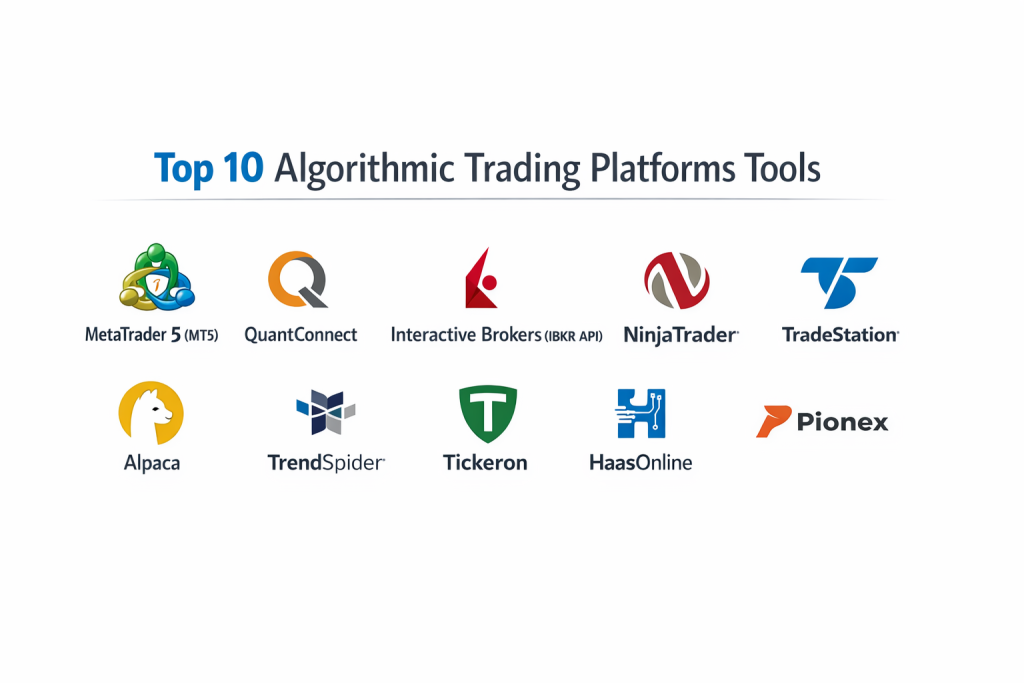
Top 10 Algorithmic Trading Platforms Tools
1 — MetaTrader 5 (MT5)
MetaTrader 5 is the successor to the legendary MT4, widely considered the standard for retail algorithmic trading in Forex and CFDs. It offers a powerful environment for “Expert Advisors” (EAs).
Key features:
- MQL5 Scripting: A high-level, object-oriented language designed specifically for financial trading.
- Multi-Threaded Strategy Tester: Allows for rapid backtesting of complex strategies using real tick data.
- Marketplace Integration: Built-in access to thousands of ready-made robots and indicators.
- Virtual Hosting (VPS): One-click cloud hosting to ensure algorithms run 24/7 without interruption.
- Depth of Market (DOM): Real-time views of liquidity and order flow for advanced execution.
Pros:
- Completely free to use through most major brokerage firms.
- Massive community support; you can find an answer to any coding question instantly.
Cons:
- MQL5 is a proprietary language, meaning your skills aren’t easily transferable to other industries.
- Primarily focused on Forex/CFDs; integration with US-based equities is limited.
Security & compliance: Bank-grade encryption, 2FA, and compliant with major global regulators (FCA, ASIC, CySEC) through its broker partners.
Support & community: Extensive MQL5.com community, comprehensive documentation, and a global network of freelance developers.
2 — QuantConnect
QuantConnect is a cloud-based algorithmic trading platform that caters to quants who prefer institutional-quality data and coding in Python or C#.
Key features:
- LEAN Engine: An open-source trade execution engine that powers the entire platform.
- Multi-Language Support: Code in Python or C# within a browser-based IDE.
- Global Data Library: Access to high-resolution historical data for equities, options, futures, forex, and crypto.
- Alpha Streams: A marketplace where traders can license their successful algorithms to institutional investors.
- Cloud Backtesting: Run massive simulations across high-performance clusters without needing local hardware.
Pros:
- No infrastructure management; everything from data to servers is handled in the cloud.
- Uses industry-standard languages, making it a favorite for professional quant developers.
Cons:
- Requires significant coding knowledge; there is no “no-code” drag-and-drop builder.
- Free tier is limited; professional-grade data and compute power require a subscription.
Security & compliance: SOC 2 compliant, AES-256 encryption, and secure API key management via environment variables.
Support & community: Very active developer forum, professional Slack channel, and deep technical documentation.
3 — Interactive Brokers (IBKR API)
Interactive Brokers is the preferred choice for sophisticated traders who want to build their own custom platforms on top of a world-class brokerage infrastructure.
Key features:
- TWS API: Support for Python, C++, Java, .NET, and even Excel.
- Global Access: Automate trades on over 150 markets across 33 countries.
- Advanced Order Types: Access to 100+ order types and algos like VWAP and Accumulate/Distribute.
- Paper Trading: Highly realistic simulated environment to test API logic before going live.
- Fractional Shares: Ability to automate portfolio rebalancing even with high-priced stocks.
Pros:
- Lowest margin rates and commission costs in the industry for high-volume traders.
- Unmatched asset breadth; trade everything from gold to Japanese stocks from one API.
Cons:
- The API documentation is notoriously difficult and fragmented for beginners.
- Trader Workstation (TWS) software must often be running in the background to bridge the API.
Security & compliance: SEC/FINRA regulated, SIPC protection, and extremely robust multi-factor authentication (IB Key).
Support & community: Dedicated API support team, GitHub repositories, and institutional-grade webinars.
4 — NinjaTrader
NinjaTrader is a powerhouse for futures and forex traders, known for its high-performance charting and C#-based automation environment (NinjaScript).
Key features:
- NinjaScript: A powerful C#-based framework for building indicators and strategies.
- Market Analyzer: A real-time scanner that can trigger algorithms based on custom conditions.
- Advanced Backtesting: Includes “Walk Forward Optimization” to prevent over-fitting strategies.
- Strategy Builder: A point-and-click tool for non-coders to create automated logic.
- Direct Brokerage: Seamless execution through their own clearinghouse for low-cost futures trading.
Pros:
- Superior charting and order flow visualization compared to web-based platforms.
- Extensive library of 3rd-party add-ons (thousands of indicators and automated strategies).
Cons:
- The desktop software is Windows-only; Mac users must use a VPS or Parallels.
- Historical data for high-resolution backtesting often requires a paid subscription.
Security & compliance: NFA/CFTC regulated, segregated client funds, and SOC-compliant data centers.
Support & community: Daily live training webinars, a very helpful support forum, and 24/5 technical assistance.
5 — TradeStation
TradeStation is the pioneer of retail algorithmic trading, famous for its “EasyLanguage” which allows traders to write code using English-like syntax.
Key features:
- EasyLanguage: A proprietary language designed to be readable and easy to learn for non-programmers.
- RadarScreen: A real-time market monitoring tool that can track thousands of symbols simultaneously.
- Portfolio Maestro: Backtest and optimize strategies across an entire portfolio of assets at once.
- Strategy Optimization: Advanced genetic algorithms to find the best parameters for your strategy.
- Integrated Brokerage: One-click transition from backtest to live automated execution.
Pros:
- Excellent for traders who want to automate but aren’t professional software engineers.
- Comprehensive research and historical data are included for active account holders.
Cons:
- The platform can be resource-intensive and feel “dated” compared to modern SaaS tools.
- High inactivity fees for users who don’t trade frequently or maintain a high balance.
Security & compliance: SEC and FINRA regulated, SIPC insured, and utilizes high-level data encryption.
Support & community: Decades of “EasyLanguage” tutorials, a robust user forum, and dedicated client service reps.
6 — Alpaca
Alpaca is a modern, developer-first platform that provides a commission-free API for stock and crypto trading, built specifically for the “Fintech” era.
Key features:
- Restful API: Simple, modern API architecture that integrates easily with any programming language.
- Commission-Free: Zero-commission trading on US stocks and ETFs (perfect for high-frequency algos).
- Paper Trading: Unlimited free paper trading accounts with real-time market data.
- Webhooks: Trigger trades directly from 3rd party signals like TradingView or Slack.
- Market Data API: Built-in streaming data for real-time price updates.
Pros:
- The easiest setup for a developer; you can get an API key and place a trade in minutes.
- No minimum deposit, making it highly accessible for testing small-scale algorithms.
Cons:
- Limited asset classes (primarily US stocks and crypto); no futures or options.
- Basic web interface; not designed for manual charting or analysis.
Security & compliance: FINRA/SIPC member, utilizes OAuth for secure third-party integrations, and AES-256 encryption.
Support & community: Very active Slack and Discord communities, well-maintained GitHub SDKs, and excellent API docs.
7 — TrendSpider
TrendSpider is an AI-driven platform that bridges the gap between manual charting and full automation through “No-Code” strategy building.
Key features:
- Strategy Tester: A visual builder that allows you to backtest strategies without writing a single line of code.
- Automated Charting: AI-powered trendline and pattern recognition.
- Trading Bots: Deploy algorithms based on technical indicators or price action in a few clicks.
- Multi-Timeframe Analysis: Algorithms can monitor data across multiple timeframes simultaneously.
- Dynamic Alerts: Alerts that follow trendlines, allowing for automated entries on breakouts.
Pros:
- Ideal for “Visual Traders” who want the power of algorithms without the burden of coding.
- Cloud-based; your bots run in the cloud even when your computer is turned off.
Cons:
- Less flexible than code-based platforms for highly custom or complex statistical logic.
- Pricing is subscription-based and can be expensive for casual traders.
Security & compliance: SOC 2 Type II, secure cloud architecture, and encrypted API connections to brokers.
Support & community: High-quality video tutorials, active “TrendSpider University,” and responsive live chat support.
8 — Tickeron
Tickeron is an AI-powered marketplace and platform that uses “Artificial Intelligence Robots” to find and execute trade ideas for retail investors.
Key features:
- AI Robots: Pre-built algorithms that scan the market and provide entry/exit signals with “Odds of Success.”
- Pattern Recognition Engine: Scans thousands of stocks daily to find high-probability chart patterns.
- Trend Prediction Engine: Uses AI to predict the likely direction of an asset over the next several days.
- Portfolio Optimizer: Algorithms that suggest the best asset allocation to minimize risk.
- Paper Trade Integration: Test the AI’s suggestions in a risk-free environment.
Pros:
- “Ready-to-use” algorithms; great for people who want to follow proven mathematical models.
- Covers a wide range of assets including Stocks, ETFs, Forex, and Crypto.
Cons:
- The “Black Box” nature means you don’t always know exactly why the AI is making a specific trade.
- The user interface can be cluttered and overwhelming due to the sheer amount of data.
Security & compliance: Uses SSL encryption and secure payment processing; complies with standard consumer data protection laws.
Support & community: Educational webinars, a vast library of “How-to” articles, and email support.
9 — HaasOnline
HaasOnline is the most advanced platform for cryptocurrency algorithmic trading, offering deep customization through its “HaasScript” language.
Key features:
- HaasScript: A powerful, domain-specific language for building crypto-specific strategies.
- Visual Editor: A drag-and-drop “block” system for those who want to build bots without coding.
- Backtesting & Flash-Testing: High-speed testing using exchange-specific historical data.
- Arbitrage Bots: Specialized bots to profit from price differences across 20+ crypto exchanges.
- Non-Custodial: The platform never touches your funds; it only sends commands via API.
Pros:
- Unrivaled power in the crypto space; supports complex strategies like “Inter-exchange Arbitrage.”
- Extreme privacy; you can host the platform locally to keep your strategies 100% private.
Cons:
- Steep learning curve; even the visual editor requires an understanding of logic flows.
- Expensive pricing, often requiring payment in Bitcoin for the highest-tier plans.
Security & compliance: 2FA, IP whitelisting for APIs, and no access to withdrawal permissions (Varies by Exchange).
Support & community: Very active Telegram and Discord groups, extensive Wiki, and professional support tickets.
10 — Pionex
Pionex is a unique cryptocurrency exchange with 16 “Built-in” trading bots, making algorithmic trading accessible to everyone with zero setup.
Key features:
- Grid Trading Bot: Automatically buys low and sells high within a specified price range.
- Rebalancing Bot: Maintains a fixed ratio of assets (e.g., 50% BTC / 50% ETH) automatically.
- DCA (Dollar Cost Averaging) Bot: Automates recurring buys to smooth out volatility.
- Trailing Take Profit: An algo that lets profits run by only closing a trade when the price reverses.
- Low Fees: Industry-leading trading fees of only 0.05% for most bots.
Pros:
- Zero technical knowledge required; you just choose a bot and set the parameters.
- The bots are completely free to use (you only pay the standard trading fee).
Cons:
- Limited to the Pionex exchange; you cannot use these bots on Binance or Coinbase.
- No custom scripting; you are restricted to the 16 pre-defined bot types.
Security & compliance: FinCEN MSB licensed in the US, MAS (Singapore) pending, and utilizes deep liquidity from Binance and Huobi.
Support & community: Large community on Discord and Telegram, 24/7 live chat support, and easy-to-follow tutorials.
Comparison Table
| Tool Name | Best For | Platform(s) Supported | Standout Feature | Rating |
| MetaTrader 5 | Forex Traders | Windows, Mobile | Massive EA Ecosystem | 4.6 |
| QuantConnect | Quant Pros | Cloud (Browser) | Python/C# Cloud Compute | 4.8 |
| Interactive Brokers | Global Multi-Asset | API, Desktop | Institutional Infrastructure | 4.5 |
| NinjaTrader | Futures Traders | Windows (Desktop) | Advanced Order Flow | 4.7 |
| TradeStation | Active Strategy Builders | Desktop, Web | EasyLanguage Syntax | 4.4 |
| Alpaca | Developers (SaaS) | API, Web | Commission-Free Stock API | 4.7 |
| TrendSpider | No-Code Technicals | Cloud (Browser) | AI Chart Recognition | 4.6 |
| Tickeron | AI Signal Seekers | Web, Mobile | AI Odds of Success | 4.4 |
| HaasOnline | Crypto Power Users | Windows, Linux | HaasScript Customization | 4.7 |
| Pionex | Crypto Beginners | Web, Mobile | 16 Built-in Exchange Bots | 4.5 |
Evaluation & Scoring of Algorithmic Trading Platforms
| Criterion | Weight | Evaluation Focus |
| Core Features | 25% | Backtesting, execution speed, and language flexibility. |
| Ease of Use | 15% | UI/UX, learning curve, and “No-Code” options. |
| Integrations | 15% | API robustness and connectivity to major brokers/exchanges. |
| Security & Compliance | 10% | Encryption, 2FA, and regulatory standing of the provider. |
| Performance | 10% | Latency, uptime, and handling of high-frequency data. |
| Support | 10% | Documentation, community forums, and response times. |
| Price / Value | 15% | Licensing fees vs. trading commission savings. |
Which Algorithmic Trading Platforms Tool Is Right for You?
Solo Users vs SMB vs Mid-Market vs Enterprise
For Solo Users just starting out, Pionex or MetaTrader 5 offer the lowest barrier to entry. SMBs and Prop Firms usually gravitate toward NinjaTrader or TradeStation because they offer a balance of power and manageable costs. Mid-Market and Enterprise institutions (like hedge funds) almost exclusively use QuantConnect or Interactive Brokers API due to the need for institutional-grade data, Python integration, and global market access.
Budget-Conscious vs Premium Solutions
If you are Budget-Conscious, Alpaca (zero commissions) and Pionex (free bots) are the clear winners. On the Premium side, QuantConnect (professional data feeds) and HaasOnline (high license fees) are worth the investment for serious traders who need advanced features like high-performance cloud backtesting or cross-exchange arbitrage.
Feature Depth vs Ease of Use
For Ease of Use, TrendSpider and Tickeron are excellent because they handle the “math” via AI and visual builders. If you require absolute Feature Depth—the ability to control every single tick and micro-second of execution—you must choose a code-heavy platform like QuantConnect or NinjaTrader.
Integration and Scalability Needs
If you need to Scale a strategy across global markets (Asia, Europe, US), Interactive Brokers is the only logical choice. If your integration is purely focused on Web-based Fintech Apps, the Alpaca API is the most modern and scalable RESTful interface available.
Security and Compliance Requirements
Traders in highly regulated environments (like the US or UK) should prioritize Interactive Brokers, TradeStation, or NinjaTrader, as they are fully regulated broker-dealers. Crypto-specific platforms like HaasOnline offer security through non-custodial setups, meaning they never hold your money—they only send trade instructions to your exchange.
Frequently Asked Questions (FAQs)
Do I need to know how to code to use these platforms?
Not necessarily. Platforms like TrendSpider, Pionex, and the Tickeron AI robots offer “no-code” or “low-code” solutions. However, learning Python or C# will significantly expand what you can achieve.
Is algorithmic trading legal?
Yes, it is perfectly legal and accounts for over 70% of the volume in major stock markets. However, your algorithms must comply with exchange rules regarding market manipulation and “spoofing.”
Can I run my algorithms while my computer is off?
Yes, if you use a “Cloud-based” platform (like QuantConnect or TrendSpider) or host your desktop software (like MetaTrader 5) on a Virtual Private Server (VPS).
What is “Backtesting”?
Backtesting is the process of running your trading algorithm against historical market data to see how it would have performed in the past. It is a critical step to verify a strategy’s viability.
How much money do I need to start?
Some platforms like Alpaca and Pionex have $0 minimums. However, to effectively run most algorithms, a starting capital of $2,000–$5,000 is generally recommended to handle margin and drawdowns.
What is “Slippage”?
Slippage is the difference between the price you expect to get and the price at which the trade actually executes. High-quality platforms allow you to model this in your backtests.
Are these bots “Set and Forget”?
Absolutely not. Markets change, and a strategy that worked yesterday might fail tomorrow (known as “Alpha Decay”). Algorithms require constant monitoring and periodic optimization.
Which language is best for trading: Python or C++?
Python is the industry standard for research and data analysis due to its ease of use. C++ is used for high-frequency trading (HFT) where every microsecond of execution speed matters.
Can I trade Crypto and Stocks on the same platform?
Yes, platforms like QuantConnect, Interactive Brokers, and Tickeron support multi-asset trading, allowing you to manage stocks and crypto in one place.
What is “Over-fitting” in backtesting?
Over-fitting (or Curve Fitting) happens when you make your algorithm so specific to past data that it fails to perform in the real, unpredictable market.
Conclusion
The transition from manual to Algorithmic Trading is a significant milestone in any trader’s career. It represents a shift from “guessing” to “systematic execution.” As we have seen, the landscape of platforms is diverse: MetaTrader 5 remains the king of retail Forex, QuantConnect is the playground for professional quants, and Pionex has made bot trading accessible to the average crypto enthusiast.
The “best” platform isn’t the one with the most features, but the one that aligns with your technical skills and market focus. If you are a coder, embrace the flexibility of Alpaca or Interactive Brokers. If you are a visual thinker, let TrendSpider‘s AI do the heavy lifting. Ultimately, an algorithm is only as good as the logic behind it—choose the tool that allows you to express that logic most clearly and execute it most reliably.