Introduction
An Airline Reservation System (ARS) is the central engine that powers the modern aviation industry. At its core, it is a complex database and transaction processor that manages seat inventory, flight schedules, passenger manifests, and ticket prices. These systems connect airlines with travel agents, global distribution networks, and directly with passengers through websites and mobile apps. Without this technology, the global travel industry would come to a standstill, as these platforms ensure that every seat is accounted for and that no flight is overbooked beyond manageable limits.
The importance of an ARS lies in its ability to handle millions of transactions simultaneously while maintaining perfect accuracy. It isn’t just about booking a seat; it is about managing a dynamic ecosystem where prices change by the second based on demand, fuel costs, and competition. For an airline, the right system can mean the difference between a profitable flight and a loss, as it optimizes “yield management”—the art of selling the right seat to the right person at the right time.
Key Real-World Use Cases
- Inventory Management: Tracking how many seats are available across thousands of flights and different cabin classes (Economy, Business, First).
- Dynamic Pricing: Automatically adjusting ticket costs based on how many days are left until departure and current booking trends.
- Passenger Service (PSS): Managing the check-in process, baggage handling, and loyalty programs (Frequent Flyer miles).
- Interline Connectivity: Allowing a passenger to book a single journey that spans two or more different airlines seamlessly.
What to Look For (Evaluation Criteria)
When evaluating an airline reservation system, the most critical factor is reliability. A system downtime of even ten minutes can result in millions of dollars in lost revenue and stranded passengers. You should also look for scalability, ensuring the software can handle seasonal spikes in holiday travel. Ease of integration with Global Distribution Systems (GDS) like Amadeus or Sabre is essential for visibility. Finally, look for New Distribution Capability (NDC) support, which allows airlines to sell personalized offers and extras like extra legroom or meal upgrades directly to the consumer.
Best for: Commercial airlines of all sizes (charter, low-cost, or full-service), travel management companies, and large-scale travel agencies that require direct access to flight inventory.
Not ideal for: Small local tour operators who do not manage their own flight inventory, or individual travel bloggers who only need basic affiliate booking links rather than deep system access.
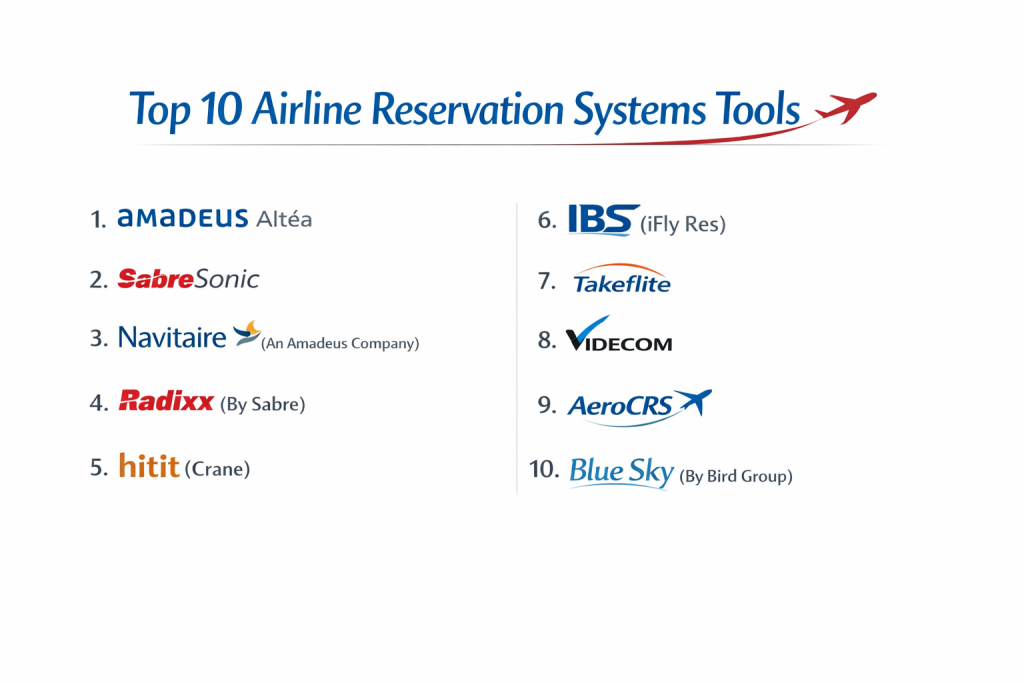
Top 10 Airline Reservation Systems Tools
1 — Amadeus Altéa
Amadeus Altéa is the industry heavyweight, used by many of the world’s leading full-service carriers. It is a comprehensive suite that covers everything from the initial booking to the final check-in at the gate.
- Key features:
- Full Passenger Service System (PSS) integration.
- Advanced revenue management and seat optimization.
- Real-time flight schedule and inventory updates.
- Direct connection to the world’s largest travel distribution network.
- Comprehensive loyalty program management.
- High-level automation for re-accommodating passengers during delays.
- Pros:
- Unmatched global reach and connectivity with travel agents worldwide.
- Highly stable architecture designed for massive, global airlines.
- Cons:
- Significant implementation time and very high cost.
- The interface can be overwhelming for smaller, regional teams.
- Security & compliance: Complies with GDPR, PCI-DSS for payments, and features SOC 2 Type II certification with heavy data encryption.
- Support & community: Global 24/7 support offices, extensive online documentation, and a massive ecosystem of certified developers.
2 — SabreSonic
Sabre is a major competitor to Amadeus, providing a highly flexible and data-driven reservation system. It is designed to help airlines grow their revenue through personalized customer offers.
- Key features:
- Intelligent retailing tools to sell ancillary services (bags, seats, wifi).
- Robust inventory and schedule management.
- Integrated check-in and departure control systems.
- Mobile-first design for passenger self-service.
- Advanced data analytics for market trend forecasting.
- Seamless integration with Sabre’s Global Distribution System.
- Pros:
- Excellent at “upselling” and maximizing revenue per passenger.
- Strong presence and reliability in the North American and global markets.
- Cons:
- Frequent updates can sometimes require staff to undergo constant re-training.
- Complex pricing structures that can be hard for mid-sized airlines to navigate.
- Security & compliance: Adheres to ISO 27001 standards, PCI-DSS, and features robust multi-factor authentication (MFA).
- Support & community: Offers “Sabre University” for training and high-touch account management for enterprise clients.
3 — Navitaire (An Amadeus Company)
Navitaire is specifically built for Low-Cost Carriers (LCCs) and “hybrid” airlines. It focuses on keeping costs low while maximizing efficiency and digital sales.
- Key features:
- High-volume transaction processing for ticketless travel.
- Simplified web-based booking engine.
- Ancillary revenue focus (charging for every extra service).
- Integrated loyalty and voucher management.
- Scalable cloud-based architecture.
- Automated email and SMS passenger notifications.
- Pros:
- Perfectly tailored for the “no-frills” business model where speed is key.
- Lower operational overhead compared to full-service systems.
- Cons:
- Lacks some of the complex “interlining” features needed for major global alliances.
- Customer service options are more streamlined and less “white-glove.”
- Security & compliance: Benefits from Amadeus’s corporate security standards, including GDPR and PCI compliance.
- Support & community: Good documentation and a strong community of low-cost carrier operators.
4 — Radixx (By Sabre)
Radixx provides a modern, cloud-native platform designed for small to mid-sized airlines. It is built to be agile, allowing smaller airlines to compete with the giants.
- Key features:
- Microservices-based architecture for better uptime.
- Direct-to-consumer booking engine (Internet Booking Engine).
- Comprehensive travel agent portal.
- Integrated departure control for airport operations.
- Flexible pricing modules for regional markets.
- Pros:
- Much faster to deploy than the massive enterprise systems.
- The cloud-native design means fewer hardware worries for the airline.
- Cons:
- May struggle with the sheer volume of a global “Tier 1” airline.
- Not as many third-party integrations as Amadeus or Sabre’s main lines.
- Security & compliance: SSAE 16 compliant, PCI-DSS certified, and uses modern cloud encryption.
- Support & community: Known for being more responsive to the specific needs of smaller regional airlines.
5 — Hitit (Crane)
Hitit is a rapidly growing provider that offers a modular approach. Airlines can pick and choose only the parts of the system they need, which is great for budget control.
- Key features:
- Crane PAX: The core reservation and passenger system.
- Crane RA: Advanced revenue accounting.
- Crane LL: Dedicated loyalty management.
- Multi-currency and multi-language support.
- Integrated schedule and slot management.
- Pros:
- One of the most user-friendly interfaces in the aviation world.
- Very cost-effective due to its modular “pay for what you use” model.
- Cons:
- Brand recognition is lower than the “Big Two” in some markets.
- Finding staff already trained on Crane can be harder than finding Amadeus experts.
- Security & compliance: ISO 9001 and ISO 27001 certified; fully compliant with international aviation data standards.
- Support & community: Offers 24/7 technical support and regular user group conferences.
6 — IBS Software (iFly Res)
IBS Software focuses on the “New-Gen” traveler. Their iFly Res system is built with a heavy emphasis on digital-first interaction and NDC (New Distribution Capability).
- Key features:
- Native NDC support for personalized retailing.
- Unified passenger profile to track history across all touchpoints.
- Social media booking integration.
- Real-time business intelligence dashboards.
- Highly flexible rule engine for promotions.
- Pros:
- Excellent for airlines that want to be “tech-forward” and mobile-centric.
- Strong focus on passenger experience and personalization.
- Cons:
- Implementation requires a high degree of technical collaboration.
- Can be expensive for very small regional carriers.
- Security & compliance: SOC 1 & SOC 2 compliant, GDPR ready, and features high-level data masking.
- Support & community: Strong professional services team to help with the initial digital transformation.
7 — Takeflite
Takeflite is a niche player that dominates the regional and “bush” airline market. It is designed for small fleets that operate in remote areas or small regional hops.
- Key features:
- All-in-one platform including cargo and passenger management.
- Offline mode for areas with poor internet connectivity.
- Simple seat map and booking management.
- Pilot and crew scheduling integration.
- Basic accounting and invoicing.
- Pros:
- Handles both cargo and passengers in one system—vital for regional airlines.
- Very simple to learn for small teams wearing many hats.
- Cons:
- Lacks the heavy-duty revenue management of global systems.
- Not designed for airlines with hundreds of aircraft.
- Security & compliance: Standard SSL encryption and basic PCI compliance; Varies based on regional setup.
- Support & community: Very personal support with a deep understanding of small-scale aviation.
8 — Videcom
Videcom offers a robust and affordable web-based system for smaller international and domestic airlines. It provides a “big airline” feel without the “big airline” price tag.
- Key features:
- Integrated GDS connectivity (Amadeus, Sabre, Travelport).
- Comprehensive XML API for custom website builds.
- Interline and code-share support.
- Real-time financial and operational reporting.
- Secure payment processing with multiple gateways.
- Pros:
- Excellent value for money for growing airlines.
- Very reliable uptime and fast system response times.
- Cons:
- The reporting interface is functional but lacks modern “visual” flair.
- Fewer automated marketing tools than some competitors.
- Security & compliance: Fully PCI-DSS compliant with regular security audits and encrypted data storage.
- Support & community: Known for reliable, long-term relationships with their airline partners.
9 — AeroCRS
AeroCRS is a cloud-based provider that focuses on “out of the box” functionality. It is designed to get an airline up and running in a matter of weeks, not months.
- Key features:
- Easy-to-use Internet Booking Engine (IBE).
- Agent and corporate portals.
- Integrated CRM and loyalty system.
- Connection to major travel meta-search engines (like Skyscanner).
- Simple distribution management.
- Pros:
- Incredibly fast setup and very low technical barrier to entry.
- Great for start-up airlines or small charter operations.
- Cons:
- Limited customization options for very specific business rules.
- Not ideal for massive airlines with highly complex needs.
- Security & compliance: Cloud-based security with standard encryption; GDPR compliant.
- Support & community: Responsive help desk and a growing library of self-service training videos.
10 — Blue Sky (By Bird Group)
Blue Sky is an emerging player that offers a modern, nimble solution for airlines that want to move away from legacy “green screen” systems.
- Key features:
- Modern graphical user interface (GUI) for all modules.
- Mobile check-in and boarding pass generation.
- Centralized inventory control.
- Basic revenue management and reporting.
- Multi-distribution channel support.
- Pros:
- Very easy for new staff to learn because it looks like modern software.
- Flexible enough to handle both scheduled and charter flights.
- Cons:
- Smaller user community compared to industry giants.
- Fewer advanced features for international alliances.
- Security & compliance: Varies by region; generally follows standard web security protocols and payment safety.
- Support & community: Focused support for their specific client base, often providing custom feature development.
Comparison Table
| Tool Name | Best For | Platform(s) Supported | Standout Feature | Rating |
| Amadeus Altéa | Global Full-Service | Web, Desktop | Global GDS Dominance | 4.8 / 5 |
| SabreSonic | Retail-Focused Airlines | Web, Mobile | Personalization Engine | 4.7 / 5 |
| Navitaire | Low-Cost Carriers | Cloud, Web | Efficiency & Low Cost | 4.5 / 5 |
| Radixx | Mid-Market Airlines | Cloud-Native | Agile Microservices | 4.3 / 5 |
| Hitit (Crane) | Modular Needs | Web, Desktop | Flexible Components | 4.6 / 5 |
| IBS iFly Res | Tech-Forward Carriers | Web, Mobile | Native NDC Support | 4.4 / 5 |
| Takeflite | Regional / Cargo | Web, Mobile, Offline | Cargo/PAX Hybrid | N/A |
| Videcom | Small International | Web | GDS Connectivity | N/A |
| AeroCRS | Start-up Airlines | Cloud | Speed of Setup | 4.2 / 5 |
| Blue Sky | Modern Small Fleets | Web | Intuitive Modern GUI | N/A |
Evaluation & Scoring of Airline Reservation Systems
The scoring below reflects how these tools serve the diverse needs of the aviation industry.
| Category | Weight | Average Score | Evaluation Logic |
| Core Features | 25% | 9.5/10 | Ability to manage inventory, pricing, and check-in accurately. |
| Ease of Use | 15% | 6.5/10 | Aviation software is notoriously complex; modern tools score higher. |
| Integrations | 15% | 9.0/10 | Crucial for connecting to GDS, travel agents, and airports. |
| Security & Compliance | 10% | 10/10 | Non-negotiable due to passport and credit card data. |
| Performance | 10% | 9.0/10 | Must handle massive search volumes and ticket sales 24/7. |
| Support | 10% | 8.0/10 | Airlines need immediate help if a system goes down. |
| Price / Value | 15% | 7.0/10 | These are massive investments; value is found in yield growth. |
Which Airline Reservation Systems Tool Is Right for You?
Solo Users vs SMB vs Mid-Market vs Enterprise
There are no “solo users” in the sense of a single person owning an airline, but for Small Charter Operators, a tool like AeroCRS is perfect. Mid-Market airlines (regional carriers) benefit most from Radixx or Hitit, which offer a balance of power and price. For the Global Enterprise (Lufthansa, Delta, etc.), only Amadeus Altéa or SabreSonic can handle the extreme complexity of thousands of flights per day and global alliances.
Budget-Conscious vs Premium Solutions
If you are operating on a tight margin (common in the airline world), Navitaire is the gold standard for keeping cost-per-passenger low. It avoids the expensive “extras” of full-service systems. If you want a Premium solution that squeezes every possible dollar out of a seat through smart retailing, SabreSonic or IBS Software are the better investments.
Feature Depth vs Ease of Use
Legacy systems like Amadeus are incredibly deep but can take months for a new employee to master. If your airline struggles with high staff turnover at the airport counter, choosing a more modern, intuitive system like Blue Sky or Hitit can save you thousands in training costs and reduce mistakes at the gate.
Integration and Scalability Needs
Always think five years ahead. If you plan to join an alliance (like Star Alliance) or code-share with other airlines, you must choose a system with high connectivity like Amadeus. If you are a standalone regional airline that just needs to sell tickets on your own website, a simpler cloud solution will suffice.
Security and Compliance Requirements
Every airline handles sensitive passenger data (Passports, Credit Cards). Ensure your chosen tool is PCI-DSS compliant at a minimum. If you fly into Europe, GDPR compliance is a must. The major players (Amadeus, Sabre, IBS) are the most reliable in this area as they have dedicated teams for international law compliance.
Frequently Asked Questions (FAQs)
1. What exactly is a Passenger Service System (PSS)?
A PSS is a suite of software that includes the Airline Reservation System (ARS), the Inventory System, and the Departure Control System (DCS). It manages the entire journey from booking to boarding.
2. How long does it take to implement a new reservation system?
For a small airline using a cloud tool like AeroCRS, it can take 4–8 weeks. For a major carrier moving to Amadeus, it can take 12–24 months of planning and data migration.
3. What is NDC and why does it matter?
New Distribution Capability (NDC) is a modern data standard that lets airlines show more than just a flight price. It allows them to sell “rich content” like lounge access or meals directly through travel agents.
4. Can these systems handle cargo?
Some systems like Takeflite are built for both, but most major airlines use separate, specialized software for cargo that “talks” to the passenger reservation system.
5. How do these systems prevent overbooking?
They use complex algorithms to predict how many people won’t show up. While they allow overbooking to maximize profit, the system keeps it within a safe margin based on historical data.
6. Are these systems hosted in the cloud?
Most newer systems (Radixx, AeroCRS) are “cloud-native.” Older legacy systems are moving to the cloud (like Amadeus on Google Cloud) to improve speed and reliability.
7. How much do these systems cost?
Pricing is usually a mix of a large setup fee plus a small fee for every ticket sold (e.g., $1.00 to $5.00 per passenger). Total costs can range from thousands to millions of dollars.
8. Can I use these systems for a private charter business?
Yes, but you would likely want a simplified version. Look for tools that emphasize “on-demand” scheduling rather than a fixed global timetable.
9. What is the difference between an ARS and a GDS?
The ARS is the airline’s internal “brain.” The GDS (Global Distribution System) is the “network” that broadcasts that information to travel agents and websites like Expedia.
10. What is the biggest mistake when choosing a system?
Buying more “power” than you need. A small airline doesn’t need the complexity of Amadeus; the high cost and difficult interface can actually slow down a small, nimble team.
Conclusion
Choosing an Airline Reservation System is a “once-in-a-decade” decision that defines how your airline operates and grows. The most important insight is that the technology should match your business model. If you are a low-cost carrier, don’t buy a system built for luxury global alliances. If you are a regional player, prioritize a tool that can handle cargo and passengers in one simple dashboard.
Ultimately, while features and pricing are important, reliability is the true winner. An airline thrives on trust—the trust that a seat will be there when the passenger arrives at the gate. By choosing a system that balances technical depth with modern security, you ensure that your airline is built on a foundation that can withstand the fast-changing world of aviation. The “best” system isn’t the one with the most buttons; it’s the one that lets you fly your passengers safely and profitably every single day.