Introduction
An airline crew scheduling tool is a specialized software system used to create, manage, and optimize the work schedules for pilots, flight attendants, and other flight crew. It is the mission-critical brain that ensures every flight has a legally qualified and rested crew, while balancing complex rules, crew preferences, and operational efficiency. Far more advanced than a simple calendar, it handles intricate regulations and real-time disruptions.
This software is vitally important because it directly impacts safety, compliance, and profitability. It ensures crews do not exceed legal duty limits, manages costly training and vacation bids, and minimizes disruptions from sick calls or weather. Efficient scheduling means better crew utilization, lower operational costs, and higher crew satisfaction.
In practice, these tools are used for monthly bid awards where crew members select their preferred trips, daily operational adjustments to cover last-minute sick calls or aircraft changes, long-term strategic planning for training and fleet growth, and ensuring regulatory compliance with strict aviation authority rules (like FAA, EASA). When evaluating a tool, key criteria include: compliance automation, optimization engine strength, integration with other airline systems (flight ops, payroll), mobile accessibility for crew, user interface for planners, and robustness for real-time disruption management.
Best for: These tools are essential for Crew Planners, Crew Controllers, Flight Operations Managers, and airline scheduling departments. They are used by regional carriers, major national airlines, and large international airline groups. The aviation industry is the primary user, though similar tools exist for maritime and rail operations.
Not ideal for: These are highly specialized systems not suitable for general employee scheduling in other industries (like retail or healthcare). They are overkill for very small charter operations with a handful of crew; manual methods or simple spreadsheets may suffice there.
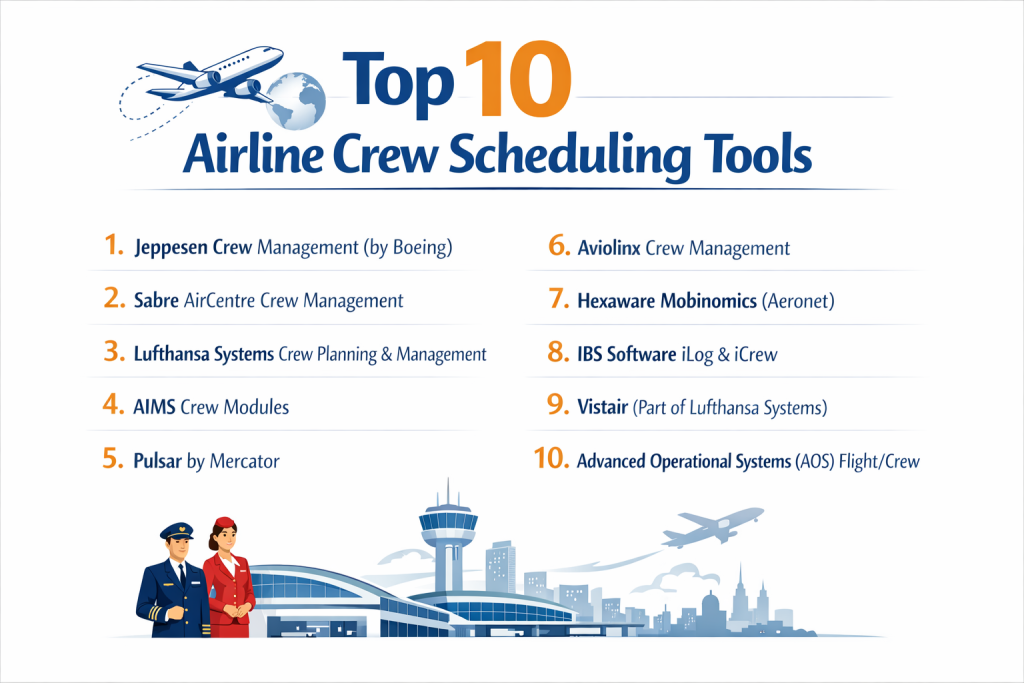
Top 10 Airline Crew Scheduling Tools
Here is a detailed overview of the leading platforms that keep airline crews flying safely and efficiently.
1 — Jeppesen Crew Management (by Boeing)
Jeppesen Crew Management is an industry-standard, comprehensive suite used by many of the world’s largest airlines. It’s known for its depth, robustness, and integration with Jeppesen’s broader flight planning and navigation ecosystem.
Key features:
- End-to-end crew management: Covers long-term planning, bid award, pairing construction, real-time tracking, and payroll integration.
- Advanced optimization: Powerful algorithms to create cost-efficient pairings and monthly schedules that comply with complex union and regulatory rules.
- Regulatory compliance engine: Hard-coded rulesets for global aviation authorities (FAA, EASA, etc.) to prevent violations.
- Crew access portal: “Crew Web” provides crew members with schedules, trade boards, and trip information.
- Disruption management: Strong tools for real-time reassignment and recovery during irregular operations (IROPS).
- Fatigue risk management: Integrates with scientific models to help manage crew fatigue.
Pros:
- Unmatched depth and proven reliability for large, complex airline operations.
- Strong regulatory compliance foundation, reducing legal risk.
- Part of the trusted Jeppesen/Boeing aviation ecosystem.
Cons:
- Can be extremely expensive and complex to implement, often requiring long project timelines.
- User interface can feel dated and less intuitive compared to newer solutions.
- Perceived as less agile for smaller or rapidly changing airlines.
Security & compliance: Enterprise-grade aviation security standards. Designed to meet strict regulatory audit requirements. Specific certifications like ISO 27001 are expected.
Support & community: 24/7 global support from Boeing/Jeppesen. Has a vast user community among major airlines, with dedicated user group conferences.
2 — Sabre AirCentre Crew Management
Sabre AirCentre Crew Management is a key component of Sabre’s extensive airline IT portfolio. It is a modern, scalable solution that emphasizes integration with Sabre’s reservations, operations, and planning suites.
Key features:
- Native ecosystem integration: Seamless data flow with Sabre’s scheduling, operations, and movement management systems.
- User-friendly interface: Modern, role-based UX for both planners and crew members.
- Cloud-based deployment: Offered as a SaaS solution, reducing IT overhead and enabling easier updates.
- Powerful pairing optimizer: Efficiently builds crew pairings that minimize costs and deadheads.
- Mobile crew app: Provides crews with schedules, alerts, and document access on any device.
- Analytics and reporting: Strong business intelligence tools for analyzing crew efficiency and costs.
Pros:
- Excellent choice for airlines already invested in the Sabre ecosystem for other functions.
- Modern, web-based architecture offers flexibility and easier maintenance.
- Strong focus on the user experience for operational staff.
Cons:
- As part of a large suite, it can be part of a broader, more costly commercial relationship.
- May be seen as a direct competitor to in-house systems for airlines that develop their own.
- Customization can be governed by the platform’s architecture.
Security & compliance: Cloud security adhering to high standards (SOC 2, ISO 27001). Built to handle sensitive crew and operational data.
Support & community: Supported by Sabre’s global aviation services division. Active user groups and dedicated account management for enterprise clients.
3 — Lufthansa Systems Crew Planning & Management
Lufthansa Systems offers a suite of crew management tools born from the operational expertise of one of the world’s leading airline groups. Its solutions are known for precision and a strong European footprint.
Key features:
- Proven airline pedigree: Developed with direct input from Lufthansa Group airlines.
- Integrated suite: Modules for strategic planning, tactical pairing, and operative control (ROSTER, pairing, CREW CONTROL).
- Sophisticated bid award: Flexible system to handle complex seniority-based bidding processes.
- Efficient disruption management: Tools to quickly re-crew during disruptions while minimizing downstream impact.
- Crew portals and apps: Comprehensive self-service tools for crew members.
- Focus on optimization: Aims to achieve very high crew utilization rates.
Pros:
- Built with real-world, large-scale airline operational wisdom.
- Strong optimization capabilities that deliver measurable cost savings.
- Reliable and robust for demanding hub-and-spoke operations.
Cons:
- May carry a perception of being tailored to the Lufthansa Group model.
- Implementation and customization can be significant undertakings.
- Competes directly with other airline IT departments (like Sabre and Amadeus).
Security & compliance: German-engineered with a strong focus on data security and regulatory compliance (EASA focused). Meets high industry standards.
Support & community: Backed by Lufthansa Systems’ global support network. Strong user base in Europe and among airlines with similar operational models.
4 — AIMS (Airline Information Management System) Crew Modules
AIMS is a comprehensive, modular airline operations suite, and its crew modules are used by many mid-sized and large airlines worldwide. It is known for being highly configurable to fit specific airline needs.
Key features:
- Fully integrated suite: Crew scheduling works within a single database alongside maintenance, flight ops, and weight & balance.
- High configurability: Can be tailored to an airline’s specific business rules, union agreements, and regulatory environment.
- Robust tracking: Real-time tracking of crew legality, qualifications, and flight time duty period (FTDP) limits.
- Automated reporting: Generates required reports for authorities and internal management.
- Legacy and modern support: Has evolved over decades, serving a wide range of airline types.
- On-premise or hosted: Offers deployment flexibility.
Pros:
- “Single source of truth” integration with other critical operations data.
- Highly adaptable to unique airline processes and legacy requirements.
- Proven track record with a diverse global customer base.
Cons:
- The interface can feel technical and dated compared to pure web-based solutions.
- Customization can lead to higher long-term maintenance costs.
- Perceived as a more traditional, albeit reliable, solution.
Security & compliance: Trusted platform with a long history in secure airline operations. Compliance features are built-in but may require configuration.
Support & community: Supported by the AIMS vendor and a network of implementation partners. Has a long-standing, loyal customer community.
5 — Pulsar by Mercator (a CITIC Pacific Capital company)
Pulsar is a modern, best-of-breed crew management system known for its powerful optimization engine and user-centric design. It is often chosen by airlines looking for a fresh, efficient alternative to legacy systems.
Key features:
- Advanced AI-powered optimization: Renowned for its pairing and rostering optimizer, which can yield significant crew cost savings.
- Agile and cloud-native: Built on modern technology for faster implementation and updates.
- Excellent user experience: Intuitive interfaces for both planners and crew, leading to high adoption.
- Comprehensive mobile suite: Full-featured crew app for scheduling, trading, and compliance.
- Modular design: Airlines can start with core scheduling and add modules like fatigue management or crew control.
- Strong disruption recovery: Efficient tools to solve real-time crew problems.
Pros:
- Leading optimization technology that directly improves airline profitability.
- Faster, more flexible implementation than legacy monolithic systems.
- Designed with the end-user (planner and crew) in mind, reducing training time.
Cons:
- A younger company compared to giants like Jeppesen or Sabre, which may concern some risk-averse airlines.
- May require more integration work with adjacent systems not in its ecosystem.
- While growing, its market presence is smaller than the historical leaders.
Security & compliance: Modern cloud security standards (SOC 2, ISO 27001). Designed to meet global aviation regulatory demands.
Support & community: Known for responsive, partnership-oriented support. Developing a strong community among its growing customer base.
6 — Aviolinx Crew Management
Aviolinx offers a suite of airline operations software, with its crew management system targeting small to mid-sized airlines and charter operators. It emphasizes affordability and practicality.
Key features:
- Cost-effective solution: Positioned as a more affordable entry into automated crew scheduling.
- Integrated operations: Often implemented alongside Aviolinx’s flight planning and dispatch modules.
- Core scheduling functions: Handles pairing, rostering, bidding, and basic legality checks.
- Web-based access: Provides browser-based access for planners and crew.
- Suitable for complexity: Can handle a range of operations from simple to moderately complex.
- Vendor support: Often sold with strong vendor support and implementation services.
Pros:
- Good value proposition for regional airlines, cargo carriers, and charter operators.
- Easier and faster to implement than enterprise mega-suites.
- Integrated approach can simplify IT architecture for smaller airlines.
Cons:
- May lack the deep optimization and extreme scalability of top-tier systems.
- Feature set might not satisfy the needs of a very large, global network carrier.
- Brand recognition is lower than the market leaders.
Security & compliance: Meets standard industry requirements for data security and privacy. Specific certifications should be verified with the vendor.
Support & community: Typically includes close vendor support. Serves a niche of small-to-mid-sized operators.
7 — Hexaware Mobinomics (Aeronet)
Mobinomics (formerly Aeronet) from Hexaware is a cloud-based crew management product leveraging modern digital technology. It focuses on agility, data analytics, and improving the crew experience.
Key features:
- Digital crew experience: Strong emphasis on mobile self-service, chatbots for queries, and seamless communication.
- AI/ML-driven insights: Uses analytics for predictive disruption management and crew preference forecasting.
- Modular microservices architecture: Allows for flexible deployment and easier integration with other best-of-breed systems.
- Fatigue management: Incorporates advanced bio-mathematical models for fatigue risk.
- Crew engagement tools: Features aimed at improving crew satisfaction and work-life balance.
- API-first design: Built for easy connectivity in a modern airline IT landscape.
Pros:
- Focused on the modern “digital airline” and improving the life of crew members.
- Agile and adaptable, suitable for airlines undergoing digital transformation.
- Strong use of data and AI for proactive management.
Cons:
- May be a shift in philosophy for airlines used to traditional, rules-heavy systems.
- As a newer architecture, it may not have the decades of refined rule libraries of legacy systems.
- Part of a broader IT services company, rather than a pure aviation software firm.
Security & compliance: Cloud-native security model. Compliant with relevant data protection and aviation standards.
Support & community: Supported by Hexaware’s global IT services. Targets airlines looking for a digital partner.
8 — IBS Software iLog & iCrew
IBS Software is a major provider to the travel and transportation industry. Its iCrew solution (part of the iLog resource optimization suite) is a comprehensive system for airlines and crew leasing companies.
Key features:
- Part of a resource suite: Integrates with iLog for aircraft maintenance and flight deck crew scheduling for holistic resource planning.
- Rules-driven scheduler: Handles complex union agreements, regulatory rules, and airline policies.
- Crew portal and mobility: Self-service tools for crew bidding, trading, and viewing documents.
- Leasing company focus: Strong capabilities for managing crews who work for multiple airlines (wet lease scenarios).
- Reporting and analytics: Comprehensive reporting for operational and financial analysis.
- Global customer base: Used by airlines and operators in various regions.
Pros:
- Strong integrated view of multiple operational resources (aircraft and crew).
- Proven system for managing complex, multi-entity crew scenarios.
- Reliable and scalable for growing airlines.
Cons:
- Can be a substantial implementation project.
- The broader IBS suite might be more than a small airline needs.
- User interface may prioritize function over modern design aesthetics.
Security & compliance: Adheres to industry-standard security protocols. Used by major airlines, implying strong compliance features.
Support & community: Global support from IBS. Has a significant user base, particularly in Asia and the Middle East.
9 — Vistair (Part of Lufthansa Systems)
Vistair, now part of Lufthansa Systems, specializes in documentation and operations management, with crew management as a key component. It’s known for strong integration between scheduling and compliance documentation.
Key features:
- Document-centric approach: Tightly links crew schedules with the mandatory documentation (licenses, medicals, passports, visas).
- Compliance assurance: Actively tracks document expiry and crew qualifications, preventing illegal assignments.
- Streamlined operations: Reduces manual work for ops staff by automating document checks.
- Crew management core: Provides standard pairing, rostering, and bidding functionalities.
- Suitable for various operators: Used by airlines, business aviation, and helicopter operators.
- Regulatory expertise: Strong understanding of international aviation regulations.
Pros:
- Excellent for operators where document compliance is a major pain point or risk.
- Reduces administrative burden and minimizes “administrative groundings.”
- Integrates scheduling with the crucial “readiness to fly” checks.
Cons:
- May not have the same depth of optimization as dedicated crew management giants.
- The primary strength is in the compliance/document area, with scheduling as a supporting function.
- Brand is now absorbed into the larger Lufthansa Systems portfolio.
Security & compliance: Inherently strong, given its focus on secure document management and regulatory compliance.
Support & community: Supported by the Lufthansa Systems network. Has a strong reputation in the business aviation and regional airline sectors.
10 — Advanced Operational Systems (AOS) Flight/Crew
AOS provides integrated airline operations software, and its crew module is designed to work seamlessly with its flight scheduling and tracking systems. It often appeals to airlines seeking a tightly integrated, practical solution.
Key features:
- Tight integration: Crew scheduling shares a real-time database with flight scheduling, tracking, and dispatch.
- Real-time visibility: Operations control center (OCC) has a unified view of crew and aircraft status.
- Practical design: Focuses on solving daily operational problems for controllers and planners.
- Disruption management: Tools to manage crew during delays and cancellations in the operational timeframe.
- Configurable rules: Can be set up to match the airline’s specific operational policies.
- Proven reliability: Used by a number of established airlines.
Pros:
- Excellent real-time situational awareness for integrated operations control.
- Streamlined workflow for controllers managing daily crew movements.
- Stable and reliable system for 24/7 operations.
Cons:
- May not have the same level of long-term strategic planning optimization as some competitors.
- Brand is less visible than the global giants.
- Primarily an integrated suite, less of a stand-alone “best of breed” crew optimizer.
Security & compliance: Built for secure, reliable airline operations. Meets standard industry requirements.
Support & community: Supported directly by AOS. Has a loyal customer base among airlines using its integrated suite.
Comparison Table
| Tool Name | Best For (Target User or Scenario) | Platform(s) Supported | Standout Feature | Rating |
|---|---|---|---|---|
| Jeppesen Crew Management | Large, complex global airlines needing proven depth & reliability | Client/Server, Web | Industry Standard Depth & Regulatory Foundation | N/A |
| Sabre AirCentre Crew | Airlines invested in the Sabre ecosystem wanting a modern cloud solution | Cloud (SaaS), Web, Mobile | Modern UX & Native Sabre Ecosystem Integration | N/A |
| Lufthansa Systems CP&M | Airlines valuing European engineering & large-hub optimization | Client/Server, Web | Airline-Group Proven Optimization & Efficiency | N/A |
| AIMS Crew Modules | Airlines wanting a fully integrated ops suite with high configurability | On-premise/Hosted, Client | “Single Source of Truth” Integration & High Customization | N/A |
| Pulsar by Mercator | Airlines prioritizing cutting-edge optimization & user experience | Cloud-native, Web, Mobile | Leading AI Optimization Engine & Agile Design | N/A |
| Aviolinx Crew Management | Small to mid-sized airlines & charters seeking cost-effective automation | Web-based | Practicality & Affordability for Regional Operators | N/A |
| Hexaware Mobinomics | “Digital Airlines” focusing on crew experience & AI-driven insights | Cloud, Mobile, AI | Digital Crew Experience & Predictive Analytics | N/A |
| IBS Software iCrew | Airlines & crew leasing companies with complex, multi-entity needs | Client/Server, Web | Strong for Leasing Scenarios & Integrated Resource View | N/A |
| Vistair (Lufthansa Systems) | Operators where document compliance is as critical as the schedule itself | Web-based | Document-Centric Compliance & “Readiness to Fly” Focus | N/A |
| AOS Flight/Crew | Airlines needing tight, real-time integration between crew & flight ops | Integrated Client | Real-Time OCC Visibility & Integrated Operations Control | N/A |
Evaluation & Scoring of Airline Crew Scheduling Tools
To compare platforms systematically, score each from 1 (Poor) to 5 (Excellent) based on your airline’s specific operational profile.
| Evaluation Criteria | Weight | Score (1-5) | Weighted Score | Notes on What to Look For |
|---|---|---|---|---|
| Core Features | 25% | Does it cover pairing, rostering, bidding, legality, and IROPS recovery effectively? | ||
| Ease of Use | 15% | Is it intuitive for planners and crew? Will it reduce training time and errors? | ||
| Integrations & Ecosystem | 15% | Does it integrate with your flight ops, payroll, crew training, and other key systems? | ||
| Security & Compliance | 10% | Is it built for aviation’s regulatory environment? Can it pass audits from your CAA? | ||
| Performance & Reliability | 10% | Can it run 24/7 without downtime? Is it fast during critical disruption recovery? | ||
| Support & Community | 10% | Is vendor support knowledgeable and available 24/7? Is there a user community for best practices? | ||
| Price / Value | 15% | Does the total cost (license, implementation, support) justify the operational savings and risk reduction? | ||
| TOTAL SCORE | 100% | /100 |
Which Airline Crew Scheduling Tool Is Right for You?
The choice is driven by your airline’s size, network complexity, and strategic focus.
- Regional & Small Airlines / Charter Operators: You need functionality without massive cost. Aviolinx or the core modules of AOS or AIMS offer good value. Pulsar’s agility is also a strong contender for growth-oriented carriers.
- Mid-Sized & National Airlines: You need robust optimization and scalability. Pulsar excels here. Sabre AirCentre Crew offers a modern path. Lufthansa Systems or IBS iCrew are solid, established choices.
- Large Global Network Carriers: You need proven scale, depth, and global support. Jeppesen is the traditional leader. Sabre and Lufthansa Systems compete directly here. These are multi-year, strategic partnerships.
- Crew Leasing Companies & ACMI Providers: Your needs center on managing crews across multiple clients. IBS iCrew has specific strengths here, as do the configurability of AIMS and Pulsar.
- Budget-Conscious vs. Premium: Aviolinx represents the value end. Jeppesen, Sabre, and Lufthansa Systems are premium investments. Pulsar positions itself as a premium-value alternative with high ROI from optimization.
- Feature Depth vs. Ease of Use: Legacy systems like Jeppesen and AIMS offer immense depth but can be complex. Newer systems like Sabre AirCentre and Pulsar prioritize user experience. Hexaware Mobinomics focuses on crew-facing ease.
- Integration Needs: If you are a Sabre shop for reservations, their crew module makes sense. If you use Lufthansa Systems’ other products, integration is natural. For a best-of-breed approach, ensure the tool has strong APIs (like Pulsar or Hexaware).
- Security & Compliance Requirements: All serious tools are built for this. The key is ensuring the tool’s regulatory rule sets are up-to-date for your primary authorities (FAA, EASA, etc.) and that it can produce the audit trails required for compliance demonstrations.
Frequently Asked Questions (FAQs)
1. What’s the difference between pairing, rostering, and bidding?
- Pairing: Building sequences of flights (trips) that start and end at the same crew base, complying with all rules.
- Rostering: Assigning these pairings and other duties (training, standby) to individual crew members over a monthly or monthly period.
- Bidding: The process where crew members select their preferred pairings or patterns for the upcoming period, often based on seniority.
2. How do these tools handle last-minute sick calls or disruptions?
This is called disruption management or recovery. The tool can automatically find the best available reserve crew, re-sequence other crews, or even rebuild pairings to cover open flights while minimizing cost and rule violations. Speed here is critical.
3. Are these tools only for large airlines?
No. While the most complex are for large airlines, there are scaled-down, cost-effective solutions (like Aviolinx) for regional, charter, and cargo operators. The business case for automation starts with even a moderately sized crew group.
4. How long does it take to implement a new crew system?
For a large airline, it’s a major multi-year project involving data migration, rule configuration, testing, and training. For a smaller airline with a simpler operation and a modern cloud system, it could be 12-18 months.
5. Can these systems really save money?
Yes, significantly. Savings come from: Optimized pairings that reduce hotel and deadhead costs, higher crew utilization, reduced administrative labor, and avoiding costly regulatory fines for violations.
6. What about crew fatigue management?
Modern systems integrate Fatigue Risk Management Systems (FRMS). They use bio-mathematical models (like SAFTE or FAST) to predict fatigue risk based on schedules, providing alerts and helping planners build safer rosters.
7. How do crew members interact with the system?
Through crew portals or mobile apps. They view schedules, submit bids, trade trips with colleagues, report availability issues, and access important documents. A good crew interface is vital for adoption.
8. What is “minimum crew” and how do systems optimize for it?
Airlines must carry extra “reserve” crew to cover absences. Optimization aims to find the minimum number of reserve crew needed to cover expected sick calls and disruptions at a given confidence level (e.g., 95%), reducing idle labor costs.
9. What’s a common mistake airlines make when selecting a system?
Underestimating the importance of the implementation partner and internal change management. The best software will fail if not implemented correctly or if the planning team is not properly trained and bought into the new processes.
10. Is the move to cloud-based systems the future?
Yes. Cloud solutions (Sabre AirCentre, Pulsar, Hexaware) offer advantages: lower upfront cost (OpEx vs. CapEx), easier updates, built-in disaster recovery, and scalability. However, some airlines with specific data sovereignty needs may still prefer on-premise.
Conclusion
Choosing an airline crew scheduling tool is one of the most significant technology decisions an airline can make. It is not just a software purchase; it is a strategic partnership that will define operational efficiency, crew satisfaction, and regulatory safety for a decade or more.
The right tool aligns perfectly with your airline’s operational model—whether you’re a point-to-point low-cost carrier, a complex global hub operator, or a regional specialist. It must balance raw optimization power with practical usability for the controllers who manage daily crises and the crew members whose lives it governs.
There is no single “best” system. The winner is the platform that becomes a seamless extension of your operations team, delivering schedules that are safe, legal, efficient, and fair. By prioritizing core needs around compliance, optimization, and integration, and by carefully managing the immense change that comes with implementation, an airline can select a system that provides a decisive competitive advantage in the demanding world of aviation operations.