Introduction
An AdTech Platform is a specialized tool that acts as a marketplace for digital space. Think of it like a stock exchange, but instead of trading shares of companies, people are trading “impressions”—which is just a fancy way of saying a single view of an advertisement. These platforms are important because they allow a business in one part of the world to show an ad to a specific person in another part of the world at the exact moment that person is interested in a product. Without AdTech, buying an ad would take days of phone calls; with it, it takes a fraction of a heartbeat.
In the real world, these platforms are used to make sure money isn’t wasted. For example, a car company can use AdTech to make sure their ads only show up for people who are actually looking to buy a vehicle, rather than showing them to everyone. This is called “targeting.” When you are looking for an AdTech tool, you should look for how much of the internet it can reach, how good its “anti-fraud” tools are (to stop fake computer clicks), and how easy it is to see your data and results.
Best for: These tools are built for marketing managers at large companies, advertising agencies that handle many clients, and website owners who want to make money by showing ads. They are essential for any business that spends a significant amount of money on digital growth and needs to track every cent.
Not ideal for: A tiny local shop or a hobbyist with a small budget. If you only want to spend $50 a month, you are better off using the simple “Boost Post” buttons on social media sites rather than learning a complex AdTech platform.
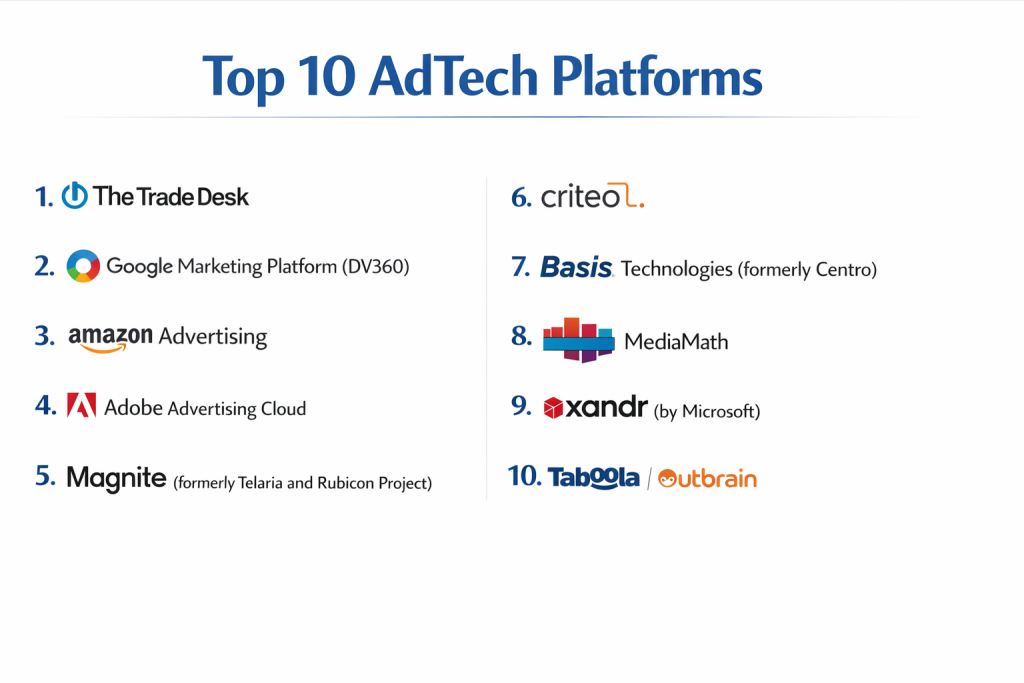
Top 10 AdTech Platforms
1 — Google Marketing Platform (DV360)
This is the “big brother” of the advertising world. It is an end-to-end platform that allows big brands to plan, buy, and measure their ads across almost every corner of the web, including YouTube and Google’s massive network of partner sites.
- Key features:
- Access to the world’s largest amount of ad space (inventory).
- Deep integration with Google Analytics to see what people do after clicking.
- Advanced “Automated Bidding” that uses a computer brain to find the best price.
- High-quality tools to build beautiful, moving ads (Creative Studio).
- Unified reporting so you can see all your results in one single chart.
- Sophisticated audience targeting based on what people search for.
- Pros:
- It has the most reach of any platform in the world; you can find almost anyone here.
- It works perfectly with all other Google tools, making data very easy to move.
- Cons:
- It is very complex and usually requires a certified expert to run it.
- It can feel like a “black box” where you don’t always know exactly why a decision was made.
- Security & compliance: SOC 2, ISO 27001, and fully GDPR/CCPA compliant. It uses high-level encryption for all data.
- Support & community: Massive help center, dedicated account managers for big spenders, and a huge global community of experts.
2 — The Trade Desk
The Trade Desk is often seen as the biggest rival to Google. It is an “independent” platform, which means they don’t own the websites where the ads show up. This makes many people trust them more because they don’t have a “favorite” place to put your ads.
- Key features:
- A very clean and modern dashboard that is easier to use than Google’s.
- Strong focus on “Connected TV” (ads on apps like Hulu or Roku).
- “Koa” AI that helps you optimize your spending in real-time.
- A massive marketplace of third-party data to help find the right customers.
- Excellent tools for audio advertising (like on Spotify or digital radio).
- Transparency that shows you exactly how much every middle-man is being paid.
- Pros:
- They are leaders in the “Future of TV,” making them great for big brand campaigns.
- Their customer service is widely considered to be the best in the industry.
- Cons:
- They require a very high minimum spend, so they are not for small businesses.
- You have to sign a long-term contract to get the best features.
- Security & compliance: SOC 2 Type II compliant; very strong privacy protections and GDPR adherence.
- Support & community: High-touch support team and a great online learning site called “The Trade Desk Edge Academy.”
3 — Amazon Advertising
If you sell a physical product, Amazon is now one of the most important AdTech platforms. It allows you to show ads to people while they are actually shopping, which is the most powerful time to reach them.
- Key features:
- “Sponsored Products” that put your items at the top of search results.
- Access to “First-Party Data” (knowing exactly what people actually buy).
- Video ads that show up on Prime Video and Freevee.
- Ads that follow people around the rest of the internet after they look at a product on Amazon.
- “Amazon Marketing Cloud” for very deep data analysis.
- Automatic “re-stock” alerts that trigger ads when you have items in the warehouse.
- Pros:
- People on Amazon are there to buy, not just browse, so the sales are much higher.
- The data on actual buying habits is better than any other company on Earth.
- Cons:
- It only really works if you are selling products inside the Amazon store.
- The advertising dashboard can be very confusing and messy to navigate.
- Security & compliance: Top-tier security as part of Amazon Web Services (AWS); GDPR and CCPA compliant.
- Support & community: Good documentation, but individual human support can be hard to get unless you spend a lot.
4 — Meta Ads Manager
While mostly known for Facebook and Instagram, Meta is a giant AdTech platform that also shows ads on thousands of other apps through its “Audience Network.” It is famous for its “visual” style of advertising.
- Key features:
- Unmatched targeting based on what people like, who their friends are, and their hobbies.
- “Lookalike Audiences” that find new customers who “look” like your current ones.
- Very easy tools to build ads using just your phone.
- High-performing Instagram Story and Reel ad formats.
- Integrated “Shop” features so people can buy without leaving the app.
- Automatic “A/B testing” to see which photo or headline works best.
- Pros:
- It is the most “human” platform; ads feel like part of a social feed.
- The computer brain (algorithm) is incredibly good at finding buyers with very little help.
- Cons:
- Privacy changes on iPhones have made it harder for Meta to track sales than it used to be.
- Ad costs can go up very quickly if your “creative” (photo/video) isn’t perfect.
- Security & compliance: SOC 2 compliant; strict GDPR rules, though they have faced some legal challenges in Europe.
- Support & community: Huge amount of online tutorials; chat support is available but can be hit-or-miss.
5 — Criteo
Criteo is the world leader in “Retargeting.” If you have ever looked at a pair of shoes online and then saw those same shoes follow you to every other website you visited, that was likely Criteo at work.
- Key features:
- High-speed dynamic ads that show the exact product a user just looked at.
- A massive “Commerce Data” set that tracks billions of dollars in shopping.
- Built-in tools for “Retail Media” (showing ads on store websites like Target or Walmart).
- AI that guesses which product a customer might want next.
- Large-scale video retargeting across the web.
- Pros:
- It is famous for “bringing people back” to finish a purchase, which makes it very profitable.
- It is very easy to set up—you just add a small bit of code to your site.
- Cons:
- It can be annoying to customers if the ads “follow” them too much.
- It doesn’t help much with finding new people who have never heard of you.
- Security & compliance: ISO 27001 certified and very strict about GDPR (they are based in Europe).
- Support & community: Good account management for retail brands and helpful technical guides.
6 — Magnite
Magnite is a platform for “Publishers”—the people who own the websites and TV apps. It helps them sell their space to the highest bidder. It is currently the largest independent platform of its kind in the world.
- Key features:
- Specializes in “Premium” video and Connected TV.
- “Header Bidding” technology that lets many buyers bid at the same time to get a higher price.
- Tools to manage private “invite-only” auctions for high-end ad space.
- Real-time dashboard to see how much money your website is making.
- High-level protection to block “bad ads” from showing up on your site.
- Pros:
- If you own a popular app or website, this is the best tool to maximize your profit.
- They have access to very high-quality ads from the world’s biggest brands.
- Cons:
- It is not for people who want to buy ads; it is for people who want to sell space.
- It requires a very large amount of website traffic to be allowed to join.
- Security & compliance: SOC 2 Type II compliant; follows all major privacy regulations globally.
- Support & community: Highly professional technical support for large media companies.
7 — Microsoft Advertising
Microsoft has become a major player by combining Bing search ads with the professional data of LinkedIn. It is a fantastic choice for businesses that sell to other businesses (B2B).
- Key features:
- Shows ads on Bing, DuckDuckGo, and Yahoo search engines.
- Use of LinkedIn profile data to target ads (e.g., “Show this to all CEOs in Chicago”).
- “Netflix” ad partnership (Microsoft handles the ads you see on Netflix).
- Access to the “Windows” audience through the Start menu and browser.
- Simple tool to “Import from Google” so you can copy your ads over in one click.
- Pros:
- The people who use Bing are often older and have more money to spend.
- The LinkedIn data is a “gold mine” for B2B companies.
- Cons:
- Much less traffic than Google; you will run out of people to show ads to much faster.
- The ad-building software can be a little slow and frustrating to use.
- Security & compliance: Top-tier Microsoft security; fully GDPR, HIPAA, and ISO compliant.
- Support & community: Very good phone and chat support, often better than Google’s.
8 — Xandr (by Microsoft)
Xandr is a very advanced platform that Microsoft bought to handle high-level ad trading. It is used by major television networks and giant advertising agencies to run complex “data-driven” campaigns.
- Key features:
- “AppNexus” marketplace for buying and selling ad space in real-time.
- Powerful tools for building your own “private” ad network.
- Strong focus on “Invest” (buying) and “Monetize” (selling) in one tool.
- Advanced data science tools to build your own custom bidding rules.
- Great reach in the European and Latin American markets.
- Pros:
- It is a “power user” tool that offers more control than almost any other platform.
- It is very good at combining TV ads with internet ads.
- Cons:
- It is very difficult to learn and is strictly for large professional teams.
- It can be very expensive due to various fees for different features.
- Security & compliance: ISO 27001 and SOC 2 compliant; adheres to strict global privacy standards.
- Support & community: Professional enterprise-grade support and deep technical documentation.
9 — Taboola
Taboola is the leader of “Native Advertising.” These are the ads that look like news articles, usually found at the bottom of a page under a heading like “Recommended for You” or “Around the Web.”
- Key features:
- Ads that look like “Content” rather than “Sales Pitches.”
- Reach on world-famous news sites like NBC, USA Today, and MSN.
- “SmartBid” that changes your price based on how likely someone is to click.
- Video ads that play automatically as you scroll down a news story.
- A tool to test different headlines to see which one gets more “clicks.”
- Pros:
- Because the ads look like news, people tend to trust them more than banners.
- It is a great way to get people to read your blog posts or “educational” pages.
- Cons:
- Sometimes the quality of the websites where ads show up can be a bit low.
- It is easy to get “clicks,” but it can be harder to turn those clicks into “sales.”
- Security & compliance: GDPR compliant; strict internal rules about what kind of “news” can be advertised.
- Support & community: Good self-service help center and account managers for medium-to-large spenders.
10 — AdRoll
AdRoll is a platform built for small-to-medium businesses. It takes the complex world of AdTech and makes it simple, allowing a small shop to run ads across Google, Meta, and thousands of websites from one place.
- Key features:
- Multi-channel retargeting (Email, SMS, and Web ads together).
- A very simple “Consent Manager” to keep your website legal and safe.
- An AI that picks the best place to show your ad so you don’t have to.
- Ready-to-use templates for ads and emails.
- Connects to Shopify and Wix with just one click.
- Pros:
- It is the most “friendly” AdTech tool for someone who isn’t a marketing expert.
- It allows a small business to look like a “big brand” by showing up everywhere.
- Cons:
- They charge a monthly subscription fee on top of what you spend on ads.
- You have less control over the specific websites where your ads appear.
- Security & compliance: GDPR and CCPA compliant; uses secure data processing for customer lists.
- Support & community: Very good support for small businesses, including chat and email.
Comparison Table
| Tool Name | Best For | Platform(s) Supported | Standout Feature | Rating (Approx.) |
| Google (DV360) | Huge Global Campaigns | All Web, YouTube | Largest Reach | 4.4 / 5 |
| The Trade Desk | Connected TV / Independent | Web, CTV, Audio | “Koa” AI Brain | 4.6 / 5 |
| Amazon Advertising | E-commerce Sellers | Amazon, Twitch | Real Buying Data | 4.2 / 5 |
| Meta Ads Manager | Visual Brands / Social | FB, IG, Apps | Lookalike Audiences | 4.5 / 5 |
| Criteo | Online Retailers | All Web | Dynamic Retargeting | 4.1 / 5 |
| Magnite | Website Owners | Web, CTV, Apps | High Selling Profits | 4.0 / 5 |
| Microsoft Ads | B2B / LinkedIn Users | Bing, LinkedIn | LinkedIn Data | 4.2 / 5 |
| Xandr | Advanced Trading | All Web, TV | Custom Bidding | 4.1 / 5 |
| Taboola | Content / News Ads | News Websites | Native Article Ads | 3.9 / 5 |
| AdRoll | Small Businesses | Web, Social, Email | Simple “All-in-One” | 4.3 / 5 |
Evaluation & Scoring of AdTech Platforms
We use this scoring system to help you understand which tools are the most “well-rounded” for a professional business.
| Category | Weight | What we look for |
| Core Features | 25% | Can it target the right people and show ads everywhere? |
| Ease of Use | 15% | Is the dashboard easy to navigate or is it a nightmare? |
| Integrations | 15% | Does it talk to your website, your CRM, and your store? |
| Security & Compliance | 10% | Does it follow privacy laws and stop fake bot clicks? |
| Performance | 10% | Does the software run fast and give real-time data? |
| Support & Community | 10% | Is there a person to help you when you are confused? |
| Price / Value | 15% | Is the return on investment (ROI) worth the platform fees? |
Which AdTech Platforms Tool Is Right for You?
Choosing an AdTech tool is a big commitment because it is where you will spend your hard-earned money. Here is a simple guide to help you decide.
Small Businesses and Startups
If you are just starting and don’t have a team of experts, AdRoll or Meta Ads Manager are your best options. They are built to be used by “regular” people and don’t require you to spend $20,000 a month just to get started. They help you look big without needing a big budget.
Online Product Sellers (E-commerce)
If you sell things like clothes, gadgets, or food, you should prioritize Amazon Advertising (if you sell there) and Criteo. These tools focus on people who are in the “shopping mood” and are very good at bringing back people who almost bought something but got distracted.
B2B and Professional Services
If you sell software, consulting, or medical equipment to other businesses, Microsoft Advertising is your “secret weapon.” Because it uses LinkedIn data, you can target people based on their job title and company, which saves you from wasting money on people who aren’t the decision-makers.
Global Brands and Agencies
If you are spending millions of dollars across different countries, you need the “Heavy Hitters.” Google Marketing Platform and The Trade Desk are the gold standards. They provide the deep security, the massive reach, and the detailed reporting that a large corporation needs to stay organized and profitable.
Frequently Asked Questions (FAQs)
1. What is the difference between AdTech and MarTech?
AdTech is for reaching “new” people who don’t know you yet (through ads). MarTech (Marketing Technology) is for talking to people you already know (through email or your own website).
2. Is AdTech expensive?
It can be. Some platforms (like The Trade Desk) require a minimum spend of $10,000+ per month. Others (like AdRoll) let you start with just a few hundred dollars.
3. What is “Programmatic” advertising?
It is the automated buying and selling of ads. Instead of a person buying a spot on a website, a computer “bids” on that spot in real-time as a user loads the page.
4. How does AdTech find my customers?
It uses “Data.” This could be things like what people have searched for, what websites they have visited, their age, their city, and even what apps they have on their phone.
5. What is “Ad Fraud”?
This is when fake computer programs (bots) click on your ads to make it look like people are interested. Good AdTech platforms have “Detectors” to stop this and save your money.
6. Do I need a special degree to use these?
For the big tools like Google DV360, yes, you usually need training. For the smaller tools like AdRoll or Meta, most people can learn them by watching a few hours of videos.
7. Is my privacy safe with AdTech?
New laws like GDPR mean that platforms must ask for your permission before tracking you. Most top-tier platforms are now very strict about protecting individual names and personal details.
8. What is “Connected TV” (CTV)?
This refers to ads shown on a television that is connected to the internet, such as through a smart TV or a device like an Apple TV. It is the fastest-growing part of AdTech.
9. Can I run ads on multiple sites at once?
Yes. That is the main job of an AdTech platform. One single “campaign” can show your ad on thousands of different news sites, blogs, and apps simultaneously.
10. How do I know if it’s working?
The platforms provide “Conversion Tracking.” This tells you exactly how many people clicked your ad and then went on to buy something or sign up for your newsletter.
Conclusion
The world of AdTech Platforms is the engine that keeps the internet free for everyone to use. By allowing businesses to find the right customers at the right time, these tools make advertising less of a “guessing game” and more of a science.
The “best” tool for you depends entirely on your size and what you are trying to sell. If you are small, keep it simple with AdRoll. If you are a shopper’s paradise, use Amazon and Criteo. If you are a global giant, the power of Google and The Trade Desk will be your best choice. Take your time to test these tools, start with a small budget, and always keep an eye on your results to ensure your money is working as hard as you are.