Introduction
Actuarial Modeling Software is a specialized category of computational tools used by actuaries to assess risk, value future financial uncertainties, and maintain the solvency of insurance companies and pension funds. At its core, this software allows professionals to build complex mathematical representations of real-world financial systems. By simulating thousands of possible future scenarios—such as changes in mortality rates, interest rate fluctuations, or natural disasters—these tools help organizations determine how much capital they must hold today to pay out claims decades from now. Modern actuarial platforms have evolved from simple spreadsheet add-ons into high-performance computing (HPC) ecosystems capable of processing massive datasets across cloud environments.
The importance of these systems is magnified by the tightening of global regulatory standards, such as IFRS 17 and Solvency II. These regulations require insurers to provide unprecedented levels of transparency and granularity in their financial reporting, a feat impossible to achieve with manual processes. Beyond compliance, actuarial modeling is the engine behind product innovation. It allows insurers to price “usage-based” policies or climate-resilient products with precision. By centralizing assumptions and calculations, these tools ensure that a company’s financial “truth” is consistent, auditable, and resilient to the departure of individual staff members.
Key Real-World Use Cases
Actuarial modeling software is the primary tool for several mission-critical functions within the financial sector:
- Asset Liability Management (ALM): Ensuring that the timing and value of an insurer’s investments (assets) match their expected future payouts (liabilities).
- Pricing and Product Development: Calculating the appropriate premiums for new life, health, or property insurance products based on risk profiles.
- Reserving: Estimating the present value of future claims to ensure the company remains solvent and meets regulatory capital requirements.
- Economic Capital Modeling: Simulating extreme “black swan” events to determine the total capital a firm needs to survive a 1-in-200-year catastrophe.
- Pension Valuation: Projecting the future costs of retirement benefits for large corporate or public sector workforces.
What to Look For (Evaluation Criteria)
When selecting an actuarial platform, organizations should prioritize these four pillars:
- Computational Performance: Can the software handle large-scale “stochastic” (randomly determined) simulations across thousands of scenarios without lagging?
- Governance and Auditability: Does the tool track every change made to a model, allowing auditors to see who changed an assumption and why?
- Flexibility vs. Pre-built Content: Does the software offer “closed” black-box models for speed, or “open” code that allows actuaries to customize formulas?
- Cloud Integration: Does it support elastic scaling on platforms like Azure or AWS to handle end-of-quarter processing spikes?
Best for:
- Life and Health Insurers: Who manage long-duration contracts requiring decades of projections.
- Property & Casualty (P&C) Carriers: Needing robust catastrophe modeling and pricing tools.
- Pension Consultants: Managing the complex benefit structures of large-scale retirement funds.
- Regulatory Compliance Officers: Who require standardized, auditable reporting for IFRS 17 and Solvency II.
Not ideal for:
- General Financial Accountants: Who may find the heavy statistical focus and stochastic modeling overkill for standard bookkeeping.
- Small Brokerages: Who do not bear the underlying risk and therefore do not need to model reserves or solvency.
- Basic Data Analysts: Where standard business intelligence tools or Python/R libraries might suffice for simpler trend analysis.
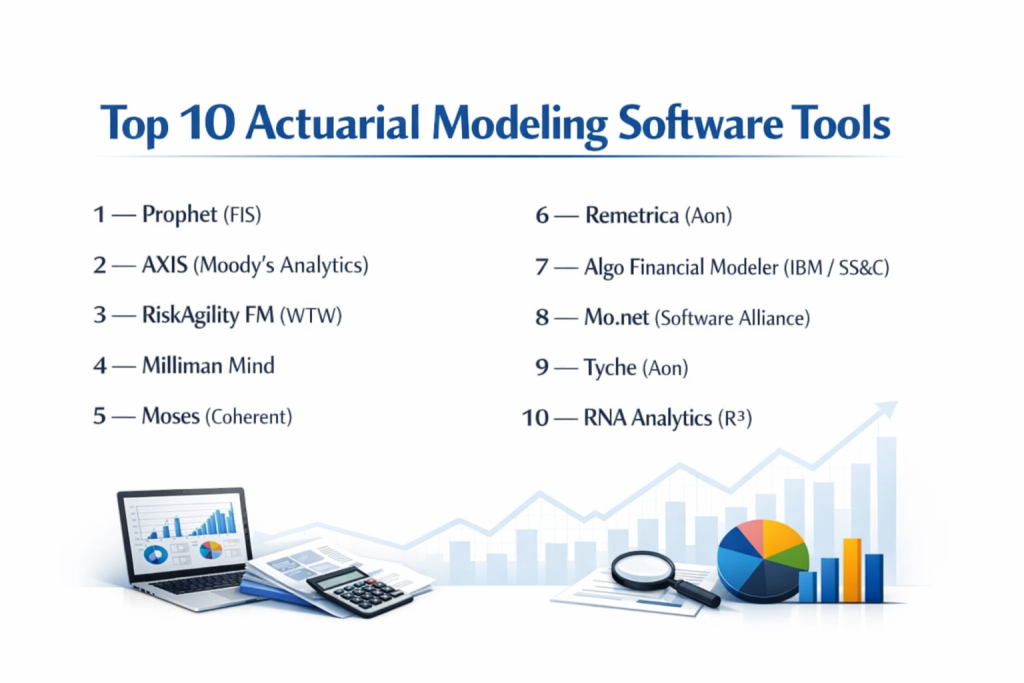
Top 10 Actuarial Modeling Software Tools
1 — Prophet (FIS)
Prophet, developed by FIS, is perhaps the most widely used actuarial modeling suite in the global life insurance industry. It is known for its rigorous ability to handle massive scale and its extensive library of pre-defined actuarial code.
Key features:
- Prophet Professional: The core desktop environment for model development and debugging.
- Prophet Enterprise: A highly controlled, server-based environment for production runs and governance.
- IFRS 17 Module: Specialized libraries designed to meet the latest global reporting standards.
- GIA (General Insurance Advantage): Specialized modules for non-life insurance modeling.
- HPC Cloud Integration: Seamless scaling to high-performance computing clusters for heavy simulations.
Pros:
- Unmatched global reputation; it is the “standard” for many regulatory bodies and audit firms.
- Extremely deep library of pre-coded formulas for almost every insurance product type.
Cons:
- The user interface can feel somewhat dated and less intuitive than newer SaaS rivals.
- Licensing costs are among the highest in the market, often requiring significant hardware investment.
Security & compliance: SOC 2 Type II, ISO 27001, and GDPR compliant; robust audit logs and version control.
Support & community: Global 24/7 support, extensive user conferences, and a massive ecosystem of certified consultants.
2 — AXIS (Moody’s Analytics)
Moody’s Analytics AXIS is a dominant force in the North American market, particularly praised for its “closed-system” approach which ensures high levels of consistency and speed across the enterprise.
Key features:
- Integrated Modules: Seamlessly handles pricing, valuation, ALM, and hedging within one system.
- Automated Data Processing: High-speed data ingestion and validation tools.
- Cloud-Native Scalability: Fully managed SaaS options that remove the need for internal server maintenance.
- Pre-Built Content: Users don’t write code from scratch; they select and configure pre-validated actuarial methods.
- Stochastic Modeling: High-performance engine for complex nested simulations.
Pros:
- High degree of “System Integrity”—it is very difficult for users to “break” the underlying models, which auditors love.
- Faster implementation times since most logic is pre-built and doesn’t require bespoke coding.
Cons:
- Less flexibility for actuaries who want to write completely unique, proprietary code.
- Historically very focused on North American regulations (though expanding globally).
Security & compliance: SOC 2, HIPAA (for health modules), and ISO 27001 compliant.
Support & community: Excellent client training programs and a highly responsive technical support team.
3 — RiskAgility FM (WTW)
RiskAgility FM by Willis Towers Watson (WTW) is built on an “open” modeling framework, giving actuaries total control over their formulas while maintaining a modern, high-performance environment.
Key features:
- High-Performance Architecture: Specifically designed to run thousands of scenarios in minutes.
- Open Modeling: Allows actuaries to see, edit, and create every single line of code in the model.
- Team Edition: Facilitates collaborative model development with robust versioning.
- Data Integration: Strong ETL (Extract, Transform, Load) tools to clean and format policy data.
- Projection Engine: Designed for both deterministic and stochastic projections.
Pros:
- The ultimate tool for “Creative Actuaries” who want to build unique competitive advantages through custom logic.
- Modern, flexible UI that feels more like a development environment than a legacy database.
Cons:
- Requires a higher level of coding proficiency from the actuarial staff.
- The “Open” nature requires more internal governance to ensure users don’t introduce errors.
Security & compliance: SOC 2 Type II and GDPR compliant; features strong role-based access controls (RBAC).
Support & community: Backed by WTW’s massive consulting arm; includes deep documentation and expert-led onboarding.
4 — Milliman Mind
Milliman Mind is a unique entrant that focuses on transforming Excel models into secure, high-performance, and auditable web applications. It bridges the gap between the flexibility of Excel and the power of enterprise software.
Key features:
- Excel-to-Cloud: Converts existing Excel logic into a robust, cloud-hosted model.
- Automated Documentation: Generates audit trails and model documentation automatically.
- Governance Framework: Wraps Excel formulas in a layer of version control and user permissions.
- Scalable Computing: Offloads heavy calculations from the local PC to powerful cloud servers.
- Collaborative Dashboards: Visual output for stakeholders who don’t need to see the underlying math.
Pros:
- Extremely low learning curve for teams that are already “Excel-heavy.”
- Significant cost savings compared to migrating to a completely new proprietary coding language.
Cons:
- It still relies on Excel’s logic, which can be less efficient than C++ or Python-based engines for massive datasets.
- Not ideal for the most complex stochastic simulations required by the world’s largest insurers.
Security & compliance: SOC 2 Type II and GDPR compliant; ensures data stays encrypted in transit and at rest.
Support & community: Direct access to Milliman’s world-leading actuarial consultants.
5 — Moses (Coherent)
Coherent Moses (and the newer Coherent Spark) is a high-speed logic engine that turns complex Excel-based actuarial models into enterprise-grade APIs in seconds.
Key features:
- Spark Logic Engine: Instantly converts spreadsheets into cloud APIs.
- High-Speed Execution: Capable of running millions of policy simulations in parallel.
- Version Control: Keeps a complete history of every model iteration.
- Testing Suite: Integrated tools to validate that the API matches the original spreadsheet logic.
- Connectivity: Easily connects actuarial logic to front-end sales portals or mobile apps.
Pros:
- The fastest way to “productize” actuarial logic for use in digital insurance storefronts.
- Removes the “Black Box” problem by keeping the logic in the familiar Excel environment.
Cons:
- Best used as a “bridge” or deployment tool rather than a standalone valuation platform.
- The pricing model can scale quickly based on the number of API calls or “sparks.”
Security & compliance: SOC 2 Type II, ISO 27001, and GDPR compliant.
Support & community: Strong focus on developer documentation and agile support for InsurTech startups.
6 — Remetrica (Aon)
Remetrica, developed by Aon, is the industry leader for P&C (re)insurance and capital modeling. It focuses on the stochastic nature of general insurance risk.
Key features:
- Stochastic Modeling: Designed specifically to handle the “random” nature of catastrophes and large losses.
- Capital Modeling: Helps insurers determine the “Economic Capital” needed for Solvency II.
- Visual Programming: Uses a “block-based” graphical interface to build models instead of just lines of code.
- Reinsurance Optimization: Specialized tools to test the effectiveness of different reinsurance structures.
- Transparency: Users can “drill down” into any component to see the underlying distributions.
Pros:
- The gold standard for Reinsurance and P&C capital modeling.
- The visual interface makes it much easier to explain complex risk models to non-actuarial executives.
Cons:
- Not designed for Life/Health insurance valuation or long-term reserving.
- Requires specialized training to master the probabilistic modeling concepts.
Security & compliance: SOC 2, ISO 27001, and standard encryption for financial data.
Support & community: Supported by Aon’s global network of risk experts; excellent regional user groups.
7 — Algo Financial Modeler (IBM / SS&C)
Formerly an IBM product and now under the SS&C umbrella, Algo Financial Modeler (AFM) provides a robust platform for both life and non-life actuarial modeling with a focus on risk management.
Key features:
- Flexible Model Construction: Supports both pre-built templates and custom coding.
- Distributed Computing: Uses a proprietary grid engine to speed up heavy valuations.
- Regulatory Compliance: Deep focus on Solvency II, IFRS 17, and LDTI (for US Life).
- Data Foundation: Integrated with SS&C’s broader financial data management tools.
- Risk Aggregation: Aggregates risks across different business units for a group-level view.
Pros:
- Extremely stable and reliable for large, diverse financial institutions.
- Strong integration with SS&C’s other insurance and investment accounting platforms.
Cons:
- Can be slower to adopt the latest “Cloud-Native” features compared to smaller startups.
- The implementation process often requires significant professional services.
Security & compliance: SOC 2 Type II, ISO 27001, and GDPR compliant.
Support & community: Comprehensive enterprise support and deep industry expertise in the North American and UK markets.
8 — Mo.net (Software Alliance)
Mo.net is a high-performance actuarial modeling platform that emphasizes speed, flexibility, and ease of integration into existing corporate IT systems.
Key features:
- Financial Modeling Engine: Uses a high-performance C#-based calculation core.
- Model Development Environment: A modern IDE (Integrated Development Environment) for actuaries.
- API Integration: Allows actuarial models to be called by other business systems in real-time.
- Cloud Scaling: Built to leverage Microsoft Azure for on-demand calculation bursts.
- IFRS 17 Solution: A dedicated package for managing the heavy data and calculation needs of IFRS 17.
Pros:
- One of the fastest calculation engines in the industry, significantly reducing “overnight” run times.
- Uses standard C# logic, making it easier for IT departments to support.
Cons:
- Smaller global footprint and community compared to giants like Prophet or AXIS.
- Requires staff with a good grasp of C# or similar programming languages.
Security & compliance: SOC 2 and ISO 27001 compliant.
Support & community: Responsive, UK-based support team and a growing user base in Europe and Asia.
9 — Tyche (Aon)
Tyche, another Aon-owned platform (via acquisition), is known for its incredible speed in capital modeling and its focus on being “Software for the Future.”
Key features:
- Unrivaled Performance: Often claims to be 10x to 100x faster than traditional modeling tools.
- General Insurance Specialist: Deeply optimized for P&C, Lloyd’s syndicates, and large brokers.
- Integrated Business Planning: Links actuarial models to the wider business strategy and planning.
- Stochastic Valuation: Advanced tools for analyzing the volatility of claims and investments.
- Ease of Integration: Built to sit comfortably within a modern “Data Lake” architecture.
Pros:
- The best choice for organizations where “Speed to Insight” is the primary competitive driver.
- Excellent for modeling complex Lloyd’s of London syndicates and reinsurance pools.
Cons:
- Very specialized toward P&C and capital modeling; less suited for traditional Life valuation.
- Premium pricing reflects its “High Performance” positioning.
Security & compliance: SOC 2 Type II and GDPR compliant.
Support & community: High-touch support from the Tyche specialized team within Aon.
10 — RNA Analytics (R³)
RNA Analytics provides the R³ (R-Cubed) suite, which offers a comprehensive global modeling solution that balances pre-built standard code with the ability to customize.
Key features:
- R³ Console: A centralized management tool for models, data, and users.
- R³ Modeller: The development environment for building and testing actuarial logic.
- Global Standard Code: Provides a solid foundation for IFRS 17 and local regulatory requirements.
- Parallel Processing: Efficiently uses multi-core CPUs and grid environments.
- Flexible Licensing: Offers both on-premise and cloud-based deployments.
Pros:
- Excellent “Out of the Box” functionality for global regulatory standards.
- Very strong presence and support in the Asia-Pacific (APAC) market.
Cons:
- The user community in North America is smaller than that of AXIS or Prophet.
- Documentation is thorough but can be technical for newer users.
Security & compliance: SOC 2 Type II and ISO 27001 compliant.
Support & community: Multilingual support teams and a growing global user network.
Comparison Table
| Tool Name | Best For | Platform(s) Supported | Standout Feature | Rating |
| Prophet (FIS) | Global Life Insurers | Web / On-Prem / Cloud | Massive Actuarial Library | N/A |
| AXIS (Moody’s) | North American Life | Cloud (SaaS) | Closed-System Integrity | N/A |
| RiskAgility FM | Custom Life Modeling | Windows / Cloud | Open-Source Code Control | N/A |
| Milliman Mind | Excel-Heavy Teams | Cloud (SaaS) | Excel-to-Cloud Transition | N/A |
| Coherent Spark | API-Based Pricing | Cloud (SaaS) | Spreadsheet-to-API Speed | N/A |
| Remetrica (Aon) | P&C & Reinsurance | Windows / Cloud | Visual Probability Blocks | N/A |
| Algo FM (SS&C) | Diversified Risk | On-Prem / Cloud | Institutional Grid Engine | N/A |
| Mo.net | High-Speed Integration | Cloud (Azure) / API | C#-Based Performance | N/A |
| Tyche (Aon) | Lloyd’s & Capital | Windows / Cloud | Ultra-Fast Simulations | N/A |
| RNA Analytics | APAC / Global Regs | Windows / Cloud | R³ Standard Code Library | N/A |
Evaluation & Scoring of Actuarial Modeling Software
| Criterion | Weight | Evaluation Focus |
| Core Features | 25% | Stochastic engines, reserving libraries, and ALM depth. |
| Ease of Use | 15% | UI modernness, learning curve, and Excel integration. |
| Integrations | 15% | Cloud readiness, API availability, and ETL capabilities. |
| Security & Compliance | 10% | Audit trails, SOC 2/ISO status, and IFRS 17 readiness. |
| Performance | 10% | Parallel processing speed and simulation stability. |
| Support | 10% | Professional services, training, and global presence. |
| Price / Value | 15% | Total cost of ownership vs. time-to-insight. |
Which Actuarial Modeling Tool Is Right for You?
Solo Users vs SMB vs Mid-Market vs Enterprise
If you are an Independent Actuarial Consultant or a small boutique, Milliman Mind or Coherent Spark are excellent choices because they leverage your existing Excel skills while providing professional-grade governance. Mid-Market insurers should look at RNA Analytics or Mo.net, which offer high-end performance without the massive overhead of the “Big Two.” Large Enterprises with global footprints typically default to Prophet or AXIS because these platforms provide the “Safety in Numbers”—auditors and regulators are already intimately familiar with their outputs.
Budget-Conscious vs Premium Solutions
For those on a strict budget, the “Excel-Wrapper” models (Milliman Mind) are significantly more affordable than migrating to a proprietary language. However, the “Premium” solutions like Tyche or Prophet Enterprise are priced for high performance. For a Tier 1 insurer, the cost of the software is often negligible compared to the financial risk of a model error or a missed regulatory deadline.
Feature Depth vs Ease of Use
If your primary concern is “Ease of Use” and consistency across a large team of junior actuaries, Moody’s AXIS is the winner due to its closed-system nature. If you need “Feature Depth” and the ability to customize every nuance of your liability projections, WTW RiskAgility FM or Prophet offer the professional-grade coding environments you need.
Integration and Scalability Needs
If your actuarial model needs to “talk” to your sales portal to provide real-time quotes, Coherent Spark and Mo.net have the best API-first architectures. If your need is “Computational Scalability” to run 50,000 scenarios by tomorrow morning, look for tools with native Azure or AWS grid support, such as Prophet or Tyche.
Security and Compliance Requirements
Companies requiring strict IFRS 17 compliance should prioritize Prophet, RNA Analytics, or Algo FM, as these vendors have spent the last five years building specialized modules specifically for these standards. If you handle highly sensitive health data in the US, ensure the cloud provider is HIPAA compliant—a focus for Moody’s and Milliman.
Frequently Asked Questions (FAQs)
What is the difference between “Open” and “Closed” modeling?
“Open” modeling allows actuaries to view and edit the underlying code (like RiskAgility FM). “Closed” modeling provides pre-built, tested modules that users configure but don’t rewrite (like AXIS).
Can actuarial software replace Excel?
It doesn’t replace it but rather “graduates” it. Actuaries still use Excel for ad-hoc analysis, but use modeling software for production valuations that require auditability and speed.
What is a “Stochastic” simulation?
It is a model that accounts for randomness. Instead of projecting one future, it projects 1,000+ different futures to see the range of possible outcomes.
How long does it take to implement Prophet or AXIS?
A full migration can take anywhere from 12 to 24 months, depending on the complexity of the products and the state of the historical data.
Do I need an IT degree to use RiskAgility FM or Mo.net?
No, but a basic understanding of coding principles (like C# or Python) is increasingly necessary for modern actuarial work.
What is IFRS 17?
It is an international accounting standard that changes how insurers report their profits and liabilities. It requires very heavy actuarial calculations.
Is cloud-based actuarial software safe?
Yes, modern SaaS providers use encryption, SOC 2 compliance, and dedicated instances to ensure insurance data is as safe as it would be on an internal server.
What is “Computational Grid”?
It is a network of many computers working together to solve a single problem, allowing an actuary to run simulations in minutes that would take weeks on a laptop.
Why is actuarial software so expensive?
You are paying for the “Actuarial Library”—the years of expert development that ensure the formulas are legally and mathematically sound.
Can these tools model climate change risk?
Yes, many P&C tools like Remetrica are now incorporating climate-specific “catastrophe models” to predict the impact of rising sea levels or extreme storms.
Conclusion
The selection of an Actuarial Modeling System is perhaps the most critical technical decision an insurance company’s Chief Actuary will make. The industry is currently in a “Golden Age” of software choice, moving away from slow, local-server models toward agile, cloud-native ecosystems. If you are a life insurer looking for the global gold standard, Prophet remains the benchmark. If you are a North American firm seeking high governance and speed, AXIS is the dominant force. For those who value the ultimate flexibility to build proprietary logic, WTW RiskAgility FM is the premier choice.
Ultimately, the best tool is the one that aligns with your team’s technical skills and your company’s risk appetite. A tool that is too complex will lead to “key person risk,” while a tool that is too rigid might prevent you from pricing a revolutionary new product. As you evaluate these platforms, remember that the software is only as good as the data it receives and the actuaries who interpret its results.