Introduction
A/B testing tools are specialized software platforms that enable users to create, run, and analyze experiments by comparing two or more variations of a webpage, app feature, email campaign, or ad to determine which performs better based on predefined metrics like conversion rates, click-throughs, or engagement. These tools typically include visual editors for making changes without code, audience segmentation, statistical analysis engines to declare winners, and reporting dashboards for insights. Advanced ones incorporate AI for automated testing and multivariate capabilities.
The importance of A/B testing tools lies in their ability to drive data-informed optimization in a competitive digital landscape. They help businesses maximize ROI by identifying what resonates with users, reducing guesswork in design/marketing decisions, and accelerating growth through iterative improvements. In an era of personalization and rapid user feedback, these tools support agile development, enhance user experience, and boost metrics like revenue or retention. With AI advancements, they now offer predictive analytics and auto-optimization, making experimentation accessible even for non-technical teams. Key real-world use cases include e-commerce sites testing product page layouts for higher sales, SaaS companies optimizing onboarding flows to reduce churn, marketers A/B’ing email subject lines for better open rates, media outlets experimenting with headlines for increased traffic, and app developers testing UI elements for improved user satisfaction.
When choosing an A/B testing tool, users should evaluate ease of implementation (no-code editors vs. SDKs), statistical rigor (sample size calculators, confidence levels), integration with analytics/CMS/CRM (Google Analytics, WordPress, Salesforce), audience targeting options (geo, device, behavior), multivariate/multipage testing support, performance impact (async loading to avoid slowdowns), and pricing based on traffic volume or tests run. Additionally, look for AI-driven insights, heatmaps/click tracking, compliance with privacy laws, and mobile/app testing capabilities to ensure comprehensive coverage.
Best for: Product managers, marketers, UX designers, growth hackers, developers, and analysts benefit most from A/B testing tools. They suit solo freelancers optimizing personal sites, SMBs testing marketing campaigns on limited budgets, mid-market companies scaling user acquisition, and enterprises in e-commerce, SaaS, media, and finance requiring rigorous, data-driven experimentation at high volumes.
Not ideal for: Very small sites with low traffic—manual changes and basic analytics suffice. Organizations without defined metrics or testing culture may not see ROI. Those needing purely qualitative feedback might prefer user testing tools over quantitative A/B platforms.
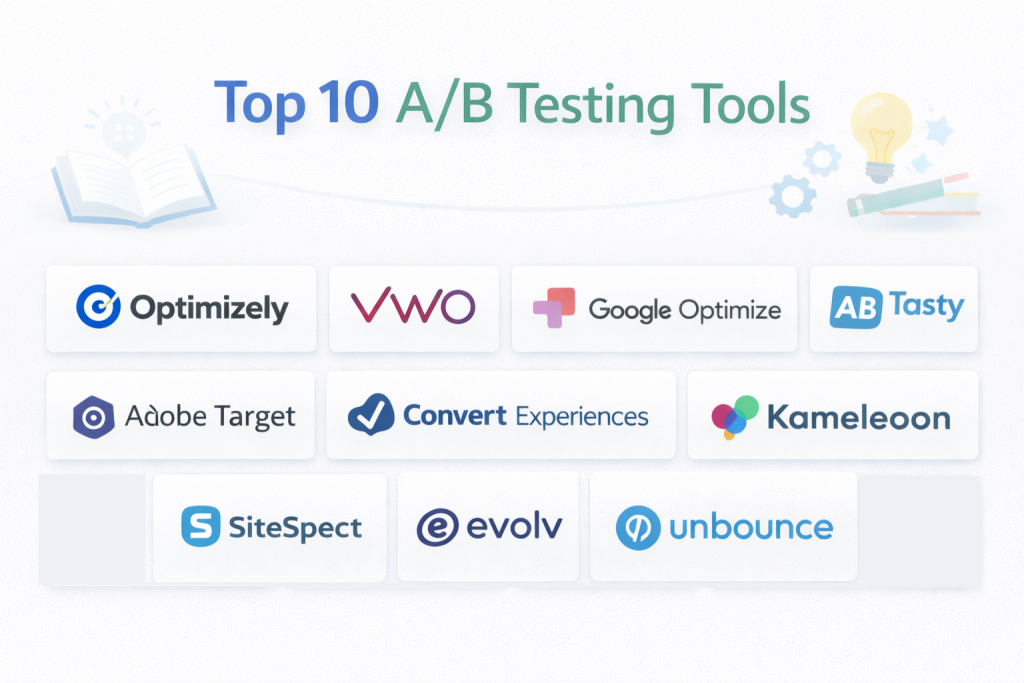
Top 10 A/B Testing Tools Tools
1 — Optimizely
Optimizely is a leading experimentation platform that enables full-stack A/B testing, personalization, and feature flagging across web, mobile, and server-side applications. It’s designed for enterprise teams in e-commerce and SaaS who need advanced segmentation, statistical analysis, and integration with data warehouses for holistic optimization strategies. Optimizely combines visual editing with code-based testing, making it versatile for marketers and developers alike, while its AI-powered recommendations help automate variant creation and winner selection for faster iterations.
Key features:
- Full-stack experimentation for web/mobile/server.
- AI-driven personalization and recommendations.
- Advanced audience targeting and segmentation.
- Statistical engine with sequential testing.
- Feature flags for controlled rollouts.
- Integrations with Google Analytics, Amplitude, Snowflake.
- Experiment collaboration and reporting dashboards.
Pros:
- Robust enterprise-grade scalability and compliance.
- Comprehensive full-stack capabilities reduce tool sprawl.
- Strong AI features accelerate testing cycles.
Cons:
- Premium pricing may deter smaller teams.
- Steep learning curve for advanced features.
- Setup requires technical expertise for full utilization.
Security & compliance: SSO, encryption, audit logs; SOC 2, GDPR, HIPAA compliant.
Support & community: Detailed onboarding, 24/7 enterprise support, active forums and user groups.
2 — VWO
VWO (Visual Website Optimizer) is a user-friendly A/B testing and conversion optimization platform with visual editors and heatmaps, targeted at marketers and growth teams in e-commerce and digital agencies. It emphasizes no-code testing for quick experiments on websites and apps. VWO provides end-to-end optimization with session recordings, surveys, and multivariate testing, helping teams identify friction points and test solutions rapidly.
Key features:
- Visual editor for no-code changes.
- Heatmaps, clickmaps, and session recordings.
- Multivariate and split URL testing.
- Behavioral targeting and segmentation.
- Baye sian and frequentist stats engines.
- Integrations with Google Analytics, HubSpot, WordPress.
- AI-powered test ideas and personalization.
Pros:
- Intuitive for non-technical users.
- Comprehensive user behavior insights.
- Affordable entry-level plans.
Cons:
- Advanced features in higher tiers.
- Limited server-side testing.
- Occasional interface glitches.
Security & compliance: Encryption, audit logs; SOC 2, GDPR compliant.
Support & community: Good docs, chat support, community webinars.
3 — Google Optimize
Google Optimize is a free A/B testing tool integrated with Google Analytics, designed for marketers and analysts optimizing websites based on data insights. It’s simple for basic tests but scalable with Analytics audiences. Google Optimize allows easy variant creation and targeting, perfect for data-driven teams leveraging Google ecosystem for quick wins.
Key features:
- Integration with Google Analytics 360.
- A/B, multivariate, and redirect tests.
- Audience targeting from Analytics.
- Visual editor.
- Reporting in Analytics.
- Personalization experiences.
- Experiment objectives from goals.
Pros:
- Free for most users.
- Seamless with Google tools.
- Easy setup for beginners.
Cons:
- Sunsetted in 2023; alternatives needed.
- Limited advanced stats.
- No mobile app testing.
Security & compliance: Google standards; GDPR compliant.
Support & community: Google docs, forums.
4 — AB Tasty
AB Tasty is a customer experience optimization platform with A/B testing, personalization, and feature experimentation. It targets mid-market to enterprise in e-commerce and media for user-centric improvements. AB Tasty combines testing with AI segmentation and journey mapping, helping teams deliver tailored experiences at scale.
Key features:
- AI-powered segmentation.
- Visual and code editors.
- Multivariate testing.
- Personalization engine.
- Feature flags.
- Integrations with Analytics, CRM.
- Heatmaps and analytics.
Pros:
- Strong personalization.
- User-friendly for marketers.
- Good European compliance.
Cons:
- Pricing opaque.
- Limited free tier.
- Slower for large sites.
Security & compliance: SSO, encryption; GDPR, SOC 2.
Support & community: Dedicated, resources.
5 — Adobe Target
Adobe Target is an enterprise A/B testing and personalization tool integrated with Adobe Experience Cloud. It serves large brands for AI-driven optimization across channels. Adobe Target uses machine learning for auto-allocation and recommendations, ideal for data-rich enterprises.
Key features:
- AI auto-targeting.
- Multivariate and experience testing.
- Audience discovery.
- Integration with Analytics, Experience Manager.
- Mobile/app testing.
- Reporting dashboards.
- Omnichannel support.
Pros:
- Powerful AI and analytics.
- Enterprise scale.
- Comprehensive suite.
Cons:
- High cost.
- Complex setup.
- Adobe ecosystem heavy.
Security & compliance: SSO, audit; SOC 2, GDPR, HIPAA.
Support & community: Enterprise.
6 — Convert Experiences
Convert is a privacy-focused A/B testing platform with unlimited tests and features. It emphasizes GDPR compliance and no-flicker testing for accurate results. Convert offers advanced targeting and stats, suited for agencies and e-commerce optimizing without data privacy concerns.
Key features:
- Unlimited tests/projects.
- No-flicker asynchronous loading.
- Advanced segmentation.
- Bayesian/frequentist stats.
- Integrations with Analytics, Shopify.
- Heatmaps add-on.
- API access.
Pros:
- Privacy-first design.
- Unlimited features.
- Good value.
Cons:
- Interface older.
- Support ticket-based.
- Limited AI.
Security & compliance: GDPR focus; encryption.
Support & community: Tickets, docs.
7 — Kameleoon
Kameleoon is an AI personalization and A/B testing platform for web and apps. It uses predictive scoring for targeting. Kameleoon provides hybrid testing with AI insights, ideal for e-commerce and media personalizing at scale.
Key features:
- AI predictive targeting.
- Full-stack testing.
- Personalization engine.
- Integrations with data platforms.
- Real-time dashboards.
- Mobile SDK.
- Compliance tools.
Pros:
- Strong AI.
- European hosting.
- Flexible.
Cons:
- Pricing premium.
- Setup time.
- Less known US.
Security & compliance: GDPR, encryption.
Support & community: Dedicated.
8 — SiteSpect
SiteSpect is a client-side A/B testing platform with real-user monitoring. It avoids tags for performance.
SiteSpect offers tag-free testing, suited for enterprises prioritizing speed and accuracy.
Key features:
- Tag-free implementation.
- Real-user metrics.
- Multivariate testing.
- Personalization.
- Integrations.
- Analytics.
- Mobile support.
Pros:
- No performance impact.
- Accurate data.
- Enterprise focus.
Cons:
- Complex.
- Costly.
- Limited small teams.
Security & compliance: Compliance strong.
Support & community: Professional.
9 — Evolv
Evolv is an AI optimization platform for continuous experimentation. It uses ML to test variants automatically.
Evolv focuses on AI-driven evolution, ideal for e-commerce seeking hands-off optimization.
Key features:
- AI variant generation.
- Continuous testing.
- Personalization.
- Integrations.
- Dashboards.
- Behavioral analysis.
- API.
Pros:
- Automated AI.
- Hands-off.
- Good results.
Cons:
- Less control.
- Premium.
- Data needs.
Security & compliance: GDPR.
Support & community: Enterprise.
10 — Unbounce
Unbounce is a landing page builder with A/B testing for marketing campaigns. It includes AI copy generation.
Unbounce optimizes pages with testing, suited for marketers running ads.
Key features:
- Landing page builder.
- A/B testing.
- AI copy.
- Dynamic text replacement.
- Integrations.
- Analytics.
- Popups.
Pros:
- Marketing-focused.
- Easy pages.
- Good conversions.
Cons:
- Limited full sites.
- Pricing per page.
- Less enterprise.
Security & compliance: GDPR.
Support & community: Resources.
Comparison Table
| Tool Name | Best For | Platform(s) Supported | Standout Feature | Rating |
|---|---|---|---|---|
| Optimizely | Enterprise full-stack | Web/Mobile/Server | AI recommendations | N/A |
| VWO | Marketing optimization | Web/Mobile | Behavior insights | N/A |
| Google Optimize | Free data-driven testing | Web | Analytics integration | N/A |
| AB Tasty | Personalization & journeys | Web/Mobile | AI segmentation | N/A |
| Adobe Target | Enterprise AI testing | Web/Mobile | Auto-allocation | N/A |
| Convert | Privacy-focused testing | Web | Unlimited tests | N/A |
| Kameleoon | AI predictive | Web/Mobile | Hybrid testing | N/A |
| SiteSpect | Tag-free accuracy | Web | Real-user monitoring | N/A |
| Evolv | AI continuous optimization | Web | Variant evolution | N/A |
| Unbounce | Landing page marketing | Web | AI copy generation | N/A |
Evaluation & Scoring of A/B Testing Tools
| Tool Name | Core Features (25%) | Ease of Use (15%) | Integrations & Ecosystem (15%) | Security & Compliance (10%) | Performance & Reliability (10%) | Support & Community (10%) | Price / Value (15%) | Total Score |
|---|---|---|---|---|---|---|---|---|
| Optimizely | 10 (2.5) | 8 (1.2) | 9.5 (1.425) | 9.5 (0.95) | 9.5 (0.95) | 9 (0.9) | 8 (1.2) | 9.13 |
| VWO | 9.5 (2.375) | 9 (1.35) | 9 (1.35) | 9 (0.9) | 9 (0.9) | 8.5 (0.85) | 9 (1.35) | 9.03 |
| Google Optimize | 8 (2.0) | 9 (1.35) | 9 (1.35) | 8.5 (0.85) | 8.5 (0.85) | 8 (0.8) | 10 (1.5) | 8.73 |
| AB Tasty | 9 (2.25) | 8.5 (1.275) | 8.5 (1.275) | 8.5 (0.85) | 9 (0.9) | 8 (0.8) | 8.5 (1.275) | 8.63 |
| Adobe Target | 10 (2.5) | 7.5 (1.125) | 9.5 (1.425) | 9.5 (0.95) | 9.5 (0.95) | 9 (0.9) | 7 (1.05) | 8.9 |
| Convert | 9 (2.25) | 8 (1.2) | 8 (1.2) | 9 (0.9) | 9 (0.9) | 8 (0.8) | 9 (1.35) | 8.6 |
| Kameleoon | 9 (2.25) | 8 (1.2) | 8.5 (1.275) | 9 (0.9) | 9 (0.9) | 8 (0.8) | 8 (1.2) | 8.53 |
| SiteSpect | 9 (2.25) | 7.5 (1.125) | 8 (1.2) | 9 (0.9) | 9.5 (0.95) | 8 (0.8) | 7.5 (1.125) | 8.35 |
| Evolv | 9 (2.25) | 8 (1.2) | 8 (1.2) | 8 (0.8) | 9 (0.9) | 7.5 (0.75) | 7.5 (1.125) | 8.23 |
| Unbounce | 8.5 (2.125) | 9 (1.35) | 8 (1.2) | 8 (0.8) | 8.5 (0.85) | 8 (0.8) | 8.5 (1.275) | 8.4 |
Which A/B Testing Tools Tool Is Right for You?
A/B testing tool selection hinges on your team’s size, technical skills, and optimization goals, with options ranging from free starters to enterprise suites.
For solo users like freelancers or bloggers, Google Optimize or Unbounce provide easy, no-code testing for sites or pages without heavy investment.
SMBs often choose VWO or AB Tasty for balanced features, user-friendly interfaces, and integrations with tools like Google Analytics, allowing growth without overwhelming complexity.
Mid-market companies benefit from Optimizely or Kameleoon, offering advanced segmentation, multivariate testing, and AI insights to scale experiments across products.
Enterprises favor Adobe Target or SiteSpect for full-stack capabilities, robust compliance, and integration with enterprise stacks like CRM or data warehouses for data-driven decisions at scale.
If you’re budget-conscious, start with Google Optimize’s free tier or Convert’s privacy-focused plans that offer unlimited tests at reasonable costs.
Premium solutions like Optimizely or Adobe Target justify higher prices with AI automation, personalized experiences, and enterprise support for high-stakes optimization.
Balance feature depth (Optimizely/Adobe for multivariate/full-stack) vs. ease of use (VWO/Unbounce for visual editing)—depth suits data teams, ease marketers.
For integration and scalability, Adobe Target excels in marketing clouds, while Optimizely handles large traffic with reliable stats.
Security and compliance requirements are critical in regulated industries—tools like Convert (GDPR focus) or Adobe (HIPAA) ensure data protection and auditability.
Assess your traffic volume, experiment types (web vs. app), and team expertise—trial multiple to find the best fit for sustainable optimization.
Frequently Asked Questions (FAQs)
What is an A/B testing tool? It’s software for comparing two versions of a digital asset to see which performs better on metrics like conversions or engagement, using random user splitting and statistical analysis.
Why use A/B testing tools? They provide data-backed insights to optimize user experience, increase revenue, and reduce risks from changes, essential for growth in competitive digital spaces.
How much do A/B testing tools cost? Free tiers (Google Optimize) to $100-500/month for mid-tier (VWO), or custom enterprise pricing (Optimizely) based on traffic/tests.
Best free A/B testing tool? Google Optimize for basic web testing with Analytics integration; limited but effective start.
Implementation complexity? No-code tools like VWO quick (hours); full-stack like Optimizely require dev setup (days/weeks).
Common mistake in A/B testing? Running tests too short—leads to invalid results. Best: Use sample size calculators, test one variable.
Privacy concerns with testing? GDPR-compliant tools like Convert avoid cookies; always anonymize data.
Scalability for high traffic? Enterprise tools like Adobe Target handle millions; check performance impact.
Alternatives to dedicated tools? Basic Google Analytics experiments; full for complex needs.
AI role in A/B testing? Auto-variants and winner prediction in Optimizely/AB Tasty save time.
Mobile app testing? Most support; Optimizely/VWO strong SDKs.
Measure success? Conversion lifts, statistical significance, ROI on changes.
Conclusion
This exploration of top A/B testing tools reveals a mature market with leaders like Optimizely and Adobe Target for enterprises, user-friendly options like VWO and AB Tasty for marketers, and accessible choices like Google Optimize and Unbounce for smaller teams. Key insights include the rise of AI for automated testing, integration with analytics for deeper insights, and emphasis on privacy-compliant experimentation in a regulated world. These tools have evolved from simple split tests to sophisticated platforms supporting multivariate, personalization, and full-stack optimization, enabling businesses to iterate faster and more confidently.
What matters most when choosing an A/B testing tool is alignment with your technical capabilities, traffic scale, and business objectives—ease for quick wins, depth for complex experiments, and integrations for seamless workflows. Remember, the “best” tool depends on your specific needs rather than one universal winner; what excels for an e-commerce giant may overwhelm a startup. Take time to trial options, define clear metrics, and involve your team to select a tool that not only runs tests but drives meaningful growth. The right A/B testing software transforms guesswork into data-driven success, ultimately enhancing user satisfaction and bottom-line results.