Introduction
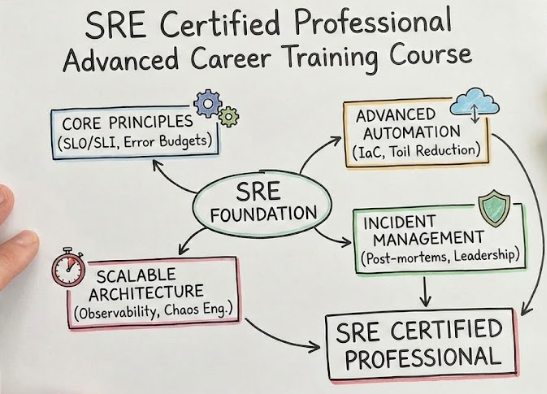
Reliability is widely considered the most critical feature of any software product. If a system is not available, no other feature matters to the user. As software systems grow in complexity, the traditional methods of managing infrastructure are often found to be insufficient. Site Reliability Engineering (SRE) was introduced to apply engineering principles to operations tasks. The SRE Certified Professional (Training & Certification) is designed to provide engineers with a structured framework for building and maintaining highly available systems.
In the modern landscape of cloud computing and distributed systems, downtime is no longer tolerated. The “hope is not a strategy” mindset is replaced by a data-driven approach where every decision is backed by metrics. For both individual engineers and organizational managers, obtaining a formal certification is seen as a way to standardize practices across teams. It is ensured that a common language is spoken when discussing system health, incident response, and automation.
Certification Overview Table
| Track | Level | Who it’s for | Prerequisites | Skills Covered | Recommended Order |
| Site Reliability Engineering | Professional | DevOps, SREs, Managers | Basic Linux & Coding | SLOs, SLIs, Toil, Automation | Core Certification |
Why Choose DevOpsSchool?
When a platform for professional growth is selected, the quality of the curriculum and the expertise of the instructors are analyzed. DevOpsSchool is chosen by many because the training is rooted in practical, hands-on experience rather than just theoretical concepts. The focus is shifted from simply passing an exam to actually gaining the skills required to manage production environments.
It is observed that the training provided by DevOpsSchool aligns with the latest industry requirements. The complex concepts of SRE are broken down into manageable modules. Ongoing support is offered to ensure that every learner can apply these principles to their specific work environment. By choosing this path, a connection is made with a global community of practitioners who share insights on the latest trends in reliability and automation.
Certification Deep-Dive: SRE Certified Professional
What is this certification?
The SRE Certified Professional (Training & Certification) is a specialized program centered on the discipline of Site Reliability Engineering. A deep understanding of how to balance the need for new features with the requirement for system stability is provided. It is based on the proven methodologies used by leading technology companies to manage global-scale infrastructure.
Who should take this certification?
This certification is recommended for Software Engineers who wish to understand the operational side of their code. It is also highly beneficial for System Administrators and DevOps Engineers who want to move toward a more automated, code-centric way of working. Managers find value in this program as it provides the tools needed to measure and improve team efficiency and system reliability.
Skills you will gain
- Metric Definition: The art of defining Service Level Indicators (SLIs) and Service Level Objectives (SLOs) is mastered.
- Error Budget Management: The ability to use error budgets to make informed decisions about product releases is developed.
- Toil Reduction: Strategies for identifying and automating manual, repetitive tasks are learned.
- Incident Response: A structured approach to managing outages and conducting blameless post-mortems is acquired.
- Observability: Skills in setting up comprehensive monitoring and alerting systems are enhanced.
- Capacity Planning: The process of forecasting resource requirements to ensure system performance is understood.
Real-world projects you should be able to do
- Automated Dashboard Creation: A real-time monitoring dashboard is designed to track SLO compliance.
- Infrastructure as Code (IaC): Server setups are automated using scripts to ensure consistency across environments.
- Post-Mortem Documentation: A detailed, blameless report is written after a simulated system failure to identify root causes.
- Alert Optimization: An alerting logic is configured to ensure that engineers are only notified for critical, actionable issues.
Preparation plan
7–14 days plan
The fundamental concepts of SRE are reviewed during this initial period. The core philosophy of “treating operations as a software problem” is studied. The differences between SRE and traditional DevOps are explored to build a strong theoretical foundation.
30 days plan
Hands-on practice is emphasized in this phase. Monitoring tools are set up in a lab environment. Calculations for error budgets are performed based on various availability targets. The lifecycle of an incident is simulated to understand the roles of an on-call engineer.
60 days plan
Advanced topics such as distributed tracing and complex automation workflows are tackled. Mock exams are taken to identify areas where more study is needed. Real-world case studies of system failures are analyzed to understand how SRE principles could have prevented them.
Common mistakes to avoid
- Over-complicating Metrics: Too many SLIs are often defined, leading to confusion. It is recommended to focus on a few critical indicators that truly reflect the user experience.
- Ignoring Culture: SRE is as much about culture as it is about tools. The importance of a blameless culture is sometimes overlooked by technical teams.
- Manual Fixes: Quick manual fixes are often prioritized over long-term automated solutions, which leads to the accumulation of “toil.”
Best next certification after this
- Same track: Advanced SRE Architecture.
- Cross-track: DevSecOps Professional (Training & Certification).
- Leadership / management: Strategic Engineering Leadership.
Choose Your Learning Path
1. DevOps Path
This path is intended for those who wish to bridge the gap between development and operations. A focus is placed on the automation of the CI/CD pipeline. It is best for engineers who want to ensure that software is delivered quickly and reliably.
2. DevSecOps Path
Security is integrated into every stage of the development lifecycle in this track. It is chosen by professionals who believe that security should not be an afterthought. Tools for automated vulnerability scanning and compliance are explored in depth.
3. Site Reliability Engineering (SRE) Path
The core of this path is system uptime and performance. It is suited for individuals who enjoy solving complex technical puzzles related to scale and reliability. Data analysis is used to drive every operational decision.
4. AIOps / MLOps Path
As Artificial Intelligence becomes more common, the need to manage these models in production grows. This path is designed for engineers who work with machine learning pipelines. It ensures that models are updated and deployed without disrupting the service.
5. DataOps Path
The flow of data through an organization is managed with an agile mindset in this track. It is ideal for data engineers who want to ensure high data quality and low latency in their data pipelines.
6. FinOps Path
Cloud costs are often difficult to manage as systems scale. This path is focused on bringing financial accountability to the cloud. It is best for those who want to balance technical performance with business expenses.
Role → Recommended Certifications Mapping
The alignment between specific job roles and the SRE Certified Professional (Training & Certification) is detailed here:
- DevOps Engineer: The SRE certification is combined with CI/CD mastery to create a well-rounded professional.
- Site Reliability Engineer (SRE): This is the primary certification, often followed by specialized training in observability and distributed systems.
- Platform Engineer: The certification helps in building internal developer platforms that are inherently reliable.
- Cloud Engineer: Reliability principles are applied to cloud-native services to ensure high availability across multiple regions.
- Security Engineer: SRE concepts are used to ensure that security tools themselves are highly available and do not become a bottleneck.
- Data Engineer: The reliability of data pipelines is improved by applying SLOs to data delivery times.
- FinOps Practitioner: An understanding of how reliability impacts cost is gained through the SRE framework.
- Engineering Manager: The program is used to define clear performance metrics for the entire engineering department.
Next Certifications to Take
After the completion of the SRE professional track, further specialization is often pursued:
- One same-track certification: Advanced Infrastructure Engineering is recommended to deepen technical expertise.
- One cross-track certification: Cloud Security Specialist is suggested to broaden the professional scope.
- One leadership-focused certification: Technical Product Management is advised for those moving into strategic roles.
Training & Certification Support Institutions
DevOpsSchool
A wide range of technical training programs is provided by this institution. It is recognized for its commitment to community-driven learning and practical excellence.
Cotocus
Customized training solutions for corporate teams are offered here. The curriculum is tailored to meet the specific needs of large-scale engineering organizations.
ScmGalaxy
A comprehensive repository of technical knowledge and community forums is maintained. It serves as a valuable resource for engineers seeking to troubleshoot complex infrastructure issues.
BestDevOps
The most current tools and methodologies are always featured in the training programs offered here. It is an ideal choice for staying updated with the rapid changes in the tech industry.
devsecopsschool.com
The intersection of security and operations is the primary focus of this school. It is the leading destination for learning how to build secure automated pipelines.
sreschool.com
A dedicated environment for mastering SRE principles is provided. Every aspect of the SRE framework is explored with academic rigor and practical focus.
aiopsschool.com
The use of machine learning to enhance IT operations is taught here. It prepares engineers for the future of automated system management.
dataopsschool.com
Agile methodologies are applied to data management in the courses provided by this institution. It focuses on the reliability of the entire data lifecycle.
finopsschool.com
The financial aspects of cloud computing are decoded here. It helps engineers and finance professionals work together to optimize cloud spending.
FAQs Section
1. Is the SRE Certified Professional exam considered difficult?
A high level of technical understanding is required, making the exam moderately difficult. Success is usually achieved through a combination of study and hands-on practice.
2. How much preparation time is generally needed?
For most working professionals, a period of six to eight weeks is recommended to fully grasp the concepts.
3. Are there specific prerequisites for this certification?
While not mandatory, a basic understanding of scripting and cloud infrastructure is highly encouraged.
4. Can this certification be taken online?
Yes, training and certification are offered in both online and classroom formats to suit different learning preferences.
5. What is the primary benefit of being SRE certified?
Recognition as an expert in system reliability is gained, which opens doors to senior engineering roles globally.
6. How is “Toil” addressed in the training? Toil is defined as manual work that lacks enduring value. Strategies for identifying and eliminating it through automation are a core part of the course.
7. Does the program cover Google’s SRE standards?
Yes, the curriculum is heavily influenced by the industry-standard practices established by Google.
8. Is the certification recognized in India?
It is highly valued by major technology hubs across India and is recognized by top multinational corporations.
9. How does SRE help in career growth?
The transition from a generalist role to a specialized, high-demand position in reliability engineering is facilitated.
10. Are mock tests provided during the training?
Regular assessments and mock exams are included to help candidates prepare for the final certification.
11. Is the certification focused on specific tools?
While various tools are used in labs, the focus remains on the underlying principles that can be applied to any toolset.
12. Can a developer benefit from this SRE course?
Absolutely. Developers learn to write code that is more resilient and easier to maintain in a production environment.
Additional FAQs for SRE Certified Professional
13. What is the main difference between SLIs and SLOs?
An SLI is a specific measurement, while an SLO is a target value for that measurement over a period of time.
14. Why is the concept of an Error Budget important?
It provides a clear, data-driven way to decide when to slow down feature releases in favor of improving stability.
15. Is incident management taught in this program?
Yes, the entire lifecycle of an incident, from detection to post-mortem, is covered in detail.
16. What are “Blameless Post-Mortems”?
These are reviews of system failures that focus on technical causes rather than blaming individuals, fostering a culture of learning.
17. Is automation always the answer in SRE?
While highly encouraged, the course teaches when to automate and when manual intervention might still be necessary.
18. How does SRE relate to Platform Engineering?
SRE principles are often used by platform teams to ensure the reliability of the services they provide to developers.
19. What role does observability play in SRE?
Observability is seen as the foundation that allows engineers to understand the internal state of a system based on its outputs.
20. Is help provided for the final certification exam?
Comprehensive study guides and instructor support are provided to ensure a high success rate for all candidates.
Testimonials
Kiran “The understanding of Error Budgets was a turning point in my career. My ability to communicate technical risks to the business has been greatly improved.”
Meera “Hands-on labs were exceptionally useful. The transition from a traditional Ops role to an SRE position was made possible by this certification.”
Rajesh “As a Senior Engineer, I found the focus on toil reduction very practical. My team is now more focused on high-value engineering tasks than manual work.”
Sneha “The blameless culture taught in the course has completely changed how our team handles outages. We are now much more efficient in our recovery process.”
Amit “The SRE Certified Professional program provided a clear roadmap for my professional development. My confidence in managing large-scale systems has increased.”
Conclusion
The pursuit of the SRE Certified Professional (Training & Certification) is a strategic move for any engineer or manager. By focusing on reliability as a core feature, a foundation for long-term career success is built. The balance between innovation and stability is maintained through the application of SRE principles. Strategic learning and careful certification planning are recommended to stay ahead in the competitive global market.