Introduction
What is DevSecOps Certified Professional Online Training?
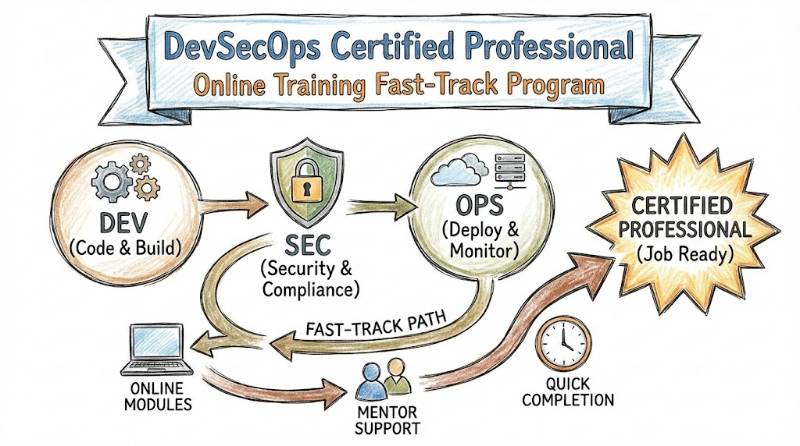
The DevSecOps Certified Professional Online Training is a program where the focus is placed on merging security with the fast-paced world of DevOps. It is not just about learning a few tools. It is about changing how software is created. In this training, the methods for “shifting security left” are taught. This means that security tests are performed as soon as the code is written, rather than waiting for the software to be fully finished. By doing this, vulnerabilities are found and fixed much faster.
Why it matters in today’s software, cloud, and automation ecosystem
In the current era, software is being updated every hour. If security is handled manually, it cannot keep up with this speed. Data breaches are becoming more common and more expensive for companies. Therefore, a system is needed where security is automated. This training matters because it teaches how to use automation to keep applications safe. It ensures that speed does not come at the cost of safety. Every engineer in the cloud era is expected to know how to protect the data they handle.
Why certifications are important for engineers and managers
Certifications are often viewed as a mark of a professional’s dedication to their craft. For an engineer, being certified in a program like this means that their skills have been tested against industry standards. It gives them the confidence to speak about security during high-level meetings. For managers, these certifications are a tool to ensure that the whole team is speaking the same language. It helps in building a culture where everyone is responsible for the safety of the product, which reduces the risk of human error.
A Detailed Table for the Certification Track
| Track | Level | Who it’s for | Prerequisites | Skills Covered | Recommended Order |
| Security Operations | Professional | Engineers and Leaders | Basic Linux & Git | SAST, DAST, Secrets, Cloud | After DevOps Foundation |
Why Choose DevOpsSchool?
DevOpsSchool is often preferred by those who want to learn from people who have spent years in the field. The training is not just based on books; it is based on real struggles and successes found in the industry.
- Practical Learning: The lessons are designed around hands-on labs where real tools are used in a safe environment.
- Updated Content: The materials are updated frequently so that they always match the latest security threats and tool versions.
- Mentor Support: Guidance is provided by experts who can answer difficult questions based on their own experiences.
- Community Access: Learners are given access to a large network of professionals where ideas and job opportunities are shared regularly.
A Deep Look into the Certification Details
DevSecOps Certified Professional (DSOCP)
What is this certification?
This is a professional-level course that explains how to build a “Security Highway.” It focuses on adding automated security checkpoints into the pipes that deliver software. It ensures that no piece of code moves forward if it has a known weakness.
Who should take this certification?
- Software Developers: Those who want to learn how to write code that is hard to hack from the very start.
- DevOps Engineers: Those who are already building pipelines but need to make them more secure.
- Cloud Architects: Professionals who are designing large systems and need to ensure the whole structure is safe.
- Security Teams: People who come from a traditional security background and want to learn about modern automation.
Skills you will gain
- Static Analysis (SAST): Learning is provided on how to scan source code for bugs before it is even compiled.
- Dynamic Analysis (DAST): Techniques are taught to test a running application for weaknesses just like a hacker would.
- Container Security: Methods are shown to secure Docker and Kubernetes so that the “packages” carrying the code are safe.
- Secrets Management: Instruction is given on how to hide passwords and keys so they are never leaked in the code.
- Compliance Automation: Understanding is built on how to make sure the software follows legal rules automatically.
Real-world projects you should be able to do
- Secure Pipeline Setup: A Jenkins or GitLab pipeline will be built that automatically runs security scans every time a change is made.
- Vulnerability Report Generation: Automated reports will be created that tell the team exactly where the risks are and how to fix them.
- Hardening Containers: Docker images will be cleaned of all unnecessary files to make them smaller and much harder to attack.
- Access Control Policies: Rules will be written to ensure that only the right people can touch sensitive parts of the system.
Preparation plan
- 7–14 days plan: The focus is kept on the basic ideas. The first two weeks are spent understanding the “Why” of DevSecOps and getting comfortable with simple Linux commands.
- 30 days plan: During this month, the focus shifts to the “How.” Daily practice is done with tools like SonarQube or Snyk to see how they find bugs in the code.
- 60 days plan: The final month is used for complex projects. Full pipelines are built, and different tools are made to work together smoothly. Mock tests are also taken during this time.
Common mistakes to avoid
- Ignoring the Culture: Many people focus only on the tools. However, security is also about how people work together. If the team does not talk, the tools will not help.
- Too Much Automation Too Fast: Trying to automate everything in one day often leads to a broken system. It is better to start small and grow slowly.
- Not Testing the Backups: People often secure the front door but forget to check if their data can be recovered if something goes wrong.
Best next certification after this
- Same track: Advanced Cloud Security Specialist.
- Cross-track: Site Reliability Engineering (SRE) to learn about system uptime.
- Leadership / management: IT Strategy and Governance.
Selecting the Right Learning Path
The Path for DevOps
This path is best for those who want to focus on the flow of work. It is chosen by engineers who want to make sure that code moves from the developer’s laptop to the customer’s screen as fast as possible without breaking anything.
The Path for DevSecOps
This path is for the “Safety Guardians.” It is suited for those who believe that speed is good, but safety is mandatory. It teaches how to build a shield around the software while it is being built.
The Path for Site Reliability Engineering (SRE)
This is for people who love stability. It is the best choice for those who want to ensure that a website never goes down, even when millions of people are using it at the same time.
The Path for AIOps / MLOps
This is a newer path for those working with Artificial Intelligence. It is best for engineers who need to manage complex data models and want to use AI to find problems in their systems before they happen.
The Path for DataOps
This path is meant for data experts. It is chosen by those who want to apply the lessons of DevOps to data science, ensuring that data is clean, safe, and delivered on time.
The Path for FinOps
This is the “Money Path.” It is best for those who want to bridge the gap between engineering and the finance department. It teaches how to keep the cloud bills low while the performance remains high.
Recommended Mapping of Roles to Certifications
- DevOps Engineer: DevSecOps Certified Professional and GitOps Foundation.
- Site Reliability Engineer (SRE): SRE Certified Professional and Chaos Engineering.
- Platform Engineer: Kubernetes Specialist and DevSecOps Professional.
- Cloud Engineer: Cloud Security Expert and DSOCP.
- Security Engineer: DevSecOps Certified Professional and Cloud Infrastructure Security.
- Data Engineer: DataOps Professional and Data Security.
- FinOps Practitioner: FinOps Certified Associate and Cloud Cost Management.
- Engineering Manager: Leadership in Tech and DevSecOps for Managers.
Guidance on Next Steps for Learners
It is always advised that a professional should never stop learning. Once a track is finished, the next step should be planned carefully.
- Same-track: If security is the main goal, moving into deeper cloud-specific security is recommended.
- Cross-track: A security expert who understands SRE is seen as very valuable because they understand both safety and stability.
- Leadership-focused: If a move into management is desired, training in team building and business strategy is the best choice.
Institutions Providing Training and Support
DevOpsSchool
At DevOpsSchool, a very practical approach is taken. The training is delivered through live sessions where questions are encouraged. A lot of support is given to ensure every student completes their projects.
Cotocus
Cotocus is known for helping companies change their ways of working. Their training is very much focused on what is actually happening in the industry right now. They provide a bridge between learning and doing.
ScmGalaxy
This is a place where a lot of free knowledge is shared. It is a great support system for those who want to keep reading and learning about new tools every day after their formal training is over.
BestDevOps
A very focused environment is provided at BestDevOps. They are experts in helping people who are stuck in old ways of working to move into modern, high-paying cloud roles.
devsecopsschool.com
This is a specialized school that only thinks about security. It is a perfect place for those who want to become true experts in the field of DevSecOps without any distractions.
sreschool.com
The focus here is entirely on reliability. It is where engineers go to learn how to build systems that are strong enough to handle any kind of failure.
aiopsschool.com
This institution teaches how the future of IT will look. They show how machine learning can be used to manage large systems more easily than humans can.
dataopsschool.com
The whole world of data is covered here. They show how to make data pipelines as reliable and fast as software pipelines.
finopsschool.com
This school helps people understand the cost of the cloud. It is a vital place for those who want to help their companies save money while growing.
Frequently Asked Questions (FAQs)
General Career Questions
- Is this field difficult to enter? It requires effort, but with the right guidance, it is very achievable for any IT professional.
- How long does it take to get certified? Most people find that two months of steady study is the right amount of time.
- What should be known before starting? A basic understanding of how the web works and some simple Linux skills are helpful.
- Is there a specific order for these courses? It is usually best to start with a basic DevOps course before moving into security.
- Will this help in getting a better salary? Yes, specialists in security and automation are currently among the highest-paid in the industry.
- What kind of companies hire these professionals? Every company from small startups to the biggest banks needs these skills today.
- Is the certification recognized everywhere? Yes, the standards taught are used by tech companies all over the world.
- How often should the skills be updated? In this field, it is good to look at new tools and trends at least once every year.
- Can someone from a non-tech background do this? It is harder, but with a lot of practice in basics, it can be done.
- Is coding a mandatory skill? Being able to read code and write simple scripts is very important for automation.
- Are the exams held online? Yes, most evaluations and tests are conducted through online platforms for convenience.
- Is there support for finding jobs? Many of these institutions provide a community where job postings are shared.
DevSecOps Professional Training Specifics
- What is the focus of this specific training?
The main focus is the automation of security within the software lifecycle. - Which tools are used in the labs?
Industry-standard tools like Vault, Jenkins, and various scanning tools are used. - Is container security a big part of the course?
Yes, a significant amount of time is spent on Docker and Kubernetes security. - How are the practical skills tested?
Skills are usually tested through the completion of a capstone project. - Can a manager benefit from this technical course?
Yes, it helps them understand the real risks their teams are facing. - Does it cover different cloud providers?
The concepts taught are general and can be applied to any major cloud platform. - What is “Shift Left”?
It is the idea of doing security testing earlier in the development process to save time and money. - Is there any post-training support?
Most learners continue to have access to the community and updated materials.
Testimonials from the Field
Arjun
The understanding of how to stop a bad piece of code from reaching the customer was gained here. The practical approach made the complex topics feel simple.
Kavita
A clear path was found to move from manual testing to automated security. The confidence to lead a team through these changes was built during the training.
Michael
The focus on real-world problems instead of just theory was very appreciated. The skills learned were put to use in the office the very next day.
Fatima
It was hard to find a course that covered both DevOps and deep security. This program filled that gap and helped in making a significant career move.
Rajesh
The way the trainers explained the “Why” behind every security step was excellent. The projects helped in mastering the tools in a very short time.
Conclusion
The DevSecOps Certified Professional Online Training is not just a certificate on a wall. It is a transformation of how work is done. By learning to integrate security into every step of the process, a more reliable and safer future is built for the software industry. Strategic planning of one’s learning path is the best way to ensure long-term success in this ever-changing field.