Introduction
The software industry has undergone a massive shift. In the past, we had clear lines between the people who wrote the code and the people who managed the servers. Today, those lines are gone. We are now in a world where speed is the currency of success. However, moving fast without a plan is a recipe for disaster. This is where the industry faces its biggest gap: we have plenty of smart engineers who can build tools, but we lack the leaders who can manage the entire process. Transitioning from a technical role to a management role is not just a promotion; it is a complete mindset shift. It is about moving from “how do I fix this server?” to “how do I build a team that never breaks the server?”
Defining the Leadership Path
What exactly is a Certified DevOps Manager?
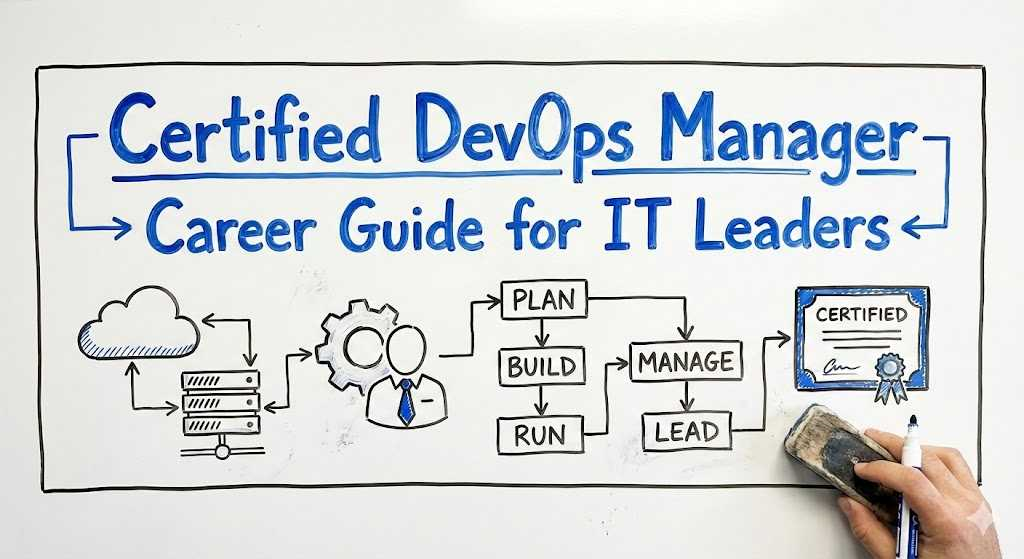
A Certified DevOps Manager is much more than a team lead. Think of them as the bridge between the technical engine room and the business boardroom. While DevOps engineers focus on pipelines, Kubernetes clusters, and automation scripts, the Manager focuses on the “Big Picture.” They are responsible for the culture of the team, the budget for the cloud infrastructure, and the long-term strategy of software delivery. They ensure that the technical efforts actually help the company make money and save time. It is a role that requires a unique mix of technical understanding and emotional intelligence.
The Value in Today’s Tech World
We are operating in a “Cloud-First” and increasingly “AI-Driven” ecosystem. Companies are deploying code hundreds of times a day. In this high-speed environment, a Certified DevOps Manager is the safety valve. They ensure that speed does not compromise security or stability. Without strong leadership, DevOps teams often burn out or build complex systems that no one else understands. A certified manager brings order to this chaos. They align the engineering goals with business goals, ensuring that every dollar spent on AWS or Azure brings value back to the company.
Why You Should Prioritize Certification
You might ask, “Why do I need a piece of paper if I have experience?” The answer is validation and structure. Experience teaches you how to solve specific problems you have faced, but a certification teaches you the standard framework for problems you haven’t faced yet. It fills in the gaps in your knowledge. Furthermore, in a competitive global market—whether you are applying in Bangalore, London, or Silicon Valley—recruiters use certifications as a filter. It tells them immediately that you speak the standard language of DevOps leadership and have mastered the core competencies required to lead enterprise teams.
Core Certification Comparison
| Specialization | Category | Target Professional | Required Knowledge | Core Competencies | Path Order |
| DevOps Leadership | Executive | Leads, Architects, Senior Engineers | SDLC and basic Cloud | Cultural Change, Budgeting, Pipeline Governance | Advanced Career Stage |
Why choose DevOpsSchool?
Choosing where to learn is just as important as what to learn. DevOpsSchool has distinguished itself by focusing on “Real-World Readiness” rather than just academic theory. Many training centers will help you pass an exam, but they leave you unprepared for the first day on the job. DevOpsSchool takes a different approach. They emphasize hands-on labs that simulate real, messy production environments—because that is what the real world looks like. Their mentors are industry veterans who have seen technologies come and go, so they teach you the timeless principles along with the modern tools. Plus, their alumni community provides a support network that stays with you throughout your career.
Deep-Dive: Certified DevOps Manager
A Brief Look at This Program
This certification acts as a career bridge. It is specifically designed for technical professionals who are ready to stop answering pagers at 3 AM and start designing the strategies that prevent those alarms from going off in the first place. It covers the crucial “human” and “financial” sides of technology that most engineering courses ignore.
Who is the Ideal Candidate?
- Senior DevOps Engineers: If you have mastered the tools and are now guiding juniors, this is your next step.
- Project Managers: If you manage technical projects but feel lost when the team talks about “containers” or “microservices,” this will give you the technical context you need.
- Software Architects: If you design systems, you need to understand how those systems are delivered and maintained.
- Aspiring CTOs: If your long-term goal is to run a technology department, this certification lays the foundational knowledge of operations management.
Skills You Will Master
- Governance and Compliance: You will learn how to design automated policies that keep your software legal and secure. This means ensuring no code goes to production without passing security checks.
- Resource Optimization (FinOps): You will gain the ability to analyze cloud bills and understand where the money is going. You will learn to spot waste—like servers running when no one is using them—and fix it.
- Change Management: The hardest part of DevOps is changing how people work. You will learn psychological strategies to convince traditional developers and operation teams to collaborate and trust automation.
- Architectural Oversight: You will learn how to evaluate new technologies. Just because a tool is “trendy” doesn’t mean it fits your company. You will learn to make decisions based on ROI and long-term stability.
Real-World Projects for Your Portfolio
- Designing a Global Deployment Strategy: You will be tasked with creating a plan to update a live application used by millions of people across three continents without any downtime. This teaches you about “Blue/Green” and “Canary” deployment strategies.
- DevOps Cost Audit & Optimization: You will be given a sample dataset of a company’s cloud spending. Your job will be to find the leaks and propose a plan to cut costs by 20% using FinOps principles, such as reserved instances and auto-scaling.
- Security Pipeline Integration: You will design a “DevSecOps” workflow where security is not an afterthought. You will build a blueprint that automatically blocks a release if a vulnerability is found, showing you how to balance speed with safety.
Study Timeline
- The 14-Day Sprint: Dedicate your first two weeks to the concepts. Read about the “Three Ways of DevOps” (Flow, Feedback, Learning). Understand the difference between Agile, Lean, and DevOps. Do not touch any tools yet; just get the philosophy right.
- The 30-Day Deep Dive: Now, look at the toolchain from a manager’s view. You don’t need to learn how to write complex Kubernetes manifests, but you must understand why Kubernetes helps a business scale. Study how Jenkins, Docker, and Terraform fit together to create a factory for software.
- The 60-Day Mastery: Shift your focus to scenarios. Practice answering “What if?” questions. What if the cloud provider goes down? What if a key engineer leaves the team? What if the budget is cut? This phase prepares you for the decision-making part of the exam.
Frequent Pitfalls to Sidestep
- Over-technicality: A common mistake is trying to memorize every command line argument. This is a management exam. Focus on the workflow and the business value, not the syntax.
- Ignoring the “People” Factor: Never forget that DevOps is 50% culture. If you focus only on automation and ignore the team dynamics, you will fail the exam and the job.
- Lack of Strategic Thinking: Don’t just pick a tool because it’s popular. Always ask “Why?” Be prepared to justify your choices based on cost, team skill level, and long-term maintenance.
Future Learning Steps
- In the same track: Move towards Platform Engineering Leadership, where you manage the internal developer platforms.
- Across different tracks: Explore the Certified DevSecOps Professional path to deepen your understanding of cybersecurity risks.
- Moving Higher: Look into Executive Leadership programs for Technology Officers to prepare for C-suite roles.
Selecting Your Career Track
1. The Generalist (DevOps)
This is the classic path. It is best for those who enjoy the entire lifecycle of software. You are the conductor of the orchestra, ensuring that developers, testers, and operations teams work in harmony. You focus on removing bottlenecks.
2. The Protector (DevSecOps)
This path is for those who are naturally cautious and detail-oriented. If you worry about data breaches and hackers, this is for you. You will learn to “shift left,” meaning you move security checks to the start of the process rather than checking at the end.
3. The Specialist in Stability (SRE)
Site Reliability Engineering is for the “firefighters” and “mechanics” of the tech world. If you love solving complex puzzles and analyzing why a system crashed, choose this. You focus on reliability, uptime, and creating systems that heal themselves.
4. The Intelligence Expert (AIOps/MLOps)
This is the frontier of DevOps. It is designed for those who want to work with Data Scientists. You will learn how to automate the training and deployment of Machine Learning models, which is a very different challenge from deploying standard web apps.
5. The Data Strategist (DataOps)
Data is the new oil, and DataOps is the pipeline. This path is for data engineers who are tired of broken data flows. You will apply DevOps principles—like version control and automated testing—to data, ensuring it is clean and reliable.
6. The Value Optimizer (FinOps)
This is a rapidly growing field for the business-minded engineer. If you enjoy spreadsheets and efficiency as much as servers, FinOps is perfect. You will manage the financial health of the cloud, ensuring innovation doesn’t bankrupt the company.
Job Role to Certification Alignment
- DevOps Engineer: You should start with Certified DevOps Professional. It solidifies your technical base.
- Site Reliability Engineer (SRE): The Certified SRE Practitioner is your go-to. It focuses on SLIs, SLOs, and error budgets.
- Platform Engineer: You need the Kubernetes and Cloud Native Specialist certification to master the infrastructure layer.
- Cloud Engineer: Focus on specific AWS or Azure Solutions Architect exams to master the platform you use daily.
- Security Engineer: The Certified DevSecOps Expert is essential for integrating security tools into CI/CD.
- Data Engineer: The Certified DataOps Professional helps you bring agility to your data warehouses.
- FinOps Practitioner: The Certified FinOps Associate will give you the framework to manage cloud costs.
- Engineering Manager: The Certified DevOps Manager is your ultimate goal to lead any of the teams above.
What to Learn Next?
According to industry trends and data from GurukulGalaxy, here is a strategic way to stack your certifications:
- The Vertical Move: If you are already in DevOps, go deeper by mastering Infrastructure as Code (Terraform). This makes you an expert in one key area.
- The Horizontal Move: If you are in DevOps, broaden your horizon by taking a Security (DevSecOps) course. This makes you a “T-Shaped” professional who is valuable in multiple roles.
- The Management Move: Once you have a strong technical foundation, the Certified DevOps Manager is your final destination. It prepares you to stop doing the work and start leading the people who do the work.
Recommended Learning Hubs
- DevOpsSchool: A premier institution known for its rigorous bootcamps. They don’t just teach; they mentor. Their focus on project-based learning ensures you have a portfolio to show, not just a certificate.
- Cotocus: A specialized consultancy and training firm. They are excellent for high-level, strategic training, particularly in cloud-native technologies and platform engineering transformations.
- ScmGalaxy: This is a community-driven platform. It is one of the best places to find deep, technical guides on specific tools like git, Jenkins, and Ansible. It’s great for troubleshooting and deep dives.
- BestDevOps: Perfect for the busy professional. They focus on concise, practical, bite-sized learning modules that help you solve specific problems quickly without fluff.
- devsecopsschool.com: This site is dedicated entirely to the intersection of security and operations. If you want to specialize in keeping pipelines safe, this is the most focused resource available.
- sreschool.com: The go-to hub for reliability engineering. They focus heavily on the Google-style of SRE, teaching you about error budgets, toil reduction, and incident management.
- aiopsschool.com: A pioneer in the emerging field of AIOps. They teach you how to use AI tools to monitor your systems and predict failures before they happen.
- dataopsschool.com: The main resource for DataOps. They bridge the gap between data science and operations, teaching you how to build robust data pipelines.
- finopsschool.com: A specialized learning center for cloud financial management. They teach the frameworks needed to foster a culture of financial accountability in tech teams.
Common Questions & Answers
General Certification Queries
- Is the exam very hard?
Yes, it is challenging, but in a specific way. It tests your judgment and decision-making skills rather than just your memory of commands. - How long should I study?
For a working professional, we recommend 8 to 12 weeks. This gives you enough time to absorb the material without getting overwhelmed. - Do I need a degree?
A degree is helpful, but in the DevOps world, practical skills and certifications often carry more weight than a traditional university degree. - What if I fail?
Don’t worry. Most training providers and certification bodies allow you to retake the exam after a short “cooling-off” period to review your weak areas. - Is this good for Indian markets?
Absolutely. India is a global hub for tech services, and there is a massive shortage of qualified managers who can lead DevOps teams. - Can I do this part-time?
Yes, the courses and study plans are specifically designed for people who have full-time jobs. You can study on weekends or evenings. - Is cloud knowledge mandatory?
Yes. You don’t need to be an expert, but you must understand the basics of cloud computing (AWS, Azure, or GCP) since most DevOps happens in the cloud. - Will this help me get a remote job?
Yes. DevOps Leadership is a role that translates very well to remote work, as you are managing digital processes and distributed teams. - What is the passing mark?
Generally, you need to score around 70% to pass. This ensures that only those who truly understand the material get certified. - Do I get a physical certificate?
You will typically receive a digital verifiable badge for LinkedIn and a high-quality PDF certificate you can print. - Is there a lab exam?
Many high-level certifications now include a practical component where you must solve a real problem in a simulated environment. - Are there any age limits?
No. Tech leadership is about maturity and mindset. Whether you are 25 or 50, if you have the skills, you can lead.
Specifics on Certified DevOps Manager
- Do I need to be an expert in Linux?
You should be comfortable navigating a Linux terminal, as it is the backbone of the internet, but you don’t need to be a kernel hacker. - How does this differ from a Scrum Master?
A Scrum Master focuses on the process of meetings and agility. A DevOps Manager understands the technical “how” and “why” much more deeply. - Is Python required?
You should understand the logic of scripting to automate tasks, but you won’t be asked to write complex software applications from scratch. - Does it cover Docker?
Yes. As a manager, you must understand containerization because it changes how your team develops, ships, and runs applications. - What is the best part of the course?
Most students find the “Cultural Transformation” section the most valuable. It teaches you how to handle the human resistance to change. - Can I move to the US with this?
Global certifications are recognized worldwide and can be a strong addition to your visa application for skilled technical roles. - Is the certification renewed annually?
Usually, these certifications are valid for 2 to 3 years. After that, you may need to take a short refresher to stay current. - Is mentorship included?
If you train with premium providers like DevOpsSchool, mentorship is often a key part of the package, giving you access to experts for career advice.
What Professionals Are Saying
- Arjun, Senior Team Lead: “I spent years as a technical engineer, but I hit a ceiling. I didn’t know how to step into management. This path gave me the exact framework I needed to stop doing the tasks and start leading the team.”
- Priya, System Architect: “The focus on real-world scenarios was incredible. I used the disaster recovery plan I learned in the course the very next week when our production server had a minor outage. It saved us hours of downtime.”
- Rohan, Engineering Director: “I used to worry about our cloud costs spiraling out of control every month. Now, thanks to the FinOps section, I have a clear strategy to keep our spending low while our performance stays high.”
- Ananya, Project Manager: “Coming from a non-technical background, this course was a lifesaver. It isn’t just about tools; it gave me the confidence to sit in meetings with CTOs and speak their language fluently.”
- Vikram, Operations Head: “Transitioning to a Manager role seemed impossible because I was ‘too technical.’ This certification helped me balance my technical skills with business logic. It changed my career trajectory.”
Final Thoughts
Stepping into the role of a Certified DevOps Manager is about shifting your perspective. It is about moving your focus from the microscopic details of “how things work” to the macroscopic view of “how things should work” for the business. It is a journey of personal and professional growth that prepares you for the highest levels of technical leadership. By following a structured learning path and choosing the right training partners, you ensure that your career remains resilient and relevant in an industry that never stops changing. Plan your journey, stay curious, and lead the transformation.