Introduction
Shift marketplace platforms are digital ecosystems designed to connect businesses with on-demand workers to fill short-term, hourly, or gig-based positions. These platforms act as a modern alternative to traditional temporary staffing agencies, leveraging mobile technology to facilitate real-time matching between open shifts and qualified professionals. Typically, they handle the end-to-end process, including job posting, worker vetting, time tracking, and payments, allowing businesses to scale their workforce up or down instantly based on demand.
The importance of these tools has grown alongside the rise of the gig economy and the need for operational agility in industries like hospitality, retail, and logistics. Real-world use cases include a restaurant finding a last-minute server to cover a call-off, a warehouse staffing up for a holiday rush, or an event organizer hiring dozens of banquet captains for a one-day gala. When choosing a platform, users should evaluate the depth of the worker pool in their specific region, the rigor of the vetting process, the speed of payment processing, and the intuitiveness of the mobile interface for both managers and workers.
Best for: Small to large enterprises in hospitality, light industrial, retail, and event management sectors that require flexible staffing solutions. It is ideal for hiring managers who need to fill roles quickly without the administrative overhead of traditional hiring.
Not ideal for: Organizations seeking highly specialized, long-term professional roles or companies in rural areas where the localized worker pool may be insufficient.
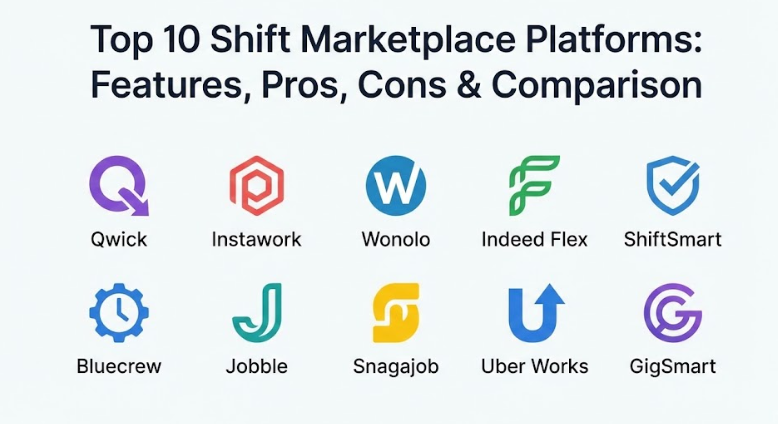
Top 10 [Shift Marketplace Platforms] Tools
1 — Instawork
Instawork is a leading on-demand staffing platform that connects businesses with thousands of “pros” for hourly shifts in hospitality, light industrial, and retail sectors. It is designed for businesses needing reliable, pre-vetted labor for one-off gigs or seasonal needs.
- Large Talent Pool: Offers a wide variety of roles, from skilled hospitality positions to general manual labor.
- Pre-Vetted Workers: Requires pros to prove their work experience and qualifications before joining.
- Shift Instruction Portal: Provides automated instructions and clock-in/out features within the app.
- Top Pro Program: Tiered loyalty program (Bronze to Platinum) that incentivizes high-quality worker performance.
- Instant Payment Option: Features “Instapay,” allowing workers to access earnings shortly after shift completion.
- In-App Communication: Facilitates direct messaging between hiring managers and pros for last-minute coordination.
Pros:
- Highly flexible for picking up same-day or seasonal shifts without sign-up fees for workers.
- Offers occupational accident insurance covered by the hiring company, reducing liability for the employer.
Cons:
- Shift availability can be inconsistent and is often restricted to workers with high internal ratings.
- Some users report challenges with customer support responsiveness during billing or suspension disputes.
Security & compliance: Standard data encryption; GDPR compliant; background checks vary by employer requirement.
Support & community: Features a robust help center and live coaches to assist workers through their employment journey.
2 — Wonolo
Wonolo (Work Now Locally) provides an on-demand labor marketplace primarily focused on light industrial, delivery, and merchandising roles. It is designed to help businesses fill immediate staffing gaps with local independent contractors.
- Tap-to-Hire: Allows businesses to post a job and workers to accept it with a single tap on their mobile device.
- Wide Industry Reach: Frequently used for warehouse, general labor, and large-scale retail merchandising shifts.
- Performance Rating System: Both employers and workers rate each other after shifts to maintain quality control.
- Detailed Job Briefs: Allows employers to specify dress codes (e.g., plain black attire) and safety requirements.
- In-App Time Tracking: Integrated clock-in and clock-out functionality to streamline payroll processing.
- Supplemental Insurance: Deducts a small “trust and safety fee” to cover occupational accident insurance for contractors.
Pros:
- Extremely low-friction hiring process that can fill positions within minutes of posting.
- Provides a way for businesses to test out potential long-term hires through temporary shifts.
Cons:
- Most positions are independent contractor roles, meaning workers are responsible for their own tax withholding.
- The app can be glitchy, sometimes failing to load directions or payment setup details correctly.
Security & compliance: Background checks required for certain roles; data encrypted in transit.
Support & community: Primarily digital support via the app; extensive online resources for independent contractors.
3 — Qwick
Qwick is an on-demand staffing platform specifically tailored for the hospitality industry, connecting hotels, caterers, and restaurants with experienced professionals. It is designed for businesses that struggle with high turnover and need reliable banquet captains, bartenders, and cooks.
- Hospitality Focused: Deep specialization in roles like banquet servers, dishwashers, and mixologists.
- Orientation Interview: Requires all “pros” to attend an orientation to verify skills and professionalism.
- Rapid Fulfillment: Capable of getting workers to a business location in as little as one hour.
- Custom Service Fees: Charges businesses a service fee (typically 40% of the hourly wage) while remaining free for workers.
- Instant Pay: Offers payouts within 30 minutes of shift completion for a small processing fee.
- Voluntary Background Checks: Allows workers to undergo checks to qualify for high-security venue shifts.
Pros:
- High-quality talent pool due to the mandatory orientation and requirement for one year of experience.
- Penalty-free gig declining allows for a highly motivated and voluntary workforce.
Cons:
- Currently limited to major metropolitan areas in the United States.
- Heavy service fees for employers compared to traditional localized job boards.
Security & compliance: Stripe-integrated payment processing; optional Checkr background checks; standard data protection.
Support & community: High ratings for helpful staff; dedicated professional app for managing hospitality shifts.
4 — Indeed Flex
Indeed Flex is a comprehensive staffing solution owned by Indeed that provides flexible work options across hospitality, retail, and logistics. It is designed for larger enterprises needing a reliable, tech-enabled workforce with a focus on worker satisfaction.
- Advanced Matching AI: Uses algorithms to match workers with shifts based on their verified experience and location.
- Daily Pay Withdrawals: Allows workers to access a portion of their earned wages immediately after a shift.
- Training & Development: Offers upskilling opportunities for workers to qualify for higher-paying specialized roles.
- Unified Indeed Ecosystem: Leverages Indeed’s massive user base to maintain a consistently deep worker pool.
- Seasonal Bonuses: Frequently offers financial incentives during peak holidays like Christmas or Easter.
- Detailed Employer Profiles: Workers can view company ratings before accepting shifts to ensure a good fit.
Pros:
- Highly user-friendly app interface that simplifies the shift discovery and claiming process.
- Reliability and timely payments are consistently praised by long-term users.
Cons:
- Some users have reported poor experiences with an automated “AI interviewer” during onboarding.
- Geofencing issues can sometimes lead to workers being offered shifts that are too far from their actual location.
Security & compliance: GDPR compliant; SOC 2 certified; integrated background screening.
Support & community: Features a strong online support team and localized branches for physical onboarding in some regions.
5 — Bacon
Bacon is a flexible work marketplace that connects established companies with on-demand hourly workers. It is designed for businesses like warehousing and convention centers that face drastic fluctuations in labor needs.
- No Conversion Fees: Allows businesses to hire top-performing Bacon workers for full-time roles without traditional agency fees.
- Custom Wage Setting: Empowers businesses to set their own hourly wages and select their own workers based on profiles.
- Three-Strike Policy: Maintains workforce reliability by penalizing workers who do not meet attendance or quality standards.
- One-Click Application: Simplified worker interface that removes the need for resumes or formal interviews.
- Private Insurance Policies: Protects workers with occupational and accident plans similar to workers’ comp.
- Direct Platform Payments: Processes ACH, credit card, and check payments directly through the app without hidden subscriptions.
Pros:
- No long-term contracts or subscription fees; businesses only pay for the shifts actually worked.
- High level of worker accountability through a transparent 5-star rating and review system.
Cons:
- High competition for gigs can lead to “application limit reached” errors for workers.
- Geographic availability is still expanding, making it less viable for companies outside major hubs.
Security & compliance: Optional background checks; general liability and worker accident insurance included.
Support & community: Known for personal interactions with a dedicated client success team for larger accounts.
6 — Jobble
Jobble is a nationwide gig work platform that offers a wide range of short-term and long-term opportunities in logistics, retail, and event staffing. It is designed for both independent contractors and businesses seeking flexible high-volume labor.
- Nationwide Operation: Available in all 50 U.S. states, providing consistent reach for multi-location businesses.
- Recurring Shift Management: Supports single-day gigs as well as multi-week or monthly recurring work contracts.
- Integrated Insurance Plans: Offers workers the ability to purchase health, auto, and renters insurance through the platform.
- Jobble Insurance PPO: Provides access to one of the largest PPO networks in the U.S. for gig workers.
- Shift Estimator Tool: Allows workers to estimate potential total earnings for a gig before applying.
- Verified Payment Tracks: Ensures workers are paid within 7 days via direct deposit after shift completion.
Pros:
- One of the few platforms offering comprehensive insurance benefits to its gig workforce.
- Highly scalable for large events or warehouse surges requiring hundreds of workers simultaneously.
Cons:
- Does not typically compensate workers if an employer cancels a gig at the last minute.
- Technical performance can be sluggish, with slow clock-in/out times reported on certain mobile devices.
Security & compliance: Mandatory SSN submission and background checks for all workers.
Support & community: Offers 24/7 user support, though some users report difficulty reaching live agents during off-hours.
7 — Bluecrew
Bluecrew is a technology-driven staffing platform that specializes in providing W-2 employees for hourly work in light industrial and hospitality sectors. It is designed for businesses seeking the reliability of traditional employees with the flexibility of gig tech.
- W-2 Employment Model: Unlike 1099 platforms, Bluecrew acts as the employer of record, handling all taxes and benefits.
- Workforce Management Dashboard: Comprehensive tools for tracking attendance, performance, and overtime in real-time.
- Automated Compliance: Handles local labor law requirements and worker classifications automatically.
- Real-Time Notifications: Sends instant alerts to workers for shift reminders or changes.
- Long-Term Placement Tracking: Facilitates the transition of temporary workers into permanent roles.
Pros:
- Higher worker reliability and security as pros are protected by the W-2 employment framework.
- Excellent for companies that need to minimize worker misclassification risks.
Cons:
- Frequent reports of technical issues, such as account lockouts and password reset bugs.
- Lack of direct phone support can lead to long wait times for resolving pay disputes.
Security & compliance: HIPAA and SOC 2 compliant; rigorous data protection for employee records.
Support & community: High ratings for leadership and culture within the employee base, though customer support can be slow.
8 — ShiftSmart
ShiftSmart is an global labor marketplace that connects workers with diverse tasks ranging from retail store audits to call center shifts. It is designed for large-scale retail and service organizations needing decentralized labor.
- Global Labor Reach: Operates internationally, supporting remote tasks and on-site retail shifts.
- Micro-Task Integration: Allows for very short shifts (store audits) alongside traditional hourly work.
- Performance Scoring: Assigns “reliability” and “on-time” scores to prioritize high-performing workers for premium shifts.
- In-App Training Modules: Provides orientation and task-specific training within the mobile interface.
- Automated Shift Reminders: Uses AI to call or message workers before their shifts to ensure high attendance rates.
Pros:
- Highly versatile, offering remote call center work as well as in-person retail roles.
- Performance-based prioritization helps consistent workers earn more over time.
Cons:
- Significant user dissatisfaction reported regarding payment rejections and “rejected” completed tasks.
- Heavy reliance on an automated chatbot for customer service, often lacking live human escalation.
Security & compliance: Varies by region; standard data encryption; background checks for sensitive roles.
Support & community: Primarily bot-driven support; active community discussion on independent contractor forums.
9 — Snagajob
Snagajob is a veteran in the hourly work space, transitioning from a job board to an integrated marketplace with its “Snagajob for Employers” platform. It is designed for restaurants and retail businesses seeking a broad candidate reach.
- Extensive Candidate Network: Connects employers with a massive pool of over 100 million registered job seekers.
- Automated Job Distribution: Instantly posts open shifts across multiple partner platforms to increase visibility.
- Integrated Applicant Tracking (ATS): Streamlines the entire hiring workflow from application to onboarding.
- Integrated Background Checks: Allows employers to conduct safety screenings directly through the platform.
- Mobile-Optimized Applications: Ensures high conversion rates by catering to mobile-first hourly workers.
- Performance Analytics: Provides reports on recruitment effectiveness and time-to-fill metrics.
Pros:
- Cost-effective for businesses of all sizes, often filling roles within hours of posting.
- Highly intuitive interface that requires minimal technical training for hiring managers.
Cons:
- Inconsistent candidate quality, with some applicants failing to meet basic job requirements.
- Communication tools within the platform can be limited, making deep engagement challenging.
Security & compliance: SOC 2 compliant; encrypted data storage; integrated background screening partners.
Support & community: Large established brand with professional support teams and extensive documentation.
10 — Connecteam
Connecteam is a comprehensive “deskless” workforce management platform that includes a powerful shift marketplace and scheduling module. It is designed for mobile-first businesses that need to manage internal shifts and internal gig marketplaces.
- Internal Shift Swapping: Allows employees to offer and claim shifts among themselves with manager approval.
- AI-Driven Auto-Scheduling: Automatically creates optimized schedules based on employee availability and labor laws.
- Geofenced Time Clock: Ensures workers only clock in when they are physically at the job site.
- Unified Communication Hub: Features chat, status updates, and company directories in a single mobile app.
- Mobile-First Training: Delivers quizzes and training materials directly to workers’ smartphones.
- Labor Law Compliance Tools: Monitors overtime and break requirements to ensure legal compliance.
Pros:
- All-in-one solution that replaces multiple apps for scheduling, communication, and training.
- Highly customizable, allowing businesses to tailor workflows to their specific industry terminology.
Cons:
- Not a “public” marketplace; it is designed for managing your own team rather than hiring new freelancers on-demand.
- Advanced features like auto-scheduling require higher-tier paid plans.
Security & compliance: GDPR, SOC 2, and ISO certified; robust SSO and audit logs.
Support & community: High ratings for customer service; extensive help center and a 14-day free trial.
Comparison Table
| Tool Name | Best For | Platform(s) Supported | Standout Feature | Rating (Trustpilot/App Store) |
| Instawork | Hospitality & Manual Labor | iOS, Android | Top Pro tiered loyalty program | 3.7/5 |
| Wonolo | Light Industrial & Logistics | iOS, Android | “Trust & Safety” worker insurance | 3.5/5 |
| Qwick | Hospitality Professionals | iOS, Android | Mandatory pro orientation | 4.3/5 |
| Indeed Flex | Large Enterprise Retail | iOS, Android | Indeed ecosystem integration | 4.2/5 |
| Bacon | Warehouse & Events | iOS, Android | No temp-to-hire conversion fees | 4.2/5 |
| Jobble | Event Staffing & Retail | iOS, Android, Web | Jobble Insurance PPO network | 3.8/5 |
| Bluecrew | W-2 Compliant Staffing | iOS, Android | Employer of Record (W-2) model | 4.7/5 |
| ShiftSmart | Retail Audits & Support | iOS, Android | Performance-based shift priority | 2.5/5 |
| Snagajob | High-Volume Hourly Hiring | iOS, Android, Web | Automated job board distribution | 4.1/5 |
| Connecteam | Deskless Team Management | iOS, Android, Web | AI-driven internal auto-scheduling | 4.3/5 |
Evaluation & Scoring of [Shift Marketplace Platforms]
The following evaluation uses a weighted scoring rubric designed to reflect the technical and operational priorities of modern hiring managers and workers.
| Category | Weight | Evaluation Criteria |
| Core Features | 25% | On-demand matching, time tracking, integrated payments, and insurance coverage. |
| Ease of Use | 15% | Mobile interface intuitiveness, signup speed, and clock-in/out reliability. |
| Integrations | 15% | API availability for payroll, HRIS, and ERP systems. |
| Security & Compliance | 10% | Worker classification (W-2 vs 1099), SOC 2, GDPR, and data encryption. |
| Performance | 10% | Platform uptime, app speed, and fulfillment rates during peak demand. |
| Support & Community | 10% | Live support availability, documentation quality, and dispute resolution speed. |
| Price / Value | 15% | Fee structure (service fees vs subscriptions) and ROI. |
Which [Shift Marketplace Platforms] Tool Is Right for You?
Choosing the right platform depends on your organizational structure, your geographic location, and your risk tolerance regarding worker classification.
- Solo Users and SMBs: For small businesses or individuals needing occasional help, Instawork and Bacon are excellent due to their “pay-as-you-go” models with no subscription fees. They provide low-barrier access to localized talent.
- Mid-Market Companies: Organizations with consistent but fluctuating needs should consider Jobble or Qwick. These offer better scalability across multiple states and specialized hospitality talent.
- Enterprise Organizations: Large retail or logistics chains benefit from Indeed Flex or Snagajob. These platforms leverage massive databases and advanced AI to ensure high fulfillment rates across hundreds of locations.
- Compliance-First Businesses: If your organization has strict legal requirements regarding worker classification, Bluecrew is the strongest choice. By using a W-2 model, they handle all employer liabilities, significantly reducing legal risks.
- Budget-Conscious Solutions: If you are focused on minimizing costs, Bitwarden (for general gig work) or localized Facebook/WhatsApp groups remain alternatives, though they lack the security and vetting of platforms like Wonolo. Bacon is also notable for having no conversion fees if you decide to hire a worker permanently.
Frequently Asked Questions (FAQs)
- What is a shift marketplace platform?It is a digital app that connects businesses with on-demand workers for short-term hourly shifts, handling everything from hiring to payments.
- How do these platforms vet their workers?Most platforms, like Qwick and Instawork, require orientation, skill verification, or past work history before a “pro” can accept shifts.
- Are workers employees or independent contractors?It varies; platforms like Wonolo use 1099 contractors, while Bluecrew uses a W-2 employment model where they are the employer of record.
- What industries use these platforms the most?Hospitality (restaurants, hotels), logistics (warehousing), retail, and event management are the primary sectors.
- Can I hire a worker permanently off the platform?Yes, many platforms like Bacon and Jobble encourage temp-to-hire, often without the high conversion fees typical of staffing agencies.
- How quickly can I find a worker for a shift?Fulfillment can be extremely fast; platforms like Qwick can sometimes get a worker to your site in as little as one hour.
- Do these platforms provide insurance?Yes, most (like Wonolo and Instawork) include occupational accident insurance or liability insurance as part of their service fee.
- How is the service fee calculated?Typically, the platform takes a percentage of the worker’s hourly wage—often between 30% and 40%—charged directly to the business.
- Can workers set their own rates?Usually not; on platforms like Qwick, the business sets the wage, or the platform establishes a standard regional rate.
- What happens if a worker doesn’t show up?Most platforms have a “reliability score” or “three-strike” system that penalizes or bans workers for no-shows to protect employers.
Conclusion
The rise of shift marketplace platforms has fundamentally changed how the hourly workforce and businesses interact, replacing the slow, manual processes of traditional staffing with real-time, data-driven matching. For businesses, these tools provide unparalleled flexibility to manage labor costs and fill immediate gaps during peak seasons or unexpected absences. For workers, they offer the freedom to build their own schedules and access same-day payments, turning hourly work into a flexible, manageable gig.
When choosing a platform, the most important factor is the alignment of the tool’s worker pool with your industry’s specific needs. A hospitality business will find more success with Qwick or Instawork, while a logistics firm should prioritize Wonolo or Jobble. Ultimately, the “best” tool is the one that provides the highest reliability and fulfillment rate while maintaining a secure, compliant environment for your workforce. As the technology continues to evolve, features like AI-driven auto-scheduling and integrated insurance will likely become the standard, making the gig economy even more stable for both sides of the marketplace.