Introduction
Review management platforms are specialized software solutions designed to help businesses monitor, solicit, and respond to customer feedback across multiple online review sites from a single dashboard. These platforms aggregate data from sources like Google Business Profile, Yelp, Facebook, and industry-specific sites (such as TripAdvisor or G2) to provide a unified view of a brand’s online reputation. By automating the process of asking for reviews via email or SMS and using AI to help draft responses, these tools ensure that businesses maintain a high star rating and a healthy volume of recent feedback.
The importance of these platforms is rooted in consumer behavior; a vast majority of buyers consult online reviews before making a purchase decision. Furthermore, search engines like Google use review signals—such as frequency, quantity, and sentiment—as a primary ranking factor for local SEO. Key real-world use cases include a multi-location restaurant chain managing feedback for 50 outlets, a medical practice ensuring HIPAA-compliant responses to patient feedback, or an e-commerce brand showcasing verified reviews on their website to increase conversion rates. When evaluating these tools, users should prioritize the number of supported integrations, the ease of the automation workflow, and the depth of the sentiment analysis reporting.
Best for: Local businesses with physical storefronts, multi-location franchises, healthcare providers, hospitality brands, and e-commerce companies. It is a vital tool for Marketing Managers, Reputation Specialists, and Customer Success teams.
Not ideal for: B2B companies with a very low volume of high-ticket clients where feedback is handled exclusively through personal account management. It may also be overkill for micro-businesses that only receive one or two reviews per year.
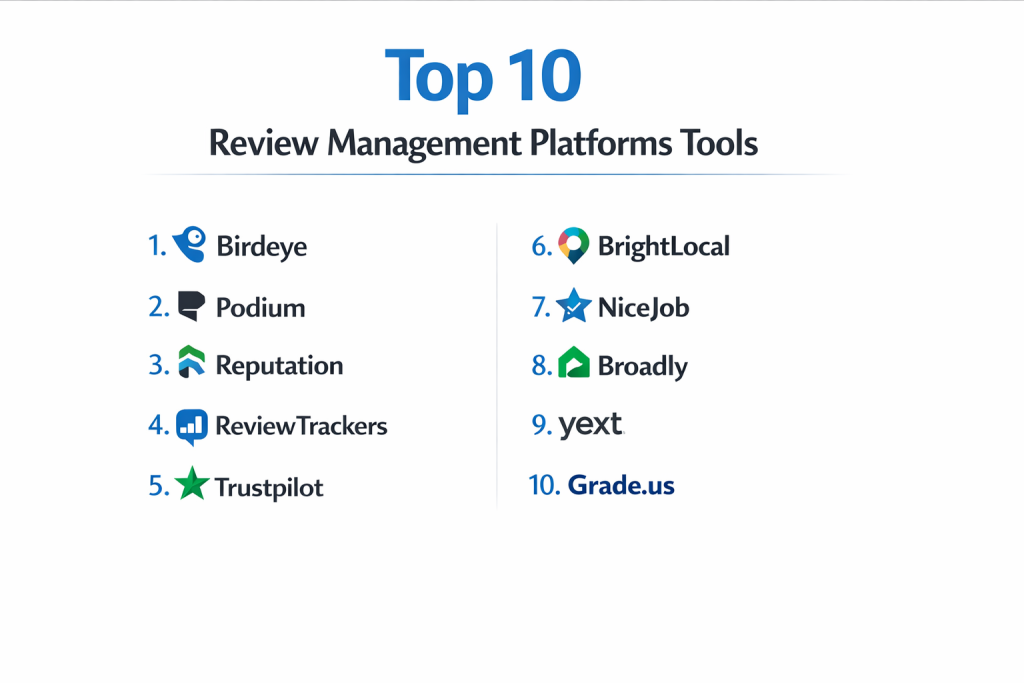
Top 10 Review Management Platforms Tools
1 — Birdeye
Birdeye is an all-in-one reputation and customer experience platform designed for multi-location businesses. It goes beyond simple review management by offering integrated messaging, surveys, and ticketing to turn feedback into actionable business improvements.
- Key features
- Automated review solicitation via SMS, email, and QR codes.
- Unified inbox for managing reviews, social comments, and webchats.
- AI-powered “Natural Language Processing” (NLP) for deep sentiment analysis.
- Review “Gatekeeping” alerts to flag negative feedback for immediate resolution.
- Competitor benchmarking to compare star ratings and volume.
- Custom landing pages to showcase best reviews for SEO.
- Robust mobile app for managing reputation on the go.
- Pros
- Excellent for large enterprises needing to manage hundreds of locations.
- Highly sophisticated AI insights that identify specific operational issues (e.g., “long wait times”).
- Cons
- Pricing is on the higher end of the market.
- The platform is feature-rich, which can be overwhelming for small teams.
- Security & compliance: SOC 2 Type II, HIPAA compliant, GDPR, and SSO support.
- Support & community: 24/7 live support, dedicated account managers for enterprise, and Birdeye University.
2 — Podium
Podium focuses on “Lead-to-Review” workflows, primarily utilizing text messaging as the core communication channel. It is designed for local businesses that want to modernize their customer interactions through mobile-first technology.
- Key features
- Text-to-review invitations that boast high open and conversion rates.
- Centralized “Interaction Management” for all customer conversations.
- Integrated payment processing within the text thread.
- Automated “Review Requests” triggered by point-of-sale (POS) integrations.
- Bulk messaging for marketing promotions and updates.
- Team collaboration tools for assigning specific reviews to staff.
- Webchat-to-text conversion for seamless website lead capture.
- Pros
- The most intuitive mobile interface for busy business owners.
- Proven to increase review volume rapidly through SMS convenience.
- Cons
- High cost relative to competitors who offer more traditional email options.
- Best features are often gated behind the most expensive pricing tiers.
- Security & compliance: SOC 2, HIPAA compliant, and encrypted data transmission.
- Support & community: Extensive help center, live chat, and a large user community of local service providers.
3 — Reputation
Reputation (formerly Reputation.com) is an enterprise-grade platform that specializes in “Reputation Score” metrics. It is built for complex organizations that require high-level data governance and cross-departmental reporting.
- Key features
- Proprietary “Reputation Score” to measure brand health against industry averages.
- Integration with over 1,000 review sites and social media platforms.
- Managed services for businesses that want an agency to handle responses.
- Advanced “Business Listings” management to ensure data accuracy.
- Sophisticated surveys with conditional logic.
- Social listening and publishing tools integrated into the platform.
- Deep Salesforce and HubSpot integrations for CRM data syncing.
- Pros
- The most comprehensive reporting for the C-suite and executives.
- Incredible scale; can handle thousands of locations without performance lag.
- Cons
- The setup and implementation process can take several weeks.
- Not suitable for small businesses due to the enterprise pricing model.
- Security & compliance: ISO 27001, SOC 2 Type II, GDPR, and HIPAA compliant.
- Support & community: High-touch enterprise support and localized account management.
4 — ReviewTrackers
ReviewTrackers provides a data-heavy approach to reputation management. It is designed for brands that want to dig deep into customer feedback trends to drive operational changes and marketing strategy.
- Key features
- Centralized dashboard for monitoring 100+ review sites.
- “Smart Response” templates to maintain brand voice while saving time.
- Competitive intelligence tool to track rival performance.
- Keyword alerts to monitor specific product or service mentions.
- Local SEO reporting to track ranking improvements.
- Automated review requests with customizable email triggers.
- Open API for building custom internal dashboards.
- Pros
- Very clean, data-focused UI that prioritizes efficiency.
- Excellent value for mid-market companies that don’t need “all-in-one” messaging.
- Cons
- Lacks the advanced SMS marketing features found in Podium or Birdeye.
- The mobile app is not as feature-complete as the desktop version.
- Security & compliance: GDPR compliant, encryption at rest, and secure SSO.
- Support & community: Robust knowledge base, webinars, and dedicated customer success teams.
5 — Trustpilot
Trustpilot is unique because it is both a management tool and a high-authority consumer-facing review site. It is best for e-commerce and digital services looking to build global trust through a recognizable brand.
- Key features
- “Verified” review status to combat fake feedback and bots.
- SEO-rich “TrustBoxes” (widgets) to display reviews on your website.
- Google Seller Ratings integration to show stars in Google Ads.
- Automated review invitations via e-commerce platform plugins.
- Public response profiles to engage with customers openly.
- Advanced “Fraud Detection” software to maintain list integrity.
- Analytics on review performance and invitation conversion.
- Pros
- High consumer brand recognition increases review response rates.
- The “Seller Ratings” feature is a massive driver for Google Ads CTR.
- Cons
- You are largely limited to the Trustpilot ecosystem (doesn’t manage Google/Yelp as well).
- Free version is very limited and the paid versions are expensive.
- Security & compliance: GDPR compliant and SOC 2 (Varies).
- Support & community: Massive global community and extensive self-help documentation.
6 — BrightLocal
BrightLocal is the leading tool for local SEO professionals and agencies. While it handles review management, it is primarily focused on helping businesses rank higher in local search results.
- Key features
- “Review Inbox” that aggregates feedback from all major local sites.
- Automated “Review Generation” campaigns via email and SMS.
- Comprehensive “Citation Tracker” to manage business listings.
- Local Search Grid to see how your star rating impacts map rankings.
- Whitelabel reporting for agencies to send to their clients.
- “Get Reviews” tool with customizable landing pages.
- Review “Monitoring” only plans for budget-conscious users.
- Pros
- Exceptional value for money, especially for agencies managing multiple clients.
- Combines SEO rankings with reputation data in one view.
- Cons
- The interface is more “technical” and may be harder for non-marketers.
- Automation features are not as “real-time” as Podium’s SMS engine.
- Security & compliance: GDPR compliant and secure payment processing.
- Support & community: Highly rated customer support and a wealth of local SEO training.
7 — NiceJob
NiceJob is designed for small service businesses (contractors, cleaners, photographers) who want a “set it and forget it” solution to getting more reviews and social proof.
- Key features
- “Stories” feature that automatically turns reviews into social media posts.
- Smart funnel that sends review requests at the optimal time.
- SMS and email automation with intelligent follow-ups.
- Integration with field service software like Jobber and Housecall Pro.
- Real-time “Social Proof” widgets for websites.
- Leaderboards to track which employees are generating the most reviews.
- No-contract, monthly pricing.
- Pros
- Extremely easy to use with a very modern, playful interface.
- The “Stories” feature is one of the best for automated social marketing.
- Cons
- Not built for large enterprise hierarchies or complex reporting.
- Limited support for niche, industry-specific review sites.
- Security & compliance: GDPR compliant and standard web encryption.
- Support & community: Active Facebook group and responsive in-app chat.
8 — Broadly
Broadly focuses on the “Customer Journey,” helping small businesses manage everything from the first lead to the final review. It aims to improve the professional appearance of local service companies.
- Key features
- Automated review requests that sync with CRM and POS data.
- Webchat tool that funnels leads directly into the management dashboard.
- Modern, branded email templates for review solicitation.
- Team “Incentive” tracking based on positive feedback.
- One-click response tools for Google and Facebook.
- Consolidated “Team Inbox” for SMS and email communication.
- Website builder services that integrate with the review platform.
- Pros
- Strong focus on branding and making the business look professional.
- Excellent for home service companies that need integrated lead management.
- Cons
- Pricing can be opaque and often requires a sales demo.
- Reporting is basic compared to ReviewTrackers or Reputation.
- Security & compliance: HIPAA compliant and GDPR compliant.
- Support & community: Dedicated onboarding specialists and 1-on-1 account reviews.
9 — Yext
Yext is primarily a “Knowledge Management” platform that handles business listings, but its review management suite is an essential component for enterprise-level brand control.
- Key features
- Global “Direct Integration” with 200+ maps, apps, and search engines.
- AI Search-driven review generation.
- Centralized response management with approval workflows for large teams.
- “Sentiment Analysis” powered by Yext’s proprietary AI engine.
- Review “Generation” through emails and customized scannable codes.
- Integration of reviews into your own website search results.
- Intelligent “Duplicate Suppression” for business listings.
- Pros
- The absolute best for “Listings Accuracy,” which is the foundation of reviews.
- Enterprise-level security and governance are top-tier.
- Cons
- Very expensive and often requires a large annual commitment.
- Can be overly complex for a business that only wants to manage reviews.
- Security & compliance: ISO 27001, SOC 2 Type II, HIPAA, and GDPR compliant.
- Support & community: 24/7 global support and “Yext Hitchhikers” training community.
10 — Grade.us
Grade.us (part of the ASG group) is a “white-label” first platform. It is the go-to choice for agencies that want to sell review management services under their own brand.
- Key features
- Fully white-labelable dashboard and reports.
- Multi-channel review acquisition (Email, SMS, and Print).
- “Review Funnel” that guides users to the correct platform.
- Automatic “Review Promotion” on social media feeds.
- Advanced scheduling for drip campaigns.
- Detailed agency-level reporting and client management.
- API access for custom integrations.
- Pros
- The most flexible platform for agencies looking to build their own SaaS offering.
- Competitive pricing for high-volume client management.
- Cons
- The UI feels slightly more “utilitarian” compared to modern tools like NiceJob.
- Requires some initial setup work to customize the white-label settings.
- Security & compliance: GDPR compliant and secure SSO.
- Support & community: Extensive documentation and email-based agency support.
Comparison Table
| Tool Name | Best For | Platform(s) Supported | Standout Feature | Rating |
| Birdeye | Multi-location Enterprise | Web / Mobile | AI Natural Language Processing | 4.8/5 |
| Podium | SMS-led Local SMB | Web / Mobile | Integrated Text Payments | 4.6/5 |
| Reputation | Large Global Brands | Web / Mobile | Industry Reputation Score | 4.5/5 |
| ReviewTrackers | Data-driven Mid-market | Web / Mobile | Smart Response Templates | 4.6/5 |
| Trustpilot | E-commerce Authority | Web | Google Seller Ratings | 4.4/5 |
| BrightLocal | Agencies / Local SEO | Web | Citation & Ranking Grid | 4.7/5 |
| NiceJob | Service Business Growth | Web / Mobile | Review-to-Social “Stories” | 4.8/5 |
| Broadly | Professional Branding | Web / Mobile | Branded Lead-to-Review UI | 4.4/5 |
| Yext | Listings & Knowledge | Web | 200+ Direct Map Integrations | 4.3/5 |
| Grade.us | Agency White-labeling | Web | Customizable Review Funnels | 4.5/5 |
Evaluation & Scoring of Review Management Platforms
We have scored these tools based on a weighted rubric that reflects the priorities of a modern business or agency.
| Category | Weight | Evaluation Focus |
| Core Features | 25% | Review monitoring, automated generation, and sentiment analysis. |
| Ease of Use | 15% | Dashboard intuitiveness and the friction level of the mobile app. |
| Integrations | 15% | Connectivity with CRM, POS, and niche review sites. |
| Security & Compliance | 10% | Presence of SOC 2, HIPAA, and GDPR certifications. |
| Performance | 10% | Reliability of notifications and automation triggers. |
| Support & Community | 10% | Access to 24/7 help and educational resources. |
| Price / Value | 15% | ROI relative to the monthly cost and contract terms. |
Which Review Management Platform Tool Is Right for You?
Solo Users vs SMB vs Mid-Market vs Enterprise
If you are a Solo User or a tiny local business, NiceJob or BrightLocal are your best options. They are affordable and easy to manage without a marketing degree. SMBs with high customer volume will benefit most from Podium‘s SMS-first approach. Mid-Market companies needing deep data will prefer ReviewTrackers. For the Enterprise, the choice is between Birdeye (for customer experience focus) or Reputation and Yext (for massive scale and listing accuracy).
Budget-Conscious vs Premium Solutions
If you are budget-conscious, BrightLocal and Grade.us offer the most features for the lowest per-location cost. If you have the budget for a premium solution, Podium and Birdeye provide a full suite of communication tools that replace multiple other software subscriptions (like webchat and SMS marketing).
Feature Depth vs Ease of Use
For those who want “Feature Depth,” Birdeye and Reputation offer sentiment analysis and competitor tracking that can take months to fully master. If you prioritize “Ease of Use,” NiceJob and Podium are designed so that a busy business owner can manage their reputation in just five minutes a day from their phone.
Integration and Scalability Needs
If you use a specific CRM like Jobber, ServiceTitan, or Salesforce, your choice should be dictated by which tool has a “Native Integration.” Podium and Reputation excel at syncing with external databases to trigger review requests automatically the moment a job is marked as “complete.”
Security and Compliance Requirements
Healthcare providers must choose a HIPAA-compliant platform like Birdeye, Podium, or Broadly to ensure that responding to reviews doesn’t violate patient privacy laws. Financial and government sectors should prioritize the SOC 2 and ISO 27001 certifications found in enterprise tools like Yext and Reputation.
Frequently Asked Questions (FAQs)
Can these tools remove negative reviews for me?
No tool can “delete” a legitimate negative review. However, these platforms help you dispute reviews that violate terms of service (like spam or hate speech) and help you drown out the occasional negative review with a high volume of positive ones.
Why is SMS better than email for getting reviews?
Studies consistently show that SMS open rates are as high as 98%, compared to around 20% for email. Because review requests are time-sensitive, the “instant” nature of text messaging usually results in a 3x to 5x higher response rate.
What is “Review Gating” and is it legal?
Review Gating is the practice of only asking happy customers for reviews while filtering out unhappy ones. Platforms like Google and Yelp strictly forbid this, and modern tools now focus on “Review Resolution” rather than gating to remain compliant.
Do these tools manage my Google Business Profile too?
Yes, most of these platforms (like Yext and Birdeye) allow you to update your hours, address, and photos on Google Business Profile directly from their dashboard, ensuring consistency across the web.
How do I respond to a review using AI?
Many platforms now include AI assistants that read the review and draft a professional response. You can then review, edit, and post it, which saves significant time for managers handling high volumes.
What is “Sentiment Analysis”?
Sentiment analysis uses AI to read thousands of reviews and tell you what customers are happy or unhappy about without you reading every one. It can tell you if “Price” is a common complaint or if “Service” is your biggest strength.
Is Trustpilot better than Google Reviews?
They serve different purposes. Google Reviews are essential for local SEO and map rankings. Trustpilot is a powerful third-party “trust signal” for e-commerce sites and global brands to show on their website.
Can I manage reviews for 50 different locations in one place?
Yes, enterprise tools like Birdeye and Reputation are built specifically for this. You can see an “aggregate” score for the whole brand or drill down into the performance of a single store.
What is the “Reputation Score”?
This is a metric used by platforms like Reputation.com to give you a single number (usually 1-1,000) that represents your brand health based on review volume, sentiment, and listing accuracy.
Do I have to sign a long-term contract?
It varies. SMB-focused tools like NiceJob and BrightLocal offer monthly plans. Enterprise tools like Yext and Birdeye typically require a 12-month annual contract.
Conclusion
The “best” review management tool is the one that fits into your existing daily workflow. If you are a busy contractor, the automated “Social Stories” and simplicity of NiceJob make it a winner. If you are a large medical group, the security and SMS-capabilities of Birdeye are essential. And for those focused on the SEO side of reputation, BrightLocal remains the gold standard for value and data.
In choosing a platform, remember that the software is only half the battle. The most successful businesses use these tools to create a “culture of feedback,” where they don’t just collect stars, but actually use the insights to improve their service. A five-star reputation is built on five-star operations, and these platforms are the best way to prove that to the world.